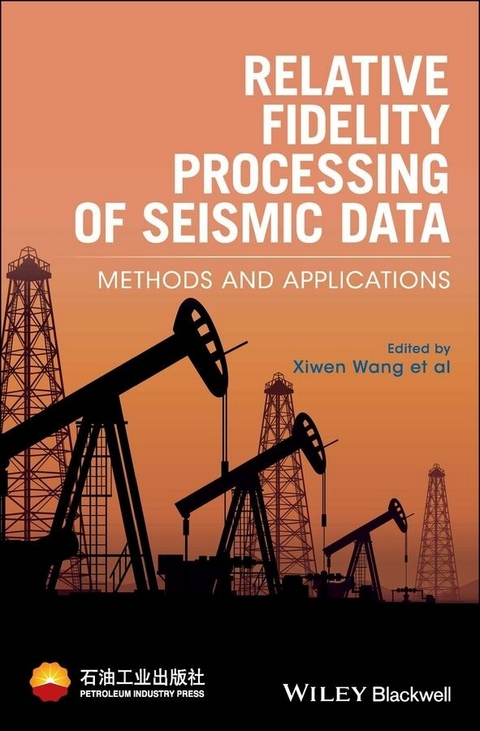
Relative Fidelity Processing of Seismic Data (eBook)
John Wiley & Sons (Verlag)
978-1-119-05293-7 (ISBN)
This book presents a comprehensive overview of relative fidelity preservation processing methods and their applications within the oil and gas sector. Four key principles for wide-frequency relative fidelity preservation processing are illustrated throughout the text. Seismic broadband acquisition is the basis for relative fidelity preservation processing and the influence of seismic acquisition on data processing is also analyzed. The methods and principles of Kirchhoff integral migration, one-way wave equation migration and reverse time migration are also introduced and illustrated clearly. Current research of relative amplitude preservation migration algorithms is introduced, and the corresponding numerical results are also shown.
RTM (reverse time migration) imaging methods based on GPU/CPU systems for complicated structures are represented. This includes GPU/CPU high performance calculations and its application to seismic exploration, two-way wave extrapolation operator and boundary conditions, imaging conditions and low frequency noise attenuation, and GPU/CPU system based RTM imaging algorithms. Migration velocity model building methods in depth domain for complicated structures are illustrated in this book. The research status and development of velocity model building are introduced. And the impacting factors are also discussed. Several different velocity model building methods are also represented and analyzed. The book also provides the reader with several case studies of field seismic data imaging in different kinds of basins to show the methods used in practice.
Dr. Xiwen Wang is the Vice President of the northwest Branch of the Petroleum Exploration and Development Research Institute, and is well known as a senior technical expert of CNPC. He has chaired numerous major sci-tech projects for CNPC, publishing nearly a hundred papers for domestic and international academic periodicals.
This book presents a comprehensive overview of relative fidelity preservation processing methods and their applications within the oil and gas sector. Four key principles for wide-frequency relative fidelity preservation processing are illustrated throughout the text. Seismic broadband acquisition is the basis for relative fidelity preservation processing and the influence of seismic acquisition on data processing is also analyzed. The methods and principles of Kirchhoff integral migration, one-way wave equation migration and reverse time migration are also introduced and illustrated clearly. Current research of relative amplitude preservation migration algorithms is introduced, and the corresponding numerical results are also shown. RTM (reverse time migration) imaging methods based on GPU/CPU systems for complicated structures are represented. This includes GPU/CPU high performance calculations and its application to seismic exploration, two-way wave extrapolation operator and boundary conditions, imaging conditions and low frequency noise attenuation, and GPU/CPU system based RTM imaging algorithms. Migration velocity model building methods in depth domain for complicated structures are illustrated in this book. The research status and development of velocity model building are introduced. And the impacting factors are also discussed. Several different velocity model building methods are also represented and analyzed. The book also provides the reader with several case studies of field seismic data imaging in different kinds of basins to show the methods used in practice.
Dr. Xiwen Wang is the Vice President of the northwest Branch of the Petroleum Exploration and Development Research Institute, and is well known as a senior technical expert of CNPC. He has chaired numerous major sci-tech projects for CNPC, publishing nearly a hundred papers for domestic and international academic periodicals.
Title Page 5
Copyright Page 6
Contents 7
Preface 9
Chapter 1 Study on Method for Relative Fidelity Preservation of Seismic Data 13
1.1 Introduction 13
1.2 Discussion on Impact on Processing of High-resolution, High SNR for Seismic Acquisition and Observation Mode 15
1.3 Discussion on the Cause of Notching 23
1.4 Discussion of Impact on Processing of Relative Fidelity Preservation Seismic Data for Seismic Acquisition and Observation Mode 29
1.5 Comparison of Results of High-resolution, High SNR Processing and Relative Fidelity Preservation Processing 40
1.6 Elastic Wave Forward Modeling 42
1.7 Conclusions 45
References 46
Chapter 2 Method and Principle for Seismic Migration and Imaging 49
2.1 Kirchhoff Integral Prestack Depth Migration 49
2.1.1 History of Kirchhoff integral prestack depth migration 49
2.1.2 Implementation principle of Kirchhoff integral method prestack depth migration 50
2.2 Amplitude Preservation Fourier Finite Difference Prestack Depth Migration Method 52
2.3 Reverse Time Migration 58
2.3.1 Isotropic reverse time migration 58
2.3.2 Anisotropic reverse time migration of VTI media 69
References 85
Chapter 3 Study of Reverse Time Migration Method for Areas With Complicated Structures Based on the GPU/CPU System 87
3.1 Introduction 87
3.2 The GPU/CPU High0performance Calculation and Its Application in Seismic Exploration 89
3.2.1 Introduction of the GPU/CPU system 89
3.2.2 GPU/CPU high-performance computing and the application in seismic exploration 92
3.3 Study on the Two-way Wave Extrapolation Operator and Its Boundary Conditions 94
3.3.1 High-order difference method 95
3.3.2 Boundary condition issue of reverse time migration 102
3.4 Study on the Imaging Condition and Low-frequency Noise Suppression Method 103
3.4.1 Study on imaging condition and low-frequency noise generation mechanism 103
3.4.2 Theory and application of Laplace filtering suppressing low-frequency noise 104
3.5 Study and Application of RTM Prestack Imaging Algorithm based on the GPU/CPU System 110
3.5.1 Analysis of structural characteristics of the GPU/CPU platform 110
3.5.2 Analysis of the application features of CUDA programming language in the GPU/CPU platform 112
3.5.3 Realization strategy of RTM prestack imaging based on the GPU/CPU 113
3.6 Conclusions 123
References 126
Chapter 4 Study and Application of Velocity Model Building Method for the Areas with Complicated Structures 129
4.1 Introduction 129
4.2 Status Quo and the Development of the Velocity Model Building Method 130
4.3 Impacting Factors for the Velocity Model Building 132
4.3.1 The influences of initial velocity model accuracy on velocity modeling 133
4.3.2 The influences of static correction on velocity modeling 133
4.3.3 The influences of SNR on velocity modeling 134
4.3.4 The influence of prestack data irregularity on velocity modeling 134
4.3.5 The influences of geological body on velocity 136
4.3.6 The influences of subsurface structural features on velocity 137
4.3.7 The influences of media lateral anisotropy on velocity 138
4.3.8 The influences of multiples on velocity 138
4.3.9 Analysis of the accuracy of various velocity calculating methods 138
4.4 Study and Application of the Seismic Velocity Model Building Method 140
4.4.1 Modeling method based coherence inversion velocity 142
4.4.2 Constructing velocity field with root mean square (RMS) velocity conversion and cycling method 145
4.4.3 CIG gathers velocity modeling 145
4.4.4 Velocity modeling by seismic tomography (ST) method 149
4.4.5 Velocity modeling of CFP gathers 153
4.4.6 Multi-information restricted interval control velocity modeling method 155
4.5 Quality Monitoring and Accuracy Discussion of the Seismic Velocity Model Building 168
4.5.1 Velocity model under logging data constraint 168
4.5.2 Velocity modeling constrained by geological structure pattern 169
4.5.3 Optimization of the velocity model under seismic imaging constraint 171
4.5.4 Constraint from migration algorithm 172
4.5.5 Velocity model accuracy and imaging effect evaluation method 173
4.6 Velocity Analysis Method for Reverse Time Migration in Angle Domain 174
4.6.1 Generation of CIP gathers in angle domain from reverse time migration 175
4.6.2 Angle domain velocity analysis method 180
4.7 Study of the Full Waveform Inversion Method 184
4.7.1 Study status of full waveform inversion 185
4.7.2 Gradient guidance full waveform inversion 185
4.7.3 FWI discussion and further development trend 190
References 192
Chapter 5 Case Study 195
5.1 Application of 3D Prestack Reverse Time Migration in Subsalt Imaging 195
5.1.1 Main problems challenging subsalt seismic survey 195
5.1.2 Features of the Pre-Caspian Basin and its seismic geological conditions 196
5.1.3 Geologic structure of the Pre-Caspian Basin 197
5.1.4 Sedimentary evolution and stratigraphic characteristics of the basin 198
5.1.5 Analysis of subsalt seismic data features 199
5.1.6 Difficulties in seismic imaging of subsalt structure and analysis of the problems 201
5.1.7 Quantitative identification to subsalt pseudo-structure by forward modeling 203
5.1.8 Research on subsalt seismic velocity modeling and imaging method 204
5.1.9 Comparison and research on reverse time migration imaging effect 215
5.1.10 Study on subsalt structure features and description of major traps 217
5.2 Application of High-density All-round Seismic Data Processing in the Carbonatite Region 222
5.2.1 General 222
5.2.2 Research concept and technical strategy 231
5.2.3 Key processing techniques 233
5.2.4 Analysis of difficulty tackling effect 263
5.2.5 Conclusions and understandings 269
5.3 Application of Seismic Imaging Method for Complicated Structures in the Tuha and Jiuquan Basins 270
5.3.1 Overview 270
5.3.2 Key techniques 278
5.3.3 Application effect and actual survey effectiveness 301
5.3.4 Conclusions and understanding 311
5.4 Application of the Seismic Prestack Imaging Method in the Buried Hill Structural Zone in the Nanpu of Jidong Oilfield 315
5.4.1 Overview of the project 315
5.4.2 Research route and technical measures 317
5.4.3 Key processing techniques 317
5.4.4 Analysis on research and processing effects 339
5.4.5 Conclusions and understanding 341
References 341
Index 345
EULA 363
| Erscheint lt. Verlag | 27.2.2017 |
|---|---|
| Sprache | englisch |
| Themenwelt | Naturwissenschaften ► Geowissenschaften ► Geologie |
| Technik | |
| Wirtschaft | |
| Schlagworte | case studies of field seismic data imaging • Data processing • Dr. Xiwen Wang • earth sciences • Energie • Energy • Erdgas u. Erdöl • Erdgas u. Erdöl • Geologie • Geologie u. Geophysik • Geology & Geophysics • Geophysik • Geowissenschaften • GPU/CPU high performance calculations • GPU/CPU system based RTM imaging algorithms • GPU/CPU systems • Kirchhoff integral migration • low frequency noise attenuation • Migration velocity model building methods • Natural Gas & Petroleum Products • Oil and Gas • one-way wave equation migration • Petroleum • relative amplitude preservation migration algorithms • relative fidelity preservation processing methods • Relative Fidelity Processing of Seismic Data: Methods and Applications • reverse time migration • RTM • Seismic Acquisition • Seismic broadband acquisition • seismic exploration • Seismik • Structural Geology & Tectonics • Strukturgeologie • Strukturgeologie, Tektonik • two-way wave extrapolation boundary conditions • two-way wave extrapolation operator • wide-frequency relative fidelity preservation processing |
| ISBN-10 | 1-119-05293-9 / 1119052939 |
| ISBN-13 | 978-1-119-05293-7 / 9781119052937 |
| Informationen gemäß Produktsicherheitsverordnung (GPSR) | |
| Haben Sie eine Frage zum Produkt? |
 PDF (Adobe DRM)
Kopierschutz: Adobe-DRM
Adobe-DRM ist ein Kopierschutz, der das eBook vor Mißbrauch schützen soll. Dabei wird das eBook bereits beim Download auf Ihre persönliche Adobe-ID autorisiert. Lesen können Sie das eBook dann nur auf den Geräten, welche ebenfalls auf Ihre Adobe-ID registriert sind.
Details zum Adobe-DRM
Dateiformat: PDF (Portable Document Format)
Mit einem festen Seitenlayout eignet sich die PDF besonders für Fachbücher mit Spalten, Tabellen und Abbildungen. Eine PDF kann auf fast allen Geräten angezeigt werden, ist aber für kleine Displays (Smartphone, eReader) nur eingeschränkt geeignet.
Systemvoraussetzungen:
PC/Mac: Mit einem PC oder Mac können Sie dieses eBook lesen. Sie benötigen eine
eReader: Dieses eBook kann mit (fast) allen eBook-Readern gelesen werden. Mit dem amazon-Kindle ist es aber nicht kompatibel.
Smartphone/Tablet: Egal ob Apple oder Android, dieses eBook können Sie lesen. Sie benötigen eine
Geräteliste und zusätzliche Hinweise
Buying eBooks from abroad
For tax law reasons we can sell eBooks just within Germany and Switzerland. Regrettably we cannot fulfill eBook-orders from other countries.
aus dem Bereich