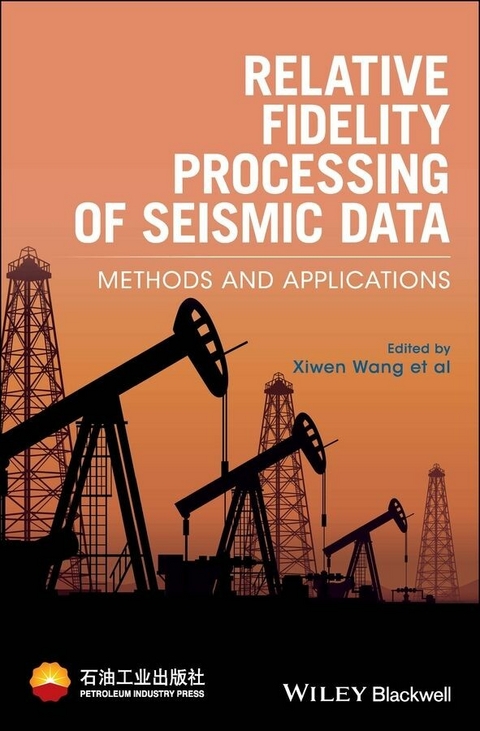
Relative Fidelity Processing of Seismic Data (eBook)
John Wiley & Sons (Verlag)
978-1-119-05292-0 (ISBN)
This book presents a comprehensive overview of relative fidelity preservation processing methods and their applications within the oil and gas sector. Four key principles for wide-frequency relative fidelity preservation processing are illustrated throughout the text. Seismic broadband acquisition is the basis for relative fidelity preservation processing and the influence of seismic acquisition on data processing is also analyzed. The methods and principles of Kirchhoff integral migration, one-way wave equation migration and reverse time migration are also introduced and illustrated clearly. Current research of relative amplitude preservation migration algorithms is introduced, and the corresponding numerical results are also shown.
RTM (reverse time migration) imaging methods based on GPU/CPU systems for complicated structures are represented. This includes GPU/CPU high performance calculations and its application to seismic exploration, two-way wave extrapolation operator and boundary conditions, imaging conditions and low frequency noise attenuation, and GPU/CPU system based RTM imaging algorithms. Migration velocity model building methods in depth domain for complicated structures are illustrated in this book. The research status and development of velocity model building are introduced. And the impacting factors are also discussed. Several different velocity model building methods are also represented and analyzed. The book also provides the reader with several case studies of field seismic data imaging in different kinds of basins to show the methods used in practice.
Dr. Xiwen Wang is the Vice President of the northwest Branch of the Petroleum Exploration and Development Research Institute, and is well known as a senior technical expert of CNPC. He has chaired numerous major sci-tech projects for CNPC, publishing nearly a hundred papers for domestic and international academic periodicals.
This book presents a comprehensive overview of relative fidelity preservation processing methods and their applications within the oil and gas sector. Four key principles for wide-frequency relative fidelity preservation processing are illustrated throughout the text. Seismic broadband acquisition is the basis for relative fidelity preservation processing and the influence of seismic acquisition on data processing is also analyzed. The methods and principles of Kirchhoff integral migration, one-way wave equation migration and reverse time migration are also introduced and illustrated clearly. Current research of relative amplitude preservation migration algorithms is introduced, and the corresponding numerical results are also shown. RTM (reverse time migration) imaging methods based on GPU/CPU systems for complicated structures are represented. This includes GPU/CPU high performance calculations and its application to seismic exploration, two-way wave extrapolation operator and boundary conditions, imaging conditions and low frequency noise attenuation, and GPU/CPU system based RTM imaging algorithms. Migration velocity model building methods in depth domain for complicated structures are illustrated in this book. The research status and development of velocity model building are introduced. And the impacting factors are also discussed. Several different velocity model building methods are also represented and analyzed. The book also provides the reader with several case studies of field seismic data imaging in different kinds of basins to show the methods used in practice.
Dr. Xiwen Wang is the Vice President of the northwest Branch of the Petroleum Exploration and Development Research Institute, and is well known as a senior technical expert of CNPC. He has chaired numerous major sci-tech projects for CNPC, publishing nearly a hundred papers for domestic and international academic periodicals.
Preface vii
1 Study on Method for Relative Fidelity Preservation of Seismic Data 1
1.1 Introduction 1
1.2 Discussion on Impact on Processing of High?]resolution, High SNR for Seismic Acquisition and Observation Mode 3
1.3 Discussion on the Cause of Notching 11
1.4 Discussion of Impact on Processing of Relative Fidelity Preservation Seismic Data for Seismic Acquisition and Observation Mode 17
1.5 Comparison of Results of High?]resolution, High SNR Processing and Relative Fidelity Preservation Processing 28
1.6 Elastic Wave Forward Modeling 30
1.7 Conclusions 33
References 34
2 Method and Principle for Seismic Migration and Imaging 37
2.1 Kirchhoff Integral Prestack Depth Migration 37
2.2 Amplitude Preservation Fourier Finite Difference Prestack Depth Migration Method 40
2.3 Reverse Time Migration 46
References 73
3 Study of Reverse Time Migration Method for Areas With Complicated Structures Based on the GPU/CPU System 75
3.1 Introduction 75
3.2 The GPU/CPU High?]performance Calculation and Its Application in Seismic Exploration 77
3.3 Study on the Two?]way Wave Extrapolation Operator and Its Boundary Conditions 82
3.4 Study on the Imaging Condition and Low?]frequency Noise Suppression Method 91
3.5 Study and Application of RTM Prestack Imaging Algorithm based on the GPU/CPU System 98
3.6 Conclusions 111
References 114
4 Study and Application of Velocity Model Building Method for the Areas with Complicated Structures 117
4.1 Introduction 117
4.2 Status Quo and the Development of the Velocity Model Building Method 118
4.3 Impacting Factors for the Velocity Model Building 120
4.4 Study and Application of the Seismic Velocity Model Building Method 128
4.5 Quality Monitoring and Accuracy Discussion of the Seismic Velocity Model Building 156
4.6 Velocity Analysis Method for Reverse Time Migration in Angle Domain 162
4.7 Study of the Full Waveform Inversion Method 172
References 180
5 Case Study 183
5.1 Application of 3D Prestack Reverse Time Migration in Subsalt Imaging 183
5.2 Application of High?]density All?]round Seismic Data Processing in the Carbonatite Region 210
5.3 Application of Seismic Imaging Method for Complicated Structures in the Tuha and Jiuquan Basins 258
5.4 Application of the Seismic Prestack Imaging Method in the Buried Hill Structural Zone in the Nanpu of Jidong Oilfield 303
References 329
Index 333
1
Study on Method for Relative Fidelity Preservation of Seismic Data
1.1 Introduction
The reservoir of lithology formation, under the control of multiple factors such as regional structures and depositional facies belt, shows some distribution regularity and also has significant exploration potential. However, the exploration challenge is relatively great due to their complex concealment. In recent years, China has made great breakthroughs and discoveries in this field, proving favorable and huge remaining resource potential; this has gradually become the major field of reservoir gain in China [1–4].
The lithology analysis of these lithology reservoirs poses high requirements for the seismic data processing [5–7]. The first challenge is to increase the resolution of seismic data, so as to identify the geologic features like thin sand layers and sand body pinch‐out points, on the processed seismic data. Second, to preserve the amplitude, and not damage the module of amplitude relation between adjacent seismic traces on processing flow. However, previous study mainly focused on identifying thin layers, increasingly widening the frequency band of seismic data and improving the dominant frequency. Therefore, a lot of high‐resolution seismic processes have been developed for the purpose of increasing seismic dominant frequency.
Increasing the resolution of seismic data is mostly realized by deconvolution method [8–19], which is an important means in seismic data processing. In order to increase the resolution of seismic data, an operator for high frequency deconvolution is devised to identify thin layers. However, which principles should be used to determine the frequency bandwidth and dominant frequency of operator for high frequency deconvolution? Is it possible to increase the dominant frequency of the operator for high frequency deconvolution without restriction? These are the questions that remain to be discussed.
Figure 1.1 presents the comparison of lithology reservoir seismic profiles through SN31 wellblock in the Luxi area of Junggar Basin. In Figure 1.1a, a high‐resolution and high‐S/N seismic processing technology was adopted. The lithology reservoir of J2t0 of SN31 wellblock was interpreted from the seismic profile shown in the figure (it also proved to be sand reservoir through drilling), but from the profile, the continuity of J2t0 reservoir was favorable (in the location of Well S302, the J2t0 extended for more than 1 km to the updip direction of the reservoir until the lithology reservoir pinched out). For this purpose, a number of wells were planned for this complete lithology reservoir. Wells S302 and S302 shown on the figure were among them, but their drilling effectiveness varied greatly. The reservoir in Well S303 is very good and the well is a high oil producer, while reservoir in Well S302 is poor (lithology varied, and J2t0 reservoir is mainly mudstone).
Figure 1.1 Comparison between (a) conventional seismic profile and (b) relative fidelity seismic profile through wells S302 and S303.
From the analysis of the data on Figure 1.1, it was believed that the over emphasizing on the high resolution and high SNR during processing deteriorated the fidelity of processed results, directly resulting in the distortion of lithology reservoir seismic response that was reflected on seismic profile.
On seismic profile, the display reliability of seismic response on lithology reservoirs is subject to the fidelity of seismic processing. Currently, it is very difficult to realize absolute seismic fidelity preservation processing, but relative fidelity preservation processing is possible. Figure 1.1b shows the relative fidelity preservation profile that was reprocessed as per the flowchart in Figure 1.13, in 2006. As clearly shown in the figure, the reflection of J2t0 reservoir in Well S302 is very weak, indicating that the reservoir is no longer present. The pinch‐out point of J2t0 reservoir identified on seismic profile is nearly 300 m to downdip direction of lithology reservoir in Well S302, which matches with the data of Well S302 that has been completed.
This has raised a question: the processing of seismic data is the key in exploration of lithology reservoirs. Only when the seismic response of reservoir properties is truly reflected on the profile after seismic processing to the greatest extent can the seismic data be effectively used to identify the lithology reservoirs.
In view of the above problems, we made analysis by selecting a 2D high‐resolution pilot line of 8 km from the Shidong area in the Junggar Basin across Wells Shidong‐2 and Shidong‐4, on the results of high resolution and high SNR processing and relative fidelity preservation processing. Based on this, we came up with a processing method for relative fidelity of seismic data.
Relative fidelity preservation processing[5] of seismic data should pay attention to the following items: (1) Protection of effective frequency band. The widening of effective band should rely on SNR of seismic data. In order to widen the low S/N seismic data to high frequency band, it is necessary to control the bandwidth and dominant frequency of the deconvolution operator. The main function of deconvolution is to increase the energy of high frequency components within the effective band so as to prevent notch frequency at effective high frequency band. (2) Protection of low frequency, especially that of 3–8 Hz. The scenarios that suppress low frequency data of 10 Hz and below in high resolution and high SNR processing, or give significant loss of effective low frequency information with adoption of strong f‐k noise elimination should be avoided. (3) Amplitude preservation. Modification modules like RNA should not be applied to avoid damaging the lateral relationship of seismic channel amplitude. (4) Phase preservation. The module should not be used as it may damage the phase position in processing, while the zero phase deconvolution and surface consistent deconvolution will not damage the phase relation. Compared with the profile processed by high resolution and high SNR, the profile processed by relative fidelity preservation could reflect the seismic effect on subsurface sand reservoirs quite genuinely.
While discussing the processing method of relative fidelity preservation processing or high‐resolution and high SNR processing, the effect of seismic acquisition manner on seismic data processing is also elaborated in this book. Seismic broadband acquisition is the basis for relative fidelity preservation processing. Based on the seismic pilot survey line, we analyzed and discussed the effects of seismic acquisition source and observation means on the data processed by high resolution and high SNR or by relative fidelity in terms of profile reflection features and spectrum features.
1.2 Discussion on Impact on Processing of High‐resolution, High SNR for Seismic Acquisition and Observation Mode
Figure 1.2 is the t0 contour of the sand bottom boundary in the Cretaceous Qinshuihe Formation of the Shidong area in the Junggar Basin. It is located in the distribution area of the oil layer of the Qingshuihe formation in Well Shidong No. 2 region and Well Shidong No. 4 region, which is highlighted by yellow in the figure. But based on the previous seismic data, it is really difficult to explain the reservoir distribution characteristics of these two wells. Therefore, in 2002, seismic pilot survey lines (blue line) across Wells Shidong No. 2 and Shidong No. 2 were deployed to study and find out a method for improving the quality of field seismic data acquisition, thus meeting the requirements of lithology reservoir exploration.
Figure 1.2 The t0 contour of the sand bottom boundary in Cretaceous Qinshuihe Formation of Shidong area.
The seismic pilot survey lines across Well Shidong No. 2 and Shidong No. 4 is 8 km long, with acquisition factors including: (1) Single well excitation: excitation well depth is 85 ~ 139 m; the dosage of explosive per well is 4 kg and the number of wells is 1, so the total dosage for single well excitation is 4 kg. The offset distance is 50 m. The number of receiving channels is 1200 and the distance between channels is 5 m (or 240 receiving channels with a 25 m interval). (2) Combined well excitation: excitation well depth is 6 m; the dosage of explosive per well is 2 kg and the number of wells is 10, so the total explosive dosage is 20 kg. The offset distance is 50 m. The number of receiving channels is 1200 and the distance between channels is 5 m (or 240 receiving channels with a 25 m interval). (3) Controllable seismic source excitation: 4 seismic sources multiplied by 6 times and the scan frequency is 8 ~ 90 Hz. The offset distance is 25 m. The number of receiving channels is 300 and the distance between channels is 25 m. High resolution and high SNR process (Figure 1.2) were used to increase the resolution of seismic data and find out the reservoir distribution characteristics in the Qingshuihe formation between Well Shidong No. 2 region and Well Shidong No. 4 region. In data processing, zero phase deconvolution was used both at prestack and poststack in order to increase the resolution; additionally, the random noise attenuation modification was employed to improve the signal‐to‐noise ratio.
We analyzed the...
| Erscheint lt. Verlag | 27.2.2017 |
|---|---|
| Sprache | englisch |
| Themenwelt | Naturwissenschaften ► Geowissenschaften ► Geologie |
| Technik | |
| Wirtschaft | |
| Schlagworte | case studies of field seismic data imaging • Data processing • Dr. Xiwen Wang • earth sciences • Energie • Energy • Erdgas u. Erdöl • Erdgas u. Erdöl • Geologie • Geologie u. Geophysik • Geology & Geophysics • Geophysik • Geowissenschaften • GPU/CPU high performance calculations • GPU/CPU system based RTM imaging algorithms • GPU/CPU systems • Kirchhoff integral migration • low frequency noise attenuation • Migration velocity model building methods • Natural Gas & Petroleum Products • Oil and Gas • one-way wave equation migration • Petroleum • relative amplitude preservation migration algorithms • relative fidelity preservation processing methods • Relative Fidelity Processing of Seismic Data: Methods and Applications • reverse time migration • RTM • Seismic Acquisition • Seismic broadband acquisition • seismic exploration • Seismik • Structural Geology & Tectonics • Strukturgeologie • Strukturgeologie, Tektonik • two-way wave extrapolation boundary conditions • two-way wave extrapolation operator • wide-frequency relative fidelity preservation processing |
| ISBN-10 | 1-119-05292-0 / 1119052920 |
| ISBN-13 | 978-1-119-05292-0 / 9781119052920 |
| Informationen gemäß Produktsicherheitsverordnung (GPSR) | |
| Haben Sie eine Frage zum Produkt? |
 EPUB (Adobe DRM)
Kopierschutz: Adobe-DRM
Adobe-DRM ist ein Kopierschutz, der das eBook vor Mißbrauch schützen soll. Dabei wird das eBook bereits beim Download auf Ihre persönliche Adobe-ID autorisiert. Lesen können Sie das eBook dann nur auf den Geräten, welche ebenfalls auf Ihre Adobe-ID registriert sind.
Details zum Adobe-DRM
Dateiformat: EPUB (Electronic Publication)
EPUB ist ein offener Standard für eBooks und eignet sich besonders zur Darstellung von Belletristik und Sachbüchern. Der Fließtext wird dynamisch an die Display- und Schriftgröße angepasst. Auch für mobile Lesegeräte ist EPUB daher gut geeignet.
Systemvoraussetzungen:
PC/Mac: Mit einem PC oder Mac können Sie dieses eBook lesen. Sie benötigen eine
eReader: Dieses eBook kann mit (fast) allen eBook-Readern gelesen werden. Mit dem amazon-Kindle ist es aber nicht kompatibel.
Smartphone/Tablet: Egal ob Apple oder Android, dieses eBook können Sie lesen. Sie benötigen eine
Geräteliste und zusätzliche Hinweise
Buying eBooks from abroad
For tax law reasons we can sell eBooks just within Germany and Switzerland. Regrettably we cannot fulfill eBook-orders from other countries.
aus dem Bereich