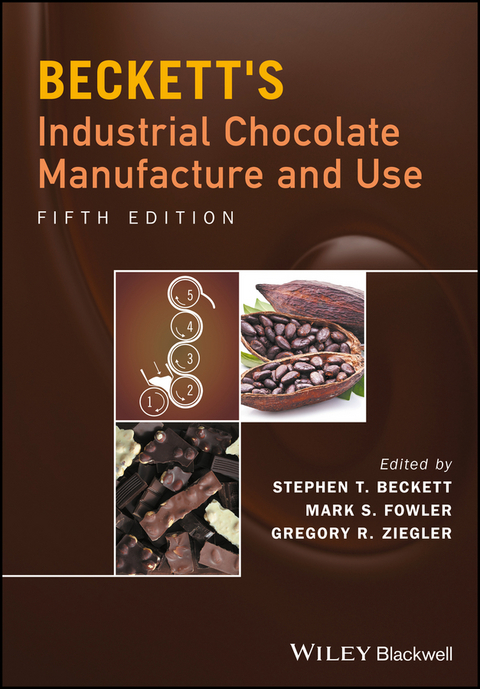
Beckett's Industrial Chocolate Manufacture and Use (eBook)
John Wiley & Sons (Verlag)
978-1-118-92357-3 (ISBN)
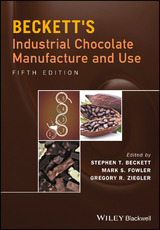
Since the publication of the first edition of Industrial Chocolate Manufacture and Use in 1988, it has become the leading technical book for the industry.
From the beginning it was recognised that the complexity of the chocolate industry means that no single person can be an expert in every aspect of it. For example, the academic view of a process such as crystallisation can be very different from that of a tempering machine operator, so some topics have more than one chapter to take this into account. It is also known that the biggest selling chocolate, in say the USA, tastes very different from that in the UK, so the authors in the book were chosen from a wide variety of countries making the book truly international. Each new edition is a mixture of updates, rewrites and new topics. In this book the new subjects include artisan or craft scale production, compound chocolates and sensory.
This book is an essential purchase for all those involved in the manufacture, use and sale of chocolate containing products, especially for confectionery and chocolate scientists, engineers and technologists working both in industry and academia.
The new edition also boasts two new co-editors, Mark Fowler and Greg Ziegler, both of whom have contributed chapters to previous editions of the book. Mark Fowler has had a long career at Nestle UK, working in Cocoa and Chocolate research and development - he is retiring in 2013. Greg Ziegler is a professor in the food science department at Penn State University in the USA.
About the Editors
Stephen T. Beckett, Formerly Nestlé Product Technology Centre, York, UK
Mark S. Fowler, Formerly Nestlé Product Technology Centre, York, UK
Gregory R. Ziegler, Department of Food Science, Penn State University, USA
Since the publication of the first edition of Industrial Chocolate Manufacture and Use in 1988, it has become the leading technical book for the industry. From the beginning it was recognised that the complexity of the chocolate industry means that no single person can be an expert in every aspect of it. For example, the academic view of a process such as crystallisation can be very different from that of a tempering machine operator, so some topics have more than one chapter to take this into account. It is also known that the biggest selling chocolate, in say the USA, tastes very different from that in the UK, so the authors in the book were chosen from a wide variety of countries making the book truly international. Each new edition is a mixture of updates, rewrites and new topics. In this book the new subjects include artisan or craft scale production, compound chocolates and sensory.This book is an essential purchase for all those involved in the manufacture, use and sale of chocolate containing products, especially for confectionery and chocolate scientists, engineers and technologists working both in industry and academia.The new edition also boasts two new co-editors, Mark Fowler and Greg Ziegler, both of whom have contributed chapters to previous editions of the book. Mark Fowler has had a long career at Nestle UK, working in Cocoa and Chocolate research and development he is retiring in 2013. Greg Ziegler is a professor in the food science department at Penn State University in the USA.
About the Editors Stephen T. Beckett, Formerly Nestlé Product Technology Centre, York, UK Mark S. Fowler, Formerly Nestlé Product Technology Centre, York, UK Gregory R. Ziegler, Department of Food Science, Pennsylvania State University, USA
1 Traditional chocolate making 1
Stephen T. Beckett
2 Cocoa beans: from tree to factory 9
Mark S. Fowler and Fabien Coutel
3 Production of cocoa mass cocoa butter and cocoa powder 50
Henri J. Kamphuis revised by Mark S. Fowler
4 Sugar and bulk sweeteners 72
Christof Krüger
5 Ingredients from milk 102
Ulla P. Skytte and Kerry E. Kaylegian
6 Chocolate Crumb 135
Martin A. Wells
7 Properties of cocoa butter and vegetable fats 153
Geoff Talbot
8 Flavour development in cocoa and chocolate 185
Gottfried Ziegleder
9 Particle size reduction 216
Gregory R. Ziegler and Richard Hogg
10 Conching 241
Stephen T. Beckett Konstantinos Paggios and Ian Roberts
11 Chocolate flow properties 274
Bettina Wolf
12 Bulk chocolate handling 298
John H. Walker
13 Tempering 314
Erich J. Windhab
14 Moulding enrobing and cooling chocolate products 356
Michael P. Gray revised and updated by Ángel Máñez-Cortell
15 Non?]conventional machines and processes 400
Dave J. Peters
16 Chocolate panning 431
Marcel Aebi revised by Mark S. Fowler
17 Chocolate rework 450
Edward Minson and Randall Hofberger
18 Artisan chocolate making 456
Sophie Jewett
19 Chocolate compounds and coatings 479
Stuart Dale
20 Recipes 492
Edward G. Wohlmuth
21 Sensory evaluation of chocolate and cocoa products 509
Meriel L. Harwood and John E. Hayes
22 Nutritional and health aspects of chocolate 521
Joshua D. Lambert
23 Quality control and shelf life 532
Marlene B. Stauffer
24 Instrumentation 555
Ulrich Loeser
25 Food safety in chocolate manufacture and processing 598
Faith Burndred and Liz Peace
26 Packaging 620
Carl E. Jones
27 The global chocolate confectionery market 654
Jonathan Thomas
28 Legal aspects of chocolate manufacture 675
Richard Wood
29 Intellectual property: Protecting products and processes 695
Patrick J. Couzens
30 Future trends 727
Stephen T. Beckett
Index 739
'The fifth edition of this invaluable book continues to be the definitive work on all things to do with cocoa and chocolate... The level of detail is well judged, offering explanation, practical advice and plenty of technical and scientific detail in each chapter, but also providing cross references and an excellent bibliography at the end of each chapter to allow further investigation of topics. The writing style is lucid, drawing the reader into the subject and exciting interest and further reading. In addition to the text, there are many useful and interesting photographs, tables, drawings and charts which enhance the discussions and illustrate important points ... This is a book which justifies its place at the hand of anyone involved in cocoa and chocolate. There will be very few in the industry whose knowledge and experience are so comprehensive as not to find useful information between its covers.' Confectionery Production, November 2017
Contributors
Stephen T. Beckett, BSc (Durham) D.Phil. (York) in physics, worked for eight years on research into asbestosis. The interest gained here in particle size distribution measurement, together with its effect on flow properties, has continued into the confectionery industry. Here he worked for more than 27 years, initially for Rowntree Mackintosh and subsequently with Nestlé. The work was primarily concerned with research and development, but also included a period as Process Development Manager. He has given several lectures on different aspects of chocolate making at Leatherhead in the United Kingdom and ZDS, Solingen in Germany, as well as two presentations at the PMCA conference in the United States. He has written a book on the science of chocolate as well as many published technical papers and is the named inventor in numerous patents. Since retiring from Nestlé in 2006 he has been involved in research into microencapsulation using pollen particles and has been awarded the Fellowship of The Royal Society of Chemistry and become an honorary professor at the University of Hull.
Marcel Aebi is a classically trained confectioner–patissiere from Switzerland. After several years travelling around the world working in the confectionery industry, he joined Nestlé in 1978. For the last 25 years he has worked in the area of new product development and process application in panning, both in America and Europe. He is currently based at Nestlé Product Technology Centre, York, UK.
Faith Burndred has a BSc in Chemistry from the University of York. She joined Nestlé in 1992 and since then has held a variety of technical roles supporting the confectionery business, including factory quality management. She currently works at the Nestlé Product Technology Centre in York and has spent time providing technical support and training to confectionery factories worldwide in food safety matters.
Fabien Coutel obtained a Master’s degree in Food Science and Technology in 2002 from ENSCBP in Bordeaux. He has worked for Chocolat Weiss as a production manager before joining Nestlé’s Research and Development centre at York in 2007, where he has been in charge of various projects related to chocolate and cocoa processes and products. From 2012 he has been working at Nestlé’s Chocolate Centre of Excellence in Broc, Switzerland, as a cocoa expert where he also contributes to the group’s sustainability program, the Nestlé Cocoa Plan. He is a member of the ICCO Ad Hoc Panel for Fine or Flavour Cocoa.
Patrick J. Couzens joined Nestlé’s confectionery business in 1991 after obtaining a doctorate in physical chemistry from the University of York. For the first few years he worked as a research scientist and published studies of lipid migration in confectionery products. He then moved into product development, specialising in panned confectionery. In 2005 he presented a lecture on the science of chocolate at the Royal Institution in London. In recent years his career has moved into the field of intellectual property. He was a Technical Intellectual Property Manager for Nestlé Confectionery in York before moving to Switzerland where he currently leads the Patents, Regulations and Scientific Intelligence group at the Nestlé Research Centre in Lausanne. Patrick is a European Patent Attorney.
Stuart Dale joined Rowntree, later Nestlé, in 1979 as a research assistant conducting chemical analyses. He continued to study Applied Chemistry on a part‐time basis before graduating from Leeds Metropolitan University and is a Member of The Royal Society of Chemistry. In 1984 he joined the Chocolate Research team of Dr Steve T. Beckett, first in Rowntree Group Research and later at the Nestlé Product Technology Centre in York. He has since specialised in the manufacture and processing of chocolate and chocolate compounds. From 1995 he has been based in Melbourne, Australia at a Nestlé confectionery factory, improving processes, developing new products and, since 2005, as Production Manager.
Mark S. Fowler studied at the University of Oxford where he obtained a degree in zoology. He joined Rowntree in 1977 and spent several years forecasting the size of the West African cocoa crop. He participated in a cocoa quality improvement project working directly with farmers in Cote d’Ivoire. After some time in technical management in confectionery factories, he joined Nestlé’s Product Technology Centre in York. He led the Cocoa and Chocolate Research programme before becoming head of Applied Science. He is now an independent consultant in cocoa, chocolate, food science, health and nutrition.
Michael P. Gray graduated as an industrial chemist from Loughborough in 1970, followed by an MSc in microbial biochemistry from Imperial College, London. He started with Cadbury Schweppes R&D in 1972, working on milk powders, and moved to Rowntree Mackintosh in 1979, spending 15 years in a general confectionery factory, both troubleshooting and seeking ways of making chocolate more efficiently. He joined Nestlé’s R&D in York in 1998 following three years in France working on ice cream and ice cream coatings. He then spent a period involved in providing technical assistance to factories worldwide prior to retiring.
Meriel L. Harwood received a BSc in Food Science and Industry from Kansas State University. She then went on as PMCA Tresper Clark fellow at the Pennsylvania State University where she earned a MSc in Food Science researching sensory methodologies in chocolate applications. In 2013 she joined Mars Chocolate North America as Sensory and Consumer Insights Scientist and recently moved into her current role as Product Development Scientist.
John E. Hayes earned his BSc and MSc in food science from Cornell University and his PhD in nutritional sciences from the University of Connecticut before completing a National Research Service Award (NIH T32) fellowship in behavioural genetics and alcohol addiction at Brown University. He joined the Penn State faculty in 2009, where he runs a multifaceted research programme that applies sensory science to a diverse range of problems, including work on chemosensation, genetics and ingestive behaviour, as well as the optimisation of oral and non‐oral drug delivery systems. He has authored more than 60 peer‐reviewed articles and book chapters, and his work has appeared on CNN.com, in the Wall Street Journal, The Atlantic, The Guardian, Popular Science and Vogue, among others.
Randall (Randy) Hofberger is currently assisting the confectionery industry with his company R & D Candy Consultants. Prior to that he held technical and quality assurance positions with Nestlé, Peters Chocolate, Ward‐Johnston Candy and Carnation Co. He has a food science BSc degree from the University of Wisconsin–River Falls and a MSc in Food Science from the University of Illinois. Randy is active in industry organisations such as AACT, RCI, UW candy course and PMCA, where he assistsd with various technical presentations and classes. He is an inductee of the 2014 Candy Hall of Fame.
Richard Hogg is Professor Emeritus of Mineral Processing and Geo‐environmental Engineering at The Pennsylvania State University and is a member of the National Academy of Engineering and the Society for Mining, Metallurgy and Exploration. His primary research interests lie in colloid science and particle technology with emphasis on characterisation, mixing, agglomeration and fine grinding of powders.
Sophie Jewett has more than 15 years’ experience in the food and drink industry in product development, retail, hospitality and market research. Sophie is the creator and owner of the York Cocoa House. Established in 2011, York Cocoa House is a chocolate‐based business located in York, with café, retail and educational facilities. As well as hand‐making all of their own products, the company offers educational and engagement activities to visitors to learn more about the chocolate industry and the role York has played in the development and growth of that industry. Sophie advises, lectures and tutors at all levels within the chocolate industry, drawing on historical development and methodology to improve understanding of the evolution of the industry today in mature and emerging markets. Sophie currently lectures with the University of York specialising in the relationship that sociological, economic and technological drivers have with consumer behaviour in the chocolate industry. Areas of specific interest focus on emotional connectivity, artisan quality and the role of story‐telling in driving consumer behaviour and developing sustainable brands.
Carl E. Jones joined Nestlé Research and Development in 1987 where he trained as a food technologist before completing the Institute of Packaging Diploma in 1990, winning the award for best essay. Since 1991 he has been based in York in Nestlé’s lead Reseach and Development Centre for the global confectionery business. During his time in York he has travelled worldwide installing new wrapping lines, participating in asset utilisation projects, performing packaging materials optimisation studies, providing training ranging from packaging...
| Erscheint lt. Verlag | 28.2.2017 |
|---|---|
| Sprache | englisch |
| Themenwelt | Naturwissenschaften ► Biologie |
| Technik ► Lebensmitteltechnologie | |
| Wirtschaft ► Betriebswirtschaft / Management | |
| Weitere Fachgebiete ► Land- / Forstwirtschaft / Fischerei | |
| Schlagworte | Artisan (craft scale) • Chocolate • CoCoA • conching • enrobing • Flavour • Food Processing, Production & Manufacture • Food Science & Technology • Food Types • Herstellung u. Verarbeitung von Lebensmitteln • Industrial Engineering • Industrial Engineering / Manufacturing • Industrielle Verfahrenstechnik • Lebensmittel • Lebensmittelforschung u. -technologie • Moulding • Nutrition • Produktion i. d. Industriellen Verfahrenstechnik • rheology • Schokolade • Tempering • Verfahrenstechnik |
| ISBN-10 | 1-118-92357-X / 111892357X |
| ISBN-13 | 978-1-118-92357-3 / 9781118923573 |
| Informationen gemäß Produktsicherheitsverordnung (GPSR) | |
| Haben Sie eine Frage zum Produkt? |
 EPUB (Adobe DRM)
Kopierschutz: Adobe-DRM
Adobe-DRM ist ein Kopierschutz, der das eBook vor Mißbrauch schützen soll. Dabei wird das eBook bereits beim Download auf Ihre persönliche Adobe-ID autorisiert. Lesen können Sie das eBook dann nur auf den Geräten, welche ebenfalls auf Ihre Adobe-ID registriert sind.
Details zum Adobe-DRM
Dateiformat: EPUB (Electronic Publication)
EPUB ist ein offener Standard für eBooks und eignet sich besonders zur Darstellung von Belletristik und Sachbüchern. Der Fließtext wird dynamisch an die Display- und Schriftgröße angepasst. Auch für mobile Lesegeräte ist EPUB daher gut geeignet.
Systemvoraussetzungen:
PC/Mac: Mit einem PC oder Mac können Sie dieses eBook lesen. Sie benötigen eine
eReader: Dieses eBook kann mit (fast) allen eBook-Readern gelesen werden. Mit dem amazon-Kindle ist es aber nicht kompatibel.
Smartphone/Tablet: Egal ob Apple oder Android, dieses eBook können Sie lesen. Sie benötigen eine
Geräteliste und zusätzliche Hinweise
Buying eBooks from abroad
For tax law reasons we can sell eBooks just within Germany and Switzerland. Regrettably we cannot fulfill eBook-orders from other countries.
aus dem Bereich