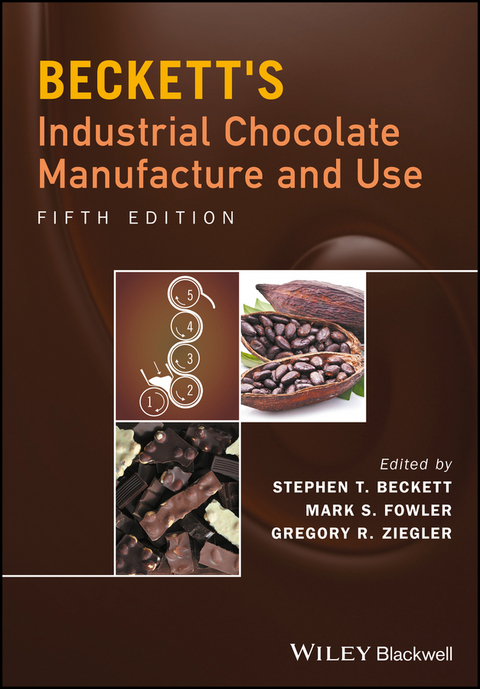
Beckett's Industrial Chocolate Manufacture and Use (eBook)
John Wiley & Sons (Verlag)
978-1-118-92358-0 (ISBN)
Since the publication of the first edition of Industrial Chocolate Manufacture and Use in 1988, it has become the leading technical book for the industry.
From the beginning it was recognised that the complexity of the chocolate industry means that no single person can be an expert in every aspect of it. For example, the academic view of a process such as crystallisation can be very different from that of a tempering machine operator, so some topics have more than one chapter to take this into account. It is also known that the biggest selling chocolate, in say the USA, tastes very different from that in the UK, so the authors in the book were chosen from a wide variety of countries making the book truly international. Each new edition is a mixture of updates, rewrites and new topics. In this book the new subjects include artisan or craft scale production, compound chocolates and sensory.
This book is an essential purchase for all those involved in the manufacture, use and sale of chocolate containing products, especially for confectionery and chocolate scientists, engineers and technologists working both in industry and academia.
The new edition also boasts two new co-editors, Mark Fowler and Greg Ziegler, both of whom have contributed chapters to previous editions of the book. Mark Fowler has had a long career at Nestle UK, working in Cocoa and Chocolate research and development - he is retiring in 2013. Greg Ziegler is a professor in the food science department at Penn State University in the USA.
About the Editors
Stephen T. Beckett, Formerly Nestlé Product Technology Centre, York, UK
Mark S. Fowler, Formerly Nestlé Product Technology Centre, York, UK
Gregory R. Ziegler, Department of Food Science, Pennsylvania State University, USA
Since the publication of the first edition of Industrial Chocolate Manufacture and Use in 1988, it has become the leading technical book for the industry. From the beginning it was recognised that the complexity of the chocolate industry means that no single person can be an expert in every aspect of it. For example, the academic view of a process such as crystallisation can be very different from that of a tempering machine operator, so some topics have more than one chapter to take this into account. It is also known that the biggest selling chocolate, in say the USA, tastes very different from that in the UK, so the authors in the book were chosen from a wide variety of countries making the book truly international. Each new edition is a mixture of updates, rewrites and new topics. In this book the new subjects include artisan or craft scale production, compound chocolates and sensory.This book is an essential purchase for all those involved in the manufacture, use and sale of chocolate containing products, especially for confectionery and chocolate scientists, engineers and technologists working both in industry and academia.The new edition also boasts two new co-editors, Mark Fowler and Greg Ziegler, both of whom have contributed chapters to previous editions of the book. Mark Fowler has had a long career at Nestle UK, working in Cocoa and Chocolate research and development he is retiring in 2013. Greg Ziegler is a professor in the food science department at Penn State University in the USA.
About the Editors Stephen T. Beckett, Formerly Nestlé Product Technology Centre, York, UK Mark S. Fowler, Formerly Nestlé Product Technology Centre, York, UK Gregory R. Ziegler, Department of Food Science, Pennsylvania State University, USA
Title Page 5
Copyright Page 6
Contents 7
Contributors 26
Preface 37
Chapter 1 Traditional chocolate making 41
1.1 History 41
1.2 Outline of the process 42
1.2.1 Preparation of cocoa nib – flavour development 45
1.2.2 Grinding – particle size reduction 45
1.2.3 Conching – flavour and texture development 47
1.3 Concept of the book 47
References 48
Chapter 2 Cocoa beans: from tree to factory 49
2.1 Introduction 49
2.2 Growing cocoa 50
2.2.1 Where cocoa is grown 50
2.2.2 Varieties of cocoa: Criollo, Forastero, Trinitario and Nacional 50
2.2.3 Climatic and environmental requirements 53
2.2.4 Propagation of the planting material 53
2.2.5 Establishment and development of the plants in the field 54
2.2.6 Major pests and diseases 55
2.2.7 Flowering and pod development 56
2.2.8 Harvesting, pod opening and yields 57
2.2.9 Environmental and sustainability aspects of cocoa cultivation 59
2.2.10 Labour practices on farms 59
2.3 Fermentation and drying 60
2.3.1 Fermentation 60
2.3.2 Microbiological aspects of fermentation 61
2.3.3 Development of cocoa flavour precursors 62
2.3.4 Drying 63
2.4 The cocoa supply chain 65
2.4.1 Internal market 66
2.4.2 International cocoa markets 66
2.4.3 Shipment of cocoa 69
2.4.4 Moisture movement during shipment 69
2.4.5 Storage of cocoa 70
2.4.6 Infestation of cocoa 71
2.5 The cocoa value chain: long-term perspectives and challenges 71
2.6 Quality assessment of cocoa 74
2.6.1 Composition of cocoa beans 74
2.6.2 Cocoa beans: quality aspects and contracts 74
2.6.3 Cocoa beans: sampling and the “cut test” 76
2.6.4 Contaminants and residues 81
2.6.5 Cocoa butter hardness 81
2.6.6 Sensory evaluation 82
2.7 Types and origins of cocoa beans used in chocolate 82
2.7.1 Sources of bulk cocoas 83
2.7.2 Côte d’Ivoire 83
2.7.3 Ghana 83
2.7.4 Indonesia 84
2.7.5 Nigeria 84
2.7.6 Cameroon 84
2.7.7 Brazil 85
2.7.8 Ecuador 85
2.7.9 Speciality and “fine” or “flavour” cocoas 85
Conclusions 87
References 88
Appendix: Abbreviations, acronyms and organisations 89
Chapter 3 Production of cocoa mass, cocoa butter and cocoa powder 90
3.1 Introduction 90
3.2 Cleaning of cocoa beans 90
3.3 Removal of shell 92
3.4 Breaking and winnowing 93
3.5 Alkalisation 94
3.6 Bean and nib roasting 94
3.7 Cocoa mass (cocoa liquor) 98
3.7.1 Grinding cocoa nibs 98
3.7.2 Quality of cocoa mass for the chocolate industry 99
3.7.3 Quality of cocoa mass for the production of cocoa powder and butter 100
3.8 Cocoa butter 102
3.9 Cocoa press cake and cocoa powder 105
3.9.1 Types of cocoa powder 107
3.9.2 Quality of cocoa powder 108
Conclusion 109
Appendix: Manufacturers of cocoa processing equipment 110
References and further reading 110
Chapter 4 Sugar and bulk sweeteners 112
4.1 Introduction 112
4.2 The production of sugar 112
4.3 Sugar qualities 114
4.4 The storage of sugar 115
4.5 Sugar grinding and the prevention of sugar dust explosions 117
4.6 Amorphous sugar 120
4.7 Other sugars and bulk sweeteners 121
4.7.1. Invert sugar 121
4.7.2 Glucose 122
4.7.3 Fructose 122
4.7.4 Tagatose 123
4.7.5 Lactose 124
4.7.6 Isomaltulose 124
4.7.7 Trehalose 124
4.7.8 Polydextrose 124
4.7.9 Inulin 125
4.7.10 Sorbitol 126
4.7.11 Mannitol 126
4.7.12 Xylitol 126
4.7.13 Erythritol 127
4.7.14 Maltitol 127
4.7.15 Maltitol syrup 128
4.7.16 Isomalt 128
4.7.17 Lactitol 128
4.8 Physiological characteristics of sugars, bulk sweeteners and special polysaccharides 129
4.9 The sweetening power of sugars and bulk sweeteners 132
4.10 Other sensory properties of sugars and bulk sweeteners 133
4.11 Solubilities and melting points of sugars and bulk sweeteners 135
4.12 Maximum conching temperatures of chocolate masses with different bulk sweeteners 135
4.13 Separate conching process for “no sugar added” chocolates 137
4.14 Pre- and probiotic chocolates 137
Conclusions 138
References 138
Chapter 5 ingredients from milk 142
5.1 Introduction 142
5.2 Milk components 143
5.2.1 Milk protein 143
5.2.2 Milk fat 145
5.2.3 Lactose 154
5.2.4 Vitamins and minerals 154
5.3 Milk-based ingredients for chocolate 154
5.3.1 Milk fat ingredients 155
5.3.2 Milk powders 158
Conclusion 171
References 171
Chapter 6 Chocolate crumb 175
6.1 Introduction and history 175
6.2 Benefits of milk crumb 176
6.3 Typical crumb recipes 177
6.4 Flavour development in chocolate crumb 177
6.5 Sugar crystallisation during crumb manufacture 181
6.6 The structure of chocolate crumb 182
6.6.1 Crystallinity 183
6.6.2 Fat availability 183
6.6.3 Fat droplet size 183
6.6.4 Aeration 184
6.6.5 Overall particle size distribution 185
6.7 Typical crumb processes and equipment 185
6.7.1 Batch oven process 186
6.7.2 Continuous processes 186
6.8 Effect of the crumb process upon the crumb properties 190
6.9 Changes to crumb during storage 190
Conclusion 191
References 192
Chapter 7 Properties of cocoa butter and vegetable fats 193
7.1 Introduction 193
7.2 Cocoa butter 194
7.2.1 Fatty acid and triglyceride composition 194
7.2.2 Polymorphism 196
7.2.3 Minor components 201
7.3 Cocoa butter equivalents 202
7.3.1 Main CBE component fats 204
7.3.2 Other CBE component fats 210
7.3.3 Structured triglycerides in CBEs 211
7.3.4 Production and uses of CBEs 213
7.4 Lauric cocoa butter substitutes 216
7.4.1 Quality control 217
7.4.2 Hydrogenated lauric CBSs 218
7.5 Non-lauric cocoa butter replacers 219
7.6 Vegetable fats with specific properties 221
7.6.1 Anti-bloom fats 221
7.6.2 Lower-calorie fats 222
Conclusion 222
References and further reading 223
Chapter 8 Flavour development in cocoa and chocolate 225
8.1 Introduction 225
8.2 Fermentation 225
8.2.1 The fermentation process 225
8.2.2 Chemical changes and development of flavour precursors 227
8.2.3 Over-fermentation 229
8.3 Drying 230
8.3.1 Influence of drying on flavour and flavour precursors 230
8.3.2 Flavour of unroasted, fermented cocoa beans 231
8.4 Roasting 233
8.4.1 The roasting process 233
8.4.2 Utilisation of flavour precursors 234
8.4.3 Roast flavour 235
8.4.4 Flavour of alkalised cocoa 241
8.5 Conching 241
8.5.1 Thin-film treatment of roasted cocoa mass 241
8.5.2 The conching process 242
8.5.3 Effect of conching on aroma development 242
8.6 Dark chocolate and milk chocolate 245
8.6.1 Dark chocolate flavour 245
8.6.2 Milk chocolate flavour 246
8.7 Flavour release in chocolate 248
References 249
Chapter 9 Particle size reduction 256
9.1 Introduction 256
9.2 Principles of fine grinding 257
9.2.1 Breakage mechanisms 257
9.2.2 Grinding processes 258
9.3 Grinding equipment 260
9.3.1 Crushers 260
9.3.2 Media mills 260
9.3.3 Impact mills 261
9.3.4 Fluid energy mills 262
9.3.5 Guidelines for equipment selection 262
9.4 Cocoa nib grinding 264
9.5 Chocolate refining 266
9.5.1 The five-roll refiner 268
9.5.2 Crumb chocolate 272
9.5.3 Sugar substitutes 272
9.5.4 The refiner-conche 272
9.5.5 Refining in the presence of water 273
9.5.6 Milling cocoa powder 273
9.6 Particle size reduction and chocolate flow properties 273
9.7 Particle size and sensory properties 277
Conclusions 278
References 279
Chapter 10 Conching 281
10.1 Introduction: the reason for conching 281
10.1.1 Flavour development 281
10.1.2 Flow property optimisation 282
10.2 The principles of conching 282
10.2.1 Removal of volatiles and temperature control 282
10.2.2 Fat and emulsifier additions 284
10.2.3 Degree of mixing 285
10.3 The three phases of conching 288
10.3.1 Dry phase conching 288
10.3.2 Pasty phase conching 289
10.3.3 Liquid phase conching 290
10.4 Conching machines 291
10.4.1 History 291
10.4.2 The first conche development 292
10.4.3 Classification of conches 292
10.4.4 Vertically oriented shaft conches 292
10.4.5 Horizontally oriented shaft conches 294
10.4.6 Single shaft conches 295
10.4.7 Two shaft conches 298
10.4.8 Three shaft conches 302
10.4.9 Continuous conches 303
10.4.10 Add-on solutions to the conching process 305
10.4.11 Combined grinding and conching 306
Conclusion 312
References and further reading 313
Chapter 11 Chocolate flow properties 314
11.1 Introduction 314
11.2 Non-Newtonian flow 315
11.3 Presentation of viscosity measurements 318
11.4 Single point flow measurement 319
11.4.1 Gallenkamp torsion viscometer 320
11.4.2 MacMichael viscometer 321
11.5 Rotational viscometers 322
11.6 Vibrational viscometers 325
11.7 Oscillatory rheometers 325
11.8 Sample preparation and measurement procedures 326
11.8.1 Sample preparation 326
11.8.2 Checking the viscometer 327
11.8.3 Preconditioning 327
11.8.4 Shear rate range 328
11.8.5 Holding time at the maximum shear rate 328
11.8.6 Hysteresis 328
11.8.7 Overall measurement time 328
11.9 Factors affecting the flow properties of chocolate 329
11.9.1 Fat content 329
11.9.2 Particle size distribution 330
11.9.3 Surface active agents (emulsifiers) 331
11.9.4 Conching 334
11.9.5 Moisture 335
11.10 Advanced methods to characterise chocolate flow behaviour 335
Conclusions 336
Acknowledgements 336
References 336
Chapter 12 Bulk chocolate handling 338
12.1 Introduction 338
12.2 Viscosity and viscometry 338
12.2.1 What is viscosity? 338
12.2.2 Laminar and turbulent flow 340
12.3 Pump sizes 341
12.3.1 Power 341
12.3.2 Speed 341
12.4 General criteria for choosing a pump 341
12.5 Types of pump 342
12.5.1 Gear pumps 342
12.5.2 Sliding vane pump 343
12.5.3 Lobe and rotary piston pumps 343
12.5.4 Screw pump 344
12.5.5 Pawl pumps 345
12.5.6 Progressive cavity pump 345
12.5.7 Positive displacement piston and diaphragm pumps 346
12.6 Pipeline pigging 347
12.7 Storage of liquid chocolate 348
12.8 Jacketed pipe work 349
12.8.1 Corrosion of stainless steel 350
12.9 Valves 351
12.9.1 Plug cock valve 351
12.9.2 Butterfly valve 351
12.9.3 Ball valve 351
12.10 Contamination removal 352
12.10.1 Magnets 352
12.10.2 Sieving 352
Conclusions 353
Acknowledgements 353
Chapter 13 Tempering 354
13.1 Introduction 354
13.2 Physics of cocoa butter crystallisation 355
13.3 Chocolate tempering technology 356
13.4 Measurement of temper and its related characteristics 358
13.4.1 Tempermeters 359
13.4.2 Differential scanning calorimetry 361
13.4.3 Thermorheometry 362
13.4.4 Nuclear magnetic resonance 363
13.5 Tempering processes 363
13.5.1 The principle of conventional continuous chocolate “stir/shear?tempering” 364
13.5.2 Impact of temperature/temperature control 364
13.5.3 Impact of shear 366
13.5.4 Importance of residence time distribution 370
13.5.5 “Recipe factors” influencing tempering quality 371
13.6 Types of tempering machine 371
13.6.1 Chocolate tempering kettles 371
13.6.2 Types of continuous industrial tempering machines 372
13.6.3 Continuous industrial seed-tempering 381
13.7 Properties of CBCS tempered chocolate 386
13.7.1 Pre-crystallised liquid state 386
13.7.2 Semi-solid and solid state 388
13.7.3 Industrial process layouts 390
13.8 Other methods of tempering 392
Conclusion 392
Acknowledgements 393
References and further reading 393
Appendix: Machinery manufacturers 395
Chapter 14 Moulding, enrobing and cooling chocolate products 396
14.1 Introduction 396
14.2 Moulding 396
14.2.1 Background 396
14.2.2 Loose and fixed mould plants 397
14.2.3 Mould conditioning 400
14.2.4 Depositors 401
14.2.5 Adding inclusions 403
14.2.6 Removal of air bubbles 404
14.2.7 Shell forming 404
14.2.8 Centre filling 405
14.2.9 Backing off 405
14.2.10 Cooling 407
14.2.11 Demoulding 410
14.2.12 Troubleshooting demoulding problems 411
14.2.13 In-line storage systems 413
14.2.14 Keeping moulds clean and changeovers 414
14.2.15 Other methods for shelling forming 414
14.2.16 Troubleshooting moulded product faults 417
14.2.17 Mould design, care and innovations 419
14.3 Enrobing 423
14.3.1 Background 423
14.3.2 Basic layout of an enrober 424
14.3.3 Enrobers with inbuilt temperers 424
14.3.4 Enrobers with external temperers 425
14.3.5 Chocolate recirculation 425
14.3.6 Temper 427
14.3.7 Product centre 427
14.3.8 Enrober components 427
14.3.9 Changeovers 433
14.3.10 Avoidance of air bubbles 433
14.3.11 Avoidance of chocolate build?up inside an enrober 433
14.3.12 Downstream processes 434
14.3.13 Cooling 435
14.3.14 Troubleshooting enrobed product faults 437
Conclusions 438
Acknowledgements 438
References and further reading 438
Chapter 15 Non-conventional machines and processes 440
15.1 Introduction 440
15.2 Ultrasound 440
15.3 High shear/low temperature crystalliser 442
15.4 High pressure temperer 444
15.5 Extrusion 445
15.5.1 Types of extruders 445
15.5.2 The extruder as a flavour modifier 447
15.5.3 The extruder as a chocolate conche 447
15.5.4 The extrusion of tubular shapes, ropes and nets 450
15.6 “Single shot” depositors 453
15.6.1 Background 453
15.6.2 Basic principle of single shot depositing 454
15.6.3 Limitations of single shot depositing 455
15.6.4 Key control parameters 457
15.7 Aeration of chocolate 458
15.7.1 Types of aeration 458
15.7.2 Vacuum aeration 459
15.7.3 High pressure aeration systems 459
15.7.4 Water evaporation methods 460
15.8 Cold forming technologies 461
15.8.1 Background 461
15.8.2 Typical cold forming process 462
15.8.3 Advantages of cold forming technologies 464
15.8.4 Disadvantages of cold forming 466
15.8.5 Cold forming variants 467
15.9 Paste conching 468
Conclusions 468
References 469
Chapter 16 Chocolate panning 471
16.1 Introduction 471
16.1.1 History 471
16.1.2 Definitions 471
16.2 Panning methods 472
16.2.1 Chocolate panning 473
16.2.2 Soft coatings 473
16.2.3 Hard coating 473
16.2.4 Film and suspension coating 473
16.3 The process of chocolate panning 474
16.3.1 Centre selection 474
16.3.2 Centre preparation 475
16.3.3 Selection of chocolate and compound coatings 478
16.3.4 Chocolate and compound engrossing 479
16.3.5 Polishing and sealing 482
16.4 Packaging and storage 484
16.5 The panning department 485
16.5.1 Room conditions 485
16.5.2 Quality and troubleshooting 486
16.5.3 Panning equipment 486
Conclusions and future developments 489
References and further reading 489
Appendix: Manufacturers of panning equipment 489
Chapter 17 Chocolate rework 490
17.1 Introduction 490
17.2 Rework 490
17.3 Constraints 491
17.4 Economics 493
Conclusions 495
References 495
Chapter 18 Artisan chocolate making 496
18.1 Introduction 496
18.2 Chocolate trends in mature markets 496
18.2.1 Value-seeking consumers 496
18.2.2 Premium quality chocolate consumption 496
18.2.3 Sustainability 497
18.2.4 Nostalgia and tradition 497
18.2.5 Health and wellbeing 497
18.3 Selecting the right product lines to make 498
18.3.1 Filled chocolates 498
18.3.2 Hand-dipped or enrobed chocolate confectionery 499
18.3.3 Moulded chocolate forms 501
18.3.4 Chocolate bars or fragments 502
18.3.5 Bean to bar chocolate products 503
18.4 Critical considerations 504
18.4.1 Ingredients 504
18.4.2 Equipment 505
18.4.3 Working environment 505
18.4.4 Shelf life 505
18.4.5 Storage 506
18.4.6 Packaging 506
18.4.7 Labelling 506
18.4.8 Costings and pricing 507
18.4.9 Skills 507
18.4.10 Health and safety 508
18.5 Taking products to market 509
18.5.1 Market stalls and food festivals 509
18.5.2 On-line retail sales 510
18.5.3 Private orders and commissions 510
18.5.4 Wholesale distribution 511
18.5.5 Chocolate concessions 511
18.5.6 Chocolate making for sweet shops and cafés 512
18.6 Selecting the right chocolate 513
18.6.1 Flavour, smoothness and speed of melt 513
18.6.2 Viscosity 513
18.6.3 In-house manufactured or purchased chocolate 513
18.6.4 Legal and recipe requirements 513
18.7 Hand-tempering techniques 514
18.7.1 Why does chocolate need tempering? 514
18.7.2 Hand-tempering methods 515
18.7.3 Testing chocolate for temper 517
Conclusions 518
Further reading 518
Chapter 19 Chocolate compounds and coatings 519
19.1 Introduction 519
19.2 What are chocolate compounds and coatings? 519
19.2.1 Ice cream coatings 521
19.3 Manufacture of compounds and coatings 522
19.4 How compounds are used 525
19.5 Benefits of using chocolate compounds 525
19.5.1 Non-tempering 525
19.5.2 Cooling 526
19.5.3 Heat resistance and fat bloom 526
19.5.4 Texture and prevention of cracking 527
19.5.5 Health benefits 527
19.6 Trans fatty acids in chocolate compounds 528
19.7 Environmental aspects 529
19.8 Summary of the properties of compound coatings 529
19.9 The future of compound coatings 529
References and further reading 531
Chapter 20 Recipes 532
20.1 Chocolate tastes in different countries 532
20.1.1 History 532
20.1.2 Taste in different countries 532
20.2 The basic ingredients 534
20.2.1 Sugar 534
20.2.2 Milk 534
20.2.3 Cocoa beans and mass 534
20.3 Conching to develop flavours 535
20.4 Chocolate recipes 536
20.4.1 Chocolate bars/tablets 536
20.4.2 Chocolate confectionery products 538
20.4.3 Ice cream and frozen desserts/confectionery 540
20.4.4 Bakery and biscuit products (including chocolate chips) 542
20.4.5 Speciality products 545
20.4.6 No added sugar chocolate 546
20.4.7 Compounds and coatings 547
Conclusions 548
Chapter 21 Sensory evaluation of chocolate and cocoa products 549
21.1 Introduction 549
21.2 Types of sensory tests 550
21.2.1 Threshold tests 550
21.2.2 Discrimination tests 551
21.2.3 Affective testing 552
21.2.4 Descriptive analysis 552
21.2.5 Time–intensity analysis 553
21.3 Special considerations 553
21.3.1 Use of coloured lighting 554
21.3.2 Sample presentation 554
21.3.3 Palate cleansers 554
21.3.4 Fatigue and sample size 555
21.3.5 Evaluation temperature and product form 556
21.3.6 Tasting instructions 556
21.4 General considerations/good sensory testing practices 557
21.4.1 Blinding codes 557
21.4.2 Sensory testing environment 557
21.4.3 Sample serving containers 558
21.4.4 Recruitment 558
Conclusions 559
References 559
Chapter 22 Nutritional and health aspects of chocolate 561
22.1 Introduction 561
22.2 Macronutrients 562
22.2.1 Fats 562
22.2.2 Carbohydrates 562
22.2.3 Proteins 562
22.3 Vitamins and minerals 563
22.4 Flavanols and proanthocyanidins 563
22.5 Methylxanthines 564
22.6 Cardiovascular disease 564
22.7 Obesity and metabolic syndrome 565
22.8 Inflammation 566
22.9 Neuroprotective and cognitive effects 567
Conclusions 569
Acknowledgements 569
References 569
Chapter 23 Quality control and shelf life 572
23.1 Introduction 572
23.2 Finding the perfect bean 572
23.3 Cocoa bean preparation on arrival 575
23.4 Cocoa bean cleaning 575
23.5 Roasting of cocoa beans 577
23.5.1 Whole bean roasting 578
23.5.2 Winnowing (separation of shell from nib) 579
23.5.3 Nib roasting 579
23.6 Cocoa nib grinding 579
23.7 Cocoa butter pressing 581
23.8 Cocoa powder 582
23.9 Chocolate manufacturing 582
23.9.1 Mixing 584
23.9.2 Refining 584
23.9.3 Conching 584
23.9.4 Standardising 585
23.9.5 Particle size 586
23.9.6 Type of fats 587
23.10 Specifications 587
23.10.1 Physical parameters 587
23.10.2 Fineness (particle size) 588
23.10.3 Fat content 588
23.10.4 Microbiological specifications 588
23.11 Tempering 588
23.12 Shelf life of finished confections 589
23.12.1 What is shelf life? 590
23.12.2 Effect of formulation 590
23.12.3 Manufacturing 591
23.12.4 Packaging and storage 591
23.12.5 Distribution 592
23.12.6 Shelf life determination 593
Chapter 24 Instrumentation 595
24.1 Introduction 595
24.1.1 General measurement tasks 595
24.1.2 Microbiological measurements 595
24.1.3 Use of data analysis 596
24.1.4 Use of data analysis to provide long-term production stability 596
24.2 Production measurement technology – in-/on-line, off-line 597
24.2.1 Recording time 597
24.2.2 Recording position (location) 597
24.2.3 Recording by numbers 601
24.2.4 Recording “patterns” 602
24.2.5 Recording the degree of filling (fill level) 602
24.2.6 Recording by weighing 602
24.2.7 Measuring temperatures 604
24.2.8 Recording the degree of temper 607
24.2.9 Pressure measurement 609
24.2.10 Measuring moisture/relative humidity 610
24.2.11 Recording flow characteristics 610
24.2.12 Recording particle size 614
24.2.13 Production monitoring 615
24.2.14 Detecting foreign matter 622
24.3 Laboratory analysis 624
24.3.1 Moisture measurement 625
24.3.2 Determination of fat content (Soxhlet) 627
24.3.3 Solid fat content 628
24.3.4 Particle size measurement 630
24.3.5 Triglyceride (triacylglycerides) composition (vegetable fat content) 632
24.4 Summary of important analytical procedures in a typical quality assurance laboratory 634
24.4.1 General 634
24.4.2 Analysis 634
Conclusions 635
Acknowledgements 636
References and further reading 636
Chapter 25 Food safety in chocolate manufacture and processing 638
25.1 Introduction 638
25.2 The importance of food safety management in chocolate processing 638
25.3 HACCP and prerequisite programmes 639
25.4 Physical hazards 639
25.4.1 Physical hazards in incoming raw materials 639
25.4.2 Physical hazards during processing 640
25.4.3 Physical hazards from failures of prerequisite programmes 642
25.4.4 Equipment to prevent and detect physical hazards 644
25.5 Chemical hazards 644
25.5.1 Chemical hazards in incoming ingredients 645
25.5.2 Chemical hazards occurring during processing 647
25.6 Microbiological hazards 647
25.6.1 Salmonella 647
25.6.2 Salmonella in raw materials 648
25.6.3 Prevention of microbiological contamination during processing 651
25.6.4 Water control and cleaning practices 652
25.6.5 Microbiological monitoring 653
25.6.6 Escherichia coli 0157:H7 and other verocytotoxin?producing E. coli 653
25.7 Allergen hazards 654
25.7.1 Allergens as ingredients 655
25.7.2 Allergens from cross?contacts at the factory 656
25.7.3 Control measures 656
Conclusions 657
References 657
Chapter 26 Packaging 660
26.1 Introduction 660
26.2 Confectionery types 660
26.2.1 Moulded chocolate tablets and bars 660
26.2.2 Chocolate countlines 661
26.2.3 Bulk chocolate 663
26.2.4 Boxed chocolates 663
26.2.5 Twist wrapping 666
26.2.6 Easter eggs and other seasonal chocolate novelties 668
26.2.7 Shelf ready/retail ready packaging 670
26.3 Flow wrap machinery and sealing 671
26.4 Materials 673
26.4.1 Aluminium foil 673
26.4.2 Paper and board 674
26.4.3 Regenerated cellulose film 677
26.4.4 Plastic films 678
26.4.5 Cold seal 682
26.4.6 Biopolymers 684
26.5 Sustainability 686
26.5.1 Biodegradable 687
26.5.2 Compostable 687
26.5.3 Renewable resources 687
26.5.4 Bioplastics 687
26.5.5 Recyclability 688
26.5.6 Recycled content 688
26.6 Portion control 688
26.6.1 Tablets/blocks 689
26.6.2 Nibbles 689
26.7 Quality control and environmental criteria 691
26.7.1 Quality control 691
26.7.2 Environmental issues 692
References and further reading 693
Chapter 27 The global chocolate confectionery market 694
27.1 Background 694
27.2 The global chocolate market 696
27.3 Industry supply 697
27.4 Global production and consumption of chocolate 699
27.5 Reasons for eating confectionery 702
27.6 The marketing of confectionery 705
27.7 The regulatory position 709
Conclusions 712
References 714
Chapter 28 Legal aspects of chocolate manufacture 715
28.1 Introduction 715
28.2 International standards – the Codex Alimentarius 715
28.2.1 Cocoa products 716
28.2.2 Chocolate products 717
28.3 European standards 720
28.3.1 Names and definitions 721
28.3.2 Optional ingredients 725
28.3.3 Calculation of minimum amounts 725
28.3.4 Use of vegetable fats other than cocoa butter 725
28.3.5 Industry initiatives 726
28.3.6 Chocolate cigarettes 726
28.4 United States of America 726
28.4.1 Breakfast cocoa 727
28.4.2 Cocoa/medium fat cocoa 727
28.4.3 Low fat cocoa 727
28.4.4 Chocolate liquor 727
28.4.5 Sweet chocolate 727
28.4.6 Milk chocolate 727
28.4.7 Buttermilk chocolate 728
28.4.8 Skim milk chocolate 728
28.4.9 White chocolate 728
28.4.10 Use of vegetable fats other than cocoa butter 729
28.5 Canada 729
28.5.1 Cocoa powder 729
28.5.2 Low fat cocoa powder 729
28.5.3 Cocoa liquor, unsweetened chocolate, bitter chocolate 729
28.5.4 Chocolate, bittersweet chocolate, semi-sweet chocolate, dark chocolate 729
28.5.5 Sweet chocolate 729
28.5.6 Milk chocolate 730
28.5.7 White chocolate 730
28.6 BRIC markets 730
28.7 Use of additives 730
28.8 Labelling 732
28.8.1 Legal name 732
28.8.2 List of ingredients 732
28.8.3 The quantity of certain ingredients (“quantitative ingredients declaration”) 732
28.8.4 Date of minimum durability and special storage conditions 733
28.8.5 Batch code 733
28.8.6 Business name and address 733
28.8.7 Place of origin 733
28.8.8 Net quantity or weight 733
28.8.9 Nutrition information 733
Conclusions 733
Further reading 734
Chapter 29 Intellectual property: Protecting products and processes 735
29.1 Introduction 735
29.2 Patents 735
29.2.1 What is a patent? 735
29.2.2 International protection 738
29.2.3 The life of a patent family 739
29.2.4 The cost of a patent 741
29.2.5 Where to find patents 742
29.2.6 How to read a patent 742
29.3 Trade marks 748
29.3.1 Maintaining trade mark rights 750
29.3.2 Unfair competition and “passing off” 751
29.4 Designs 751
29.5 Copyright 752
29.6 Contracts and agreements 753
29.7 Trade secrets 755
29.8 Defensive publication 757
29.9 Strategy 757
29.9.1 High-level strategy 758
29.9.2 Innovation strategy and IP 759
29.9.3 IP strategies for individual developments 760
29.10 Enforcement 763
29.11 How to find help 764
Conclusions 765
References 765
Appendix: Useful web addresses 766
Chapter 30 Future trends 767
30.1 Past predictions 767
30.1.1 New materials 767
30.1.2 Packaging 768
30.1.3 Processing 769
30.2 Present position 769
30.2.1 Materials 769
30.2.2 Processing 770
30.3 Possible future trends 771
Glossary 774
Useful physical constants 777
Index 779
EULA 801
'The fifth edition of this invaluable book continues to be the definitive work on all things to do with cocoa and chocolate... The level of detail is well judged, offering explanation, practical advice and plenty of technical and scientific detail in each chapter, but also providing cross references and an excellent bibliography at the end of each chapter to allow further investigation of topics. The writing style is lucid, drawing the reader into the subject and exciting interest and further reading. In addition to the text, there are many useful and interesting photographs, tables, drawings and charts which enhance the discussions and illustrate important points ... This is a book which justifies its place at the hand of anyone involved in cocoa and chocolate. There will be very few in the industry whose knowledge and experience are so comprehensive as not to find useful information between its covers.' Confectionery Production, November 2017
| Erscheint lt. Verlag | 15.2.2017 |
|---|---|
| Sprache | englisch |
| Themenwelt | Naturwissenschaften ► Biologie |
| Technik ► Lebensmitteltechnologie | |
| Wirtschaft ► Betriebswirtschaft / Management | |
| Weitere Fachgebiete ► Land- / Forstwirtschaft / Fischerei | |
| Schlagworte | Artisan (craft scale) • Chocolate • CoCoA • conching • enrobing • Flavour • Food Processing, Production & Manufacture • Food Science & Technology • Food Types • Herstellung u. Verarbeitung von Lebensmitteln • Industrial Engineering • Industrial Engineering / Manufacturing • Industrielle Verfahrenstechnik • Lebensmittel • Lebensmittelforschung u. -technologie • Moulding • Nutrition • Produktion i. d. Industriellen Verfahrenstechnik • rheology • Schokolade • Tempering • Verfahrenstechnik |
| ISBN-10 | 1-118-92358-8 / 1118923588 |
| ISBN-13 | 978-1-118-92358-0 / 9781118923580 |
| Informationen gemäß Produktsicherheitsverordnung (GPSR) | |
| Haben Sie eine Frage zum Produkt? |
 PDF (Adobe DRM)
Kopierschutz: Adobe-DRM
Adobe-DRM ist ein Kopierschutz, der das eBook vor Mißbrauch schützen soll. Dabei wird das eBook bereits beim Download auf Ihre persönliche Adobe-ID autorisiert. Lesen können Sie das eBook dann nur auf den Geräten, welche ebenfalls auf Ihre Adobe-ID registriert sind.
Details zum Adobe-DRM
Dateiformat: PDF (Portable Document Format)
Mit einem festen Seitenlayout eignet sich die PDF besonders für Fachbücher mit Spalten, Tabellen und Abbildungen. Eine PDF kann auf fast allen Geräten angezeigt werden, ist aber für kleine Displays (Smartphone, eReader) nur eingeschränkt geeignet.
Systemvoraussetzungen:
PC/Mac: Mit einem PC oder Mac können Sie dieses eBook lesen. Sie benötigen eine
eReader: Dieses eBook kann mit (fast) allen eBook-Readern gelesen werden. Mit dem amazon-Kindle ist es aber nicht kompatibel.
Smartphone/Tablet: Egal ob Apple oder Android, dieses eBook können Sie lesen. Sie benötigen eine
Geräteliste und zusätzliche Hinweise
Buying eBooks from abroad
For tax law reasons we can sell eBooks just within Germany and Switzerland. Regrettably we cannot fulfill eBook-orders from other countries.
aus dem Bereich