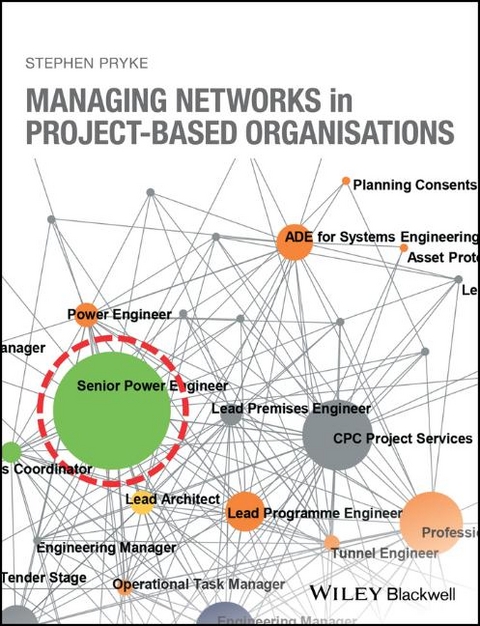
Managing Networks in Project-Based Organisations
Wiley-Blackwell (Verlag)
978-1-118-92992-6 (ISBN)
The first book demonstrating how to apply the principles of social network analysis to managing complex projects
This groundbreaking book gets project managers and students up to speed on state-of-the-art applications of social network analysis (SNA) for observing, analysing, and managing complex projects. Written by an expert at the leading edge of the SNA project management movement, it clearly demonstrates how the principles of social network analysis can be used to provide a smarter, more efficient, holistic approach to managing complex projects.
Project managers, especially those tasked with managing large, complex construction and engineering projects, traditionally have relied upon analysis and decision-making based upon hierarchical structures and vaguely defined project systems, much of which is borrowed from historic scientific management approaches. However, it has become apparent that a more sophisticated methodology is required for observing project systems and managing relationships with today’s more knowledgeable and demanding clients. Social network analysis (SNA) provides just such an approach. Unfortunately, existing books on social network analysis are written primarily for sociologists and mathematicians, with little or no regard for the needs of project managers — until now. The first and only book of its kind, Managing Networks in Project-Based Organisations:
Offers a framework and a fully-developed approach to applying SNA theory and methodologies to large, complex projects
Describes highly effective strategies and techniques for managing the iterative and transient relationships between network-defining actor roles involved in the delivery of complex projects
Uses numerous real-world examples and case studies of successful applications of SNA to large-scale construction and engineering projects around the world
Draws on its author’s decades of experience managing complex projects for demanding clients, as well as his extensive academic research in Project Management
Managing Networks in Project-Based Organisations is an important working resource for project management professionals and consultants, especially those serving the construction and engineering industries. It is also an excellent text/reference for postgraduate students of project management and supply chain management, as well as academic researchers of project management.
Stephen Pryke, FRICS, MSc, PhD, PGCertEd, DipS, MCMI, is Professor of Supply Chain and Project Networks, Course Director of the MSc Project and Enterprise Management and Director of Postgraduate Teaching and Learning at University College London. He is also the Director of the Centre for Organisational Network Analysis (CONA@UCL). He has provided project management training and consultancy to a number of major European companies and has been a consultant with Durland Consulting in Chicago, a management consultant specialising in social network analysis.
List of Figures xi
About the Author xiii
Preface xv
Acknowledgements xvii
1 Introduction 1
Structure of the Book 2
2 Theoretical Context 11
Management Context 11
Project Transitions 12
Project Management as Practice 12
Systems Theory and Networks 13
Transient Relationships 13
Dyadic Contractual Relationships and Structure 14
Permanent and Temporary Organising 15
Structure and Networks 16
Information Classification 16
Nodes and Linkages 17
Summary 18
3 Networks and Projects 21
Definition 22
Origins and History of the Concept of Social Networks and their Analysis 22
Problems with Projects 24
Actor Role Classification and Ritualistic Behaviour 25
Routines 26
Are Networks a Response to Uncertainty in Projects? 27
Temporary Project Systems and their Replication 28
Beyond the ‘Iron Triangle’ 28
Why Networks? 30
Individuals and Firms in Networks 32
Problems Associated with the Use of SNA in Project Research 32
Summary 33
4 Why Networks? 35
Definition 36
Why Choose Social Network Analysis? 36
Problems Associated with the Use of SNA in Project Research 37
Concepts and Terminology 38
Defining the Population for the Study 46
What is a Network? 46
Actor Characteristics 47
Network Characteristics 55
Some Final Thoughts 56
Conclusion 58
5 Self‐Organising Networks in Projects 61
Introduction 61
What Do Project Clients Want? 63
Dangerous Assumptions 66
Implications if these Assumptions are Incorrect 69
Networks and Uncertainty 70
Does it Matter How We Conceptualise the Project? 70
Procurement Through Markets and Hierarchies; Project Design and Delivery Through Networks 71
Summary and Conclusions 73
6 Game Theory and Networks 77
Introduction 77
To Begin: Some History 78
What is a Game? 79
Key Assumptions 83
Benefits of Applying Game Theory to Project Networks 85
Other Considerations in Applying Game Theory to Project Networks 85
Choices About Actions and Co‐Players 86
NashEquilibrium 88
Anti‐Coordination Behaviour: ‘Hawk–Dove’ and ‘Chicken’ Games 89
Game Theory and Information Exchange Network Formation 89
Game Theory and the Five Dangerous Assumptions in Projects 90
Summary and Conclusions 93
7 Network Roles and Personality Types 95
Network Roles 98
Personality Traits 104
Humour and Behaviour in Networks 104
Profiling an Ideal Project Network Actor 109
Specific Personality Traits 109
Network Roles and Personality Traits 113
Summary 115
8 Network Enabling 117
What Do We Mean by Network Enabling? 117
Trust 119
Empathy 120
Reciprocity, Favours and Psychological Contracts 123
Implications of Violation of Psychological Contracts 124
Generosity 126
Characteristics ofIndividuals that are Destructive for Networks 128
Narcissism 129
Egotism 130
Summary 131
9 Project Networks and Building Information Modelling 133
BIM Origins 133
Building Information Modelling and Information Management 134
Information Management and Organisation Structure 135
BIM as an Artefact 135
Self‐Organising Networks in the Context of Design 137
BIM and Networks: A Research Agenda 139
10 Introduction to the Case Studies 143
Technical Overview of Case Studies 143
Research Funding 146
Summary 146
11 Case Study 1: Communities in Self‐Organising Project Networks 147
Data Collection 148
Data Analysis 150
Findings 150
Communities in Self‐Organising Project Networks 152
Summary 154
12 Case Study 2: Dysfunctional Prominence in Self‐Organising Project Networks 157
Data Collection 157
Data Analysis 158
Actor Prominence Measures 158
Organisational Networks 160
Summary 162
13 Case Study 3: Costing Networks 165
Conceptual Framework 165
Network Costs 166
Data Analysis 167
Summary 168
14 Summary and Conclusions 171
Introduction 171
Chapter Summaries 171
Conclusions 177
Appendix 181
References 183
Index 207
| Erscheinungsdatum | 28.09.2017 |
|---|---|
| Verlagsort | Hoboken |
| Sprache | englisch |
| Maße | 170 x 239 mm |
| Gewicht | 476 g |
| Themenwelt | Technik ► Bauwesen |
| Technik ► Elektrotechnik / Energietechnik | |
| Wirtschaft ► Betriebswirtschaft / Management | |
| ISBN-10 | 1-118-92992-6 / 1118929926 |
| ISBN-13 | 978-1-118-92992-6 / 9781118929926 |
| Zustand | Neuware |
| Informationen gemäß Produktsicherheitsverordnung (GPSR) | |
| Haben Sie eine Frage zum Produkt? |
aus dem Bereich