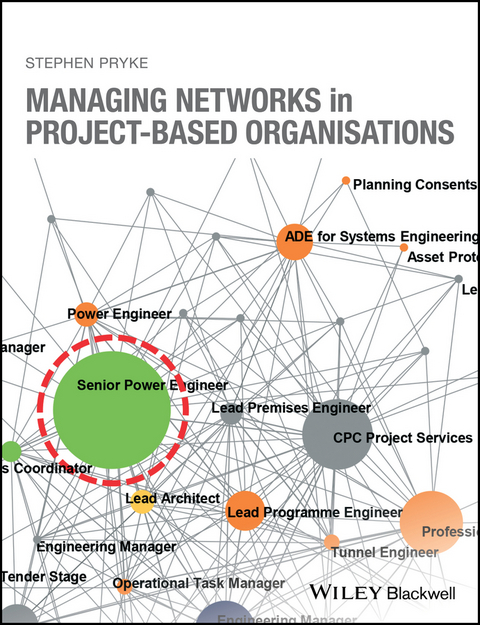
Managing Networks in Project-Based Organisations (eBook)
John Wiley & Sons (Verlag)
978-1-118-92990-2 (ISBN)
The first book demonstrating how to apply the principles of social network analysis to managing complex projects
This groundbreaking book gets project managers and students up to speed on state-of-the-art applications of social network analysis (SNA) for observing, analysing, and managing complex projects. Written by an expert at the leading edge of the SNA project management movement, it clearly demonstrates how the principles of social network analysis can be used to provide a smarter, more efficient, holistic approach to managing complex projects.
Project managers, especially those tasked with managing large, complex construction and engineering projects, traditionally have relied upon analysis and decision-making based upon hierarchical structures and vaguely defined project systems, much of which is borrowed from historic scientific management approaches. However, it has become apparent that a more sophisticated methodology is required for observing project systems and managing relationships with today's more knowledgeable and demanding clients. Social network analysis (SNA) provides just such an approach. Unfortunately, existing books on social network analysis are written primarily for sociologists and mathematicians, with little or no regard for the needs of project managers - until now. The first and only book of its kind, Managing Networks in Project-Based Organisations:
- Offers a framework and a fully-developed approach to applying SNA theory and methodologies to large, complex projects
- Describes highly effective strategies and techniques for managing the iterative and transient relationships between network-defining actor roles involved in the delivery of complex projects
- Uses numerous real-world examples and case studies of successful applications of SNA to large-scale construction and engineering projects around the world
- Draws on its author's decades of experience managing complex projects for demanding clients, as well as his extensive academic research in Project Management
Managing Networks in Project-Based Organisations is an important working resource for project management professionals and consultants, especially those serving the construction and engineering industries. It is also an excellent text/reference for postgraduate students of project management and supply chain management, as well as academic researchers of project management.
Stephen Pryke, FRICS, MSc, PhD, PGCertEd, DipS, MCMI, is Course Director of the MSc Project and Enterprise Management and Director of Postgraduate Teaching and Learning at University College London. He is also the Director of the Centre for Organisational Network Analysis (CONA@UCL). He has provided project management training and consultancy to a number of major European companies and has been a consultant with Durland Consulting in Chicago, a management consultant specialising in social network analysis.
The first book demonstrating how to apply the principles of social network analysis to managing complex projects This groundbreaking book gets project managers and students up to speed on state-of-the-art applications of social network analysis (SNA) for observing, analysing, and managing complex projects. Written by an expert at the leading edge of the SNA project management movement, it clearly demonstrates how the principles of social network analysis can be used to provide a smarter, more efficient, holistic approach to managing complex projects. Project managers, especially those tasked with managing large, complex construction and engineering projects, traditionally have relied upon analysis and decision-making based upon hierarchical structures and vaguely defined project systems, much of which is borrowed from historic scientific management approaches. However, it has become apparent that a more sophisticated methodology is required for observing project systems and managing relationships with today s more knowledgeable and demanding clients. Social network analysis (SNA) provides just such an approach. Unfortunately, existing books on social network analysis are written primarily for sociologists and mathematicians, with little or no regard for the needs of project managers until now. The first and only book of its kind, Managing Networks in Project-Based Organisations: Offers a framework and a fully-developed approach to applying SNA theory and methodologies to large, complex projects Describes highly effective strategies and techniques for managing the iterative and transient relationships between network-defining actor roles involved in the delivery of complex projects Uses numerous real-world examples and case studies of successful applications of SNA to large-scale construction and engineering projects around the world Draws on its author s decades of experience managing complex projects for demanding clients, as well as his extensive academic research in Project Management Managing Networks in Project-Based Organisations is an important working resource for project management professionals and consultants, especially those serving the construction and engineering industries. It is also an excellent text/reference for postgraduate students of project management and supply chain management, as well as academic researchers of project management.
Stephen Pryke, FRICS, MSc, PhD, PGCertEd, DipS, MCMI, is Professor of Supply Chain and Project Networks, Course Director of the MSc Project and Enterprise Management and Director of Postgraduate Teaching and Learning at University College London. He is also the Director of the Centre for Organisational Network Analysis (CONA@UCL). He has provided project management training and consultancy to a number of major European companies and has been a consultant with Durland Consulting in Chicago, a management consultant specialising in social network analysis.
List of Figures xi
About the Author xiii
Preface xv
Acknowledgements xvii
1 Introduction 1
Structure of the Book 2
2 Theoretical Context 11
Management Context 11
Project Transitions 12
Project Management as Practice 12
Systems Theory and Networks 13
Transient Relationships 13
Dyadic Contractual Relationships and Structure 14
Permanent and Temporary Organising 15
Structure and Networks 16
Information Classification 16
Nodes and Linkages 17
Summary 18
3 Networks and Projects 21
Definition 22
Origins and History of the Concept of Social Networks and their Analysis 22
Problems with Projects 24
Actor Role Classification and Ritualistic Behaviour 25
Routines 26
Are Networks a Response to Uncertainty in Projects? 27
Temporary Project Systems and their Replication 28
Beyond the 'Iron Triangle' 28
Why Networks? 30
Individuals and Firms in Networks 32
Problems Associated with the Use of SNA in Project Research 32
Summary 33
4 Why Networks? 35
Definition 36
Why Choose Social Network Analysis? 36
Problems Associated with the Use of SNA in Project Research 37
Concepts and Terminology 38
Defining the Population for the Study 46
What is a Network? 46
Actor Characteristics 47
Network Characteristics 55
Some Final Thoughts 56
Conclusion 58
5 Self?]Organising Networks in Projects 61
Introduction 61
What Do Project Clients Want? 63
Dangerous Assumptions 66
Implications if these Assumptions are Incorrect 69
Networks and Uncertainty 70
Does it Matter How We Conceptualise the Project? 70
Procurement Through Markets and Hierarchies; Project Design and Delivery Through Networks 71
Summary and Conclusions 73
6 Game Theory and Networks 77
Introduction 77
To Begin: Some History 78
What is a Game? 79
Key Assumptions 83
Benefits of Applying Game Theory to Project Networks 85
Other Considerations in Applying Game Theory to Project Networks 85
Choices About Actions and Co?]Players 86
Nash Equilibrium 88
Anti?]Coordination Behaviour: 'Hawk-Dove' and 'Chicken' Games 89
Game Theory and Information Exchange Network Formation 89
Game Theory and the Five Dangerous Assumptions in Projects 90
Summary and Conclusions 93
7 Network Roles and Personality Types 95
Network Roles 98
Personality Traits 104
Humour and Behaviour in Networks 104
Profiling an Ideal Project Network Actor 109
Specific Personality Traits 109
Network Roles and Personality Traits 113
Summary 115
8 Network Enabling 117
What Do We Mean by Network Enabling? 117
Trust 119
Empathy 120
Reciprocity, Favours and Psychological Contracts 123
Implications of Violation of Psychological Contracts 124
Generosity 126
Characteristics of Individuals that are Destructive for Networks 128
Narcissism 129
Egotism 130
Summary 131
9 Project Networks and Building Information Modelling 133
BIM Origins 133
Building Information Modelling and Information Management 134
Information Management and Organisation Structure 135
BIM as an Artefact 135
Self?]Organising Networks in the Context of Design 137
BIM and Networks: A Research Agenda 139
10 Introduction to the Case Studies 143
Technical Overview of Case Studies 143
Research Funding 146
Summary 146
11 Case Study 1: Communities in Self?]Organising Project Networks 147
Data Collection 148
Data Analysis 150
Findings 150
Communities in Self?]Organising Project Networks 152
Summary 154
12 Case Study 2: Dysfunctional Prominence in Self?]Organising Project Networks 157
Data Collection 157
Data Analysis 158
Actor Prominence Measures 158
Organisational Networks 160
Summary 162
13 Case Study 3: Costing Networks 165
Conceptual Framework 165
Network Costs 166
Data Analysis 167
Summary 168
14 Summary and Conclusions 171
Introduction 171
Chapter Summaries 171
Conclusions 177
Appendix 181
References 183
Index 207
1
Introduction
Project management theory, and to some extent practice, have tended to focus on process, systems and documents. But projects are instigated, designed and delivered by human beings. This book focuses on the people involved in projects. It conceptualises the project as a social network, or more accurately, multiple layers of social networks, each network dedicated to the delivery of a particular project function. One of the exciting discoveries during the research that this book draws upon was the importance of self‐organising project networks, particularly in complex projects. In this book, I explore some of the factors that affect the behaviour of individuals as project actors, including game theory and personality type. I also consider the environmental and personal attributes that might enable networks to function more effectively, particularly in the context of the project. I look at Building Information Modelling (BIM), because there is an important link between the efforts being made in relation to BIM, and social networks. Finally, the book presents some case study material related to a two‐year research project which I led involving the Centre for Organisational Network Analysis and Transport for London.
The previous book in this series – Social Network Analysis in Construction (Pryke, 2012) – presented social network analysis (SNA) as an innovative method for the analysis of project organisations. It rationalised the SNA approach, looked at the importance of collaborative relationships in project organisations and proposed a theoretical framework to support the conceptualisation of the project as a network of relationships – contracts, information flows and financial incentives. The book proposed a model for the use of SNA which others might adopt in their research and presented four case studies, comparing collaborative, relationship‐based procurement and traditional strategies for procurement. The book provided an insight into the interpretation of network data derived from project‐based organisations and finally took a somewhat speculative look at how networks might be managed.
It was the chapter on managing networks that was in my view the most innovative, and Managing Networks aims to develop that theme using case study material gathered from recent research carried out at the Centre for Organisational Network Analysis at University College London (CONA@UCL). The raison d’être of CONA is to explore the void that is evident between procurement, systems and organisational hierarchies.
In our projects, we set about procuring resources, place those resources in structures that are often expressed either hierarchically or to a high level of abstraction, and then try to manage the self‐organising networks of human relationships that evolve, without conceptualising those relationships as networks. It is little wonder that we often find it difficult to analyse why some projects seem to be successful and others less so. A small group of those associated with CONA@UCL set about trying to classify, and to some extent quantify, organisationally, the ‘good’ projects and the ‘bad’ projects, using the language of the social network analysts. Examples of this work are: Badi and Pryke (2006), Badi et al. (2014), Badi et al. (2016a and 2016b), Doloi et al. (2016), Pryke et al. (2017), Pryke et al. (2015a and 2015b), Pryke (2014), Pryke et al. (2014), Pryke et al. (2013), Pryke and Badi (2013), Shepherd and Pryke (2014), El‐Sheikh and Pryke (2010), Pryke (2005a and 2005b), Pryke and Pearson (2006).
So, this book aims to respond to the needs of several groups: those who ask what the social network theory of project organisations is; the practitioners who ask ‘how can I use social network analysis to run smarter projects’; the students who ask how we can start teaching project management in a way that helps them to identify network and actor characteristics – to classify project coalition activity and the actors involved in network terms and to start to build toward defining management in a project‐based environment in network terms.
The analysis and representation or visualisation of project‐focused activity has involved task‐dependency‐based approaches, structural analysis (hierarchical) and process mapping, all of which fail to reflect the relationships that deliver our projects – relationships that we can classify by project function.
Structure of the Book
Chapter 2: Theoretical Context This chapter locates the concept of managing networks within a context of managing projects and their supply chains. A number of assumptions have been made about the nature of projects around which procurement and project management practices have evolved. I argue in Chapter 2 that our choice of procurement and the subsequent project management strategies applied have not kept pace with the complexity of many projects. It is also argued that at the point where procurement is completed (and resources identified and secured) a transition occurs where those resources have to configure themselves into systems that will deliver a successful project. We know little of how these self‐organising systems evolve. Our lack of awareness means that we typically do not facilitate or manage these systems.
The chapter reflects on the vestiges of scientific management that still remain in project management research and practice. The fact that our projects are delivered by unpredictable, sometimes irrational, imperfect human beings seems sometimes to be ignored in our discussion about programming, risk management and the whole range of sub‐systems that we typically bring together in project management. The chapter concludes by pointing to the fact that our highly‐connected lives no longer rely on distinguishing task and social structure. Human beings essentially get things done through links to other human project actors. The idea that everything that does not constitute a formal direction or instruction under the terms of the contract should be classified as ‘informal’ is firmly rejected. There has, perhaps, been some confusion between informal and recreational ties. Although recreational ties are undoubtedly fascinating and important, this book does not deal with them.
The chapter provides a context and perhaps rationale for the chapters that follow. The key themes are developed in more depth in these subsequent chapters.
Chapter 3: Networks and Projects This chapter starts with the reflection that the last fifty years have brought only modest progress in our understanding of ‘systems… functions…interrelationships, and the location and prominence of…control and coordination centres’ (Higgin and Jessop, 1965: 56). In fact many of the techniques that we use to manage projects seem to ignore all of these issues. The chapter makes a start on the formulation of sub‐systems that might be studied to enable a better understanding of how projects are really managed. The concepts of ritualistic behaviour and routines are introduced and I reflect on the fact that individuals are attracted to routines because they provide consistency and stability, and reduce mental effort (Becker, 2004).
This chapter refers to Morris’ (2013) discussions about the maturity of project definition, or more accurately the tendency for project definition frequently to be insufficiently mature at the point of transition between pre‐ and post‐contract stages. The idea that this uncertainty, exacerbated by continually increasing complexity, leads to project actors forming networks to secure information, solve problems and disseminate processed information is introduced and rationalised. It is argued that at the transition from resource procurement to project delivery, routines are not adequate in the face of complexity in both task and structure. I ask the reader to move on from discussions about the ‘iron triangle’ for the reasons that: it is very difficult to define client needs at a stage early enough to use procurement successfully; it is difficult to avoid agency problems in procurement and delivery; and, arguably, change in project definition improves value to client and end‐users, rather than the reverse. It is not possible to allocate project and supply chain roles accurately and to maintain these roles as a constant throughout the entire project design and delivery period. Project systems are iterative and transient and this is to a great extent not reflected in the contractual relationships established through many procurement approaches.
The chapter provides an introduction to project actor characteristics (drawn from Pryke, 2012), and an overview is given of network characteristics (path lengths and density) and linkage characteristics (tie strength or value and direction). The chapter ends with a reflection on the question posed – why networks? – and makes a link to Chapter 4. The chapter concludes that the identification and analysis of interaction networks between the individuals engaged to deliver a project is the only way to observe the self‐organising, complex project function‐related networks that hold the key to understanding successful and unsuccessful project delivery. If we can understand and map these networks, we can define the actor roles and network configurations that constitute...
| Erscheint lt. Verlag | 6.7.2017 |
|---|---|
| Sprache | englisch |
| Themenwelt | Technik ► Bauwesen |
| Technik ► Elektrotechnik / Energietechnik | |
| Wirtschaft ► Betriebswirtschaft / Management ► Projektmanagement | |
| Schlagworte | Baubetrieb • Bauingenieur- u. Bauwesen • Business & Management • Civil Engineering & Construction • Construction Management • Electrical & Electronics Engineering • Elektrotechnik u. Elektronik • game theory and networks for project management • Managing construction projects • managing engineering projects • managing infrastructure projects • networks and projects • Program & Project Management • Programm- u. Projektmanagement • Project Management • project management analysis • project management approaches • Project Management Case Studies • Project management methods • Project Management Techniques • project networks and BIM • Projektmanagement • self-organising networks in projects • social network analysis for managing supply chains • social network analysis for project management • social network analysis for project management examples • social network analysis in construction project management • social network analysis in infrastructure project analysis • social networking analysis • Supply Chain Analysis • Supply Chain Management • what is social network analysis • Wirtschaft u. Management |
| ISBN-10 | 1-118-92990-X / 111892990X |
| ISBN-13 | 978-1-118-92990-2 / 9781118929902 |
| Informationen gemäß Produktsicherheitsverordnung (GPSR) | |
| Haben Sie eine Frage zum Produkt? |
 EPUB (Adobe DRM)
Kopierschutz: Adobe-DRM
Adobe-DRM ist ein Kopierschutz, der das eBook vor Mißbrauch schützen soll. Dabei wird das eBook bereits beim Download auf Ihre persönliche Adobe-ID autorisiert. Lesen können Sie das eBook dann nur auf den Geräten, welche ebenfalls auf Ihre Adobe-ID registriert sind.
Details zum Adobe-DRM
Dateiformat: EPUB (Electronic Publication)
EPUB ist ein offener Standard für eBooks und eignet sich besonders zur Darstellung von Belletristik und Sachbüchern. Der Fließtext wird dynamisch an die Display- und Schriftgröße angepasst. Auch für mobile Lesegeräte ist EPUB daher gut geeignet.
Systemvoraussetzungen:
PC/Mac: Mit einem PC oder Mac können Sie dieses eBook lesen. Sie benötigen eine
eReader: Dieses eBook kann mit (fast) allen eBook-Readern gelesen werden. Mit dem amazon-Kindle ist es aber nicht kompatibel.
Smartphone/Tablet: Egal ob Apple oder Android, dieses eBook können Sie lesen. Sie benötigen eine
Geräteliste und zusätzliche Hinweise
Buying eBooks from abroad
For tax law reasons we can sell eBooks just within Germany and Switzerland. Regrettably we cannot fulfill eBook-orders from other countries.
aus dem Bereich