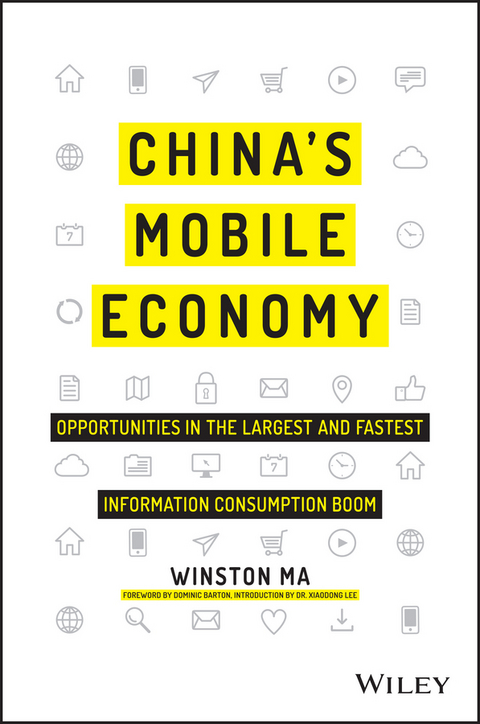
China's Mobile Economy (eBook)
John Wiley & Sons (Verlag)
978-1-119-12724-6 (ISBN)
China's Mobile Economy: Opportunities in the Largest and Fastest Information Consumption Boom is a cutting-edge text that spotlights the digital transformation in China. Organised into three major areas of the digital economy within China, this ground-breaking book explores the surge in e-commerce of consumer goods, the way in which multi-screen and mobile Internet use has increased in popularity, and the cultural emphasis on the mobile Internet as a source of lifestyle- and entertainment-based content. Targeted at the global business community, this lucid and engaging text guides business leaders, investors, investment banking professionals, corporate advisors, and consultants in grasping the challenges and opportunities created by China's emerging mobile economy, and its debut onto the global stage.
Year 2014-15 marks the most important inflection point in the history of the internet in China. Almost overnight, the world's largest digitally-connected middle class went both mobile and multi-screen (smart phone, tablets, laptops and more), with huge implications for how consumers behave and what companies need to do to successfully compete. As next-generation mobile devices and services take off, China's strength in this arena will transform it from a global 'trend follower' to a 'trend setter.'
- Understand what the digital transformation in China is, and impact on global capital markets, foreign investors, consumer companies, and the global economy as a whole
- Explore the e-commerce consumption boom in the context of the Chinese market
- Understand the implications of the multi-screen age and mobile Internet for China's consumers
- See how mobile Internet use, its focus on lifestyle and entertainment is aligned with today's Chinese culture
- Learn about the mobile entertainment habits of China's millennial generation and the corresponding new advertisement approaches
The development of China's mobile economy is one of the most important trends that will reshape the future of business, technology and society both in China and the world. China's Mobile Economy: Opportunities in the Largest and Fastest Information Consumption Boom introduces you to the digital transformation in China, and explains how this transformation has the potential to transform both China and the global consumer landscape.
WINSTON WENYAN MA is a Managing Director of China Investment Corporation (CIC), the sovereign wealth fund of China, with a focus on long-term investments in large-scale concentrated positions. Since joining CIC in 2008, he has held leadership roles in major direct transactions involving natural resources, financial services and high-tech sectors. Prior to joining CIC, he served as the Deputy Head of Equity Capital Markets at Barclays Capital. Previously, he was a Vice President at J.P. Morgan investment banking, and a corporate lawyer at Davis Polk & Wardwell LLP and Freshfields. He is the author of the bestsellingbook Investing in China: New Opportunities in a Transforming Stock Market (Risk Books, 2006) and has been widely quoted in global financial media. Winston was selected as a 2013 Young Global Leader at the World Economic Forum (WEF) and in 2014 he received the Distinguished Alumni Award from NYU.
Explore the world-changing digital transformation in China China's Mobile Economy: Opportunities in the Largest and Fastest Information Consumption Boom is a cutting-edge text that spotlights the digital transformation in China. Organised into three major areas of the digital economy within China, this ground-breaking book explores the surge in e-commerce of consumer goods, the way in which multi-screen and mobile Internet use has increased in popularity, and the cultural emphasis on the mobile Internet as a source of lifestyle- and entertainment-based content. Targeted at the global business community, this lucid and engaging text guides business leaders, investors, investment banking professionals, corporate advisors, and consultants in grasping the challenges and opportunities created by China's emerging mobile economy, and its debut onto the global stage. Year 2014-15 marks the most important inflection point in the history of the internet in China. Almost overnight, the world s largest digitally-connected middle class went both mobile and multi-screen (smart phone, tablets, laptops and more), with huge implications for how consumers behave and what companies need to do to successfully compete. As next-generation mobile devices and services take off, China s strength in this arena will transform it from a global trend follower to a trend setter. Understand what the digital transformation in China is, and impact on global capital markets, foreign investors, consumer companies, and the global economy as a whole Explore the e-commerce consumption boom in the context of the Chinese market Understand the implications of the multi-screen age and mobile Internet for China's consumers See how mobile Internet use, its focus on lifestyle and entertainment is aligned with today's Chinese culture Learn about the mobile entertainment habits of China s millennial generation and the corresponding new advertisement approaches The development of China s mobile economy is one of the most important trends that will reshape the future of business, technology and society both in China and the world. China's Mobile Economy: Opportunities in the Largest and Fastest Information Consumption Boom introduces you to the digital transformation in China, and explains how this transformation has the potential to transform both China and the global consumer landscape.
WINSTON WENYAN MA is a Managing Director of China Investment Corporation (CIC), the sovereign wealth fund of China, with a focus on long-term investments in large-scale concentrated positions. Since joining CIC in 2008, he has held leadership roles in major direct transactions involving natural resources, financial services and high-tech sectors. Prior to joining CIC, he served as the Deputy Head of Equity Capital Markets at Barclays Capital. Previously, he was a Vice President at J.P. Morgan investment banking, and a corporate lawyer at Davis Polk & Wardwell LLP and Freshfields. He is the author of the bestselling book Investing in China: New Opportunities in a Transforming Stock Market (Risk Books, 2006) and has been widely quoted in global financial media. Winston was selected as a 2013 Young Global Leader at the World Economic Forum (WEF) and in 2014 he received the Distinguished Alumni Award from NYU.
Foreword xi
Preface xv
Acknowledgments xxiii
About the Author xxvii
Introduction 1
Chapter 1 The World's Biggest Mobile Economy 5
Chapter 2 Users, Partners, Investors and Competitors: Global Stakeholders 37
Chapter 3 Xiaomi: The Most Valuable Start-up in China 67
Chapter 4 The Omni-Channel Age of e-Retailing 97
Chapter 5 Mobile e-Commerce and Online-to-Offline (O2O) 127
Chapter 6 Mobile Entertainment 159
Chapter 7 "Internet+" Movies 189
Chapter 8 Internet Finance 221
Chapter 9 Going Overseas: A Bumpy Road 253
Chapter 10 Launched in China 279
Bibliography 313
Index 331
Every company - and every country - must succeed at digitalization to compete successfully in the 21st century. Winston Ma delivers a rare book that is both an outstanding survey of a fast-changing and vitally important economic landscape and a delightful 'field guide' that will enrich your understanding of what's really happening on the ground."
--Dominic Barton, Global Managing Partner, McKinsey and Company
"Winston has written a first of its kind - a timely, insightful and eminently readable analyses of the world's fastest growing mobile economy. A must-read for anyone interested in China, the mobile economy, or technology, more broadly. Eye-opening and thoroughly enjoyable."
--Reuben Jeffery III, President and CEO, Rockefeller & Co., Inc.
"China is determined to make innovation an engine for the next stage of the country's development, and no sector has been more creative or dynamic than the mobile economy, which in some areas has surpassed even the United States. Winston Ma's deep dive into this fiercely competitive, constantly evolving industry dissects the companies, personalities and forces that are transforming China and that will inevitably influence commerce far beyond its shores."
--John L. Thornton, Co-Chairman, Brookings Institution
"As the world moves to mobile technologies, and with China now the world's largest market of Internet users, all stakeholders have to think about China's economy, market, and society from a completely new perspective. This is an indispensable book for understanding the emerging shape and scale of opportunities in the Middle Kingdom and beyond."
--Rod Beckstrom, Co-Author of The Starfish and the Spider; Former President and CEO, ICANN
"Chinese society is experiencing a rapid transformation, becoming increasingly industrialized and digital-based. The Chinese Internet population has officially entered into the age of mobile Internet. This extraordinary book explains how the Internet has been the engine that catapults commercial activities from offline to online and towards ubiquity."
--Xiaodong Lee, President & CEO, China Internet Network Information Center (CNNIC)
Preface
For China, the years 2014 to 2015 were the most important inflection point in the history of the internet, as the Chinese internet population officially entered the mobile internet and multi-screen age (with smartphones, tablets, personal computers and more). During this incredible period of change, the mobile internet in China gave rise to a dynamic tech sector, thriving social networks and the world's largest digitally connected middle income class. The development of China's mobile economy is one of the most important trends that will reshape the future of business, technology and society, both in China and the world.
Of course, the mobile transformation of China's economy has also had profound implications for global stakeholders dealing with the Chinese market. During China's digital boom, foreign investors are richly rewarded, and consumer goods companies see an emerging market filled with opportunities from an expanding middle class. Overseas users are cautiously adopting smartphones and mobile apps created in China, but Silicon Valley tech giants are taking notice of new competition arising from Asia. This book intends to provide a cutting-edge overview of this digital transformation in China as well as its global impact.
Chapter 1 will provide an overview of China's macro economy and the important government policy drivers behind the digital economy growth, such as urbanization, information consumption, smart cities, as well as internet plus, which is essentially the sum of it all.
This opening chapter will also introduce the big three “BAT” companies, Baidu, Alibaba and Tencent. These companies have respectively dominated the three strategic areas of the mobile market, namely the online search, e-commerce, and social network and messaging service in China. At this time of market inflection, these three key players are becoming more open-minded and proactive in moving into new areas through expansion, acquisition and strategic cooperation. Their impact can also be felt overseas by foreign investors, consumers, products users, start-ups and industry companies across the globe.
While the BAT companies strive to maintain their dominance over the digital high ground, many other Chinese firms are becoming strong players in the mobile market as well. Some of them have reached a significant size, and they come to the battlefield with unique strengths from different origins, such as Xiaomi (smartphone/hardware), LeTV (media content), Lenovo (PC/smartphone), Huawei (network/smartphone) and ZTE (telecom/smartphone). In addition, there are countless start-ups being formed every day by entrepreneurs eager to become the next Robin Li, Jack Ma or Pony Ma (the three founders of BAT, respectively).
The partnership, competition and cross-investments among these players of different traditional strengths, corporate scales and market focuses have made the mobile market extremely active and dynamic. As illustrated by the online shopping extravaganza and digital retailing revolution, the successful business models in the mobile era aim to integrate the four “Cs” seamlessly: Context, Community, Content, and Connection (see Figure P.1). As a result, the mobile internet and social networks are making a profound impact on productivity and growth in many parts of the economy. This chapter will briefly list some examples in the entertainment and media, retail and finance sectors, which will be discussed in detail in later chapters relating to corresponding business areas.
Figure P.1 The Four “Cs” in the Mobile Economy
Chapter 2 will cover the various global stakeholders and the new opportunities and challenges they are experiencing. In particular, the “going mobile” and “internet plus” trends are critical for the foreign companies heading to China in search of their slice of the digital economy pie. In this fast-changing market, even for multinational corporations that have done business in China for many decades, a comprehensive rethink of their strategies in China may be necessary. Meanwhile, the mobile infrastructure opens up new opportunities to foreign merchants who do not have or need to have, a physical presence in China. To a large extent, mastering mobile internet strategy will separate the winners from the rest of the pack in their competition for Chinese customers.
Chapter 3 is centered on Xiaomi, the highest valued start-up in China. Focusing on a niche passed up on by premium brands like Apple and Samsung, the Chinese brands like Xiaomi, Huawei and Lenovo have mainly offered low price, high performance devices, which have played well into the general Chinese population's desire to own a smartphone and to access the internet for the first time. As China's smartphone market started showing early signs of saturation in 2015, Xiaomi (and its competitors) is striving to innovate its business model and product offerings to become a true “internet company” instead of a pure “smartphone company”.
Chapter 4 starts the “internet plus” discussion with digital retailing. The online retailers have expanded so rapidly that the shopping malls, also a recent development in China, have already had their business disrupted by the new technology. The traditional retailers need to move away from the perception that e-commerce is merely another sales channel for their products, as it is critical for customers to get the same products, services and shopping experience in every channel where they choose to make purchases. As illustrated by the Alibaba/Suning alliance and the JD/Yonghui investment, the mobile era retailers have to integrate their online and offline channels, instead of having separate systems to sell products online and offline.
Chapter 5 carries the digital retailing discussion into mobile e-commerce territory and the broader online-to-offline (O2O) service consumption. The growth in “experience” consumption, such as movie-going, dining out, taxi-hailing and so on, is at the core of the O2O trends in China. The future e-commerce model – if the term e-commerce still applies here – is likely to be a seamless platform that links customers across multiple screens of mobile devices, providing standardized products as well as specialized goods and experience offerings, and connecting online content with offline activities.
Chapter 6 explores the mobile entertainment sector, which is of strategic importance for the internet giants’ digital empires. This is because entertainment content and services are not only an important revenue source by themselves, but also a distinguishing factor that draws users to any specific e-commerce ecosystem and keeps them hooked. For a large part of their time online, young netizens play online games, watch videos of TV programs and movies, assume online personas in the virtual world and form online communities to have fun together. As smartphones are becoming the top channel for internet access in China, they enjoy themselves whenever and wherever they are during their “fragmented time” throughout the day (i.e. the time they spend online while outside of their homes).
It is important to note that “fragmented time” creates a different and additional demand for entertainment content. For example, online novels can be read on mobile devices anywhere and anytime, which not only leads to a disruption of the physical book market, but also creates a different experience from traditional book reading (hence new readers). As such, the mobile internet provides a new avenue for marketing, advertising and brand building, with the biggest growth potential from people in smaller cities, who may not have PCs but are now engaging with online entertainment content using their smart devices.
Chapter 7 discusses the application of the O2O model in the movie business, which has added an online DNA to the traditional film industry. To meet the quest for high quality content, the tech giants are not only betting on set-top boxes (devices that provide contents over the internet and bypass traditional distribution) to convert TV and theater viewers to online viewing, but also creating their own blockbuster movies for the big screen at offline cinemas. The mobile internet has empowered young movie fans to get intimately involved with a movie, from the beginning to the end of a movie's life cycle. While traditional production companies face new competition, the industry has experienced soaring movie box office receipts thanks to the new social network, crowdfunding and big data. The so-called So-Lo-Mo trends (“Social-Local-Mobile”) are bringing new challenges and opportunities for both Hollywood and Chinese movie studios in the digital age.
As one would expect, the internet giants have quickly evolved into media companies. The same has also happened in dining services, car-hailing and other sectors. Because every major firm's goal is to create a “closed loop” of its own, the companies are increasingly in competition with one another. As many players race to offer services at below cost to compete for users, the market is starting to have doubts about the sustainability of such businesses. In fact, internet firms are taking huge bets by spending heavily on subsidies because the repeat customers may not stay when the subsidies end. The cases addressed in this book will examine whether a profitable model will eventually arise in those...
| Erscheint lt. Verlag | 7.11.2016 |
|---|---|
| Einführung | Xiaodong Lee |
| Vorwort | Dominic Barton |
| Sprache | englisch |
| Themenwelt | Wirtschaft ► Betriebswirtschaft / Management ► Finanzierung |
| Wirtschaft ► Betriebswirtschaft / Management ► Wirtschaftsinformatik | |
| Wirtschaft ► Volkswirtschaftslehre ► Mikroökonomie | |
| Schlagworte | changes to the Chinese economy • china's economy • China's Mobile Economy • China's Mobile Economy: Profiting from the Largest and Fastest Information Consumption Boom • Chinese ecommerce • Chinese economic transformation • Chinese economy • Chinese mobile Internet • ecommerce in China • Economics • Economics Special Topics • Finance & Investments • Finanz- u. Anlagewesen • Finanzwesen • mobile ecommerce in China • mobile Internet in China • Spezialthemen Volkswirtschaftslehre • the evolution of the Chinese economy • Volkswirtschaftslehre • Winston Wenyan Ma |
| ISBN-10 | 1-119-12724-6 / 1119127246 |
| ISBN-13 | 978-1-119-12724-6 / 9781119127246 |
| Informationen gemäß Produktsicherheitsverordnung (GPSR) | |
| Haben Sie eine Frage zum Produkt? |
 EPUB (Adobe DRM)
Kopierschutz: Adobe-DRM
Adobe-DRM ist ein Kopierschutz, der das eBook vor Mißbrauch schützen soll. Dabei wird das eBook bereits beim Download auf Ihre persönliche Adobe-ID autorisiert. Lesen können Sie das eBook dann nur auf den Geräten, welche ebenfalls auf Ihre Adobe-ID registriert sind.
Details zum Adobe-DRM
Dateiformat: EPUB (Electronic Publication)
EPUB ist ein offener Standard für eBooks und eignet sich besonders zur Darstellung von Belletristik und Sachbüchern. Der Fließtext wird dynamisch an die Display- und Schriftgröße angepasst. Auch für mobile Lesegeräte ist EPUB daher gut geeignet.
Systemvoraussetzungen:
PC/Mac: Mit einem PC oder Mac können Sie dieses eBook lesen. Sie benötigen eine
eReader: Dieses eBook kann mit (fast) allen eBook-Readern gelesen werden. Mit dem amazon-Kindle ist es aber nicht kompatibel.
Smartphone/Tablet: Egal ob Apple oder Android, dieses eBook können Sie lesen. Sie benötigen eine
Geräteliste und zusätzliche Hinweise
Buying eBooks from abroad
For tax law reasons we can sell eBooks just within Germany and Switzerland. Regrettably we cannot fulfill eBook-orders from other countries.
aus dem Bereich