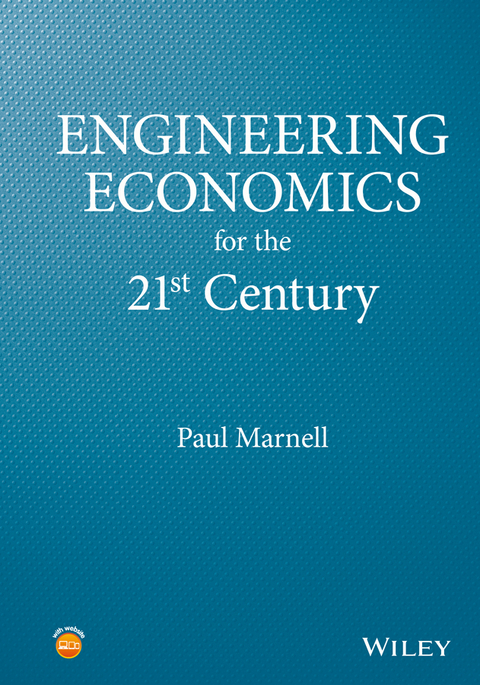
Engineering Economics for the 21st Century (eBook)
John Wiley & Sons (Verlag)
978-1-119-08543-0 (ISBN)
- Contains the 12-FACTOR Calculator, an Excel spreadsheet designed by author to provide the values of the 12 factors of engineering economics for arbitrary values of i, g ( ), and N
- Contains the ANNUAL and PRESENT WORTH COMPARISON Calculators with Component Replacements forcomparing equipment purchase quotations
- Defines quasi-simple investments and presents a Step-by-Step procedure for calculating their IRRs and balances
- Presents a classification of the four common non-simple investments and provides Step-by-Step procedures for calculating their IRRs and balances
- Compares the different profitability measures for the same investment: pretax IRR, aftertax IRR, aftertax sensitivity analysis, net present value, accounting rate of return, benefit-cost ratio, and payback period
Paul Marnell, Eng.Sc.D. (Columbia University) is an Associate Professor of Chemical Engineering at Manhattan College with 25 years of experience teaching engineering economics and chemical plant design. His doctoral thesis was 'A Theoretical Evaluation of the Persistence of Hydrodynamic Lubrication in the Hip Joint During Walking,' which was funded by Orthopedic Research Associates. Dr. Marnell attended the Oak Ridge School of (Nuclear) Reactor Technology (ORSORT) under the sponsorship of the Foster Wheeler Corporation. He has 15 years of multi-industry experience that includes: (1) Nuclear engineering positions at Foster Wheeler, Nuclear Development Associates, and Stone and Webster Engineering Corporation. (2) Interim U.S. representative for Lurgi's coal gasification process. (3) Manager of Lurgi's U.S. Environmental Projects, the first of which was the Lurgi Sulfacid plant built for the United States Steel Corporation at Neville Island, PA. (4) Consultant to and summer employee of Brookhaven National Laboratory (BNL) where he initiated their coal-water fuel program and wrote several reports and presented papers describing it.
Paul Marnell, Eng.Sc.D. (Columbia University) is an Associate Professor of Chemical Engineering at Manhattan College with 25 years of experience teaching engineering economics and chemical plant design. His doctoral thesis was "A Theoretical Evaluation of the Persistence of Hydrodynamic Lubrication in the Hip Joint During Walking," which was funded by Orthopedic Research Associates. Dr. Marnell attended the Oak Ridge School of (Nuclear) Reactor Technology (ORSORT) under the sponsorship of the Foster Wheeler Corporation. He has 15 years of multi-industry experience that includes: (1) Nuclear engineering positions at Foster Wheeler, Nuclear Development Associates, and Stone and Webster Engineering Corporation. (2) Interim U.S. representative for Lurgi's coal gasification process. (3) Manager of Lurgi's U.S. Environmental Projects, the first of which was the Lurgi Sulfacid plant built for the United States Steel Corporation at Neville Island, PA. (4) Consultant to and summer employee of Brookhaven National Laboratory (BNL) where he initiated their coal-water fuel program and wrote several reports and presented papers describing it.
Preface
Rational for the Book
Since there is a plethora of texts on engineering economics, why did I choose to write one? An historical perspective provides the answer. Eugene L. Grant wrote the first edition of his pioneering text on engineering economics in 1931, a time when engineers and students had modest mathematics training and computational tools that were limited to slide rules and tables of mathematical functions and engineering economics factors. In the ensuing years numerous texts on the subject have appeared, but the expositions in current engineering economics texts only differ from Grant's last edition in 1990 by the inclusion of topics from managerial economics. The universal reliance on tabulations of 8 of the 12 factors of engineering economics has not changed. In addition, the practice of engineering economics is still constrained by the following seven limitations of past and current engineering economics texts:
- Limited use of the important but untabulated geometric gradient series in calculations.
- The tedious use of the limited tabulated factor values in calculations.
- Using factor equations when tabulated factor values are not available.
- The tedious practice of manually preparing certain least-cost studies.
- Defining the internal rate of return IRR in Chapter 5 or 6 of a past or present text as “the interest rate earned on the unrecovered balance of an investment so that the balance is zero at the end of the investment's life.” But the meaning of “balance” is rarely referenced in the Index of a text in which this ubiquitous IRR definition occurs. Then it is stated without proof that the receipt and disbursement series are equivalent, though the concept of equivalence is often casually defined.
- Not discussing the existence of quasi-simple investments and, therefore, not providing the methods for finding their IRRs.
- Not discussing the existence of four classes of practical nonsimple investments and, therefore, not providing methods for finding their IRRs.
The goals of this text are (1) the elimination of the seven limitations of engineering economics texts and (2) enhancement of the explanations of the various profitability measures by applying them to the same investment. These goals can be achieved in a 15-week semester with three lectures per week.
To remove Limitations 1, 2, and 3, I designed the 12-FACTOR Calculator spreadsheet in Excel.1 It calculates the values of the 12-Factors for arbitrary values of i%, N, and g% when
- The 12-FACTOR Calculator provides the values of the 12-Factors for arbitrary values of i%, N, and g% when g% ≠ i%. Since some problems require factors with several values of N, the 12-FACTOR Calculator provides six input cells for them.
- The 12-FACTOR Calculator significantly reduces the computation time of problems and elevates the accuracy of their solutions by eliminating factor table lookups and minimizing reading errors.
- The 12-FACTOR Calculator eliminates the need to lookup factor equations to compute factor values that are not tabulated.
- The 12-FACTOR Calculator allows the practical use of the geometric gradient series to represent a cost component of a cost alternative or represent wholly or in part the receipt and/or disbursement series of a loan or investment.
Limitation 4 is eliminated by automating the annual or present worth least-cost studies required for the purchase of business and industrial equipment. To do so, I created the following Excel spreadsheets: ANNUAL WORTH COMPARISON Calculator with COMPONENT REPLACEMENT and the PRESENT WORTH COMPARISON Calculator with COMPONENT REPLACEMENT. They are displayed on the following page. The variables C0, l, and f% represent the initial cost, life, and annual percentage change in the cost of a component that is replaced during service time ST of the study.
The elimination of Limitation 5, the vague definition of the IRR in Chapter 5 or 6 of contemporary texts, begins on page 22 of Chapter 2. The Balance Equation is presented and explained:2
Next the General Repayment Equation (GRE) for any loan or investment is derived from Equation (1):
Hence, the present worth of a loan's principles (or an investment's disbursements) equals the present worth of the loan's payments (or an investment's receipts). That is, the two series are equivalent series.
When Equation (2) is applied to a proposed investment, everything is known except the rate of return, which is denoted by i*. Substituting the definitions for the kth cash flow CFk ≡ Rk - Dk and x ≡ 1 + i* into Equation (2) yields the General Polynomial Equation (GPE) for the unknown value of x and, hence, i*:
When we define a simple investment as an investment with one change in the signs of its cash flows, Descartes' Rule of Signs tells us and our students that there is only one positive root of the GPE. Hence, there is only one value of i* in its range of permissible values:
(A separate derivation in Chapter 6 shows that all of the intermediate balances of a simple investment are positive.)
Excel's IRR function is explained and used in Chapter 2 to find the IRR of a simple investment, and it is used in Chapter 3 to find the IRR of a spec house (a house built without a buyer) with a series of 14 monthly cash flows. The resulting monthly IRR is converted to an Annual Percentage Yield APY. The IRR function is also used in Chapter 3 to find the IRR of a proposed investment and determine a counter offer that will provide a desired IRR.
The bottom line is that finding the IRR of an investment is not based on the vague definition of the IRR in a typical contemporary text. It is precisely defined in Chapter 2 and used wherever a need for the IRR arises in the book.
Limitation 6, not recognizing the existence of quasi-simple investments, is covered in Chapter 6. A multi-simple investment is defined as a sequence of two or more simple investment patterns. The cash flow diagram of the tri-simple investment shown on the following page has three simple investment patterns. Step-by-Step 6.1 is used to determine if a multi-simple investment has a unique value of i* and positive intermediate balances. Two examples illustrate the simple calculations for finding the IRRs of bi-simple and tri-simple investments.
CFD of a Tri-Simple Investment Note: There are two negative cash flows in the first and third simple investment patterns.
Limitation 7, not providing an IRR solution strategy for the four basic nonsimple investments, is covered in the comprehensive 27-page Chapter 7. It begins with a review of the five fundamental properties of simple and quasi-simple investments. They are used to identify the properties that are not possessed by the four basic non-simple investments listed in Table 7.1.
Table 7.1 Properties of the Four Basic Non-Simple Investments
The meaning of a negative balance is explained, and the need for an external investment for the negative balances is presented. This is not new. What is new is the presentation of three easy to use Step-by-Steps for calculating the IRRs of the four classes of non-simple investments listed in Table 7.1. Chapter 7 has six numerical examples that illustrate these calculations.
Some practitioners say that non-simple investments rarely occur in practice. Table 7.2 shows that this is an overstatement.
Table 7.2 Occurrences of Non-Simple Investments
In addition to eliminating the seven limitations of contemporary engineering economics texts, this book enhances the explanations of (A) Pretax IRR, (B) Aftertax IRR, (C) Sensitivity Analysis, and (D) Other Profitability Measures by illustrating them with a common investment: a Chemical Plant Investment CPI.
TABLE 6.1 Values of the Economic Variables of a Proposed CPI
Spreadsheet 6.1 below, which is on page 136, calculates a pretax IRR% of 32.59% for the CPI.
Spreadsheet 9.1 on page 183 shows that the payment of federal and state income taxes reduces the IRR% to 23.81%, and Spreadsheet 10.2 on page 200 has a Data Table that shows how the IRR% of the CPI varies with the annual receipt R. Figure 10.1 on page 201 is the sensitivity curve for this relationship.
A Few Other Unique Features
Chapter 3 (1) Intermediate loan and investment balances are calculated recursively. (2) Spreadsheet 3.1 calculates the yearly balances and annual interests of a 30-year mortgage, and Figure 3.1 shows the variation of the normalized annual interests over the life of the...
| Erscheint lt. Verlag | 26.2.2016 |
|---|---|
| Sprache | englisch |
| Themenwelt | Technik ► Bauwesen |
| Technik ► Maschinenbau | |
| Wirtschaft ► Allgemeines / Lexika | |
| Wirtschaft ► Volkswirtschaftslehre | |
| Schlagworte | aftertax IRRs • balances • chemical engineering • Chemische Verfahrenstechnik • Economics • Industrial Engineering • Industrielle Verfahrenstechnik • Investments • irr • <p>Engineering • Maschinenbau • mechanical engineering • pretax IRRs</p> |
| ISBN-10 | 1-119-08543-8 / 1119085438 |
| ISBN-13 | 978-1-119-08543-0 / 9781119085430 |
| Informationen gemäß Produktsicherheitsverordnung (GPSR) | |
| Haben Sie eine Frage zum Produkt? |
 EPUB (Adobe DRM)
Kopierschutz: Adobe-DRM
Adobe-DRM ist ein Kopierschutz, der das eBook vor Mißbrauch schützen soll. Dabei wird das eBook bereits beim Download auf Ihre persönliche Adobe-ID autorisiert. Lesen können Sie das eBook dann nur auf den Geräten, welche ebenfalls auf Ihre Adobe-ID registriert sind.
Details zum Adobe-DRM
Dateiformat: EPUB (Electronic Publication)
EPUB ist ein offener Standard für eBooks und eignet sich besonders zur Darstellung von Belletristik und Sachbüchern. Der Fließtext wird dynamisch an die Display- und Schriftgröße angepasst. Auch für mobile Lesegeräte ist EPUB daher gut geeignet.
Systemvoraussetzungen:
PC/Mac: Mit einem PC oder Mac können Sie dieses eBook lesen. Sie benötigen eine
eReader: Dieses eBook kann mit (fast) allen eBook-Readern gelesen werden. Mit dem amazon-Kindle ist es aber nicht kompatibel.
Smartphone/Tablet: Egal ob Apple oder Android, dieses eBook können Sie lesen. Sie benötigen eine
Geräteliste und zusätzliche Hinweise
Buying eBooks from abroad
For tax law reasons we can sell eBooks just within Germany and Switzerland. Regrettably we cannot fulfill eBook-orders from other countries.
aus dem Bereich