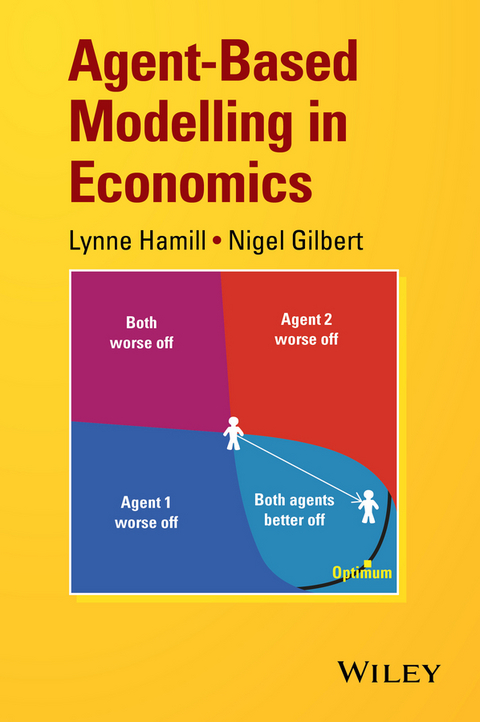
Agent-Based Modelling in Economics (eBook)
John Wiley & Sons (Verlag)
978-1-118-94551-3 (ISBN)
Agent-based modelling in economics
Lynne Hamill and Nigel Gilbert, Centre for Research in Social Simulation (CRESS), University of Surrey, UK
New methods of economic modelling have been sought as a result of the global economic downturn in 2008.This unique book highlights the benefits of an agent-based modelling (ABM) approach. It demonstrates how ABM can easily handle complexity: heterogeneous people, households and firms interacting dynamically. Unlike traditional methods, ABM does not require people or firms to optimise or economic systems to reach equilibrium. ABM offers a way to link micro foundations directly to the macro situation.
Key features:
- Introduces the concept of agent-based modelling and shows how it differs from existing approaches.
- Provides a theoretical and methodological rationale for using ABM in economics, along with practical advice on how to design and create the models.
- Each chapter starts with a short summary of the relevant economic theory and then shows how to apply ABM.
- Explores both topics covered in basic economics textbooks and current important policy themes; unemployment, exchange rates, banking and environmental issues.
- Describes the models in pseudocode, enabling the reader to develop programs in their chosen language.
- Supported by a website featuring the NetLogo models described in the book.
Agent-based Modelling in Economics provides students and researchers with the skills to design, implement, and analyze agent-based models. Third year undergraduate, master and doctoral students, faculty and professional economists will find this book an invaluable resource.
Nigel Gilbert, Professor of Sociology and Director of CRESS, University of Surrey, UK.
Lynne Hamill, Centre of Research in Social Simulation (CRESS), University of Surrey, UK.
Agent-based modelling in economics Lynne Hamill and Nigel Gilbert, Centre for Research in Social Simulation (CRESS), University of Surrey, UK New methods of economic modelling have been sought as a result of the global economic downturn in 2008.This unique book highlights the benefits of an agent-based modelling (ABM) approach. It demonstrates how ABM can easily handle complexity: heterogeneous people, households and firms interacting dynamically. Unlike traditional methods, ABM does not require people or firms to optimise or economic systems to reach equilibrium. ABM offers a way to link micro foundations directly to the macro situation. Key features: Introduces the concept of agent-based modelling and shows how it differs from existing approaches. Provides a theoretical and methodological rationale for using ABM in economics, along with practical advice on how to design and create the models. Each chapter starts with a short summary of the relevant economic theory and then shows how to apply ABM. Explores both topics covered in basic economics textbooks and current important policy themes; unemployment, exchange rates, banking and environmental issues. Describes the models in pseudocode, enabling the reader to develop programs in their chosen language. Supported by a website featuring the NetLogo models described in the book. Agent-based Modelling in Economics provides students and researchers with the skills to design, implement, and analyze agent-based models. Third year undergraduate, master and doctoral students, faculty and professional economists will find this book an invaluable resource.
Nigel Gilbert, Professor of Sociology and Director of CRESS, University of Surrey, UK. Lynne Hamill, Centre of Research in Social Simulation (CRESS), University of Surrey, UK.
Title Page 5
Copyright Page 6
Contents 7
Preface 10
Copyright notices 11
Chapter 1 Why agent-based modelling is useful for economists 13
1.1 Introduction 13
1.2 A very brief history of economic modelling 13
Traditional macroeconomic models 14
Dynamic stochastic general equilibrium models 14
Complexity economics 14
The impact of the 2008 economic crisis 15
1.3 What is ABM? 16
1.4 The three themes of this book 17
Heterogeneity 17
Dynamics 17
Interactions 18
1.5 Details of chapters 18
Chapter 2: Starting agent-based modelling 18
Chapter 3: Heterogeneous demand 18
Chapter 4: Social demand 19
Chapter 5: Benefits of barter 19
Chapter 6: The market 19
Chapter 7: Labour market 19
Chapter 8: International trade 20
Chapter 9: Banking 20
Chapter 10: Tragedy of the commons 20
Chapter 11: Summary and conclusions 20
The models 20
References 21
Chapter 2 Starting agent-based modelling 23
2.1 Introduction 23
2.2 A simple market: the basic model 24
2.3 The basic framework 25
2.4 Enhancing the basic model: adding prices 30
2.5 Enhancing the model: selecting traders 33
2.6 Final enhancement: more economically rational agents 35
2.7 Running experiments 37
2.8 Discussion 38
Appendix 2.A The example model: full version 39
References 40
Chapter 3 Heterogeneous demand 41
3.1 Introduction 41
3.2 Modelling basic consumer demand theory 42
Distributing budgets 44
Giving preferences to households 46
3.3 Practical demand modelling 51
3.4 Discussion 55
Appendix 3.A How to do it 58
Budget distribution 58
Utility function-based demand model 59
Practical demand model 60
References 64
Chapter 4 Social demand 65
4.1 Introduction 65
4.2 Social networks 65
4.3 Threshold models 68
Infection models 71
Influence models 71
4.4 Adoption of innovative products 74
4.5 Case study: household adoption of fixed-line phones in Britain 76
Modelling demographic changes 76
Modelling income 76
An income-only model 78
Modelling network effects 79
4.6 Discussion 82
Appendix 4.A How to do it 82
Social circles model 82
Threshold model 84
Phone adoption model 86
References 90
Chapter 5 Benefits of barter 92
5.1 Introduction 92
5.2 One-to-one barter 93
The Edgeworth Box 95
Dynamics of the Edgeworth Box 96
5.3 Red Cross parcels 100
Introducing shortages 106
5.4 Discussion 108
Appendix 5.A How to do it 109
Edgeworth Box game 109
Edgeworth Box random model 110
Red Cross parcels model 112
References 116
Chapter 6 The market 117
6.1 Introduction 117
6.2 Cournot–Nash model 117
Introduction 117
The agent-based model 118
6.3 Market model 120
Introduction 120
Consumers 124
Shops 125
Results 129
6.4 Digital world model 129
Introduction 129
Sellers 131
Consumers 132
Results 132
6.5 Discussion 136
Appendix 6.A How to do it 137
The Cournot–Nash model 137
Shops model 139
Digital world model 141
References 143
Chapter 7 Labour market 144
7.1 Introduction 144
The labour force 144
Employers 151
Summary 154
7.2 A simple labour market model 154
Stage 1: Wages 154
Stage 2: Job search 155
Stage 3: The Guildford labour market 160
Results 162
7.3 Discussion 163
Appendix 7.A How to do it : 167
Wage distribution model 167
Things to try using the wage distribution model 167
Job search model 169
Things to try using the job search model 169
Guildford labour market model 171
References 173
Chapter 8 International trade 175
8.1 Introduction 175
Definition of exchange rates 175
Nominal exchange rates 175
Effective exchange rates 176
Real exchange rates 177
Purchasing power parity 178
Interest rate parity 178
Exchange rate regimes 180
The experience of the British pound, the US dollar and the euro 182
8.2 Models 184
Introduction 184
Assumptions 185
Inflation 186
Depreciation 191
Exogenous drop in demand for exports 191
Fiscal change 194
8.3 Discussion 195
Appendix 8.A How to do it 197
International trade model 197
References 199
Chapter 9 Banking 201
9.1 Introduction 201
Fractional reserve banking 201
Banking crises and the regulation of banks 204
A simple example 208
9.2 The banking model 210
A basic example 210
Introducing the capital adequacy ratio target 214
Affordability and different types of loans 214
Adding interest 215
A shock to the system 216
9.3 Discussion 218
Appendix 9.A How to do it 221
Banking model 221
Things to try 222
References 224
Chapter 10 Tragedy of the commons 226
10.1 Introduction 226
Economic analysis 227
10.2 Model 230
The carrying capacity of the meadow 230
Managing the meadow 232
10.3 Discussion 237
Appendix: 10.A How to do it: : 240
Carrying capacity model 240
Meadow management model 242
References 244
Chapter 11 Summary and conclusions 246
11.1 Introduction 246
11.2 The models 246
11.3 What makes a good model? 249
11.4 Pros and cons of ABM 250
References 251
Further reading and resources 252
Index 254
EULA 259
| Erscheint lt. Verlag | 2.11.2015 |
|---|---|
| Sprache | englisch |
| Themenwelt | Mathematik / Informatik ► Mathematik ► Statistik |
| Mathematik / Informatik ► Mathematik ► Wahrscheinlichkeit / Kombinatorik | |
| Sozialwissenschaften ► Soziologie ► Empirische Sozialforschung | |
| Technik | |
| Wirtschaft ► Allgemeines / Lexika | |
| Wirtschaft ► Volkswirtschaftslehre | |
| Schlagworte | ABM • agent-based • Complexity • Dynamics • Economics • Economic Theory • Heterogeneity • Interactions • Markets • Micro-Foundations • Modelling • netlogo • Research Methodologies • Sociology • Soziologie • Soziologische Forschungsmethoden • Statistics • Statistics for Social Sciences • Statistik • Statistik in den Sozialwissenschaften • Volkswirtschaftslehre • Wirtschaftstheorie |
| ISBN-10 | 1-118-94551-4 / 1118945514 |
| ISBN-13 | 978-1-118-94551-3 / 9781118945513 |
| Informationen gemäß Produktsicherheitsverordnung (GPSR) | |
| Haben Sie eine Frage zum Produkt? |
 PDF (Adobe DRM)
Kopierschutz: Adobe-DRM
Adobe-DRM ist ein Kopierschutz, der das eBook vor Mißbrauch schützen soll. Dabei wird das eBook bereits beim Download auf Ihre persönliche Adobe-ID autorisiert. Lesen können Sie das eBook dann nur auf den Geräten, welche ebenfalls auf Ihre Adobe-ID registriert sind.
Details zum Adobe-DRM
Dateiformat: PDF (Portable Document Format)
Mit einem festen Seitenlayout eignet sich die PDF besonders für Fachbücher mit Spalten, Tabellen und Abbildungen. Eine PDF kann auf fast allen Geräten angezeigt werden, ist aber für kleine Displays (Smartphone, eReader) nur eingeschränkt geeignet.
Systemvoraussetzungen:
PC/Mac: Mit einem PC oder Mac können Sie dieses eBook lesen. Sie benötigen eine
eReader: Dieses eBook kann mit (fast) allen eBook-Readern gelesen werden. Mit dem amazon-Kindle ist es aber nicht kompatibel.
Smartphone/Tablet: Egal ob Apple oder Android, dieses eBook können Sie lesen. Sie benötigen eine
Geräteliste und zusätzliche Hinweise
Buying eBooks from abroad
For tax law reasons we can sell eBooks just within Germany and Switzerland. Regrettably we cannot fulfill eBook-orders from other countries.
aus dem Bereich