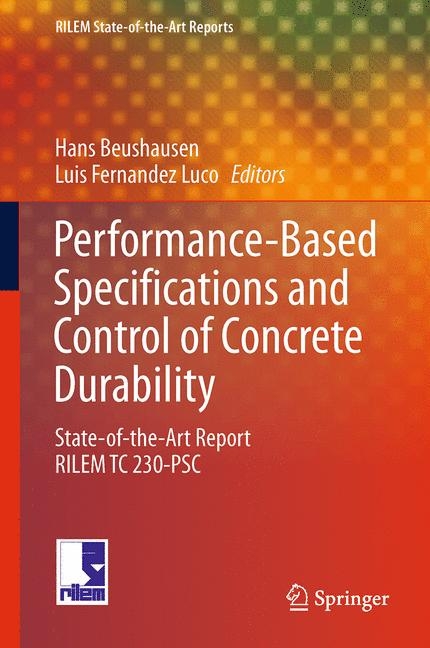
Performance-Based Specifications and Control of Concrete Durability (eBook)
XVIII, 373 Seiten
Springer Netherland (Verlag)
978-94-017-7309-6 (ISBN)
This work gives an overview of significant research from recent years concerning performance-based design and quality control for concrete durability and its implementation. In engineering practice, performance approaches are often still used in combination with prescriptive requirements. This is largely because, for most durability test methods, sufficient practical experience still has to be gained before engineers and owners are prepared to fully rely on them.
This book, compiled by RILEM TC 230-PSC, is intended to assist efforts to successfully build the foundation for the full implementation of performance-based approaches through the exchange of relevant knowledge and experience between researchers and practitioners worldwide.
This work gives an overview of significant research from recent years concerning performance-based design and quality control for concrete durability and its implementation. In engineering practice, performance approaches are often still used in combination with prescriptive requirements. This is largely because, for most durability test methods, sufficient practical experience still has to be gained before engineers and owners are prepared to fully rely on them.This book, compiled by RILEM TC 230-PSC, is intended to assist efforts to successfully build the foundation for the full implementation of performance-based approaches through the exchange of relevant knowledge and experience between researchers and practitioners worldwide.
Preface 6
Members of RILEM TC 230-PSC 8
RILEM Publications 9
Contents 17
1 Introduction 19
1.1 Background to the Work of TC 230-PSC 19
1.2 Terminology 21
1.2.1 Compliance Assessment 21
1.2.2 Designed Concrete 22
1.2.3 Deterioration Model 22
1.2.4 Durability Indicators 22
1.2.5 Durability Potential 22
1.2.6 Initial Test 22
1.2.7 Non-destructive Test 22
1.2.8 Non-invasive Test 23
1.2.9 Performance-Based Design for Durability (General) 23
1.2.10 Performance-Based Design for Durability (Specific to This Publication) 23
1.2.11 Performance Criteria 23
1.2.12 Performance Simulation Tests 23
1.2.13 Prescribed Concrete 24
1.2.14 Prescriptive Design for Durability 24
1.2.15 Pre-qualification 24
1.2.16 Producer 24
1.2.17 Semi-invasive Test Method 24
1.2.18 Service Life 24
1.2.19 Service Life Model 25
1.2.20 Specification 25
1.2.21 Transport Properties 25
1.2.22 User 25
1.2.23 Verification 25
References 25
2 Durability of Reinforced Concrete Structures and Penetrability 26
2.1 Introduction 26
2.2 Mechanisms Causing Reinforcement Corrosion 26
2.2.1 Carbonation 27
2.2.2 Chloride Ingress 27
2.3 Concrete Properties Relating to the Ingress of Aggressive Agents 27
2.3.1 Resistance Against Diffusion of CO2 28
2.3.2 Moisture Transport Properties 28
2.3.3 Resistance Against Chloride Diffusion and Convection 30
2.4 Service Life and Deterioration Models (Principles) 31
2.4.1 Carbonation Models, in Principle 32
2.4.2 Chloride Ingress Models, in Principle 33
2.4.3 Discussion on the Influence of Cracks 33
References 34
3 Prescriptive Durability Specifications 35
3.1 Introduction 35
3.2 Exposure Classes 37
3.2.1 Complementary Local Standards 38
3.3 Materials 42
3.3.1 General 42
3.3.2 Cements 42
3.3.3 Supplementary Cementitious Materials (SCM) 42
3.3.4 Aggregates 44
3.3.5 Admixtures 44
3.3.6 Water 44
3.3.7 Chloride Content of Concrete 45
3.3.8 Reinforcing Steel 46
3.4 Service Life 46
3.5 Concrete Strength Grades 47
3.6 Mix Composition Prescriptions 48
3.7 Contribution of Supplementary Cementitious Materials 48
3.8 Cover Depth Prescriptions 52
3.9 Concrete Practices 56
3.10 Compliance/Conformity Control 57
3.11 Discussion and Conclusions 58
3.11.1 Exposure Classes 58
3.11.2 Durability Indicators 60
3.11.2.1 Concrete Strength 60
3.11.2.2 Water/Cement Ratio 61
3.11.2.3 Minimum Cement Content 63
3.11.3 Final Remarks 63
References 64
4 Test Methods for Concrete Durability Indicators 66
4.1 Introduction 66
4.2 Gas Permeability 67
4.2.1 Principle and Mechanism 68
4.2.2 Test Methods 68
4.2.2.1 Figg's Method 69
4.2.2.2 Schönlin and Hilsdorf 70
4.2.2.3 Autoclam Method 72
4.2.2.4 Torrent Method 73
4.2.2.5 Permeability Exponent 74
4.2.2.6 Cembureau Method 75
4.2.2.7 Oxygen Permeability Index Test (South Africa) 77
4.2.3 Overview and Criteria for Evaluation of Concrete Quality 78
4.3 Water Permeability 81
4.3.1 Principle and Mechanism 81
4.3.2 Test Methods 81
4.3.2.1 Autoclam Method 82
4.3.2.2 Water Permeability Test 83
4.3.2.3 Depth of Penetration of Water Under Pressure 84
4.3.3 Overview and Criteria for Evaluation of Concrete Quality 85
4.4 Capillary Absorption 85
4.4.1 Principle and Mechanism 86
4.4.2 Test Methods 87
4.4.2.1 Initial Surface Absorption Test (ISAT) 87
4.4.2.2 Autoclam Method 88
4.4.2.3 Water Absorption According to RILEM CPC11.2 88
4.4.2.4 Water Absorption According to ASTM C1585 90
4.4.2.5 Water Sorptivity Test (South Africa) 91
4.4.3 Overview and Criteria for Evaluation of Concrete Quality 92
4.5 Chloride Penetration 93
4.5.1 Principle and Mechanism 93
4.5.1.1 Diffusion 94
4.5.1.2 Migration 95
4.5.2 Test Methods 95
4.5.2.1 Non-steady State Chloride Diffusion Coefficient 96
4.5.2.2 Non-steady State Chloride Migration Coefficient 97
4.5.2.3 Electrical Indication of Concrete's Ability to Resist Chloride Ion Penetration 100
4.5.2.4 Multiregime Method 101
4.5.2.5 Integral Corrosion Test (UNE 83992-2 EX-2012) 103
4.5.2.6 Permit Ion Migration Test 106
4.5.2.7 Chloride Profiling Method 108
4.5.3 Overview and Criteria for Evaluation of Concrete Quality 109
4.6 Concrete Resistivity and Conductivity 110
4.6.1 Principle and Mechanism 110
4.6.2 Test Methods 110
4.6.2.1 Direct Resistivity Test According to UNE 83988-1 110
4.6.2.2 Concrete Resistivity Wenner Probe 112
4.6.2.3 Chloride Conductivity Index Test (South Africa) 113
4.6.3 Overview and Criteria for Evaluation of Concrete Quality 115
4.7 Final Remarks 115
References 116
5 Principles of the Performance-Based Approach for Concrete Durability 121
5.1 Introduction 121
5.2 Pre-qualification Versus Compliance Control 124
5.2.1 Principles 124
5.3 Performance-Based Design and Specification (Pre-qualification) 124
5.3.1 Principles 124
5.3.2 Test Methods, Procedures and Variables 127
5.4 Performance-Based Quality Control and Compliance Assessment 128
5.4.1 Principles 128
5.4.2 Test Methods and Test Parameters 129
5.4.3 Sampling Criteria and Sampling Procedures 131
5.4.4 Actions in Case of Non-compliance 132
5.5 Environmental Actions (Quantification) 134
5.5.1 General 134
5.5.2 Quantification of the Chloride Environment 134
5.5.2.1 Marine Environment 134
5.5.2.2 Exposure to De-Icing Salts 135
5.5.2.3 Quantification of CO2 Environment 136
5.6 Development of Limiting Values for Specification and Compliance Control 137
5.6.1 General Considerations 137
5.6.2 The Use of Transport Properties in Compliance Control 138
5.6.3 Principles of the Probabilistic Approach to Statistical Variations 139
5.6.4 Semi-probabilistic Approach to Statistical Variations 141
5.6.5 Principles of the Deterministic Approach to Statistical Variations 142
References 143
6 Statistical Procedures for Performance-Based Specification and Testing 146
6.1 Introduction 146
6.2 Distributions 148
6.2.1 Random Variables 148
6.2.2 Expectation and Variance 151
6.2.3 The Normal Distribution and Other Families 153
6.2.4 Transformation of Random Variables 155
6.2.5 Functions of the Sample Values 157
6.2.6 Approximations by the Central Limit Theorem 160
6.2.7 Discrete Distributions 161
6.3 Basic Statistical Inference 163
6.3.1 Estimation for Normal Samples 163
6.3.2 Statistical Tests 165
6.3.3 Confidence Intervals 173
6.3.4 Inference for the Binomial Distribution 176
6.3.5 Inference for General Parameters 177
6.4 Analysis of Variance and Regression 179
6.4.1 Analysis of Variance 179
6.4.2 Interlaboratory Studies 183
6.4.3 Simple Linear Regression 185
6.4.4 Outlook 190
References 191
7 Responsibilities 192
7.1 Introduction 192
7.2 Performance-Based Durability Limits 194
7.3 Verification of Durability 194
7.3.1 Types of Performance Testing 198
7.3.2 Durability Tests and (Typical) Limiting Values 200
7.4 Quality Management Using Performance-Based Specifications 201
7.5 Responsibilities of the Owner/Specifier, Contractor and Supplier/Producer 202
7.5.1 Responsibilities of the Owner/Specifier/Design Authority (Engineer) 204
7.5.2 Responsibilities of the Contractor 206
7.5.3 Responsibilities of the Supplier/Producer 206
7.6 Conclusion 207
References 208
8 Application Examples of Performance-Based Specification and Quality Control 210
8.1 Introduction 210
8.2 Site Air-Permeability (``Torrent Method'') 211
8.2.1 Introduction 211
8.2.2 Specified Limiting KTs Values 212
8.2.3 Conformity Rules and Reporting 215
8.2.4 Sampling of Test Areas and Measurement Points 216
8.2.4.1 Grouping 216
8.2.4.2 Test Areas 216
8.2.4.3 Measurement Points 216
8.2.5 Age, Temperature and Moisture Conditions of the Concrete 217
8.2.6 Application 218
8.2.7 Estimation of Service Life 221
8.2.7.1 Carbonation 221
8.2.7.2 Chlorides 221
8.3 Oxygen Permeability Index (South Africa) 225
8.3.1 Prediction of Carbonation Depth Development 226
8.3.2 Performance Specifications Using OPI Values 228
8.4 Autoclam Permeability System (UK) 229
8.4.1 Functional Purpose of the Autoclam Permeability System 229
8.4.2 Choice of Test Method for Measuring Permeation Characteristics 229
8.4.3 Principle of Operation of the Autoclam Permeability System 229
8.4.4 Classification of Concrete Using the Autoclam Permeability System 232
8.4.5 Typical Field Applications of the Autoclam Permeability System 236
8.5 Service Life Prediction Using Concrete Resistivity (Spain) 238
8.5.1 Basis of the Method 240
8.5.2 The Reaction Factor 241
8.5.3 The Environmental Factor 241
8.5.4 Ageing Factor 241
8.5.5 Propagation Period 242
8.5.6 Calculation of Service Life and Application Example for the Initiation Period 243
8.5.7 Compliance Testing 244
8.5.8 Resistivity as a Durability Indicator 245
8.5.9 Site Determination in Existing Structures 245
8.5.10 Summary 247
8.6 Surface Resistivity (USA) 247
8.7 Two Electrode Resistivity Method (The Netherlands) 249
8.7.1 Test Method 249
8.7.2 Limiting Values 250
8.7.3 Example of Production Control by Resistivity Testing 251
8.8 Chloride Conductivity Index (South Africa) 253
8.8.1 Correlation Between Chloride Conductivity and Chloride Diffusion 254
8.8.2 Performance Specifications Using Chloride Conductivity Values 256
8.9 Rapid Chloride Migration Test (Suggested for Application in The Netherlands) 258
8.9.1 Service Life Model 259
8.9.2 Reliability Considerations and Semi-probabilistic Approach 260
8.9.3 Limiting Values 260
8.9.4 Application in Rijkswaterstaat Projects 261
8.10 In Situ Ionic Migration Test: PERMIT (UK) 261
8.10.1 Typical Applications of Permit Migration Test 265
8.11 Multi-level Prediction of Reinforced Concrete (RC) Durability 266
8.11.1 Principles of the Multi-level Approach 266
8.11.2 Procedure for Verification of Durability 267
8.12 Portuguese Technical Specifications 269
8.12.1 Equivalent Performance Concept 269
8.12.2 Methodology for Estimating Design Working Life 270
References 275
9 Basis for the Statistical Evaluation of Measured Cover Depths in Reinforced Concrete Structures 280
9.1 Definitions 280
9.2 Introduction 282
9.3 Procedure A: Inspection by Variables 283
9.3.1 Steps 283
9.3.2 Selection of the Cover Depth Population 283
9.3.3 Sampling Method 284
9.3.4 Measuring the Cover Depth 285
9.3.5 Statistical Distribution Functions and Detection of Outliers 286
9.3.6 Minimum Cover Depth Estimate 287
9.3.7 Evaluation of Conformity 288
9.4 Procedure B: Inspection by Attributes 291
9.4.1 Steps 291
9.4.2 Evaluation of Conformity 291
9.5 Procedure C: Inspection by Attributes---Large Lots 293
9.5.1 Steps 293
9.5.2 Sampling Method 294
9.5.3 Evaluation of Conformity 294
9.6 German Code of Practice 296
9.6.1 Qualitative Procedure 297
9.6.2 Quantitative Procedure 298
9.7 Actions in the Case of Non-conformity 299
9.8 Examples 300
9.8.1 Cover Depths in a Viaduct Deck Slab (Procedure A) 300
9.8.2 Cover Depth of the Columns Stirrups of a Viaduct (Procedure C) 303
9.9 Final Remarks 306
A9.1 Construction of Probability Plots and Detection of Potential Outliers 306
A9.2 Definition of the Lower One-Sided Tolerance Limit [12] 307
A9.3 Dealing with Spatial Autocorrelation 309
A9.4 Construction of OC Curves [12] 310
References 311
10 Venlo Application Testing (Summary) 313
10.1 Introduction 313
10.1.1 Aims and Scope 314
10.1.2 Experimental Program 315
10.1.3 Participants and Test Methods 316
10.2 Summary of Test Results 316
10.2.1 Tests Based on Permeability to Gases 318
10.2.2 Tests Based on Capillary Suction of Water 318
10.2.3 Tests Based on Ion Migration 319
10.2.4 Electrical Resistivity Measurements 320
10.3 Further Assessment from Compiled Rankings 322
10.3.1 Ranking of Test Panels for Carbonation Exposure 322
10.3.2 Ranking of Test Panels for Chloride Exposure 324
10.4 Conclusions 326
Acknowledgments 327
11 Venlo Application Testing (Individual Reports and Additional Data) 328
11.1 Introduction 328
11.2 Panel Manufacture and Concrete Properties 329
11.3 Air Permeability (OPI) and Chloride Penetration (CCI) 331
11.3.1 Introduction and Aims of the Testing 331
11.3.2 Oxygen Permeability 332
11.3.2.1 Summary of Results and General Discussion 332
11.3.2.2 Conformity Assessment (Carbonation Exposure) 334
11.3.2.3 Service Life Assessment and Carbonation Prediction 334
11.3.3 Chloride Conductivity Index 335
11.3.3.1 Summary of Results and General Discussion 335
11.3.3.2 Conformity Assessment (Chloride Exposure) 336
11.3.3.3 Service Life Assessment (Chloride Exposure) 337
11.3.4 Conclusions 338
11.4 Air-Permeability (``Torrent Method'') and Cover Depth 338
11.4.1 Aims of Testing 339
11.4.2 Testing Program 339
11.4.3 Testing Methods 339
11.4.4 Sampling 340
11.4.5 Age and Environmental Conditions 341
11.4.6 Test Results 342
11.4.6.1 Results Obtained 342
11.4.6.2 Analysis of the Results 344
Analysis of the Results of 1st Round (Age: 14--21 Days) 344
Analysis of the Results of 2nd Round (Age: 101--108 Days) 345
11.4.7 Conformity with Swiss Standards 348
11.4.7.1 Cover Depth Requirements 348
11.4.7.2 Air Permeability Requirements 349
11.4.8 Compliance with 100 Years of Service Life 350
11.5 Autoclam Permeability Tests 351
11.5.1 Introduction 351
11.5.2 Test Results 352
11.5.3 Temperature Compensated Air Permeability Indices 356
11.6 Permit Ion Migration Test 357
11.6.1 Introduction 357
11.6.2 Test Results 357
11.6.3 Predicting the Chloride Transport Through Concrete 359
11.6.4 Concluding Remarks 363
11.7 Single Chamber Method 364
11.7.1 Introduction 364
11.7.2 Test Results 364
11.7.3 Analysis of Permeability Results 364
11.8 Air Permeability (Packer Test) 365
11.8.1 Introduction 365
11.8.2 Test Results 366
11.9 Air Permeability (Seal Method) 366
11.9.1 Introduction 366
11.9.2 Test Results 367
11.9.3 Conformity and Service Life Prediction 367
11.10 Water Absorption (SWAT) 369
11.10.1 Introduction 369
References 371
12 Conclusions 372
Appendix A: Performance-Based Test Methods and Applications (By Country) 374
| Erscheint lt. Verlag | 24.9.2015 |
|---|---|
| Reihe/Serie | RILEM State-of-the-Art Reports | RILEM State-of-the-Art Reports |
| Zusatzinfo | XVIII, 373 p. 155 illus. |
| Verlagsort | Dordrecht |
| Sprache | englisch |
| Themenwelt | Technik ► Bauwesen |
| Technik ► Maschinenbau | |
| Wirtschaft ► Betriebswirtschaft / Management | |
| Schlagworte | Concrete Durability • Performance Testing • quality control • Quality Control, Reliability, Safety and Risk • RILEM • Service Life Design |
| ISBN-10 | 94-017-7309-2 / 9401773092 |
| ISBN-13 | 978-94-017-7309-6 / 9789401773096 |
| Informationen gemäß Produktsicherheitsverordnung (GPSR) | |
| Haben Sie eine Frage zum Produkt? |
 PDF (Wasserzeichen)
Größe: 9,1 MB
DRM: Digitales Wasserzeichen
Dieses eBook enthält ein digitales Wasserzeichen und ist damit für Sie personalisiert. Bei einer missbräuchlichen Weitergabe des eBooks an Dritte ist eine Rückverfolgung an die Quelle möglich.
Dateiformat: PDF (Portable Document Format)
Mit einem festen Seitenlayout eignet sich die PDF besonders für Fachbücher mit Spalten, Tabellen und Abbildungen. Eine PDF kann auf fast allen Geräten angezeigt werden, ist aber für kleine Displays (Smartphone, eReader) nur eingeschränkt geeignet.
Systemvoraussetzungen:
PC/Mac: Mit einem PC oder Mac können Sie dieses eBook lesen. Sie benötigen dafür einen PDF-Viewer - z.B. den Adobe Reader oder Adobe Digital Editions.
eReader: Dieses eBook kann mit (fast) allen eBook-Readern gelesen werden. Mit dem amazon-Kindle ist es aber nicht kompatibel.
Smartphone/Tablet: Egal ob Apple oder Android, dieses eBook können Sie lesen. Sie benötigen dafür einen PDF-Viewer - z.B. die kostenlose Adobe Digital Editions-App.
Zusätzliches Feature: Online Lesen
Dieses eBook können Sie zusätzlich zum Download auch online im Webbrowser lesen.
Buying eBooks from abroad
For tax law reasons we can sell eBooks just within Germany and Switzerland. Regrettably we cannot fulfill eBook-orders from other countries.
aus dem Bereich