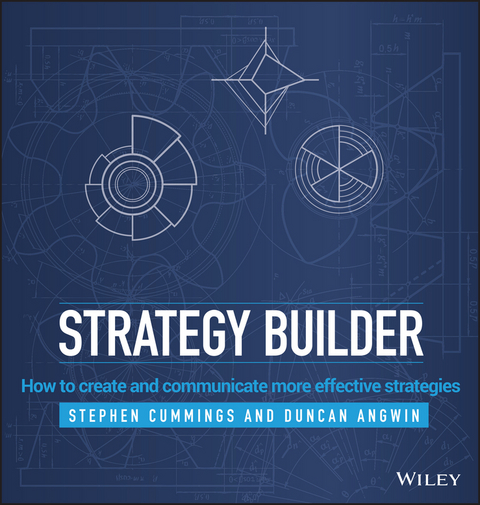
Strategy Builder (eBook)
John Wiley & Sons (Verlag)
978-1-118-70718-0 (ISBN)
YOUR STRATEGY HAS SEVEN SECONDS TO CAPTIVATE ITS AUDIENCE… So how are you going to present it? A big wordy document? A lengthy address? Slides full of bullet points?
The best way to engage and involve people is through pictures. Strategy Builder shows you how to creatively combine the best strategy frameworks to orient and animate strategy discussion and development in your team. This visual, interactive guide, with illustrations by Visory, uses real world examples and practical tips to help you:
- Discover the five key foundations that every strategy should be built upon
- Draw compelling and unique pictures that capture your organization’s distinct strategies
- Develop your skills as a leader of strategy discussions
- Understand how to use interactive drawing to engage others and achieve ‘buy in’
Praise for Strategy Builder:
Cummings & Angwin are pioneers in introducing novel approaches in teaching and applying the principles of strategy --Robert M. Grant, Bocconi University, author of Contemporary Strategy Analysis
At last someone has grasped this idea and come up with a way to help us demonstrate strategic plans and ambitions in a creative new way. --Vikki Heywood CBE, Chair of The Royal Society for the Arts
This wonderful book is the first to solve a near-universal problem: communicating strategic ideas is just as hard and just as important as coming up with them in the first place, and both are visual activities. The question is not “Do you understand?” but “Do you see?” --William Duggan, Professor, Columbia University, author Strategic Intuition
This book shows how to draw an organization's strategy so you see what's been considered, what's not been considered, and how things are related,. Strategy building is presented as a fun and involving learning process.The approach is revolutionary in that it enables not only the development but also the easy sharing of strategic understanding. --Roger L.M. Dunbar, Emeritus Professor, Stern School of Business, New York University
What a great idea! They layout is also really thoughtful; it makes you immediately want to get out a pencil and start doodling. --Adam Martin, Customer Solutions Director, The Brakes Group
As a time pressed executive it was a delight to find a book that I can dip into to find the best strategic frameworks - those that have proved the test of time and academic scrutiny as being truly useful in the workplace. Even better for an inveterate scribbler: endorsement that a picture and ‘permission to play’ with ideas visually really does say a thousand words and more! --Sarah Mitson, Global Business Director, TNSGlobal
This is an invaluable resource for any executive wanting to improve engagement in strategy development and communication. The accessible layout means that the book itself can play an active and inspiring role in strategy discussions. --Matt Thomas, Director, Braxton Associates, Strategy Consultants
At last a book that grasps the implications of recent psychology: people think visually as well as verbally. The authors provide powerful visual devices that will both help managers conceive better strategies and enable their people to execute them more effectively. --Richard Whittington, Professor at Saïd Business School, Oxford University
A powerful approach to make strategy more engaging again! Strategy Builder is landmark book is destined to make an important impact to the field of strategy, strategizing and strategic management. Executives across the board (and students of strategy) will find the core message of this book counterintuitive and compelling. The idea of 'drawing' strategy may seem like child's play, yet all great strategists and philosophers know that it is through such 'serious play' that allows us to see things differently so that we can see different things. --Robert Wright, Professor of Strategy, Hong Kong Polytechnic University
STEPHEN CUMMINGS is Professor of Management at Victoria University of Wellington and Academic Fellow of the International Council of Management Consulting Institutes. DUNCAN ANGWIN is Professor of Strategy at Oxford Brookes University and is widely published in strategic management literature (www.duncanangwin.com).
Strategy Builder Team vi
Part One: The Concept 01
Opportunities for a New Way of Developing Strategy 05
Seven Strengths of Drawing Strategy 12
What Strategy Builder Does 22
Part Two: Design 25
User's Guide to the Strategy Builder's Framework Profiles 28
Environmental Ecology 37
Competitive Positioning 71
Resources and Capabilities 105
Strategic Growth Options 139
Managing Performance Strategically 173
Part Three: Realization 207
Well-built Strategies, Simply Conveyed 209
Six Stratographic Principles 212
Get Building 233
Endnotes 239
Image Credits 242
PART ONE
THE CONCEPT
Misunderstood strategy may be the biggest problem facing most organizations today. If the people implementing a strategy don't ‘get it', confusion, dysfunction and sub-optimization result.
Over the past five years and across eight different countries we've conducted experiments into whether the way you communicate strategy make a difference? The answer: yes. Whether you are African, American, Asian, Australasian or European, an MBA student, an executive or a young entrepreneur, communicating strategy in pictures is by far the most effective way. Those shown a diagrammatic portrayal of a strategy recall with 70% accuracy; those shown a textual rendition of the same strategy underperform dramatically, recalling less than 30%.1
And it isn't just in simple reproduction that pictures add value. Those shown the strategy as text who sought to aid their recall by drawing were more than one and a half times more accurate than those who just recalled the strategy by writing. Something kinetic happens when you draw that stimulates other senses. Seeing a picture of a strategy helps, but drawing it is even more powerful.
But what might be most shocking to anybody interested in strategy was the discovery that there is little to no correlation between the amount that can be accurately recalled about a strategy and a person's confidence in acting on it. This suggests that there may be many people in organizations who don't know what their strategy is, but who are confidently implementing it anyway (which could explain why many organization's strategies appear confused in practice).
Despite the power of drawing, organizations still express strategy in the form of text. The strategic plans that sit unloved on corporate shelves, and the presentations inflicted upon staff that summarize these plans, are almost always presented as words and numbers. Surveying the websites of the Fortune 100 companies, The 100 Best Places to Work and the 50 Most Respected Companies revealed that only one used a diagram to express their strategy – one out of 250.
It seems we're building and communicating strategy all wrong. Strategy Builder outlines a revolutionary way that you can do it right. If strategy is about winning (and in our experience this is the most compelling definition of strategy), then picturing a strategy is the best way to figure out and communicate how you and your organization can win.2
The clue in the corner
It could be a bit dispiriting to dwell on the effect that the word ‘strategy' has on most people in most organizations most of the time. Talking and writing about strategy tend to put people off making it. Thinking about when you last talked strategy in your organization probably conjures up bad memories: 100-page documents that you haven't read (you suspect that nobody else has read them either); hours spent arguing about whether ‘purpose' or ‘values' or ‘philosophy' is the best word to describe something that nobody is sure they understand and the wording of which can't be agreed upon in any case; convoluted mission statements designed by committees of ‘yes men'; numerical bamboozlement; strategy ‘away days' just when your backlog is at its largest. It's no surprise, then, that many feel disengaged from or by strategy, or that a recent study found that 95% of people have little idea what their organization's strategy is.3 We believe that this lack of clarity about and involvement with strategy is one of the main reasons that organizations underperform.
However, we've been teaching strategy and advising companies about it for long enough to know that people don't inherently dislike strategy. On the contrary, most people will agree that having a good strategy is a great feeling. It focuses the mind, energizes, provides a sense of purpose and relieves anxiety. It's more the way that strategy is currently developed and communicated that turns people off.
Rather than dwelling on this problem, we decided to build a strategy book by first trying to identify places where people weren't disengaged, when they actually felt good about talking strategy, when they were as interested in it as we know people can be.
Gradually, such a place occurred to us. A large clue had been standing there in every classroom in which we have taught and in the offices where we have consulted in Asia, Africa, Australasia, Europe and the Americas for decades. Where do we see people get engaged about discussing and making strategy? Often it happens around whiteboards…
Whiteboards may now be one of the lowest-tech devices in the room, but think about what happens in a meeting at that moment when eyes move from the pre-prepared PowerPoint presentation and the thick documents to the whiteboard as somebody seizes the pen and starts to write on it: some keywords, some arrows or a flow of processes. Things change gear. As others seek their turn with the pen or to inform the scribe with their insights, things open up. Change is possible. Cufflinks are released. Sleeves are rolled up. Strategy is happening, in real time. The material and the social – things and people – work together as the whiteboard provides a vehicle for collectively figuring out how stuff fits together and where new value can be created. That moment is uplifting. It's game on. People are building something.
The same is true in the classroom. We spend a lot of time preparing slides and writing cases, but most MBAs really get into strategy when we stop lecturing and start scribing ours and their thoughts on a case and facilitating and recording their debates, uncertainties and insights into frameworks on a humble whiteboard. Of course, it's not the whiteboard, but rather what people do with it, that makes strategy engaging. And what they do is they draw, connecting words, images and insights. If this is done well that drawing is a collective experience. So, this engagement could happen on a whiteboard or a flipchart, sheets of paper, an iPad or the back of an envelope.
Pinpointing this moment leads to an excellent foundation upon which to build a book that could help managers become more engaged in strategy-making. We have come to believe that while strategy may be developed in the now conventional ways (conversations, number crunching, the writing of documents, files of PowerPoints), collectively generated graphical representations are an unrecognized but powerful approach. Educational theorists since Piaget and Brunner have shown how people learn most effectively through the combination of three modes: the concrete doing of things, the pictorial representations of things, and the symbolical description of things in text or numbers.4 People generally learn an organization's strategy by working in that organization, or they have it communicated to them in words and numbers. But the kind of pictorial representations and translations that whiteboards provide space for are useful ways of connecting the everyday activities in an organization with the high-level words and numbers from the strategic plan. They facilitate the substitution of actually being in concrete situations in ways that promote useful abstractions and group communication.5
However, if we do not recognize the importance of and potential for drawing pictures in strategy development soon, the connection that they can provide could become a missing link as technological developments and busy schedules discourage us from thoughtful drawing. There are a number of emerging opportunities for a new way of developing and communicating strategy. And drawing as the basis of building strategy has a number of key strengths. Seizing these opportunities and acting on these strengths before it is too late is what the Strategy Builder is about and we do so in three simple steps:
- By encouraging people to draw strategy – which may be as simple as stepping up to a whiteboard and using arrows to depict how you currently relate to your customers.
- By showing how many of the greatest strategy frameworks developed over the past 50 years can be used and combined in creative and playful ways to tell really engaging strategy stories.
- By distilling from these frameworks five easy-to-remember foundations that can enable you and your organization to draw a compelling strategy that can be communicated on a single page.
Notes
1 The data and findings from this experiment are reported on in Cummings, S., Angwin, D. & Daellenbach, How Graphical Representation Helps Strategy Communication, SMS (Strategic Management Society) Special Conference, Sydney, December 2014. 2 This compelling definition comes from Robert Grant: Grant, R.M. (2010). Contemporary Strategy Analysis and Cases: Text and Cases, John Wiley & Sons, Chichester, UK. It is certainly the definition that in our experience most animates and orients (in the terms of our framework no. 26) strategy students and managers alike. 3 Kaplan, R.S. and Norton, D.P. (2005). The office of strategy management. Harvard Business Review, 83(10), 72–81. 4 See, for example, Levie, W.H. and Levie, D. (1975). Pictorial memory processes. Educational Technology Research and Development, 23(1), 81–97; Anghileri, J. (2005). Children's Mathematical Thinking in the Primary Years. New York:...
| Erscheint lt. Verlag | 13.2.2015 |
|---|---|
| Sprache | englisch |
| Themenwelt | Wirtschaft ► Betriebswirtschaft / Management ► Unternehmensführung / Management |
| Schlagworte | Business & Management • Business & Management Special Topics • Business Communication • Business planning • Business Strategy • communicating strategy • Duncan Angwin • engaging stakeholders • Executive Communication • expert strategists • generating better strategy • interactive strategy builder • leadership skills • Management • Management Approach • management frameworks • Management Skills • Oxford Brookes University • selling strategy • Spezialthemen Wirtschaft u. Management • Stephen Cummings • Strategic Management • Strategie • Strategisches Management • strategy framework • strategy template • successful management techniques • The Strategy Builder: How to Create and Communicate More Effective Strategies • Victoria University • Wirtschaft u. Management |
| ISBN-10 | 1-118-70718-4 / 1118707184 |
| ISBN-13 | 978-1-118-70718-0 / 9781118707180 |
| Informationen gemäß Produktsicherheitsverordnung (GPSR) | |
| Haben Sie eine Frage zum Produkt? |
 EPUB (Adobe DRM)
Kopierschutz: Adobe-DRM
Adobe-DRM ist ein Kopierschutz, der das eBook vor Mißbrauch schützen soll. Dabei wird das eBook bereits beim Download auf Ihre persönliche Adobe-ID autorisiert. Lesen können Sie das eBook dann nur auf den Geräten, welche ebenfalls auf Ihre Adobe-ID registriert sind.
Details zum Adobe-DRM
Dateiformat: EPUB (Electronic Publication)
EPUB ist ein offener Standard für eBooks und eignet sich besonders zur Darstellung von Belletristik und Sachbüchern. Der Fließtext wird dynamisch an die Display- und Schriftgröße angepasst. Auch für mobile Lesegeräte ist EPUB daher gut geeignet.
Systemvoraussetzungen:
PC/Mac: Mit einem PC oder Mac können Sie dieses eBook lesen. Sie benötigen eine
eReader: Dieses eBook kann mit (fast) allen eBook-Readern gelesen werden. Mit dem amazon-Kindle ist es aber nicht kompatibel.
Smartphone/Tablet: Egal ob Apple oder Android, dieses eBook können Sie lesen. Sie benötigen eine
Geräteliste und zusätzliche Hinweise
Buying eBooks from abroad
For tax law reasons we can sell eBooks just within Germany and Switzerland. Regrettably we cannot fulfill eBook-orders from other countries.
aus dem Bereich