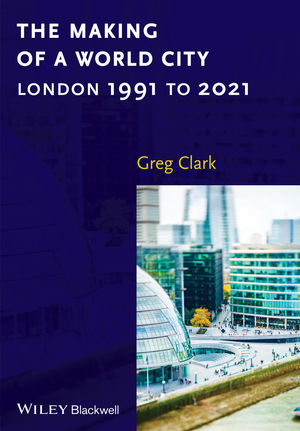
The Making of a World City (eBook)
248 Seiten
Wiley-Blackwell (Verlag)
978-1-118-60973-6 (ISBN)
After two decades of evolution and transformation, London had become one of the most open and cosmopolitan cities in the world. The success of the 2012 Olympics set a high water-mark in the visible success of the city, while its influence and soft power increased in the global systems of trade, capital, culture, knowledge, and communications.
The Making of a World City: London 1991 - 2021 sets out in clear detail both the catalysts that have enabled London to succeed and also the qualities and underlying values that are at play: London's openness and self-confidence, its inventiveness, influence, and its entrepreneurial zeal. London's organic, unplanned, incremental character, without a ruling design code or guiding master plan, proves to be more flexible than any planned city can be.
Cities are high on national and regional agendas as we all try to understand the impact of global urbanisation and the re-urbanisation of the developed world. If we can explain London's successes and her remaining challenges, we can unlock a better understanding of how cities succeed.
Greg Clark is a Londoner and expert on world cities. He works as an advisor to OECD, World Bank, Brookings Institution, ULI and more than 20 major cities around the world (including Auckland, Barcelona, Brisbane, Cape Town, Hong Kong, Johannesburg, Moscow, New York, Oslo, Rio de Janeiro, São Paulo, Singapore, Sydney and Toronto) but learned what he knows from working in London as a leader in city agencies during the period covered by this book. He has written four books for the OECD and several published reports for the Brookings Institution, British Council and ULI.
Greg Clark is a Londoner and expert on world cities. He works as an advisor to OECD, World Bank, Brookings Institution, ULI and more than 20 major cities around the world (including Auckland, Barcelona, Brisbane, Cape Town, Hong Kong, Johannesburg, Moscow, New York, Oslo, Rio de Janeiro, São Paulo, Singapore, Sydney and Toronto) but learned what he knows from working in London as a leader in city agencies during the period covered by this book. He has written four books for the OECD and several published reports for the Brookings Institution, British Council and ULI.
About the Author ix
Foreword by Martin Simmons xi
Preface by Rosemary Feenan and Robert Gordon Clark xiii
Acknowledgements xv
Section I London in 1991 - Setting the scene
1 Introduction: Honor Chapman and London:World City 3
2 London prior to 1991: The back story 11
Planning for a new world city 12
The rise of finance and a new rationale for post-industrial
London 13
A hiatus of government 16
The LDDC and a new era of pragmatism 16
3 The 1991 London:World City report and its message about
London 19
Old rivals, new rivals 22
An agenda for metropolitan governance 24
Brand new: The promotion of London 26
The future knowledge economy 29
Section II The evolution of London, 1991 to 2015
4 The internationalisation of London's economy
35
Internationalisation of London's labour force 39
The global financial crisis and after 43
5 Leadership, governance and policy 47
1997 and a new direction for metropolitan government 52
The London Plan: A global city strategy 56
London boroughs 59
Promoting London 60
London's governance today 66
6 Re-investment and urban regeneration 69
Cultural revitalisation of the South Bank: Lambeth, Southwark
and Greenwich 72
New regeneration powers from 2000 74
Regeneration in perspective 77
From de-industrial to post-industrial: Building a new experience
for markets, leisure and commerce 80
7 Corporate hub, officemarket and real estate 87
The rise and rise of tall buildings 88
The diffusion of London's office geography 89
The transformative impact of foreign capital 93
8 Homes and housing in London 99
Consensus but complacency in the 1990s 100
The London Plan and a new agenda for housing 101
London's housing predicament: Prospects and solutions
107
9 London's evolving infrastructure platform 111
The impact of TfL and citywide government on transport 113
From incrementalism to integration? 117
Section III London today and in the future
10 World cities today 121
Measuring world cities in 2015 125
Emerging world cities 128
Insights from benchmarks about short- and long-term city success
132
11 London in the next decade: Implications of the rise of
other world cities 135
Finance and business: Global leadership in a new context 138
Culture, diversity and destination 143
Higher education, technology and new sectors 145
Sustainability and liveability: Aspiration or reality? 149
Infrastructure, housing and skills 151
12 Investment in London: Challenges and solutions 159
London's relationship with the UK 160
London's constrained investment scene 162
The financial and investment capacity of London's five
principal rivals 166
London's fiscal position in perspective 169
13 Eight imperatives for London 175
14 Lessons from London for other cities 187
Appendix 195
Bibliography 197
Index 219
"The Making of a World City: London 1991 to 2021, by
leading global cities expert and Centre for London Associate Greg
Clark, which is published this month, seeks to remedy this by
considering how London got where it is today, and setting out the
challenges still facing us." (Centre for London,
10 December 2014)
The future of cities depends on their resilience. London -
messy, unplanned, organic and ungovernable - has become a
model of global city resilience. Anyone interested in
understanding the complexity of cities should read this
book.--Ricky Burdett, Professor of Urban Studies, London
School of Economics, Director, LSE Cities and Urban Age
In The Making of a World City: London 1991 to 2021 Greg Clark
draws on over 25 years of experience working within London policy
and economic development organisations, and on interviews with
around 100 leading thinkers about the past, present and future of
London, including commentators and leaders in New York, Tokyo, Hong
Kong, Paris, Singapore, and São Paulo.--Professor
Rosemary Scanlon, Dean, Shack Institute of Real Estate, New York
University
London has captured the world's imagination as a center
for financial, business, cultural, and social development. Greg
Clark has drawn on his own vast experience and that of leading
experts to write a must-read assessment one of the world's
most important cities.--Michael J. Enright, Sun Hung Kai
Professor, University of Hong Kong
The emerging world cities need to know the secrets and the
challenges of London, New York, Paris and Tokyo. This books helps
us to see London from the inside out, and it explains very clearly
how London became a leading world city.--Professor Miguel
Bucalem, Director, Centre for Cities, University of Sao
Paulo
London's rebirth as a leading World City is indeed a major
strategic achievement. Greg Clark's remarkable and positive account
of this story gives food for thought to other global cities, such
as Paris, who are following a different -less business
focused and more citizen oriented- path.--Paul
Lecroart, Senior Urban Planner, Paris Region Planning Agency (IAU
îdf)
Moscow's role as a global hub of business and finance is
evolving in ways which understand that culture, higher education,
and international promotion are critical ingredients for success.
The London story, as told by Greg Clark, reinforces these messages
and shows how former Imperial Cities can become great world cities
in the modern age.--Professor Andrei Sharonov, Dean,
Skolkovo Business School, Former Deputy Mayor of Moscow, Chairman
of Moscow Urban Forum
As Barcelona continues on its path towards to being a global
city in Europe, lessons from London become increasingly more
interesting and relevant. This book reveals London's formula
for global success in ways which educate and
entertain.--Mateu Hernandez, CEO, Barcelona Global
In this book Greg Clark tells the remarkable story of how London
reinvented itself over the past quarter century, making it, along
with New York, one of the world's two leading centers of commerce,
finance, communications and innovation.--Professor Bob
Yaro, President, Regional Plan Association of New York
Clark tells a fascinating story - how on old and seemingly tired
global city got a new lease of life - extremely well.--Ben
Rogers, Director, Centre for London.
| Erscheint lt. Verlag | 11.11.2014 |
|---|---|
| Sprache | englisch |
| Themenwelt | Technik ► Architektur |
| Wirtschaft ► Betriebswirtschaft / Management | |
| Schlagworte | Architecture • Architektur • Bauentwurf • become • Building Design • Business & Management • catalysts • City • city london • clear • Code • Cosmopolitan • decades • Design • Detail • Evolution • Flexible • Global • High • Immobilien u. Grundbesitz • Influence • London • Olympics • Plan • Planned • Power • Property & Real Estate • Stadtentwicklung • Success • Systems • Trade • two • Urban Development • visible • watermark • Wirtschaft u. Management • World |
| ISBN-10 | 1-118-60973-5 / 1118609735 |
| ISBN-13 | 978-1-118-60973-6 / 9781118609736 |
| Informationen gemäß Produktsicherheitsverordnung (GPSR) | |
| Haben Sie eine Frage zum Produkt? |
 PDF (Adobe DRM)
Kopierschutz: Adobe-DRM
Adobe-DRM ist ein Kopierschutz, der das eBook vor Mißbrauch schützen soll. Dabei wird das eBook bereits beim Download auf Ihre persönliche Adobe-ID autorisiert. Lesen können Sie das eBook dann nur auf den Geräten, welche ebenfalls auf Ihre Adobe-ID registriert sind.
Details zum Adobe-DRM
Dateiformat: PDF (Portable Document Format)
Mit einem festen Seitenlayout eignet sich die PDF besonders für Fachbücher mit Spalten, Tabellen und Abbildungen. Eine PDF kann auf fast allen Geräten angezeigt werden, ist aber für kleine Displays (Smartphone, eReader) nur eingeschränkt geeignet.
Systemvoraussetzungen:
PC/Mac: Mit einem PC oder Mac können Sie dieses eBook lesen. Sie benötigen eine
eReader: Dieses eBook kann mit (fast) allen eBook-Readern gelesen werden. Mit dem amazon-Kindle ist es aber nicht kompatibel.
Smartphone/Tablet: Egal ob Apple oder Android, dieses eBook können Sie lesen. Sie benötigen eine
Geräteliste und zusätzliche Hinweise
Buying eBooks from abroad
For tax law reasons we can sell eBooks just within Germany and Switzerland. Regrettably we cannot fulfill eBook-orders from other countries.
aus dem Bereich