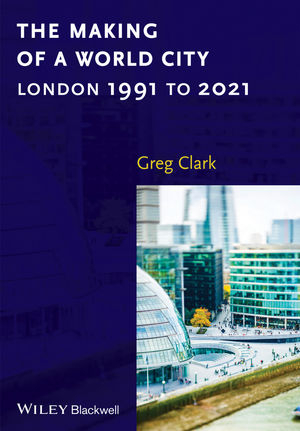
The Making of a World City (eBook)
John Wiley & Sons (Verlag)
978-1-118-60972-9 (ISBN)
In 1986 the UK Government abolished city government in London, and there was a vacuum of ideas and directions for the future of this once great city. But somehow London flourished and in 1991 the word ‘world city’ was used to describe its agenda or the future in a ground breaking report. 20 years later London is the leading city in the world. How did they do that?
The text is based around interviews with 60 key urban thinkers and practitioners from around the world, backed up by data and charts, regarding their views on London’s past, current and future position and challenges as a World City.
The study was inspired by the untimely death of Honor Chapman and has been funded by 5 of the property markets’ key players, Grosvenor, Land Securities, Great Portland Estates, the London Communications Agency and ourselves. Honor was renowned and highly respected for her analysis and insights into cities and their property markets and her involvement in the original 1991 book, London World City was testament to this. The recommendations that came from that project laid many of the foundations of modern city marketing and certainly were instrumental in making London what it is today.
The study gives a detailed guide to how London’s governance was set up and of the stages of the cities evolution, as well as thoughts from many of the world’s leading urban thinkers on where to go from here. Cities are of course high on national and regional agendas at the moment as we all try to work out the impact of urbanisation; for this reason we feel that there is a ready international market for understanding “how London did it” and what it will do next.
Greg Clark … is a Londoner and expert on world cities. He works as an city advisor to OECD, World Bank, Brookings Institution, ULI and more than 20 major cities around the world (including Auckland, Barcelona, Cape Town, Hong Kong, Johannesburg, Moscow, New York, Oslo, Rio de Janeiro, São Paulo, Singapore, and Toronto) but learned what he knows from working for 15 years in London as a leader in city agencies during the period covered by this book. He has written four books for the OECD and several published reports for the Brookings Institution, British Council and ULI. |
After two decades of evolution and transformation, London had become one of the most open and cosmopolitan cities in the world. The success of the 2012 Olympics set a high water-mark in the visible success of the city, while its influence and soft power increased in the global systems of trade, capital, culture, knowledge, and communications. The Making of a World City: London 1991 - 2021 sets out in clear detail both the catalysts that have enabled London to succeed and also the qualities and underlying values that are at play: London's openness and self-confidence, its inventiveness, influence, and its entrepreneurial zeal. London s organic, unplanned, incremental character, without a ruling design code or guiding master plan, proves to be more flexible than any planned city can be. Cities are high on national and regional agendas as we all try to understand the impact of global urbanisation and the re-urbanisation of the developed world. If we can explain London's successes and her remaining challenges, we can unlock a better understanding of how cities succeed.
Greg Clark is a Londoner and expert on world cities. He works as an advisor to OECD, World Bank, Brookings Institution, ULI and more than 20 major cities around the world (including Auckland, Barcelona, Brisbane, Cape Town, Hong Kong, Johannesburg, Moscow, New York, Oslo, Rio de Janeiro, São Paulo, Singapore, Sydney and Toronto) but learned what he knows from working in London as a leader in city agencies during the period covered by this book. He has written four books for the OECD and several published reports for the Brookings Institution, British Council and ULI.
About the Author ix
Foreword by Martin Simmons xi
Preface by Rosemary Feenan and Robert Gordon Clark xiii
Acknowledgements xv
Section I London in 1991 - Setting the scene
1 Introduction: Honor Chapman and London:World City 3
2 London prior to 1991: The back story 11
Planning for a new world city 12
The rise of finance and a new rationale for post-industrial
London 13
A hiatus of government 16
The LDDC and a new era of pragmatism 16
3 The 1991 London:World City report and its message about
London 19
Old rivals, new rivals 22
An agenda for metropolitan governance 24
Brand new: The promotion of London 26
The future knowledge economy 29
Section II The evolution of London, 1991 to 2015
4 The internationalisation of London's economy
35
Internationalisation of London's labour force 39
The global financial crisis and after 43
5 Leadership, governance and policy 47
1997 and a new direction for metropolitan government 52
The London Plan: A global city strategy 56
London boroughs 59
Promoting London 60
London's governance today 66
6 Re-investment and urban regeneration 69
Cultural revitalisation of the South Bank: Lambeth, Southwark
and Greenwich 72
New regeneration powers from 2000 74
Regeneration in perspective 77
From de-industrial to post-industrial: Building a new experience
for markets, leisure and commerce 80
7 Corporate hub, officemarket and real estate 87
The rise and rise of tall buildings 88
The diffusion of London's office geography 89
The transformative impact of foreign capital 93
8 Homes and housing in London 99
Consensus but complacency in the 1990s 100
The London Plan and a new agenda for housing 101
London's housing predicament: Prospects and solutions
107
9 London's evolving infrastructure platform 111
The impact of TfL and citywide government on transport 113
From incrementalism to integration? 117
Section III London today and in the future
10 World cities today 121
Measuring world cities in 2015 125
Emerging world cities 128
Insights from benchmarks about short- and long-term city success
132
11 London in the next decade: Implications of the rise of
other world cities 135
Finance and business: Global leadership in a new context 138
Culture, diversity and destination 143
Higher education, technology and new sectors 145
Sustainability and liveability: Aspiration or reality? 149
Infrastructure, housing and skills 151
12 Investment in London: Challenges and solutions 159
London's relationship with the UK 160
London's constrained investment scene 162
The financial and investment capacity of London's five
principal rivals 166
London's fiscal position in perspective 169
13 Eight imperatives for London 175
14 Lessons from London for other cities 187
Appendix 195
Bibliography 197
Index 219
"The Making of a World City: London 1991 to 2021, by
leading global cities expert and Centre for London Associate Greg
Clark, which is published this month, seeks to remedy this by
considering how London got where it is today, and setting out the
challenges still facing us." (Centre for London,
10 December 2014)
The future of cities depends on their resilience. London -
messy, unplanned, organic and ungovernable - has become a
model of global city resilience. Anyone interested in
understanding the complexity of cities should read this
book.--Ricky Burdett, Professor of Urban Studies, London
School of Economics, Director, LSE Cities and Urban Age
In The Making of a World City: London 1991 to 2021 Greg Clark
draws on over 25 years of experience working within London policy
and economic development organisations, and on interviews with
around 100 leading thinkers about the past, present and future of
London, including commentators and leaders in New York, Tokyo, Hong
Kong, Paris, Singapore, and São Paulo.--Professor
Rosemary Scanlon, Dean, Shack Institute of Real Estate, New York
University
London has captured the world's imagination as a center
for financial, business, cultural, and social development. Greg
Clark has drawn on his own vast experience and that of leading
experts to write a must-read assessment one of the world's
most important cities.--Michael J. Enright, Sun Hung Kai
Professor, University of Hong Kong
The emerging world cities need to know the secrets and the
challenges of London, New York, Paris and Tokyo. This books helps
us to see London from the inside out, and it explains very clearly
how London became a leading world city.--Professor Miguel
Bucalem, Director, Centre for Cities, University of Sao
Paulo
London's rebirth as a leading World City is indeed a major
strategic achievement. Greg Clark's remarkable and positive account
of this story gives food for thought to other global cities, such
as Paris, who are following a different -less business
focused and more citizen oriented- path.--Paul
Lecroart, Senior Urban Planner, Paris Region Planning Agency (IAU
îdf)
Moscow's role as a global hub of business and finance is
evolving in ways which understand that culture, higher education,
and international promotion are critical ingredients for success.
The London story, as told by Greg Clark, reinforces these messages
and shows how former Imperial Cities can become great world cities
in the modern age.--Professor Andrei Sharonov, Dean,
Skolkovo Business School, Former Deputy Mayor of Moscow, Chairman
of Moscow Urban Forum
As Barcelona continues on its path towards to being a global
city in Europe, lessons from London become increasingly more
interesting and relevant. This book reveals London's formula
for global success in ways which educate and
entertain.--Mateu Hernandez, CEO, Barcelona Global
In this book Greg Clark tells the remarkable story of how London
reinvented itself over the past quarter century, making it, along
with New York, one of the world's two leading centers of commerce,
finance, communications and innovation.--Professor Bob
Yaro, President, Regional Plan Association of New York
Clark tells a fascinating story - how on old and seemingly tired
global city got a new lease of life - extremely well.--Ben
Rogers, Director, Centre for London.
1
Introduction: Honor Chapman and London: World City
In 1991, the London Planning Advisory Committee published London: World City Moving into the 21st Century (hereafter London: World City). The content of this report was groundbreaking, and its impact on London's business and policy community considerable. It is no exaggeration to describe it as helping to usher in a new chapter in London's 2000-year history.
Published at the beginning of a new era for an enlarged global economy, London: World City recognised London's evolving role as an international urban centre. Its authors identified growing competitive pressures as other European, North American and East Asian cities proactively pursued internationalisation, and sought hub status among firms in financial services and other sectors of strategic significance. The report, researched and prepared through dialogue with a wide range of experts and overseen by London's local government and business leaders, argued strongly for London to adopt purposeful measures to promote itself internationally.
Honor Chapman, a towering figure in the city's real estate industry and a pioneer in applying the tools of competitive business analysis to the world of commercial real estate, applied this approach to thinking about London's competitive position. During 1992, she led a detailed study at Jones Lang Wootton on how London could respond to the new global challenge. A year later, this work was adopted by the newly-formed business leadership organisation London First, and detailed work began to be undertaken to prepare London's response. With support from central government, and with backing from the City of London, the City of Westminster, London Docklands Development Corporation and others, London First created London First Centre, a new inward investment centre (now integrated with London's tourism and higher education promotion and known as London & Partners). Honor Chapman was appointed its first Chief Executive, serving for three years before joining its Board as a non-Executive Director.
The premise of this book is that the activity and vision of Honor Chapman and London's business and real estate community helped steer London into a new cycle of internationalisation which was crowned by the 2012 Olympic Games, and whose effects will see London's population likely reach a landmark nine million for the first time in 2021. In the intervening period, the city became a place of unique appeal. It experienced exceptional demand for investment opportunities and corporate locations, for its labour market and higher education institutions, and as a destination of entertainment and culture. London's civil society, political leadership and commercial stakeholders all fostered an unprecedented global reach and cosmopolitan identity. In doing so, they have reaffirmed the city's open and organic character, in which change occurs in incremental, unexpected and exciting ways.
In 2015, with the Olympics now a fond memory and a new global business cycle well under way, there is a consensus that London is once again moving full steam ahead. But with a new cycle comes new challenges. London's historic strengths, and its progress since London: World City, will not, on their own, be sufficient to guarantee success in the medium-term future. Success has brought with it a new set of tasks, the unintended consequences of getting other things right. The nature of the challenges has changed, the emerging global system of cities is different to that of 1991 and many more cities are empowered to compete. The city development tools of the late 20th and early 21st centuries have proved to be effective only for certain problems. As such, London's model of success is incomplete, because it has not yet shown the capacity to manage and accommodate the growth that accompanies the additional demand stimulated for a thriving world city. The research and interviews conducted for this book have revealed an imperative for the activation of a new phase of innovation and ambition, especially (but not only) in the areas of governance, investment, housing and structural disadvantage.
The impulse for a new and positive direction for London is driven by competitive challenges: challenges to practically every role that the city plays, and from a larger number of competent urban service providers than ever before. In this book, three dimensions to this external landscape of competition are highlighted. First, other leading cities are addressing their own development challenges with new verve. New York, Paris, Hong Kong, Tokyo and Singapore are all formulating new niches, metropolitan solutions and development paths. Second, the principal cities in the fastest-growing markets now offer provision that overlaps with London in ways not previously anticipated. Dubai is now a world-class hub for aviation and Islamic finance, Shanghai a new banking and trading powerhouse, and Mumbai a capital of creative industries. Third, established European business cities such as Stockholm, Zurich, Munich, Amsterdam, Frankfurt and Basel offer attractive alternative locations in fields where London has been seeking to grow its role, such as environmental technologies, digital innovation, life sciences and design.
This book argues that London has highly distinctive, indeed inimitable, attributes that make it more resilient than most to the caprices of global competition. But it is nevertheless a reality in 2015 that many urban centres within and beyond Europe have the capacity to invest more, to deliver major developments faster, to coordinate and manage growth better, to address inclusion more effectively, and to draw on consistent and long-term financial flows and instruments. As I detail in Chapter 5, London's incremental governance empowerment has achieved significant outcomes, but there has not been sufficient progress to ensure the city's current demand bubble is translated into a commercial, social and environmental sustainability.
The concluding section of the book details the central aspects of London's current model whose modification may impact on the city's future success. Three of these elements are mentioned here. First, London's business environment has been a forceful driver of growth since the mid-1990s, but it is not so compelling on its own that it can automatically facilitate the economic growth and diversification needed to support investment and to grow the base of jobs. The city's business image and identity is regularly undermined by infrastructural systems deficits and occasional unrest. There is also a persistent tension and chronic uncertainty in the relationship between the city's commercial nucleus, on the one hand, and the national government, European regulators, and even the local and national electorate on the other.
Second, London's governance arrangements are not optimally configured to tackle inequality and exclusion in jobs and skills, or to upgrade patchy provision in housing, health care, and other amenities. There are constraints that inhibit the pursuit of more than one major infrastructure project at a time, principally the fact that such projects require national support. The city's local and metropolitan governments have very limited access to capital markets to raise the finance with which to invest in and improve infrastructure, and this is compounded by a narrow scope to integrate systems of infrastructure and utilities (largely a result of mass privatisation or ongoing national control) and achieve more efficient outcomes.
Third, London's relationship with the rest of the UK, including both its role and contribution to national development as the capital city and gateway, and its partnership with the other major cities, is poorly defined and disorganised. The capital's reputation is emerging from a cyclical low because of the banking sector's perceived contribution to the financial crisis and the initially lethargic character of the economic recovery, and the perception that this recovery is dominated by the London and the Greater South East. There remains a lack of any regional dimension of governance in the ‘Greater South East’ of England, which means London cannot easily manage growth and change with its interdependent neighbouring areas.
These three themes are just a snapshot of the factors which prevent London from leveraging intense international demand into all-round success. On the one hand, this book explains and affirms London's enduring virtues of openness, meritocracy, diversity, language and legal systems, learned institutions and knowledge creation, geo-political location, business culture, and tolerance of edginess, hedonism, and the avant-garde. On the other, it argues that London is not yet equipped to fully realise its potential, and that its weaknesses may be exposed in abrupt and unpredictable ways. The book makes the case that the period since the London: World City report witnessed a remarkable set of achievements, but that in some areas the city achieved only partial success whilst in others it only addressed the first phase of ‘permanent improvement agendas’ which are never complete.
This book advocates that London can learn from other cities as much as it inspires them. The city can draw inspiration from world cities which have effectively tackled problems that are similar in character. Hong Kong has successfully...
| Erscheint lt. Verlag | 16.10.2014 |
|---|---|
| Sprache | englisch |
| Themenwelt | Technik ► Architektur |
| Wirtschaft ► Betriebswirtschaft / Management | |
| Schlagworte | Architecture • Architektur • Bauentwurf • become • Building Design • Business & Management • catalysts • City • city london • clear • Code • Cosmopolitan • decades • Design • Detail • Evolution • Flexible • Global • High • Immobilien u. Grundbesitz • Influence • London • Olympics • Plan • Planned • Power • Property & Real Estate • Stadtentwicklung • Success • Systems • Trade • two • Urban Development • visible • watermark • Wirtschaft u. Management • World |
| ISBN-10 | 1-118-60972-7 / 1118609727 |
| ISBN-13 | 978-1-118-60972-9 / 9781118609729 |
| Informationen gemäß Produktsicherheitsverordnung (GPSR) | |
| Haben Sie eine Frage zum Produkt? |
 EPUB (Adobe DRM)
Kopierschutz: Adobe-DRM
Adobe-DRM ist ein Kopierschutz, der das eBook vor Mißbrauch schützen soll. Dabei wird das eBook bereits beim Download auf Ihre persönliche Adobe-ID autorisiert. Lesen können Sie das eBook dann nur auf den Geräten, welche ebenfalls auf Ihre Adobe-ID registriert sind.
Details zum Adobe-DRM
Dateiformat: EPUB (Electronic Publication)
EPUB ist ein offener Standard für eBooks und eignet sich besonders zur Darstellung von Belletristik und Sachbüchern. Der Fließtext wird dynamisch an die Display- und Schriftgröße angepasst. Auch für mobile Lesegeräte ist EPUB daher gut geeignet.
Systemvoraussetzungen:
PC/Mac: Mit einem PC oder Mac können Sie dieses eBook lesen. Sie benötigen eine
eReader: Dieses eBook kann mit (fast) allen eBook-Readern gelesen werden. Mit dem amazon-Kindle ist es aber nicht kompatibel.
Smartphone/Tablet: Egal ob Apple oder Android, dieses eBook können Sie lesen. Sie benötigen eine
Geräteliste und zusätzliche Hinweise
Buying eBooks from abroad
For tax law reasons we can sell eBooks just within Germany and Switzerland. Regrettably we cannot fulfill eBook-orders from other countries.
aus dem Bereich