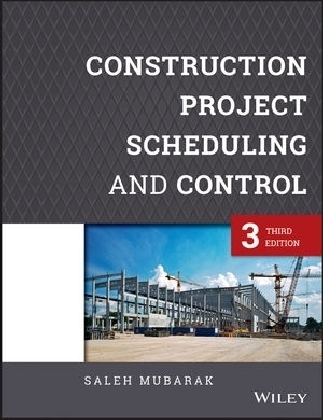
Construction Project Scheduling and Control
John Wiley & Sons Inc (Verlag)
978-1-118-84600-1 (ISBN)
- Titel erscheint in neuer Auflage
- Artikel merken
Bad scheduling can doom a construction project from the start Construction Project Scheduling and Control provides a comprehensive examination of the analytical methods used to devise a reasonable, efficient, and successful schedule for construction projects of all sizes. This updated third edition contains new information on building image modeling (BIM) and its relationship to project scheduling and control, as well as thorough coverage of the latest developments in the field. Written by a career construction professional, this informative text introduces students to new concepts in CPM scheduling, including the author's own Dynamic Minimum Lag technique. The expanded glossary and acronym list facilitate complete understanding, and the numerous solved and unsolved problems help students test their knowledge and apply critical thinking to issues in construction scheduling. A complete instructor's manual provides solutions to all problems in the book, test questions for each chapter, and additional exam questions for more comprehensive testing.
The entire success of a construction process hinges on an efficient, well-thought out schedule, which is strictly defined while allowing for inevitable delays and changes. This book helps students learn the processes, tools, and techniques used to make projects run smoothly, with expert guidance toward the realities of this complex function.
Discover realistic scheduling solutions and cutting edge methods
Learn the duties, responsibilities, and techniques of project control
Get up to date on the latest in sustainability, BIM, and lean construction
Explore the software tools that help coordinate scheduling
Scheduling encompasses everything from staff requirements and equipment needs to materials delivery and inspections, requiring a deep understanding of the process. For the student interested in construction management, Construction Project Scheduling and Control is an informative text on the field's current best practices.
SALEH MUBARAK, PHD, is an independent consultant in the field of construction project management, based in Tampa, Florida, focusing on training, writing, public speaking, and consulting. He is a former professor at a number of universities and an active member of PMI and AACE International. He served on the PMI committee that created the professional scheduler certification exam, PSP. He has more than 25 years of diversified and international experience including academia and industry; private and public sectors. He is also the author of How to Estimate with RSMeans Data, published by Wiley.
Preface ix
Preface to the First Edition xiii
Chapter 1 Introduction 1
Planning and Scheduling 2
Project Control 8
Why Schedule Projects? 8
The Scheduler 10
Scheduling and Project Management 12
Chapter 1 Exercises 12
Chapter 2 Bar (Gantt) Charts 15
Definition and Introduction 16
Advantages of Bar Charts 19
Disadvantages of Bar Charts 20
Chapter 2 Exercises 21
Chapter 3 Basic Networks 23
Definition and Introduction 24
Arrow Networks 24
Node Networks 32
Comparison of Arrow and Node Networks 38
Networks versus Bar Charts 39
Time-Scaled Logic Diagrams 40
Chapter 3 Exercises 41
Chapter 4 The Critical Path Method (CPM) 45
Introduction 46
Steps Required to Schedule a Project 47
Supplemental Steps 54
Resource Allocation and Leveling 56
Beginning-of-Day or End-of-Day Convention 58
The CPM Explained through Examples 58
Logic and Constraints 81
Chapter 4 Exercises 84
Chapter 5 Precedence Networks 91
Definition and Introduction 92
The Four Types of Relationships 95
The Percent Complete Approach 96
Fast-Track Projects 97
A Parallel Predecessor? 99
CPM Calculations for Precedence Diagrams 100
The Detailed Approach 108
The Critical Path Revisited 117
Final Discussion 117
Chapter 5 Exercises 119
Chapter 6 Resource Allocation and Resource Leveling 123
Introduction 124
The Three Categories of Resources 124
What Is Resource Allocation? 125
Resource Leveling 125
Materials Management 148
Chapter 6 Exercises 151
Chapter 7 Schedule Updating and Project Control 155
Introduction 156
The Need for Schedule Updating 156
Project Control Defined 156
Schedule Updating 157
Project Control 184
Chapter 7 Exercises 205
Chapter 8 Schedule Compression and Time-Cost Trade-Off 211
Introduction 212
Setting Priorities 213
Accelerating a Project 213
Construction versus Manufacturing 221
Direct and Indirect Costs 224
Recovery Schedules 231
Accelerating Projects Using Computers 236
Potential Issues with Uncoordinated Project
Acceleration 237
Chapter 8 Exercises 244
Chapter 9 Reports and Presentations 247
Introduction 248
The Difference between Reports and Presentations 252
Skills Necessary for Giving Good Presentations 254
The Power of Presentations 255
Reviewing Reports before and after Printing 257
General Tips on Printing Reports 258
Summary Reports 259
Paper or Electronic Reports? 259
E-Reports 262
Communications in the International Environment 263
Chapter 9 Exercises 264
Chapter 10 Scheduling as Part of the Project Management Effort 267
Introduction 268
Project Objectives 269
Defining and Measuring Project Success 270
Scheduling and Estimating 271
Estimating and Accounting 278
Scheduling and Accounting 279
Scheduling and Change Orders 280
Paperless Project Management 281
Procurement Management 281
Management of Submittals 283
The Master Schedule and Subschedules 284
Multiproject Management 286
Time Contingency and Management Options 287
Chapter 10 Exercises 290
Chapter 11 Other Scheduling Methods 291
Introduction 292
Program Evaluation and Review Technique (PERT) 292
Graphical Evaluation and Review Technique (GERT) 309
Linear Scheduling Method (LSM) 310
LSM and Project Schedule Acceleration 316
Chapter 11 Exercises 326
Chapter 12 Dynamic Minimum Lag Relationship 329
Introduction 330
Similarity between the DML Concept and the Linear Scheduling Method (LSM) 331
How Does DML Work? 332
DML Relationship in CPM Calculations 334
Conclusion 340
Chapter 12 Exercises 342
Chapter 13 Construction Delay and Other Claims 343
Preface 344
Introduction 344
Delay Claims 344
Reasons for Claims 346
Force Majeure 348
Types of Delays 349
Scheduling Mistakes Related to Delay Claims 350
Project Documentation 353
Delay Claims Resolution 356
The Importance of CPM Schedules in Delay Claims 358
Methods of Schedule Analysis 359
Chapter 13 Exercises 366
Chapter 14 Schedule Risk Management 367
Introduction 368
Types of Risk in Construction Projects 369
Schedule Risk Types 369
Definition of Risk Terms 375
Importance of Good Planning for Risk Management 377
Importance of Good CPM Scheduling Practices for Risk Assessment 377
Risk Shifting in Contracts 379
Schedule Risk Management Steps 381
Expected Value 387
Application in Scheduling 388
Examples of Risk Adjustment 389
Conclusion 390
Chapter 14 Exercises 390
Chapter 15 BIM-Based 4D Modeling and Scheduling 393
Overview of the Building Information Modeling (BIM) 393
Case Study 399
Chapter 15 Exercises 420
Appendix A Computer Project 421
General Guidelines 421
Cost Loading 426
Updating the Project 428
Change Order 429
Resource Leveling 430
Schedule Compression 431
Schedule Compression 2 433
Delay Claim 1: Unforeseen Conditions 433
Delay Claim 2: Change in the Owner’s Requirements 433
Appendix B Sample Reports 435
Tabular Reports 435
Graphic Reports 453
Abbreviations 464
Glossary 469
References 493
Bibliography 498
Index 505
| Erscheint lt. Verlag | 28.4.2015 |
|---|---|
| Verlagsort | New York |
| Sprache | englisch |
| Maße | 193 x 234 mm |
| Gewicht | 1066 g |
| Themenwelt | Technik ► Bauwesen |
| Wirtschaft ► Betriebswirtschaft / Management ► Unternehmensführung / Management | |
| ISBN-10 | 1-118-84600-1 / 1118846001 |
| ISBN-13 | 978-1-118-84600-1 / 9781118846001 |
| Zustand | Neuware |
| Informationen gemäß Produktsicherheitsverordnung (GPSR) | |
| Haben Sie eine Frage zum Produkt? |
aus dem Bereich