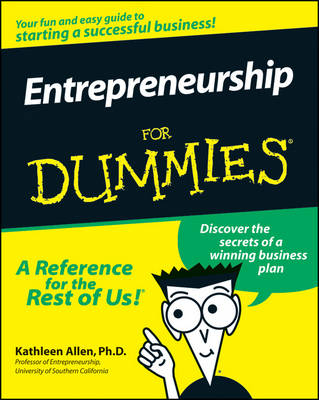
Entrepreneurship For Dummies
For Dummies (Verlag)
978-0-7645-5262-5 (ISBN)
- Titel erscheint in neuer Auflage
- Artikel merken
Thought of the perfect business idea but unsure how to start a company? Achieve your goal of entrepreneurship with this no-nonsense business guide as your partner
Today's business marketplace is filled with news of small businesses and online entrepreneurs making it big. Maybe you have a great idea for a business but little acumen when it comes to launching a business. Entrepreneurship For Dummies has what you need to get started in business in one concise and plainly written package.
From developing an opportunity and coming up with a concept to creating the company, this user-friendly book guides you step-by-step along the path to entrepreneurial success. Find out what's necessary to create a successful business: from creating a business plan, to learning how to know your customer, testing and protecting your product, and finally launching your business. You'll discover how to
Determine the best legal structure for your business
Write a financial plan and find investors
Choose a business model for your company
Hire the right team members to help you achieve your goals
Plan for future growth with the organizational model for you
Develop your company's branding and marketing strategy
Get your products and services to your customers
Prepare for unforeseen challenges
And so much more
Additionally, to ensure you're as prepared as you can be to launch your start-up, you'll learn reasons why not to start a business and ideas to spark your entrepreneurial spirit. With help on how to analyze your competitors and tips for using the internet to grow your business, Entrepreneurship For Dummies is sure to help you chase your dreams. Get your own copy today and make those dreams a reality.
Kathleen Allen, Ph.D., is a professor of entrepreneurship at USC. Her books include The Complete MBA For Dummies and eBusiness Technology Kit For Dummies.
Introduction 1
How Entrepreneurship Has Changed 1
How Entrepreneurs Define Success 2
About This Book 3
Foolish Assumptions 3
Icons Used in This Book 4
How This Book Is Organized 4
Part I: Getting Started in Entrepreneurship 4
Part II: Developing Your Business Concept 5
Part III: Creating a Company 5
Part IV: Growing a Company 5
Part V: The Part of Tens 5
How to Use This Book 6
Part I: Getting Started in Entrepreneurship 7
Chapter 1: What’s an Entrepreneur, Anyway? 9
Understanding Entrepreneurship 9
Recognizing an entrepreneurial venture 10
Putting together the pieces of an entrepreneurial venture 12
Distinguishing entrepreneurial ventures from small businesses 14
Tasting the Many Flavors of Entrepreneurship 15
The home-based entrepreneur 15
The virtual entrepreneur 16
The serial entrepreneur 17
The traditional entrepreneur 17
Deciding to Become an Entrepreneur 18
Consider your personal goals 18
Look ahead 20
Chapter 2: Moving at the Speed of E-Business 21
Everyone Runs an E-Business 22
The Internet Gives You an Edge 22
Scaling out = Competitive advantage 23
Harnessing technology = Competitive advantage 23
Turning information into knowledge = Competitive advantage 24
Breaking the Link between Information and Things 25
Sharing Information (And Everything Else) 26
Communication keeps getting easier, freer 26
Hierarchy is out, network is in 27
Everyone’s Value Chain Is Shorter 27
Making Yourself Obsolete (Before Someone Else Does It for You) 28
Changing the Way You Buy Things 29
Deconstructing the Company 30
Giving up control 31
Getting flexible and fast 31
Technology Disrupts; That’s Good 32
Chapter 3: Preparing to Hear When Opportunity Knocks 33
Starting to “Cook” on an Idea 34
1 Changing a business 34
2 Solving a problem with creativity 35
Spotting Obstacles in Your Path 35
You think you’re not creative (Think again!) 36
You loathe criticism (Well don’t we all?) 36
You’re a creature of habit 36
You lack confidence 37
You’re overconfident (jumbo ego) 37
Clearing Away the Obstacles 37
Going back to familiar territory 38
Finding a problem and solving it 38
Using your personal network 39
Making time to be creative 41
Finding a favorite thinking space 41
Playing with toys, games, and kids 41
Growing Ideas with Outside Help 42
Finding Opportunity in Failure 43
Finding Opportunity in the Unconventional 43
Finding the Right Place for Innovation 44
Making the environment friendly 44
Chapter 4: Testing an Opportunity Before You Leap 45
Starting with a Personal Assessment 46
Turning an Opportunity into a Business Concept 47
Benefits versus features: What does the customer buy? 48
Why isn’t money part of the concept? 49
Quick-Testing Your Concept 50
Getting Serious: Doing Feasibility Analysis 51
Feasibility versus business plan: Double the work? 53
An overview of feasibility analysis 54
Part II: Developing Your Business Concept 57
Chapter 5: Listening to What Your Industry Tells You 59
Understanding Your Industry 60
Using a framework of industry structure 61
Deciding on an entry strategy 64
Researching an Industry 66
Checking out the status of your industry 67
Competitive intelligence: Checking out the competition 68
Benchmarking Against the Perfect Industry 72
Chapter 6: What Your Customers Can Tell You 73
Defining Your Niche 73
Narrowing your market 74
Developing a niche strategy 76
Researching Your Customers 77
Figuring out what data you need 77
Looking at secondary sources first 78
Doing primary research to get the best information 79
Putting together a customer profile 82
Forecasting Demand: Tough but Crucial 83
Triangulating to Demand 85
Using substitute products and services to gauge demand 85
Interviewing customers and intermediaries 85
Going into limited production with a test market 86
Chapter 7: Designing Products and Services for a New Marketplace 87
Zeroing-in on a New Product 88
Become an inventor 88
Team with an inventor 89
License an invention 89
Thinking Realistically about Product Development 91
Finding the money 91
Developing new products: The process 95
Moving Fast to Prototype Stage 99
Designing right 99
Sourcing your materials 101
Making your product 102
The One-Minute Product Plan 102
Chapter 8: Protecting Your Products and Services 103
Patenting Your Better Mousetrap 104
Timing is everything 104
Is it patentable? 105
Types of patents 106
The patent process 107
Copyrighting Your Original Work of Authorship 110
Claiming copyright 110
Things you can’t copyright 111
Protecting Your Logo: A Trademark 112
Guarding Your Interests 113
Contracts 113
Nondisclosure agreements 114
Strategies for Protecting Your IP 115
Offensive strategies 116
Defensive strategies 118
Chapter 9: Getting Products and Services to Customers: Distribution 121
Outsourcing Logistics 122
Creating Your Distribution Strategy 123
Distributing through Market Channels 125
Consumer channels 125
Industrial channels 127
Using Intermediaries 127
Evaluating Your Channel 128
The cost of the channel 128
Channel coverage 130
Distribution control 130
Chapter 10: Putting Together Your Start-up Team 131
Finding Your Start-up Partners 132
The rules with family and friends 132
Covering all the bases 133
Putting everything in writing 133
Benchmarking the perfect team 134
Forming a Board of Advisors 134
Yes, you need attorneys 135
Accountants can help you survive 136
Your banker can be your friend 138
Don’t forget your insurance broker 139
Putting together an advisory board 140
Forming a Board of Directors 142
Deciding when you need a formal board 142
Creating a personal board — your mentors 144
Pulling Yourself Up by the Bootstraps 144
Outsourcing savvy 146
Leasing your staff 146
Chapter 11: Assessing Your Start-up Financial Needs 149
Estimating How Much You Will Sell 150
Getting a three-way fix on demand 151
Forecasting your sales 151
Calculating How Much You Will Spend 152
Cost of goods produced 152
General and administrative expenses 153
Taxes 153
Preparing Financial Statements 153
Calculating profit and loss — the income statement 154
Forecasting your cash flow 157
Planning to Break Even 162
Figuring How Much Money You Need 162
Taking a virtual tour of your business 163
Looking at the money you will need to spend 164
Thinking about your business in stages 165
Putting It All Together 165
The one-minute financial plan 168
Part III: Creating a Company 169
Chapter 12: Getting Ready to Do a Business Plan 171
Drawing a Conclusion about Feasibility 171
Looking at the Who, What, Where, and Why of Business Plans 172
Addressing the needs of your audience 173
Using a guideline-outline 177
Getting Started with a Vision 181
Finding the Big Mission 182
Looks Count: Preparing and Presenting the Plan 182
Making the plan look good 183
Presenting your plan 184
The one-minute business plan 186
Chapter 13: Finding Money to Start and Grow Your Venture 187
Starting with a Plan 188
When you’re financing a traditional business 189
When you’re financing for e-commerce 190
Tapping Friends, Family, and Lovers 191
Finding an Angel 192
How to spot an angel 192
How to deal with angels 193
Daring to Use Venture Capital 194
Calculating the real cost of money 195
Tracking the venture capital process 196
Selling Stock to the Public: An IPO 198
Considering the advantages and disadvantages of going public 199
Deciding to go for it 200
Finding Other Ways to Finance Growth 202
Chapter 14: Starting with the Right Legal Structure 205
Deciding on the Best Legal Form for Your Business 205
Understanding the factors that affect your choice 206
Going It Alone: The Sole Proprietorship 207
Advantages of sole proprietorships 207
Disadvantages of sole proprietorships 208
Choosing a Partner: The Partnership 209
Forming a partnership 210
The partnership agreement 210
Going for the Gold: The Corporation 211
Enjoying the benefits of a corporation 212
Weighing the risks 213
Where and how to incorporate 214
Looking for Flexibility: The S Corporation, the LLC, and the Nonprofit Corporation 215
Sizing up the S Corporation 215
Comparing the S Corporation with the LLC 216
Making profits in a nonprofit organization 217
Benchmarking Your Best Choice 218
Chapter 15: Developing a Business Model for a Digital World 219
Producing Several Models from One Product or Service 219
Your consulting company 220
Your software company 220
Your movie theater 221
Your restaurant 221
Looking for Another Gillette 222
Improving on the Bricks-and-Mortar Model 223
Providing a service with an upside 223
Making money while you sleep 227
Flying High and Fast with Internet Models 228
Taking a chance on clicks and hits 228
Using a subscription-based model 229
Growing a hybrid with clicks and bricks 230
Having it all with clicks and mortar 231
Thinking small 232
Part IV: Growing a Company 233
Chapter 16: Planning for Growth 235
Identifying Factors That Affect Growth 236
Starting with Some Basic Growth Strategies 237
Growing within Your Current Market 239
Building out your customer base 239
Developing your market 239
Developing your product 241
Branding your company 241
Growing within Your Industry 242
Moving vertically in your channel 243
Moving horizontally in your channel 243
Creating a network in your industry 244
Diversifying Outside Your Industry 244
Capitalizing on the synergy of like businesses 244
Acquiring an unrelated business 245
Going Global to Grow 245
Deciding if you’re ready 246
Finding great global markets 247
Getting help 248
Using the Internet to go global 249
Growing as a High Tech Company 250
Finding the early adopters 251
Getting to mainstream adoption 251
Surviving mainstream adoption 251
Chapter 17: Organizing Your Business for Growth 253
Moving from Entrepreneurship to Professional Management 254
Discovering your company’s culture 255
Developing a human resource policy 256
Organizing for Speed and Flexibility 258
Organizing around teams 258
Taking your company online 260
Finding and Keeping Great People 261
Recruiting the right people 262
Choosing the right candidate 264
Recruiting an experienced CEO for an e-business 267
Chapter 18: Reaching the Customer 269
Marketing to Customers, One at a Time 270
Using the customer to build your market strategy 271
Using technology to build your market strategy 272
Using the Internet to build a market strategy 273
Creating a Marketing Plan 276
Preparing to plan 277
Writing a one-paragraph marketing plan 277
Defining your customer 279
Doing your market research 280
Building and protecting your brand 280
Keeping Your Best Customers 282
Creating your promotional mix 283
Building relationships 286
Chapter 19: Proving You Can Make Money: The Financial Plan 289
Identifying the Components of a Successful Financial Plan 290
Starting with goals 291
Looking at capital budgeting 291
Budgeting for operations 292
Financial forecasts and ratios 294
Building the Financial Statements 295
Reviewing the income statement 295
Developing the balance sheet 296
Creating the cash flow from operations statement 298
Preparing the statement 299
The bottom line on cash 301
Using Financial Ratios to Judge Performance 302
Liquidity ratios 303
Profitability ratios 304
Leverage ratios 304
Cash Planning: Managing Your Working Capital 305
Planning for accounts receivable 305
Managing your accounts payable 309
Chapter 20: Planning for Things That Go Bump in the Night 311
Preparing for the Unknown: When Bad Things Happen to Good Companies 312
Protecting your company from lawsuits 312
Handling a decline in sales 314
Surviving the loss of a key employee 315
Dealing with the economy and Uncle Sam 316
Coping with product liability 317
Harvesting the Wealth with a Graceful Exit 318
Selling your business 319
Selling out but staying involved 320
When You Think You Can’t Exit Gracefully 323
Facing bankruptcy 324
Avoiding bankruptcy 326
Stepping Back from the Brink 326
Part V: The Part of Tens 329
Chapter 21: Ten Reasons Not to Start a Business 331
Because Everyone Is Doing It 331
Because You Want to Be a Millionaire 331
Because You’re Looking for a Secure Job 332
Because You Don’t Want to Work for Someone Else 332
Because You Just Came into Some Money 333
Because If the Kid Down the Street Did It, So Can You 333
Because You Want to Give Everyone in Your Family a Job 333
Because You’ve Got a Great Idea 334
Because It’s Too Risky 334
Chapter 22: Ten Ways to Spark Your Entrepreneurial Spirit 335
Start Reading about Great New Businesses 335
Join a Community Business Organization 336
Hang around a University Business School 336
Tell a Friend 337
Do a Feasibility Study 337
Leave Your Job (or Get Laid Off) 337
Discover an Industry 337
Spend Time with an Entrepreneur 338
Find a Mentor 338
Do Something — Anything 338
Chapter 23: Ten Ways to Use the Internet to Grow Your Business 339
Get Started Quickly 339
Become a Virtual Business 340
Join a Network of Business Colleagues 340
Stay in Touch with Your Customers 341
Communicate with Your Strategic Partners 341
Gather Competitive Intelligence 341
Promote Your Company 342
Reach Global Customers 342
Create an Intelligent Company 343
Develop New Products and Services 343
Chapter 24: Ten Best Resources for Gathering Competitive ntelligence 345
Pounding the Pavement 345
Shopping Your Competitors’ Turf 346
Skimming the Industry Journals 346
Surfing the Web 347
About.com 347
OneSource.com 347
IndustryLink.com 347
Dun & Bradstreet 348
Hoover’s Online 348
Lexis-Nexis 348
Government Sources 348
Index 349
| Erscheint lt. Verlag | 31.10.2000 |
|---|---|
| Sprache | englisch |
| Maße | 188 x 234 mm |
| Gewicht | 585 g |
| Themenwelt | Wirtschaft ► Betriebswirtschaft / Management ► Unternehmensführung / Management |
| ISBN-10 | 0-7645-5262-7 / 0764552627 |
| ISBN-13 | 978-0-7645-5262-5 / 9780764552625 |
| Zustand | Neuware |
| Informationen gemäß Produktsicherheitsverordnung (GPSR) | |
| Haben Sie eine Frage zum Produkt? |
aus dem Bereich