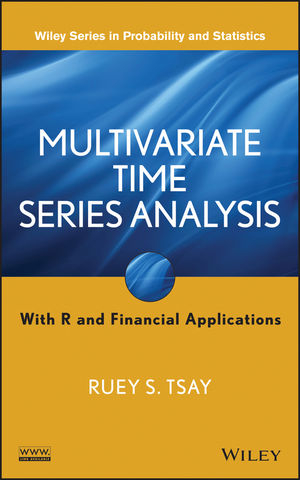
Multivariate Time Series Analysis (eBook)
John Wiley & Sons (Verlag)
978-1-118-61779-3 (ISBN)
An accessible guide to the multivariate time series tools used in numerous real-world applications
Multivariate Time Series Analysis: With R and Financial Applications is the much anticipated sequel coming from one of the most influential and prominent experts on the topic of time series. Through a fundamental balance of theory and methodology, the book supplies readers with a comprehensible approach to financial econometric models and their applications to real-world empirical research.
Differing from the traditional approach to multivariate time series, the book focuses on reader comprehension by emphasizing structural specification, which results in simplified parsimonious VAR MA modeling. Multivariate Time Series Analysis: With R and Financial Applications utilizes the freely available R software package to explore complex data and illustrate related computation and analyses. Featuring the techniques and methodology of multivariate linear time series, stationary VAR models, VAR MA time series and models, unitroot process, factor models, and factor-augmented VAR models, the book includes:
• Over 300 examples and exercises to reinforce the presented content
• User-friendly R subroutines and research presented throughout to demonstrate modern applications
• Numerous datasets and subroutines to provide readers with a deeper understanding of the material
Multivariate Time Series Analysis is an ideal textbook for graduate-level courses on time series and quantitative finance and upper-undergraduate level statistics courses in time series. The book is also an indispensable reference for researchers and practitioners in business, finance, and econometrics.
RUEY S. TSAY, PhD, is H.G.B. Alexander Professor of Econometrics and Statistics at The University of Chicago Booth School of Business. He has written over 125 published articles in the areas of business and economic forecasting, data analysis, risk management, and process control. A Fellow of the American Statistical Association, the Institute of Mathematical Statistics, and Academia Sinica, Dr. Tsay is author of Analysis of Financial Time Series, Third Edition and An Introduction to Analysis of Financial Data with R, and coauthor of A Course in Time Series Analysis, all published by Wiley.
An accessible guide to the multivariate time series tools used in numerous real-world applications Multivariate Time Series Analysis: With R and Financial Applications is the much anticipated sequel coming from one of the most influential and prominent experts on the topic of time series. Through a fundamental balance of theory and methodology, the book supplies readers with a comprehensible approach to financial econometric models and their applications to real-world empirical research. Differing from the traditional approach to multivariate time series, the book focuses on reader comprehension by emphasizing structural specification, which results in simplified parsimonious VAR MA modeling. Multivariate Time Series Analysis: With R and Financial Applications utilizes the freely available R software package to explore complex data and illustrate related computation and analyses. Featuring the techniques and methodology of multivariate linear time series, stationary VAR models, VAR MA time series and models, unitroot process, factor models, and factor-augmented VAR models, the book includes: Over 300 examples and exercises to reinforce the presented content User-friendly R subroutines and research presented throughout to demonstrate modern applications Numerous datasets and subroutines to provide readers with a deeper understanding of the material Multivariate Time Series Analysis is an ideal textbook for graduate-level courses on time series and quantitative finance and upper-undergraduate level statistics courses in time series. The book is also an indispensable reference for researchers and practitioners in business, finance, and econometrics.
RUEY S. TSAY, PhD, is H.G.B. Alexander Professor of Econometrics and Statistics at The University of Chicago Booth School of Business. He has written over 125 published articles in the areas of business and economic forecasting, data analysis, risk management, and process control. A Fellow of the American Statistical Association, the Institute of Mathematical Statistics, and Academia Sinica, Dr. Tsay is author of Analysis of Financial Time Series, Third Edition and An Introduction to Analysis of Financial Data with R, and coauthor of A Course in Time Series Analysis, all published by Wiley.
Multivariate Time Series Analysis: With R and Financial Applications 5
Copyright 6
Contents 9
Preface 17
Acknowledgements 19
1 Multivariate Linear Time Series 21
1.1 Introduction 21
1.2 Some Basic Concepts 25
1.2.1 Stationarity 25
1.2.2 Linearity 26
1.2.3 Invertibility 27
1.3 Cross-Covariance and Correlation Matrices 28
1.4 Sample CCM 29
1.5 Testing Zero Cross-Correlations 32
1.6 Forecasting 36
1.7 Model Representations 38
1.8 Outline of the Book 42
1.9 Software 43
Exercises 43
2 Stationary Vector Autoregressive Time Series 47
2.1 Introduction 47
2.2 VAR(1) Models 48
2.2.1 Model Structure and Granger Causality 48
2.2.2 Relation to Transfer Function Model 50
2.2.3 Stationarity Condition 51
2.2.4 Invertibility 52
2.2.5 Moment Equations 52
2.2.6 Implied Models for the Components 55
2.2.7 Moving-Average Representation 56
2.3 VAR(2) Models 57
2.3.1 Stationarity Condition 57
2.3.2 Moment Equations 58
2.3.3 Implied Marginal Component Models 60
2.3.4 Moving-Average Representation 60
2.4 VAR(p) Models 61
2.4.1 A VAR(1) Representation 61
2.4.2 Stationarity Condition 62
2.4.3 Moment Equations 62
2.4.4 Implied Component Models 63
2.4.5 Moving-Average Representation 63
2.5 Estimation 64
2.5.1 Least-Squares Methods 64
2.5.2 Maximum Likelihood Estimate 67
2.5.3 Limiting Properties of LS Estimate 69
2.5.4 Bayesian Estimation 75
2.6 Order Selection 81
2.6.1 Sequential Likelihood Ratio Tests 81
2.6.2 Information Criteria 83
2.7 Model Checking 86
2.7.1 Residual Cross-Correlations 86
2.7.2 Multivariate Portmanteau Statistics 91
2.7.3 Model Simplification 92
2.8 Linear Constraints 100
2.9 Forecasting 102
2.9.1 Forecasts of a Given Model 102
2.9.2 Forecasts of an Estimated Model 104
2.10 Impulse Response Functions 109
2.10.1 Orthogonal Innovations 112
2.11 Forecast ErrorVariance Decomposition 116
2.12 Proofs 118
Exercises 120
References 123
3 Vector Autoregressive Moving-Average Time Series 125
3.1 Vector MA Models 126
3.1.1 VMA(1) Model 126
3.1.2 Properties of VMA(q) Models 130
3.2 Specifying VMA Order 132
3.3 Estimation of VMA Models 133
3.3.1 Conditional Likelihood Estimation 133
3.3.2 Exact Likelihood Estimation 136
3.3.3 Initial Parameter Estimation 146
3.4 Forecasting of VMA Models 146
3.5 VARMA Models 147
3.5.1 Identifiability 148
3.5.2 VARMA(1,1) Models 150
3.5.3 Some Properties of VARMA Models 153
3.6 Implications of VARMA Models 159
3.6.1 Granger Causality 159
3.6.2 Impulse Response Functions 11
3.7 Linear Transforms of VARMA Processes 161
3.8 Temporal Aggregation of VARMA Processes 164
3.9 Likelihood Function of a VARMA Model 11
3.9.1 Conditional Likelihood Function 166
3.9.2 Exact Likelihood Function 170
3.9.3 Interpreting the Likelihood Function 172
3.9.4 Computation of Likelihood Function 174
3.10 Innovations Approach to Exact Likelihood Function 175
3.10.1 Block Cholesky Decomposition 177
3.11 Asymptotic Distribution of Maximum Likelihood
180
3.11.1 Linear Parameter Constraints 182
3.12 Model Checking of Fitted VARMA Models 183
3.13 Forecasting of VARMA Models 184
3.13.1 Forecasting Updating 186
3.14 Tentative Order Identification 186
3.14.1 Consistent AR Estimates 186
3.14.2 Extended Cross-Correlation Matrices 189
3.14.3 A Summary Two-Way Table 191
3.15 Empirical Analysis of VARMA Models 196
3.15.1 Personal Income and Expenditures 196
3.15.2 Housing Starts and Mortgage Rate 204
3.16 Appendix 212
Exercises 214
References 216
4 Structural Specification of VARMA Models 219
4.1 The Kronecker Index Approach 220
4.1.1 A Predictive Interpretation 225
4.1.2 A VARMA Specification 227
4.1.3 An Illustrative Example 228
4.1.4 The Echelon Form 231
4.1.5 The Example Continued 232
4.2 The Scalar Component Approach 232
4.2.1 Scalar Component Models 233
4.2.2 Model Specification Via Scalar Component
235
4.2.3 Redundant Parameters 236
4.2.4 VARMA Model Specification 238
4.2.5 The Transformation Matrix 238
4.3 Statistics for Order Specification 240
4.3.1 Reduced Rank Tests 240
4.4 Finding Kronecker Indices 242
4.4.1 Application 244
4.5 Finding Scalar Component Models 246
4.5.1 Implication of Scalar Component Models 247
4.5.2 Exchangeable Scalar Component Models 249
4.5.3 Searching for Scalar Components 252
4.5.4 Application 253
4.6 Estimation 257
4.6.1 Illustration of the Kronecker Index Approach 258
4.6.2 Illustration of the SCM Approach 261
4.7 An Example 265
4.7.1 The SCM Approach 265
4.7.2 The Kronecker Index Approach 272
4.7.3 Discussion and Comparison 277
4.8 Appendix: Canonical Correlation Analysis 279
Exercises 282
References 283
5 Unit-Root Nonstationary Processes 285
5.1 Univariate Unit-Root Processes 286
5.1.1 Motivation 287
5.1.2 Unit Root with Stationary Innovations 289
5.1.3 AR(1) Case 294
5.1.4 AR(p) Case 294
5.1.5 MA(1) Case 296
5.1.6 Unit-Root Tests 296
5.1.7 Example 297
5.2 Multivariate Unit-Root Processes 299
5.2.1 An Alternative Model Representation 302
5.2.2 Unit-Root VAR Processes 305
5.3 Spurious Regressions 310
5.4 Multivariate Exponential Smoothing 311
5.5 Cointegration 314
5.5.1 An Example of Cointegration 315
5.5.2 Some Justifications of Cointegration 317
5.6 An Error-Correction Form 317
5.7 Implications of Cointegrating Vectors 320
5.7.1 Implications of the Deterministic Term 320
5.7.2 Implications for Moving-Average
321
5.8 Parameterization of Cointegrating Vectors 322
5.9 Cointegration Tests 323
5.9.1 The Case of VAR Models 323
5.9.2 Specification of Deterministic Terms 324
5.9.3 Review of Likelihood Ratio Tests 325
5.9.4 Cointegration Tests of VAR Models 326
5.9.5 An Illustration 329
5.9.6 Cointegration Tests of VARMA Models 333
5.10 Estimation of Error-Correction Models 333
5.10.1 VAR Models 333
5.10.2 Reduced Regression Method 337
5.10.3 VARMA Models 338
5.11 Applications 339
5.12 Discussion 346
5.13 Appendix 347
Exercises 348
References 350
6 Factor Models and Selected Topics 353
6.1 Seasonal Models 353
6.2 Principal Component Analysis 361
6.3 Use of Exogenous Variables 365
6.3.1 VARX Models 366
6.3.2 Regression Model 372
6.4 Missing Values 377
6.4.1 Completely Missing 378
6.4.2 Partially Missing 381
6.5 Factor Models 384
6.5.1 Orthogonal Factor Models 384
6.5.2 Approximate Factor Models 390
6.5.3 Diffusion Index Models 391
6.5.4 Dynamic Factor Models 395
6.5.5 Constrained Factor Models 396
6.5.6 Asymptotic Principal Component Analysis 400
6.6 Classification and Clustering Analysis 406
6.6.1 Clustering Analysis 406
6.6.2 Bayesian Estimation 407
6.6.3 An MCMC Procedure 410
Exercises 414
References 416
7 Multivariate Volatility Models 419
7.1 Testing Conditional Heteroscedasticity 421
7.1.1 Portmanteau Test 421
7.1.2 Rank-Based Test 422
7.1.3 Simulation 423
7.1.4 Application 425
7.2 Estimation of Multivariate Volatility Models 427
7.3 Diagnostic Checks of Volatility Models 429
7.3.1 Ling and Li Statistics 429
7.3.2 Tse Statistics 432
7.4 Exponentially Weighted Moving Average 434
7.5 BEKK Models 437
7.5.1 Discussion 440
7.6 Cholesky Decomposition and Volatility Modeling 440
7.6.1 Volatility Modeling 442
7.6.2 Application 443
7.7 Dynamic Conditional Correlation Models 448
7.7.1 A Procedure for Building DCC Models 450
7.7.2 An Example 450
7.8 Orthogonal Transformation 454
7.8.1 The Go-GARCH Model 454
7.8.2 Dynamic Orthogonal Components 458
7.8.3 Testing the Existence of DOC 460
7.9 Copula-Based Models 463
7.9.1 Copulas 464
7.9.2 Gaussian and t-Copulas 465
7.9.3 Multivariate Volatility Modeling 469
7.10 Principal Volatility Components 474
7.10.1 Sample Principal Volatility Components 478
Exercises 481
References 482
Appendix A Review of Mathematics and Statistics 485
A.1 Review of Vectors and Matrices 485
A.1.1 Basic Operations 486
A.1.2 Inverse, Trace, Eigenvalue, and Eigenvector 487
A.1.3 Positive-Definite Matrix 487
A.1.4 Comparison of Two Symmetric Matrices 489
A.1.5 Idempotent Matrix, 489
A.1.6 Cholesky Decomposition 489
A.1.7 Partition of a Matrix 490
A.1.8 Vectorization and Kronecker Product 490
A.1.9 Vector and Matrix Differentiation 492
A.2 Least-Squares Estimation 497
A.3 Multivariate Normal Distributions 498
A.4 Multivariate Student-t Distribution 499
A.5 Wishart and Inverted Wishart Distributions 500
A.6 Vector and Matrix Differentials 501
A.6.1 Scalar Function 501
A.6.2 Vector Function 504
A.6.3 Matrix Function 505
A.6.4 Properties of Matrix Differential 505
A.6.5 Application 506
References 507
Index 509
| Erscheint lt. Verlag | 27.11.2013 |
|---|---|
| Reihe/Serie | Wiley Series in Probability and Statistics |
| Wiley Series in Probability and Statistics | Wiley Series in Probability and Statistics |
| Sprache | englisch |
| Themenwelt | Mathematik / Informatik ► Mathematik ► Analysis |
| Mathematik / Informatik ► Mathematik ► Statistik | |
| Mathematik / Informatik ► Mathematik ► Wahrscheinlichkeit / Kombinatorik | |
| Technik | |
| Wirtschaft ► Volkswirtschaftslehre | |
| Schlagworte | Ãkonometrie • Econometrics • Economics • Multivariate Analyse • multivariate analysis • Ökonometrie • Statistics • Statistik • Time Series • time series in statistics, MBA, statistics, multivariate time series modeling, univariate time series, finance, business, econometrics, volatility models, VARMA models, applied statistics • Volkswirtschaftslehre • Zeitreihen • Zeitreihenanalyse |
| ISBN-10 | 1-118-61779-7 / 1118617797 |
| ISBN-13 | 978-1-118-61779-3 / 9781118617793 |
| Informationen gemäß Produktsicherheitsverordnung (GPSR) | |
| Haben Sie eine Frage zum Produkt? |
 PDF (Adobe DRM)
Kopierschutz: Adobe-DRM
Adobe-DRM ist ein Kopierschutz, der das eBook vor Mißbrauch schützen soll. Dabei wird das eBook bereits beim Download auf Ihre persönliche Adobe-ID autorisiert. Lesen können Sie das eBook dann nur auf den Geräten, welche ebenfalls auf Ihre Adobe-ID registriert sind.
Details zum Adobe-DRM
Dateiformat: PDF (Portable Document Format)
Mit einem festen Seitenlayout eignet sich die PDF besonders für Fachbücher mit Spalten, Tabellen und Abbildungen. Eine PDF kann auf fast allen Geräten angezeigt werden, ist aber für kleine Displays (Smartphone, eReader) nur eingeschränkt geeignet.
Systemvoraussetzungen:
PC/Mac: Mit einem PC oder Mac können Sie dieses eBook lesen. Sie benötigen eine
eReader: Dieses eBook kann mit (fast) allen eBook-Readern gelesen werden. Mit dem amazon-Kindle ist es aber nicht kompatibel.
Smartphone/Tablet: Egal ob Apple oder Android, dieses eBook können Sie lesen. Sie benötigen eine
Geräteliste und zusätzliche Hinweise
Buying eBooks from abroad
For tax law reasons we can sell eBooks just within Germany and Switzerland. Regrettably we cannot fulfill eBook-orders from other countries.
aus dem Bereich