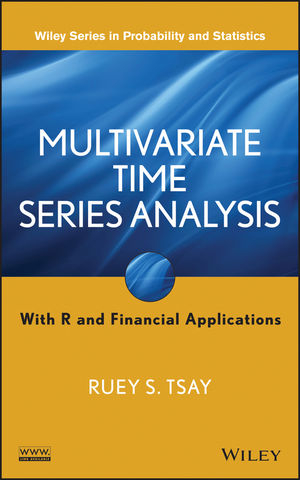
Multivariate Time Series Analysis (eBook)
John Wiley & Sons (Verlag)
978-1-118-61775-5 (ISBN)
An accessible guide to the multivariate time series tools used in numerous real-world applications
Multivariate Time Series Analysis: With R and Financial Applications is the much anticipated sequel coming from one of the most influential and prominent experts on the topic of time series. Through a fundamental balance of theory and methodology, the book supplies readers with a comprehensible approach to financial econometric models and their applications to real-world empirical research.
Differing from the traditional approach to multivariate time series, the book focuses on reader comprehension by emphasizing structural specification, which results in simplified parsimonious VAR MA modeling. Multivariate Time Series Analysis: With R and Financial Applications utilizes the freely available R software package to explore complex data and illustrate related computation and analyses. Featuring the techniques and methodology of multivariate linear time series, stationary VAR models, VAR MA time series and models, unitroot process, factor models, and factor-augmented VAR models, the book includes:
• Over 300 examples and exercises to reinforce the presented content
• User-friendly R subroutines and research presented throughout to demonstrate modern applications
• Numerous datasets and subroutines to provide readers with a deeper understanding of the material
Multivariate Time Series Analysis is an ideal textbook for graduate-level courses on time series and quantitative finance and upper-undergraduate level statistics courses in time series. The book is also an indispensable reference for researchers and practitioners in business, finance, and econometrics.
RUEY S. TSAY, PhD, is H.G.B. Alexander Professor of Econometrics and Statistics at The University of Chicago Booth School of Business. He has written over 125 published articles in the areas of business and economic forecasting, data analysis, risk management, and process control. A Fellow of the American Statistical Association, the Institute of Mathematical Statistics, and Academia Sinica, Dr. Tsay is author of Analysis of Financial Time Series, Third Edition and An Introduction to Analysis of Financial Data with R, and coauthor of A Course in Time Series Analysis, all published by Wiley.
RUEY S. TSAY, PhD, is H.G.B. Alexander Professor of Econometrics and Statistics at The University of Chicago Booth School of Business. He has written over 125 published articles in the areas of business and economic forecasting, data analysis, risk management, and process control. A Fellow of the American Statistical Association, the Institute of Mathematical Statistics, and Academia Sinica, Dr. Tsay is author of Analysis of Financial Time Series, Third Edition and An Introduction to Analysis of Financial Data with R, and coauthor of A Course in Time Series Analysis, all published by Wiley.
Preface xv
Acknowledgements xvii
1 Multivariate Linear Time Series 1
1.1 Introduction, 1
1.2 Some Basic Concepts, 5
1.3 Cross-Covariance and Correlation Matrices, 8
1.4 Sample CCM, 9
1.5 Testing Zero Cross-Correlations, 12
1.6 Forecasting, 16
1.7 Model Representations, 18
1.8 Outline of the Book, 22
1.9 Software, 23
Exercises, 23
2 Stationary Vector Autoregressive Time Series 27
2.1 Introduction, 27
2.2 VAR(1) Models, 28
2.3 VAR(2) Models, 37
2.4 VAR(p) Models, 41
2.5 Estimation, 44
2.6 Order Selection, 61
2.7 Model Checking, 66
2.8 Linear Constraints, 80
2.9 Forecasting, 82
2.10 Impulse Response Functions, 89
2.11 Forecast Error Variance Decomposition, 96
2.12 Proofs, 98
Exercises, 100
3 Vector Autoregressive Moving-Average Time Series 105
3.1 Vector MA Models, 106
3.2 Specifying VMA Order, 112
3.3 Estimation of VMA Models, 113
3.4 Forecasting of VMA Models, 126
3.5 VARMA Models, 127
3.6 Implications of VARMA Models, 139
3.7 Linear Transforms of VARMA Processes, 141
3.8 Temporal Aggregation of VARMA Processes, 144
3.9 Likelihood Function of a VARMA Model, 146
3.10 Innovations Approach to Exact Likelihood Function, 155
3.11 Asymptotic Distribution of Maximum Likelihood Estimates, 160
3.12 Model Checking of Fitted VARMA Models, 163
3.13 Forecasting of VARMA Models, 164
3.14 Tentative Order Identification, 166
3.15 Empirical Analysis of VARMA Models, 176
3.16 Appendix, 192
Exercises, 194
4 Structural Specification of VARMA Models 199
4.1 The Kronecker Index Approach, 200
4.2 The Scalar Component Approach, 212
4.3 Statistics for Order Specification, 220
4.4 Finding Kronecker Indices, 222
4.5 Finding Scalar Component Models, 226
4.6 Estimation, 237
4.7 An Example, 245
4.8 Appendix: Canonical Correlation Analysis, 259
Exercises, 262
5 Unit-Root Nonstationary Processes 265
5.1 Univariate Unit-Root Processes, 266
5.2 Multivariate Unit-Root Processes, 279
5.3 Spurious Regressions, 290
5.4 Multivariate Exponential Smoothing, 291
5.5 Cointegration, 294
5.6 An Error-Correction Form, 297
5.7 Implications of Cointegrating Vectors, 300
5.8 Parameterization of Cointegrating Vectors, 302
5.9 Cointegration Tests, 303
5.10 Estimation of Error-Correction Models, 313
5.11 Applications, 319
5.12 Discussion, 326
5.13 Appendix, 327
Exercises, 328
6 Factor Models and Selected Topics 333
6.1 Seasonal Models, 333
6.2 Principal Component Analysis, 341
6.3 Use of Exogenous Variables, 345
6.4 Missing Values, 357
6.5 Factor Models, 364
6.6 Classification and Clustering Analysis, 386
Exercises, 394
7 Multivariate Volatility Models 399
7.1 Testing Conditional Heteroscedasticity, 401
7.2 Estimation of Multivariate Volatility Models, 407
7.3 Diagnostic Checks of Volatility Models, 409
7.4 Exponentially Weighted Moving Average, 414
7.5 BEKK Models, 417
7.6 Cholesky Decomposition and Volatility Modeling, 420
7.7 Dynamic Conditional Correlation Models, 428
7.8 Orthogonal Transformation, 434
7.9 Copula-Based Models, 443
7.10 Principal Volatility Components, 454
Exercises, 461
Appendix A Review of Mathematics and Statistics 465
A.1 Review of Vectors and Matrices, 465
A.2 Least-Squares Estimation, 477
A.3 Multivariate Normal Distributions, 478
A.4 Multivariate Student-t Distribution, 479
A.5 Wishart and Inverted Wishart Distributions, 480
A.6 Vector and Matrix Differentials, 481
Index 489
CHAPTER 1
Multivariate Linear Time Series
1.1 INTRODUCTION
Multivariate time series analysis considers simultaneously multiple time series. It is a branch of multivariate statistical analysis but deals specifically with dependent data. It is, in general, much more complicated than the univariate time series analysis, especially when the number of series considered is large. We study this more complicated statistical analysis in this book because in real life decisions often involve multiple inter-related factors or variables. Understanding the relationships between those factors and providing accurate predictions of those variables are valuable in decision making. The objectives of multivariate time series analysis thus include
Let zt = (z 1t , ∙∙∙, zkt )′ be a k-dimensional time series observed at equally spaced time points. For example, let z 1t be the quarterly U.S. real gross domestic product (GDP) and z 2t the quarterly U.S. civilian unemployment rate. By studying z 1t and z 2t jointly, we can assess the temporal and contemporaneous dependence between GDP and unemployment rate. In this particular case, k = 2 and the two variables are known to be instantaneously negatively correlated. Figure 1.1 shows the time plots of quarterly U.S. real GDP (in logarithm of billions of chained 2005 dollars) and unemployment rate, obtained via monthly data with averaging, from 1948 to 2011. Both series are seasonally adjusted. Figure 1.2 shows the time plots of the real GDP growth rate and the changes in unemployment rate from the second quarter of 1948 to the fourth quarter of 2011. Figure 1.3 shows the scatter plot of the two time series given in Figure 1.2. From these figures, we can see that the GDP and unemployment rate indeed have negative instantaneous correlation. The sample correlation is −0.71.
FIGURE 1.1 Time plots of U.S. quarterly real GDP (in logarithm) and unemployment rate from 1948 to 2011. The data are seasonally adjusted.
FIGURE 1.2 Time plots of the growth rate of U.S. quarterly real GDP (in logarithm) and the change series of unemployment rate from 1948 to 2011. The data are seasonally adjusted.
FIGURE 1.3 Scatter plot of the changes in quarterly U.S. unemployment rate versus the growth rate of quarterly real GDP (in logarithm) from the second quarter of 1948 to the last quarter of 2011. The data are seasonally adjusted.
As another example, consider k = 3. Let z 1t be the monthly housing starts of the New England division in the United States, and z 2t and z 3t be the monthly housing starts of the Middle Atlantic division and the Pacific division, respectively. By considering the three series jointly, we can investigate the relationships between the housing markets of the three geographical divisions in the United States. Figure 1.4 shows the time plots of the three monthly housing starts from January 1995 to June 2011. The data are not seasonally adjusted so that there exists a clear seasonal cycle in the series. From the plots, the three series show certain similarities as well as some marked differences. In some applications, we consider large k. For instance, let zt be the monthly unemployment rates of the 50 states in the United States. Figure 1.5 shows the time plots of the monthly unemployment rates of the 50 states from January 1976 to September 2011. The data are seasonally adjusted. Here, k = 50 and plots are not particularly informative except that the series have certain common behavior. The objective of considering these series simultaneously may be to obtain predictions for the state unemployment rates. Such forecasts are important to state and local governments. In this particular instance, pooling information across states may be helpful in prediction because states may have similar social and economic characteristics.
FIGURE 1.4 Time plots of the monthly housing starts for the New England, Middle Atlantic, and Pacific divisions of the United States from January 1995 to June 2011. The data are not seasonally adjusted.
FIGURE 1.5 Time plots of the monthly unemployment rates of the 50 states in the United States from January 1976 to September 2011. The data are seasonally adjusted.
In this book, we refer to {zit } as the ith component of the multivariate time series z t . The objectives of the analysis discussed in this book include (a) to investigate the dynamic relationships between the components of z t and (b) to improve the prediction of zit using information in all components of z t .
Suppose we are interested in predicting z T+1 based on the data {z 1,…,z T }. To this end, we may entertain the model
where denotes a prediction of z T+1 and g(.) is some suitable function. The goal of multivariate time series analysis is to specify the function g(.) based on the available data. In many applications, g(.) is a smooth, differentiable function and can be well approximated by a linear function, say,
where π 0 is a k-dimensional vector, and π i are k × k constant real-valued matrices (for i = 1,…,T ). Let a T+1 = z T+1 − be the forecast error. The prior equation states that
under the linearity assumption.
To build a solid foundation for making prediction described in the previous paragraph, we need sound statistical theories and methods. The goal of this book is to provide some useful statistical models and methods for analyzing multivariate time series. To begin with, we start with some basic concepts of multivariate time series.
1.2 SOME BASIC CONCEPTS
Statistically speaking, a k-dimensional time series z t = (z 1t ,…,z kt )′ is a random vector consisting of k random variables. As such, there exists an underlying probability space on which the random variables are defined. What we observe in practice is arealization of this random vector. For simplicity, we use the same notation z t for the random vector and its realization. When we discuss properties of z t , we treat it as a random vector. On the other hand, when we consider an application, we treat z t as a realization. In this book, we assume that z t follows a continuous multivariate probability distribution. In other words, the discrete-valued (or categorical) multivariate time series are not considered. Because we are dealing with random vectors, vector and matrix are used extensively in the book. If necessary, readers can consult Appendix A for a brief review of mathematics and statistics.
1.2.1 Stationarity
A k-dimensional time series z t is said to be weakly stationary if (a) E(z t ) = μ , a k-dimensional constant vector, and (b) Cov(z t ) = E[(z t −μ )(z tμ)′] = ∑ z , a constant k × k positive-definite matrix. Here, E(z ) and Cov (z ) denote the expectation and covariance matrices of the random vector z , respectively. Thus, the mean and covariance matrices of a weakly stationary time series z t do not depend on time, that is, the first two moments of z t are time invariant. Implicit in the definition, we require that the mean and covariance matrices of a weakly stationary time series exist.
A k-dimensional time series z t is strictly stationary if the joint distribution of the m collection, (z t1 ,…,z tm ), is the same as that of (z t1+j ,…,z tm +j )′, where m, j, and (t 1 ,…,tm ) are arbitrary positive integers. In statistical terms, strict stationarity requires that the probability distribution of an arbitrary collection of z t is time invariant. An example of strictly stationary time series is the sequence of independent and identically distributed random vectors of standard multivariate normal distribution. From the definitions, a strictly stationary time series z t is weakly stationary provided that its first two moments exist.
In this chapter, we focus mainly on the weakly stationary series because strict stationarity is hard to verify in practice. We shall consider...
| Erscheint lt. Verlag | 11.11.2013 |
|---|---|
| Reihe/Serie | Wiley Series in Probability and Statistics |
| Wiley Series in Probability and Statistics | Wiley Series in Probability and Statistics |
| Sprache | englisch |
| Themenwelt | Mathematik / Informatik ► Mathematik ► Analysis |
| Mathematik / Informatik ► Mathematik ► Statistik | |
| Mathematik / Informatik ► Mathematik ► Wahrscheinlichkeit / Kombinatorik | |
| Technik | |
| Wirtschaft ► Volkswirtschaftslehre | |
| Schlagworte | Ãkonometrie • Econometrics • Economics • Multivariate Analyse • multivariate analysis • Ökonometrie • Statistics • Statistik • Time Series • time series in statistics, MBA, statistics, multivariate time series modeling, univariate time series, finance, business, econometrics, volatility models, VARMA models, applied statistics • Volkswirtschaftslehre • Zeitreihen • Zeitreihenanalyse |
| ISBN-10 | 1-118-61775-4 / 1118617754 |
| ISBN-13 | 978-1-118-61775-5 / 9781118617755 |
| Informationen gemäß Produktsicherheitsverordnung (GPSR) | |
| Haben Sie eine Frage zum Produkt? |
 EPUB (Adobe DRM)
Kopierschutz: Adobe-DRM
Adobe-DRM ist ein Kopierschutz, der das eBook vor Mißbrauch schützen soll. Dabei wird das eBook bereits beim Download auf Ihre persönliche Adobe-ID autorisiert. Lesen können Sie das eBook dann nur auf den Geräten, welche ebenfalls auf Ihre Adobe-ID registriert sind.
Details zum Adobe-DRM
Dateiformat: EPUB (Electronic Publication)
EPUB ist ein offener Standard für eBooks und eignet sich besonders zur Darstellung von Belletristik und Sachbüchern. Der Fließtext wird dynamisch an die Display- und Schriftgröße angepasst. Auch für mobile Lesegeräte ist EPUB daher gut geeignet.
Systemvoraussetzungen:
PC/Mac: Mit einem PC oder Mac können Sie dieses eBook lesen. Sie benötigen eine
eReader: Dieses eBook kann mit (fast) allen eBook-Readern gelesen werden. Mit dem amazon-Kindle ist es aber nicht kompatibel.
Smartphone/Tablet: Egal ob Apple oder Android, dieses eBook können Sie lesen. Sie benötigen eine
Geräteliste und zusätzliche Hinweise
Buying eBooks from abroad
For tax law reasons we can sell eBooks just within Germany and Switzerland. Regrettably we cannot fulfill eBook-orders from other countries.
aus dem Bereich