Cyanobacteria (eBook)
John Wiley & Sons (Verlag)
978-1-118-40222-1 (ISBN)
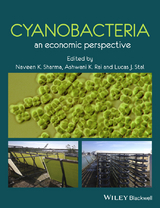
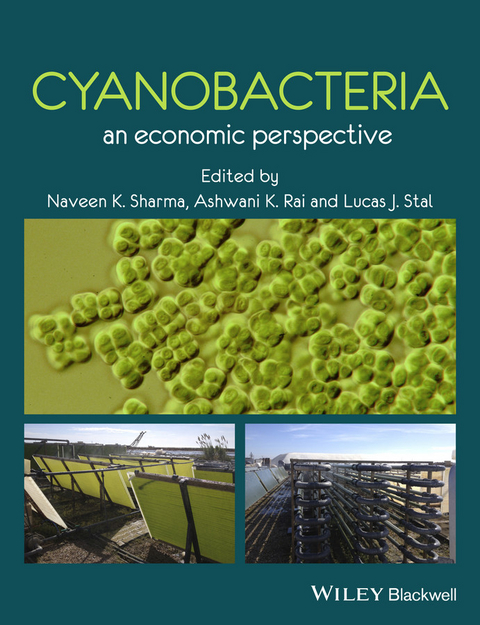
Written by leading experts in the field, Cyanobacteria: An Economic Perspective is a comprehensive edited volume covering all areas of an important field and its application to energy, medicine and agriculture.
Issues related to environment, food and energy have presented serious challenge to the stability of nation-states. Increasing global population, dwindling agriculture and industrial production, and inequitable distribution of resources and technologies have further aggravated the problem. The burden placed by increasing population on environment and especially on agricultural productivity is phenomenal. To provide food and fuel to such a massive population, it becomes imperative to find new ways and means to increase the production giving due consideration to biosphere’s ability to regenerate resources and provide ecological services.
Cyanobacteria are environment friendly resource for commercial production of active biochemicals, drugs and future energy (biodiesel, bioethanol and hydrogen).
Topics on isolation, identification and classification of cyanobacteria are discussed, as well as further sections on: summarizing a range of useful products synthesized by cyanobacteria, ecological services provided by cyanobacteria including their harmful effect in water bodies and associated flora and fauna. Chapter on tools, techniques, and patents also focus on the economic importance of the group. This book also provides an insight for future perspectives in each particular field and an extensive bibliography.
This book will be a highly useful resource for students, researchers and professionals in academics in the life sciences including microbiology and biotechnology.
Written by leading experts in the field, Cyanobacteria: An Economic Perspective is a comprehensive edited volume covering all areas of an important field and its application to energy, medicine and agriculture. Issues related to environment, food and energy have presented serious challenge to the stability of nation-states. Increasing global population, dwindling agriculture and industrial production, and inequitable distribution of resources and technologies have further aggravated the problem. The burden placed by increasing population on environment and especially on agricultural productivity is phenomenal. To provide food and fuel to such a massive population, it becomes imperative to find new ways and means to increase the production giving due consideration to biosphere s ability to regenerate resources and provide ecological services. Cyanobacteria are environment friendly resource for commercial production of active biochemicals, drugs and future energy (biodiesel, bioethanol and hydrogen). Topics on isolation, identification and classification of cyanobacteria are discussed, as well as further sections on: summarizing a range of useful products synthesized by cyanobacteria, ecological services provided by cyanobacteria including their harmful effect in water bodies and associated flora and fauna. Chapter on tools, techniques, and patents also focus on the economic importance of the group. This book also provides an insight for future perspectives in each particular field and an extensive bibliography. This book will be a highly useful resource for students, researchers and professionals in academics in the life sciences including microbiology and biotechnology.
Dr. Naveen K. Sharma, Assistant Professor, Department of Botany, Post-Graduate College, India. Professor Ashawani K. Rai, Professor in Botany, Department of Botany, Banaras Hindu University, India. Dr. Lucas J. Stal, Professor and Head of Department, Department of Marine Microbiology, Netherlands Institute of Ecology, NIOO-KNAW & Department of Aquatic Microbiology, Institute for Biodiversity and Ecosystem Dynamics, University of Amsterdam, The Netherlands.
List of contributors ix
Preface xiii
About the editors xv
Acknowledgements xvii
About the book xix
Introduction xxi
Naveen K. Sharma, Ashwani K. Rai, and Lucas J. Stal
About the companion website xxv
PART I: BIOLOGY AND CLASSIFICATION OF CYANOBACTERIA 1
Chapter 1 Cyanobacteria: biology, ecology and evolution 3
Aharon Oren
Chapter 2 Modern classification of cyanobacteria 21
Ji¢§r´¥ Kom´arek
PART II: ECOLOGICAL SERVICES RENDERED BY CYANOBACTERIA
41
Chapter 3 Ecological importance of cyanobacteria 43
Beatriz D´¥ez and Karolina Ininbergs
Chapter 4 Cyanobacteria and carbon sequestration 65
Eduardo Jacob-Lopes, Leila Queiroz Zepka, and Maria Isabel
Queiroz
Chapter 5 Ecology of cyanobacteria on stone monuments,
biodeterioration, and the conservation of cultural heritage
73
Nitin Keshari and Siba Prasad Adhikari
PART III: CYANOBACTERIAL PRODUCTS 91
Chapter 6 Therapeutic applications of cyanobacteria with
emphasis on their economics 93
Rathinam Raja, Shanmugam Hemaiswarya, Isabel S. Carvalho, and
Venkatesan
Ganesan
Chapter 7 Spirulina: an example of cyanobacteria as
nutraceuticals 103
Masayuki Ohmori and Shigeki Ehira
Chapter 8 Ultraviolet photoprotective compounds from
cyanobacteria in biomedical applications 119
Tanya Soule and Ferran Garcia-Pichel
Chapter 9 Cyanobacteria as a ''green''
option for sustainable agriculture 145
Radha Prasanna, Anjuli Sood, Sachitra Kumar Ratha, and Pawan K.
Singh
Chapter 10 The economics of cyanobacteria-based biofuel
production: challenges and opportunities 167
Naveen K. Sharma and Lucas J. Stal
Chapter 11 Cyanobacterial cellulose synthesis in the light of
the photanol concept 181
R. Milou Schuurmans, Hans C.P. Matthijs, Lucas J. Stal, and Klaas
J. Hellingwerf
Chapter 12 Exopolysaccharides from cyanobacteria and their
possible industrial applications 197
Giovanni Colica and Roberto De Philippis
Chapter 13 Phycocyanins 209
Ruperto Bermejo
Chapter 14 Cyanobacterial polyhydroxyalkanoates: an alternative
source for plastics 227
Shilalipi Samantaray, Ranjana Bhati, and Nirupama Mallick
PART IV: HARMFUL ASPECTS 245
Chapter 15 Costs of harmful blooms of freshwater cyanobacteria
247
David P. Hamilton, Susanna A. Wood, Daniel R. Dietrich, and
Jonathan Puddick
Chapter 16 Cyanotoxins 257
Jason N. Woodhouse, Melissa Rapadas, and Brett A. Neilan
PART V: TOOLS, TECHNIQUES, AND PATENTS 269
Chapter 17 Photobioreactors for cyanobacterial culturing
271
A. Catarina Guedes, Nadpi G. Katkam, Jo~ao Varela, and
Francisco XavierMalcata
Chapter 18 Commercial-scale culturing of cyanobacteria: an
industrial experience 293
Hiroyuki Takenaka and Yuji Yamaguchi
Chapter 19 Engineering cyanobacteria for industrial products
303
Timo H.J. Niedermeyer, Ekaterina Kuchmina, and Annegret Wilde
Chapter 20 Cryopreservation of cyanobacteria 319
John G. Day
Chapter 21 Patents on cyanobacteria and cyanobacterial products
and uses 329
Michael A. Borowitzka
Index 339
List of contributors
| Erscheint lt. Verlag | 22.11.2013 |
|---|---|
| Sprache | englisch |
| Themenwelt | Naturwissenschaften ► Biologie ► Mikrobiologie / Immunologie |
| Technik ► Elektrotechnik / Energietechnik | |
| Technik ► Umwelttechnik / Biotechnologie | |
| Wirtschaft | |
| Schlagworte | Aharon • Biotechnologie i. d. Biowissenschaften • Biotechnology • Biowissenschaften • Book • classification • Companion • contributors • cyanobacteria • Cyanobakterien • Ecological • Editors • Introduction • Ix • Life Sciences • List • Maria • Microbiology & Virology • Mikrobiologie u. Virologie • Modern • Part • Stal • Stone • Website • xxv part |
| ISBN-10 | 1-118-40222-7 / 1118402227 |
| ISBN-13 | 978-1-118-40222-1 / 9781118402221 |
| Informationen gemäß Produktsicherheitsverordnung (GPSR) | |
| Haben Sie eine Frage zum Produkt? |
 EPUB (Adobe DRM)
Größe: 11,0 MB
Kopierschutz: Adobe-DRM
Adobe-DRM ist ein Kopierschutz, der das eBook vor Mißbrauch schützen soll. Dabei wird das eBook bereits beim Download auf Ihre persönliche Adobe-ID autorisiert. Lesen können Sie das eBook dann nur auf den Geräten, welche ebenfalls auf Ihre Adobe-ID registriert sind.
Details zum Adobe-DRM
Dateiformat: EPUB (Electronic Publication)
EPUB ist ein offener Standard für eBooks und eignet sich besonders zur Darstellung von Belletristik und Sachbüchern. Der Fließtext wird dynamisch an die Display- und Schriftgröße angepasst. Auch für mobile Lesegeräte ist EPUB daher gut geeignet.
Systemvoraussetzungen:
PC/Mac: Mit einem PC oder Mac können Sie dieses eBook lesen. Sie benötigen eine
eReader: Dieses eBook kann mit (fast) allen eBook-Readern gelesen werden. Mit dem amazon-Kindle ist es aber nicht kompatibel.
Smartphone/Tablet: Egal ob Apple oder Android, dieses eBook können Sie lesen. Sie benötigen eine
Geräteliste und zusätzliche Hinweise
Buying eBooks from abroad
For tax law reasons we can sell eBooks just within Germany and Switzerland. Regrettably we cannot fulfill eBook-orders from other countries.
 PDF (Adobe DRM)
Kopierschutz: Adobe-DRM
Adobe-DRM ist ein Kopierschutz, der das eBook vor Mißbrauch schützen soll. Dabei wird das eBook bereits beim Download auf Ihre persönliche Adobe-ID autorisiert. Lesen können Sie das eBook dann nur auf den Geräten, welche ebenfalls auf Ihre Adobe-ID registriert sind.
Details zum Adobe-DRM
Dateiformat: PDF (Portable Document Format)
Mit einem festen Seitenlayout eignet sich die PDF besonders für Fachbücher mit Spalten, Tabellen und Abbildungen. Eine PDF kann auf fast allen Geräten angezeigt werden, ist aber für kleine Displays (Smartphone, eReader) nur eingeschränkt geeignet.
Systemvoraussetzungen:
PC/Mac: Mit einem PC oder Mac können Sie dieses eBook lesen. Sie benötigen eine
eReader: Dieses eBook kann mit (fast) allen eBook-Readern gelesen werden. Mit dem amazon-Kindle ist es aber nicht kompatibel.
Smartphone/Tablet: Egal ob Apple oder Android, dieses eBook können Sie lesen. Sie benötigen eine
Geräteliste und zusätzliche Hinweise
Buying eBooks from abroad
For tax law reasons we can sell eBooks just within Germany and Switzerland. Regrettably we cannot fulfill eBook-orders from other countries.
aus dem Bereich