


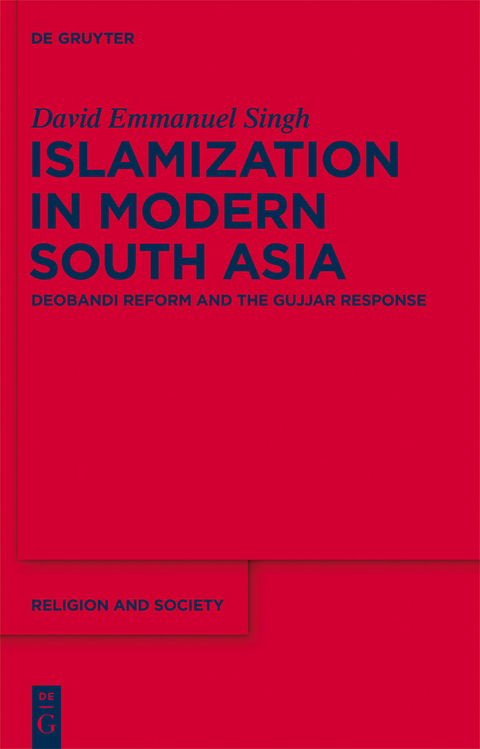
Islamization in Modern South Asia (eBook)
344 Seiten
De Gruyter (Verlag)
978-1-61451-185-4 (ISBN)
The religious identity of indegenous Gujjars in the Himilayan region remains largely unexplored. This book argues that their choice to associate with Deobandi Islam occurs in the wider context of conservation debates, local government-led efforts to relocate them from the Rajaji National Park in Uttarakhand, India, and the failure of NGOs to represent their interests. Based on documents and interviews, this detailed work explores both the continuing expansion of Deobandi reform and the responses of the Gujjars. It points toward the role of Islam in integrating marginal groups in South Asia.
David Emmanuel Singh, Oxford Centre for Mission Studies, UK.
This book explores the religious identity of the indigenous Gujjars living in Rajaji National Park (RNP), Uttarakhand, India. In the broader context of forest conservation discourse, steps taken by the local government to relocate the Gujjars outside RNP have been crucial in their choice to associate with NGOs and Deobandi Muslims. These intersecting associations constitute the context of their transitioning religious identity.The book presents a rich account of the actual process of Islamization through the collaborative agency of Deobandi madrasas and Tablighi Jama'at. Based on documents and interviews collected over four years, it constructs a particular case of Deobandi reform and also balances this with a layered description of the Gujjar responses. It argues that in their association with the Deobandis, the Gujjars internalized the normative dimensions of beliefs and practices but not at the expense of their traditional Hindu-folk culture. This capacity for adaptation bodes well for the Gujjars, but their proper integration with wider society seems assured only in association with the Deobandis. Consequently this research also points toward the role of Islam in integrating marginal groups in the wider context of society in South Asia.
lt;!doctype html public "-//w3c//dtd html 4.0 transitional//en">
David Emmanuel Singh, Oxford Centre for Mission Studies, UK.
Introduction 11
Studies on Ethnic Muslims 12
Studies on Muslim Gujjars 15
Theoretical Considerations 21
Chapter One: The Deoband School 26
Introduction 26
The Deoband School 27
Dar al-‘ulum, Deoband 28
Tablighi Jama‘at 35
Deoband among Ahl-e Hadith and Barelwis 40
The Deoband School in the Gujjar area 45
Conclusions 50
Chapter Two: The Van Gujjars 51
Introduction 51
Origins 51
Demographic Profile 59
Gujjars as part of a wider ethnic group 59
Religion-Islam 62
The Gujjars in Uttarakhand 66
The Context of Uttarakhand 66
The Gujjar in Uttarakhand 69
Contact with Rulers 73
Rajaji National Park 79
Conservation issues 79
The National Park 80
The Gujjars in RNP 83
Conclusion 87
Chapter three: The Gujjar ‘Indigeneity’ 89
Introduction 89
Discourse on Adivasis 90
NGO’s Vision for Gujjars 94
RLEK and the ‘tribal’ identity of the Gujjars 95
Religious Practice and Alleged ‘Fundamentalism’ 108
Community Forest Management 111
Other Actors 118
Conclusion 133
Chapter Four: Deobandi Islamization 134
Introduction 134
Contact with the Deoband School 135
Partnership 139
Deobandi Description of the Gujjars 143
Strategies for Outreach 148
Itinerant preaching 149
Teaching-Learning in Madrasas 155
Full-time resident teachers 164
Learning on the job 170
Madrasa education 175
Conclusion 179
Chapter Five: The Gujjar Response 181
Introduction 181
Response to Deoband 181
Knowledge and Practice of Islam 182
Practice 183
Beliefs 188
Popular Islam 192
Traditional Culture 200
Temporal Genealogy: Rajput Gotra 209
Strategic Contact 217
Comparison with the Meos 221
Conclusion 227
Concluding Discussion 228
Conclusions 228
Implications 231
Islam and Integration 231
Gujjarism and Integration 234
Spheres and Contact Zones 237
Islamization as Socialization 238
Diversity and Hybridity 239
Social Re-structuring 242
Bibliography 246
Primary Sources 246
Secondary Sources 248
Appendices 286
Appendix I 286
Appendix II 301
Appendix III 314
Appendix IV 321
Appendix V: Maps 333
Subject Index 337
People/Organisations Index 341
Place Index 343
| Erscheint lt. Verlag | 31.8.2012 |
|---|---|
| Reihe/Serie | ISSN |
| ISSN | |
| Religion and Society | Religion and Society |
| Verlagsort | Boston |
| Sprache | englisch |
| Themenwelt | Geschichte ► Teilgebiete der Geschichte ► Religionsgeschichte |
| Geisteswissenschaften ► Philosophie ► Östliche Philosophie | |
| Religion / Theologie ► Christentum ► Kirchengeschichte | |
| Geisteswissenschaften ► Religion / Theologie ► Hinduismus | |
| Geisteswissenschaften ► Religion / Theologie ► Islam | |
| Geisteswissenschaften ► Sprach- / Literaturwissenschaft ► Anglistik / Amerikanistik | |
| Geisteswissenschaften ► Sprach- / Literaturwissenschaft ► Literaturwissenschaft | |
| Naturwissenschaften | |
| Sozialwissenschaften ► Soziologie ► Spezielle Soziologien | |
| Wirtschaft ► Betriebswirtschaft / Management ► Finanzierung | |
| Schlagworte | Deoband • Islamization • Rajaji National Park • Tablighi Jama'at • Van Gujjards |
| ISBN-10 | 1-61451-185-3 / 1614511853 |
| ISBN-13 | 978-1-61451-185-4 / 9781614511854 |
| Informationen gemäß Produktsicherheitsverordnung (GPSR) | |
| Haben Sie eine Frage zum Produkt? |
 PDF (Wasserzeichen)
Größe: 2,5 MB
DRM: Digitales Wasserzeichen
Dieses eBook enthält ein digitales Wasserzeichen und ist damit für Sie personalisiert. Bei einer missbräuchlichen Weitergabe des eBooks an Dritte ist eine Rückverfolgung an die Quelle möglich.
Dateiformat: PDF (Portable Document Format)
Mit einem festen Seitenlayout eignet sich die PDF besonders für Fachbücher mit Spalten, Tabellen und Abbildungen. Eine PDF kann auf fast allen Geräten angezeigt werden, ist aber für kleine Displays (Smartphone, eReader) nur eingeschränkt geeignet.
Systemvoraussetzungen:
PC/Mac: Mit einem PC oder Mac können Sie dieses eBook lesen. Sie benötigen dafür einen PDF-Viewer - z.B. den Adobe Reader oder Adobe Digital Editions.
eReader: Dieses eBook kann mit (fast) allen eBook-Readern gelesen werden. Mit dem amazon-Kindle ist es aber nicht kompatibel.
Smartphone/Tablet: Egal ob Apple oder Android, dieses eBook können Sie lesen. Sie benötigen dafür einen PDF-Viewer - z.B. die kostenlose Adobe Digital Editions-App.
Buying eBooks from abroad
For tax law reasons we can sell eBooks just within Germany and Switzerland. Regrettably we cannot fulfill eBook-orders from other countries.


