


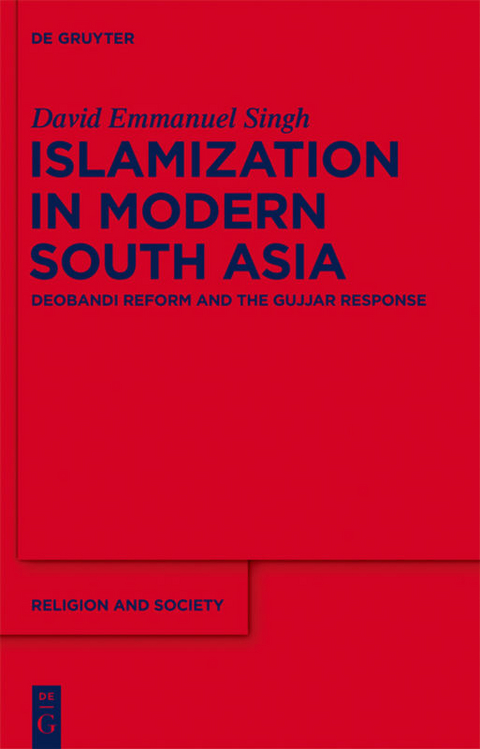
Islamization in Modern South Asia
Deobandi Reform and the Gujjar Response
Seiten
This book argues that their choice to associate with Deobandi Islam occurs in the wider context of conservation debates, local government-led efforts to relocate them from the Rajaji National Park in Uttarakhand, India, and the failure of NGOs to represent their interests.
This book explores the religious identity of the indigenous Gujjars living in Rajaji National Park (RNP), Uttarakhand, India. In the broader context of forest conservation discourse, steps taken by the local government to relocate the Gujjars outside RNP have been crucial in their choice to associate with NGOs and Deobandi Muslims. These intersecting associations constitute the context of their transitioning religious identity.The book presents a rich account of the actual process of Islamization through the collaborative agency of Deobandi madrasas and Tablighi Jama‘at. Based on documents and interviews collected over four years, it constructs a particular case of Deobandi reform and also balances this with a layered description of the Gujjar responses. It argues that in their association with the Deobandis, the Gujjars internalized the normative dimensions of beliefs and practices but not at the expense of their traditional Hindu-folk culture. This capacity for adaptation bodes well for the Gujjars, but their proper integration with wider society seems assured only in association with the Deobandis. Consequently this research also points toward the role of Islam in integrating marginal groups in the wider context of society in South Asia.
This book explores the religious identity of the indigenous Gujjars living in Rajaji National Park (RNP), Uttarakhand, India. In the broader context of forest conservation discourse, steps taken by the local government to relocate the Gujjars outside RNP have been crucial in their choice to associate with NGOs and Deobandi Muslims. These intersecting associations constitute the context of their transitioning religious identity.The book presents a rich account of the actual process of Islamization through the collaborative agency of Deobandi madrasas and Tablighi Jama‘at. Based on documents and interviews collected over four years, it constructs a particular case of Deobandi reform and also balances this with a layered description of the Gujjar responses. It argues that in their association with the Deobandis, the Gujjars internalized the normative dimensions of beliefs and practices but not at the expense of their traditional Hindu-folk culture. This capacity for adaptation bodes well for the Gujjars, but their proper integration with wider society seems assured only in association with the Deobandis. Consequently this research also points toward the role of Islam in integrating marginal groups in the wider context of society in South Asia.
David Emmanuel Singh, Oxford Centre for Mission Studies, UK.
| Erscheint lt. Verlag | 17.8.2012 |
|---|---|
| Reihe/Serie | Religion and Society ; 56 |
| Verlagsort | New York |
| Sprache | englisch |
| Maße | 155 x 230 mm |
| Gewicht | 622 g |
| Themenwelt | Geisteswissenschaften ► Philosophie ► Östliche Philosophie |
| Geisteswissenschaften ► Religion / Theologie ► Weitere Religionen | |
| Sozialwissenschaften ► Soziologie ► Spezielle Soziologien | |
| Schlagworte | Islamisierung • Südafrika (Republik) • Van Gujjards; Deoband; Tablighi Jama'at; Rajaji National Park; Islamization • VAN GUJJARS; DEOBAND; TABLIGHI JAMA'AT; RAJAJI NATIONAL PARK; ISLAMIZATION |
| ISBN-10 | 1-61451-246-9 / 1614512469 |
| ISBN-13 | 978-1-61451-246-2 / 9781614512462 |
| Zustand | Neuware |
| Informationen gemäß Produktsicherheitsverordnung (GPSR) | |
| Haben Sie eine Frage zum Produkt? |
Mehr entdecken
aus dem Bereich



aus dem Bereich


