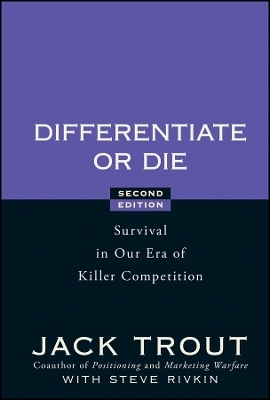
Differentiate or Die: Survival in Our Era of Kill er Competition, 2nd Edition
John Wiley & Sons Inc (Hersteller)
978-1-118-25804-0 (ISBN)
- Keine Verlagsinformationen verfügbar
- Artikel merken
A newly revised and expanded edition of the revolutionary business classic, Differentiate or Die, Second Edition shows you how to differentiate your products, services, and business in order to dominate the competition. Veteran marketing guru Jack Trout uses real-world examples and his own unique insight to show you how to bind customers to your products for long-term success and loyalty. This edition includes new case studies, new research, and updated examples from around the world.
Jack Trout is President of Trout & Partners Ltd. ( www.troutandpartners.com ), one of the nation's most prestigious marketing firms with offices in twenty-two countries. He is recognized as a top marketing guru and is the creator of the revolutionary concept of positioning. He is also the coauthor of the bestselling classic Positioning, among many other titles. Steve Rivkin is founder of Rivkin & Associates LLC ( www.rivkin.net ), a marketing and communication consultancy. He is coauthor of five books on marketing and communication strategy and is a frequent speaker at seminars and conferences around the world.
Chapter 1. The Tyranny Of Choice. Chapter 2. The Creeping Commoditization Of Categories. Chapter 3. Whatever Happened To The U.S.P.? Chapter 4. Reinventing The U.S.P. Chapter 5. Quality And Customer Orientation Are Rarely Differentiating Ideas. Chapter 6. Creativity Is Not A Differentiating Idea. Chapter 7. Price Is Rarely A Differentiating Idea. Chapter 8. Breadth Of Line Is A Difficult Way To Differentiate. Chapter 9. The Steps To Differentiation. Chapter 10. Differentiation Takes Place In The Mind. Chapter 11. Being First Is A Differentiating Idea. Chapter 12. Attribute Ownership Is A Way To Differentiate. Chapter 13. Leadership Is A Way To Differentiate. Chapter 14. Heritage Is A Differentiating Idea. Chapter 15. Market Specialty Is A Differentiating Idea. Chapter 16. Preference Is A Differentiating Idea. Chapter 17. How A Product Is Made Can Be A Differentiating Idea. Chapter 18. Being The Latest Can Be A Differentiating Idea. Chapter 19. Hotness Is A Way To Differentiate. Chapter 20. Growth Can Destroy Differentiation. Chapter 21. Differentiation Often Requires Sacrifice. Chapter 22. Being Different In Different Places. Chapter 23. Maintaining Your Difference. Chapter 24. Differentiation In The New World Of Buzz. Chapter 25. You Can Differentiate Anything. Chapter 26. Who Is In Charge Of Differentiation? Epilogue. Notes. Index.
| Erscheint lt. Verlag | 21.11.2011 |
|---|---|
| Verlagsort | New York |
| Sprache | englisch |
| Maße | 150 x 250 mm |
| Gewicht | 666 g |
| Themenwelt | Wirtschaft ► Betriebswirtschaft / Management ► Marketing / Vertrieb |
| ISBN-10 | 1-118-25804-5 / 1118258045 |
| ISBN-13 | 978-1-118-25804-0 / 9781118258040 |
| Zustand | Neuware |
| Informationen gemäß Produktsicherheitsverordnung (GPSR) | |
| Haben Sie eine Frage zum Produkt? |
aus dem Bereich