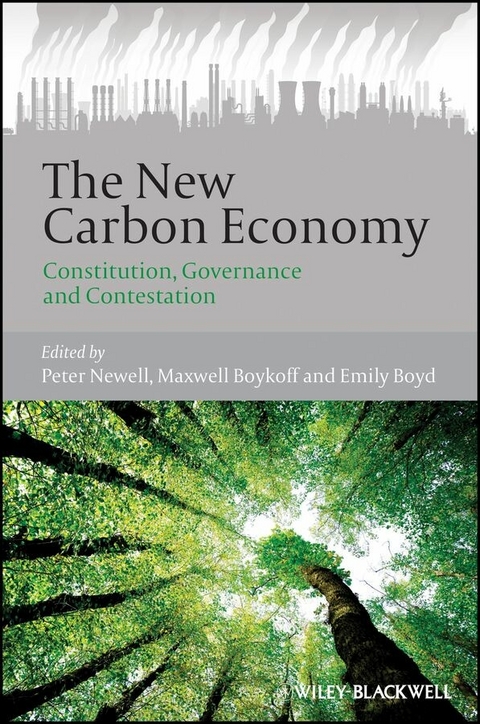
The New Carbon Economy (eBook)
John Wiley & Sons (Verlag)
978-1-118-31594-1 (ISBN)
- Examines different dimensions of the carbon economy from a range of disciplinary angles in a diversity of settings
- Provides ways for researchers to subject claims of newness and uniqueness to critical scrutiny
- Historicizes claims of the 'newness' of the carbon economy
- Covers a range of geographical settings including Europe, the US and Central America
Peter Newell is Professor of International Relations at the University of Sussex. Prior to this he was Professor of Development Studies at the University of East Anglia and held posts at the Oxford University Centre for the Environment, the Centre for the Study of Globalization and Regionalization at Warwick University, the Institute of Development Studies (Sussex), FLACSO Argentina and Climate Network Europe in Brussels. He is associate editor of the journal Global Environmental Politics. His climate publications include Climate for Change (2000), The Business of Global Environmental Governance (2005), Climate Capitalism (2010), and Governing Climate Change (2010).
Maxwell Boykoff is an Assistant Professor in the Cooperative Institute for Research in Environmental Sciences Center for Science and Technology Policy Research at the University of Colorado-Boulder. In addition, he is a Senior Visiting Research Associate in the Environmental Change Institute at the University of Oxford. His publications include the books Who Speaks for Climate?: Making Sense of Media Reporting on Climate Change (2011), and the edited volume The Politics of Climate Change (2009).
Emily Boyd is a Reader in Environmental Change and Human Communities in the Department of Geography and Environmental Sciences at the University of Reading. Previously Emily was a lecturer in Environment and Development in the School of Earth and Environment at the University of Leeds, and deputy director of the Leeds University Centre for Global Development. In addition, Emily is also a visiting researcher at Oxford University and the Stockholm Resilience Centre. Her publications include Climate Change a Beginners Guide (2010) and Adapting Institutions, Governance and Complexity: Insights for Social-ecological Resilience (2011, in press).
The New Carbon Economy provides a critical understanding of the carbon economy. It offers key insights into the constitution, governance and effects of the carbon economy, across a variety of geographical settings. Examines different dimensions of the carbon economy from a range of disciplinary angles in a diversity of settings Provides ways for researchers to subject claims of newness and uniqueness to critical scrutiny Historicizes claims of the 'newness' of the carbon economy Covers a range of geographical settings including Europe, the US and Central America
Peter Newell is Professor of International Relations at the University of Sussex. Prior to this he was Professor of Development Studies at the University of East Anglia and held posts at the Oxford University Centre for the Environment, the Centre for the Study of Globalization and Regionalization at Warwick University, the Institute of Development Studies (Sussex), FLACSO Argentina and Climate Network Europe in Brussels. He is associate editor of the journal Global Environmental Politics. His climate publications include Climate for Change (2000), The Business of Global Environmental Governance (2005), Climate Capitalism (2010), and Governing Climate Change (2010). Maxwell Boykoff is an Assistant Professor in the Cooperative Institute for Research in Environmental Sciences Center for Science and Technology Policy Research at the University of Colorado-Boulder. In addition, he is a Senior Visiting Research Associate in the Environmental Change Institute at the University of Oxford. His publications include the books Who Speaks for Climate?: Making Sense of Media Reporting on Climate Change (2011), and the edited volume The Politics of Climate Change (2009). Emily Boyd is a Reader in Environmental Change and Human Communities in the Department of Geography and Environmental Sciences at the University of Reading. Previously Emily was a lecturer in Environment and Development in the School of Earth and Environment at the University of Leeds, and deputy director of the Leeds University Centre for Global Development. In addition, Emily is also a visiting researcher at Oxford University and the Stockholm Resilience Centre. Her publications include Climate Change a Beginners Guide (2010) and Adapting Institutions, Governance and Complexity: Insights for Social-ecological Resilience (2011, in press).
List of Contributors vii
1 The "New" Carbon Economy: What's New?
Emily Boyd, Maxwell Boykoff and Peter Newell 1
2 The Matter of Carbon: Understanding the Materiality of tCO2e
in Carbon Offsets
Adam G. Bumpus 13
3 Making Markets Out of Thin Air: A Case of Capital
Involution
María Gutíerrez 41
4 Between Desire and Routine: Assembling Environment and Finance
in Carbon Markets
Philippe Descheneau and Matthew Paterson 65
5 Ecological Modernisation and the Governance of Carbon: A
Critical Analysis
Ian Bailey, Andy Gouldson and Peter Newell 85
6 Accounting for Carbon: The Role of Accounting Professional
Organisations in Governing Climate Change
Heather Lovell and Donald MacKenzie 107
7 Realizing Carbon's Value: Discourse and Calculation in
the Production of Carbon Forestry Offsets in Costa Rica
David M. Lansing 135
8 Resisting and Reconciling Big Wind: Middle Landscape Politics
in the New American West
Roopali Phadke 159
Index 183
"This book should serve as excellent platform to stimulate
further scholarly engagement with this extremely important
topic." (New Zealand Geographer, 1 April
2013)
Chapter 2
The Matter of Carbon: Understanding the Materiality of tCO2e in Carbon Offsets
Adam G. Bumpus
Introduction
Carbon offsets exist as a new socio-ecological interface in the management of the environment and economy. Offsets are tools to manage anthropogenic climate change and, in some cases, contribute to international sustainable development (Bumpus and Liverman 2008; Liverman 2009; Lovell and Liverman 2010). In addition to supposedly cheap, fast carbon reductions, offsetting also speaks to ethical debates when offsets allow those who can afford it to continue to pollute (Boyd 2009; Lohmann 2006; Lovell, Bulkeley and Liverman 2009; Vandenbergh and Ackerly 2008). Key to certain offsets is their promotion as channels of finance for local sustainable development in developing countries (Brown et al 2004; Bumpus and Liverman 2008; Figueres 2006). Offsets are complex, and centre around the creation of emissions reductions that are then traded as tonnes of carbon dioxide equivalent (tCO2e) on international markets (Bailey and Maresh 2009; Hepburn 2009). In contrast to emissions allowances that are allocated and either given away or auctioned by governments in cap and trade systems, offsets employ specific technologies or forestry mechanisms to reduce emissions in specific project activities. The material differences between different offset project types are significant because they enable and constrain the social relations necessary for offset production (Bakker and Bridge 2006:21). These differences have relevance for use of offsets as effective instruments to reduce climate-forcing greenhouse gases and promote sustainable development (Bumpus and Cole 2010; Olsen and Fenhann 2008a; UNFCCC 2001). Importantly, offsets also have relevance for long-running debates and scholarship exposing dialectic interactions in nature–society relations (Bakker 2005; Bridge and Jonas 2002; Castree 2003b, 2008a; FitzSimmons 1989; Robertson 2006).
I approach carbon reductions in offsets as a dynamic, two-way relationship of mutual influence and adjustment between social systems and material nature (Bäckstrand and Lövbrand 2006; Bakker and Bridge 2006; Boyd, Prudham and Schurman 2001; Castree 2003b, 2005:155, 160; FitzSimmons 1989; Goodman 2001). The material and discursive aspects of carbon commodification are interwoven (Bridge and Smith 2003), thus this analysis aims to show how dialectical socionatural relations influence offsets in the evolution of the new carbon economy more generally (Baldwin 2009; Boykoff et al 2009; Braun and Castree 1998; Bumpus and Liverman 2008; Escobar 1996; Lohmann 2006; Oels 2005; Redclift 2009). As others have shown, the significance of the biophysical world in nature-based industries has to be balanced with embracing aspects of nature’s social production (Boyd, Prudham and Schurman 2001; Castree 1995; Goodman 2001; Le Billon 2001; Prudham 2003): capital metabolises nature into exchangeable values affecting spaces, environments and social relations across place and scale (Blaikie and Brookfield 1987; Bryant and Bailey 1997; Bryant and Goodman 2004; Sneddon 2007; Swyngedouw 1999). Others have shown how the biophysical properties of the non-human world also often resist these processes of commodification (Bakker 2005); firms must adapt given the technologies available, their ability to mobilise resources and local socio-ecological relations that allow nature’s articulation within capitalist processes (Bakker 2003; Castree 2008b:145). In carbon offsets, broader regulatory systems, governing mechanisms, institutions and “tactics” are all present to manage the conflicts and contradictions in the commodification of carbon (Bakker 2009; Callon 2009; Lohmann 2009; Lovell and Liverman 2010:3; MacKenzie 2009).
I focus here on the calculability of tCO2e through an examination of the major material dimensions of offset technology deployment (Le Billon 2001), its specific local social relations, and the role of tools to govern reductions through carbon standards (Lohmann 2009; MacKenzie 2009). The analysis concerns the material interaction of the different technology types with local socionatural conditions and the calculation activities for offsetting that encourage the material and discursive components of the commodification of carbon. Rather than aiming for an integration of structural Marxist approaches with post-structural accounts (cf Castree 2002), I aim to provide an account of carbon offsets that finds a more epistemological middle ground that realises the importance of complementary lenses to the problem through dialectical understanding (Sneddon 2007:170). By better understanding the material dimensions of how carbon offset technologies interact with the environment and local social relations (Lovell and Liverman 2010), we are better able to understand the linkages between the political economies and evolution of the international carbon markets, and local development implications (Bumpus 2009); important critical and practical components for the emerging carbon economy (MacKenzie 2009).
Carbon dioxide is the most common anthropogenic greenhouse gas (IPCC 2007). The calculation of tonnes of carbon dioxide equivalent (ie tCO2e) arises from the need to develop a common benchmark of the global warming potential of the six greenhouse gasses over a 100-year span by using the global warming potential of 1 tonne of carbon as a baseline indicator. This article uses two carbon mitigation projects as case studies of energy-based carbon offsets in Honduras to add empirical depth to the paper, focussing on the creation of tCO2e for project-based (ie not sectoral or programmatic) offsets: a renewable energy project (small-scale hydroelectric facility), and a biomass efficiency project (improved cookstoves—ICS) project.1 As part of a broader study on the evolution of carbon offset markets, key informant interviews were conducted with carbon financiers, project developers, verifiers and communities associated with the projects. Document analysis of the case studies and direct observation triangulated the outcomes and conclusions presented here.
This analysis has two principal aims: to develop an analysis of the commodification of carbon in order to explain the socionatural processes of creating a tonne of carbon dioxide equivalent (tCO2e) and to open up the dialectical tension between the international carbon market and local socionatural relations, mediated by technology type, drawing links between governance of international carbon mechanisms and “local development” through the application of specific offset technology.
Following an explanation of my approach to the analysis, I provide a technical description of “what carbon” is to be commodified in carbon offsets and an outline of the relationship between fundamental concepts of offsetting and project types. I then delve deeper into the processes of commodification used to create carbon reduction credits in order to develop both the theoretical and practical issues for understanding tCO2e. Drawing on two different carbon offset case studies, I illustrate the major dimensions of materiality that affect their commodification of carbon reductions, and how such materiality links international carbon market evolution to local socionatural conditions. I conclude with the theoretical and policy insights that can be drawn from the analysis.
Making Carbon Reductions
Commodity status is not intrinsic, but “is the result of conscious and unconscious actions of people in specific circumstances” (Castree 2003b:283): global capitalist processes shape localities and the transformation of nature into commodities. At the same time the specific features of the raw materials themselves affect how these processes are undertaken and reworked at multiple scales (cf Barham and Coomes 1994; Swyngedouw 1999). This broad conceptualisation is useful for analysis of carbon reductions in offsets given the broader evolution of the carbon markets and the political economy of offset governance (Bumpus and Liverman 2008), and the local material specificities, and social relations, of technology deployment that allow carbon reductions to be created (Lovell and Liverman 2010).
Carbon offsets rely on “baseline-and-credit” trading systems that “create” assets: tonnes of carbon dioxide equivalent (tCO2e; Figure 1). These assets (carbon credits) represent the additional carbon reductions from a baseline of emissions through the investment in emission reduction projects that would not have otherwise taken place (Yamin 2005:30). This is the fundamental notion of environmental “additionality” that differentiates the emissions produced by an offset project from the “business-as-usual” scenario of baseline emissions without the project (Michaelowa 2005). These counterfactual scenarios are determined through analyses of the socio-political economic situations in which the offset project is taking place, and the construction of hypothetical future baseline emissions scenarios.
Figure 1: Principles of the baseline determination and the calculation of carbon credits (source: Bumpus and Liverman 2008)
The creation of tCO2e relies on the implementation of project activities and the processes of calculating, justifying and verifying emissions reductions. The materiality of the carbon, and the real world context in which it is reduced, must be kept in tension with the institutional requirements—such as carbon...
| Erscheint lt. Verlag | 3.2.2012 |
|---|---|
| Reihe/Serie | Antipode Book Series |
| Antipode Book Series | Antipode Book Series |
| Sprache | englisch |
| Themenwelt | Naturwissenschaften ► Biologie ► Ökologie / Naturschutz |
| Naturwissenschaften ► Geowissenschaften ► Geografie / Kartografie | |
| Technik | |
| Wirtschaft ► Volkswirtschaftslehre | |
| Schlagworte | Anthropogeographie • carbon emissions • climate change • Ecology • Environment • Environmental Geography • Geographie • Geography • global offset mechanisms • Human geography • regional emissions trading schemes • threat of climate change • Umweltgeographie |
| ISBN-10 | 1-118-31594-4 / 1118315944 |
| ISBN-13 | 978-1-118-31594-1 / 9781118315941 |
| Informationen gemäß Produktsicherheitsverordnung (GPSR) | |
| Haben Sie eine Frage zum Produkt? |
 EPUB (Adobe DRM)
Kopierschutz: Adobe-DRM
Adobe-DRM ist ein Kopierschutz, der das eBook vor Mißbrauch schützen soll. Dabei wird das eBook bereits beim Download auf Ihre persönliche Adobe-ID autorisiert. Lesen können Sie das eBook dann nur auf den Geräten, welche ebenfalls auf Ihre Adobe-ID registriert sind.
Details zum Adobe-DRM
Dateiformat: EPUB (Electronic Publication)
EPUB ist ein offener Standard für eBooks und eignet sich besonders zur Darstellung von Belletristik und Sachbüchern. Der Fließtext wird dynamisch an die Display- und Schriftgröße angepasst. Auch für mobile Lesegeräte ist EPUB daher gut geeignet.
Systemvoraussetzungen:
PC/Mac: Mit einem PC oder Mac können Sie dieses eBook lesen. Sie benötigen eine
eReader: Dieses eBook kann mit (fast) allen eBook-Readern gelesen werden. Mit dem amazon-Kindle ist es aber nicht kompatibel.
Smartphone/Tablet: Egal ob Apple oder Android, dieses eBook können Sie lesen. Sie benötigen eine
Geräteliste und zusätzliche Hinweise
Buying eBooks from abroad
For tax law reasons we can sell eBooks just within Germany and Switzerland. Regrettably we cannot fulfill eBook-orders from other countries.
aus dem Bereich