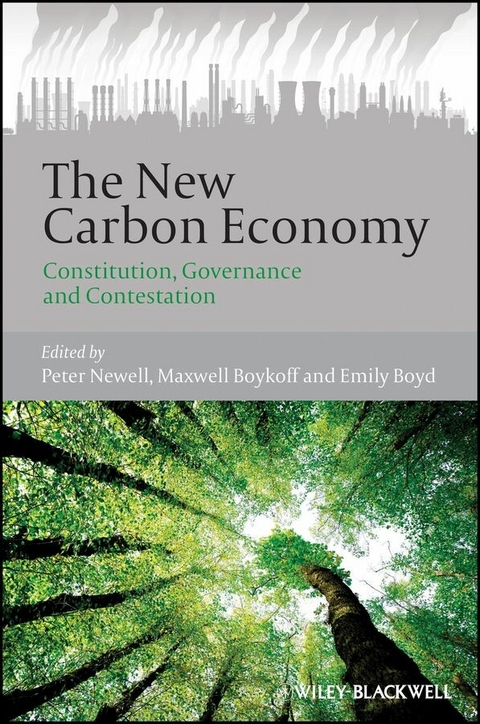
The New Carbon Economy (eBook)
John Wiley & Sons (Verlag)
978-1-118-31593-4 (ISBN)
- Examines different dimensions of the carbon economy from a range of disciplinary angles in a diversity of settings
- Provides ways for researchers to subject claims of newness and uniqueness to critical scrutiny
- Historicizes claims of the 'newness' of the carbon economy
- Covers a range of geographical settings including Europe, the US and Central America
Peter Newell is Professor of International Relations at the University of Sussex. Prior to this he was Professor of Development Studies at the University of East Anglia and held posts at the Oxford University Centre for the Environment, the Centre for the Study of Globalization and Regionalization at Warwick University, the Institute of Development Studies (Sussex), FLACSO Argentina and Climate Network Europe in Brussels. He is associate editor of the journal Global Environmental Politics. His climate publications include Climate for Change (2000), The Business of Global Environmental Governance (2005), Climate Capitalism (2010), and Governing Climate Change (2010).
Maxwell Boykoff is an Assistant Professor in the Cooperative Institute for Research in Environmental Sciences Center for Science and Technology Policy Research at the University of Colorado-Boulder. In addition, he is a Senior Visiting Research Associate in the Environmental Change Institute at the University of Oxford. His publications include the books Who Speaks for Climate?: Making Sense of Media Reporting on Climate Change (2011), and the edited volume The Politics of Climate Change (2009).
Emily Boyd is a Reader in Environmental Change and Human Communities in the Department of Geography and Environmental Sciences at the University of Reading. Previously Emily was a lecturer in Environment and Development in the School of Earth and Environment at the University of Leeds, and deputy director of the Leeds University Centre for Global Development. In addition, Emily is also a visiting researcher at Oxford University and the Stockholm Resilience Centre. Her publications include Climate Change a Beginners Guide (2010) and Adapting Institutions, Governance and Complexity: Insights for Social-ecological Resilience (2011, in press).
The New Carbon Economy provides a critical understanding of the carbon economy. It offers key insights into the constitution, governance and effects of the carbon economy, across a variety of geographical settings. Examines different dimensions of the carbon economy from a range of disciplinary angles in a diversity of settings Provides ways for researchers to subject claims of newness and uniqueness to critical scrutiny Historicizes claims of the 'newness' of the carbon economy Covers a range of geographical settings including Europe, the US and Central America
Peter Newell is Professor of International Relations at the University of Sussex. Prior to this he was Professor of Development Studies at the University of East Anglia and held posts at the Oxford University Centre for the Environment, the Centre for the Study of Globalization and Regionalization at Warwick University, the Institute of Development Studies (Sussex), FLACSO Argentina and Climate Network Europe in Brussels. He is associate editor of the journal Global Environmental Politics. His climate publications include Climate for Change (2000), The Business of Global Environmental Governance (2005), Climate Capitalism (2010), and Governing Climate Change (2010). Maxwell Boykoff is an Assistant Professor in the Cooperative Institute for Research in Environmental Sciences Center for Science and Technology Policy Research at the University of Colorado-Boulder. In addition, he is a Senior Visiting Research Associate in the Environmental Change Institute at the University of Oxford. His publications include the books Who Speaks for Climate?: Making Sense of Media Reporting on Climate Change (2011), and the edited volume The Politics of Climate Change (2009). Emily Boyd is a Reader in Environmental Change and Human Communities in the Department of Geography and Environmental Sciences at the University of Reading. Previously Emily was a lecturer in Environment and Development in the School of Earth and Environment at the University of Leeds, and deputy director of the Leeds University Centre for Global Development. In addition, Emily is also a visiting researcher at Oxford University and the Stockholm Resilience Centre. Her publications include Climate Change a Beginners Guide (2010) and Adapting Institutions, Governance and Complexity: Insights for Social-ecological Resilience (2011, in press).
List of Contributors vii
1 The "New" Carbon Economy: What's New?
Emily Boyd, Maxwell Boykoff and Peter Newell 1
2 The Matter of Carbon: Understanding the Materiality of tCO2e
in Carbon Offsets
Adam G. Bumpus 13
3 Making Markets Out of Thin Air: A Case of Capital
Involution
María Gutíerrez 41
4 Between Desire and Routine: Assembling Environment and Finance
in Carbon Markets
Philippe Descheneau and Matthew Paterson 65
5 Ecological Modernisation and the Governance of Carbon: A
Critical Analysis
Ian Bailey, Andy Gouldson and Peter Newell 85
6 Accounting for Carbon: The Role of Accounting Professional
Organisations in Governing Climate Change
Heather Lovell and Donald MacKenzie 107
7 Realizing Carbon's Value: Discourse and Calculation in
the Production of Carbon Forestry Offsets in Costa Rica
David M. Lansing 135
8 Resisting and Reconciling Big Wind: Middle Landscape Politics
in the New American West
Roopali Phadke 159
Index 183
"This book should serve as excellent platform to stimulate
further scholarly engagement with this extremely important
topic." (New Zealand Geographer, 1 April
2013)
| Erscheint lt. Verlag | 17.1.2012 |
|---|---|
| Reihe/Serie | Antipode Book Series | Antipode Book Series |
| Sprache | englisch |
| Themenwelt | Naturwissenschaften ► Biologie ► Ökologie / Naturschutz |
| Naturwissenschaften ► Geowissenschaften ► Geografie / Kartografie | |
| Technik | |
| Wirtschaft ► Volkswirtschaftslehre | |
| Schlagworte | Anthropogeographie • carbon emissions • climate change • Ecology • Environment • Environmental Geography • Geographie • Geography • global offset mechanisms • Human geography • regional emissions trading schemes • threat of climate change • Umweltgeographie |
| ISBN-10 | 1-118-31593-6 / 1118315936 |
| ISBN-13 | 978-1-118-31593-4 / 9781118315934 |
| Informationen gemäß Produktsicherheitsverordnung (GPSR) | |
| Haben Sie eine Frage zum Produkt? |
 PDF (Adobe DRM)
Kopierschutz: Adobe-DRM
Adobe-DRM ist ein Kopierschutz, der das eBook vor Mißbrauch schützen soll. Dabei wird das eBook bereits beim Download auf Ihre persönliche Adobe-ID autorisiert. Lesen können Sie das eBook dann nur auf den Geräten, welche ebenfalls auf Ihre Adobe-ID registriert sind.
Details zum Adobe-DRM
Dateiformat: PDF (Portable Document Format)
Mit einem festen Seitenlayout eignet sich die PDF besonders für Fachbücher mit Spalten, Tabellen und Abbildungen. Eine PDF kann auf fast allen Geräten angezeigt werden, ist aber für kleine Displays (Smartphone, eReader) nur eingeschränkt geeignet.
Systemvoraussetzungen:
PC/Mac: Mit einem PC oder Mac können Sie dieses eBook lesen. Sie benötigen eine
eReader: Dieses eBook kann mit (fast) allen eBook-Readern gelesen werden. Mit dem amazon-Kindle ist es aber nicht kompatibel.
Smartphone/Tablet: Egal ob Apple oder Android, dieses eBook können Sie lesen. Sie benötigen eine
Geräteliste und zusätzliche Hinweise
Buying eBooks from abroad
For tax law reasons we can sell eBooks just within Germany and Switzerland. Regrettably we cannot fulfill eBook-orders from other countries.
aus dem Bereich