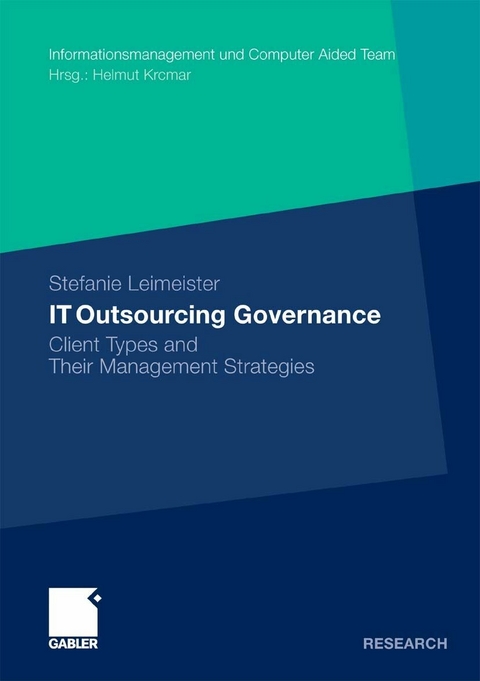
IT Outsourcing Governance (eBook)
XXVI, 368 Seiten
Betriebswirtschaftlicher Verlag Gabler
978-3-8349-6303-1 (ISBN)
Dr. Stefanie Leimeister completed her doctoral thesis under the supervision of Prof. Dr. Helmut Krcmar at the Chair of Information Systems at Technische Universität München (TUM) and currently works as a research division manager at fortiss - the TUM research institute for software intensive systems.
Dr. Stefanie Leimeister completed her doctoral thesis under the supervision of Prof. Dr. Helmut Krcmar at the Chair of Information Systems at Technische Universität München (TUM) and currently works as a research division manager at fortiss – the TUM research institute for software intensive systems.
Foreword 6
Acknowledgements 7
Abstract 8
Table of Contents 10
List of Figures 15
List of Tables 19
List of Abbreviations 22
1 Introduction 24
1.1 Problem Statement and Motivation for this Research 24
1.2 Research Objective and Research Questions 26
1.3 Outline and Structure of the Thesis 29
2 Epistemological Foundation and Research Methodology 31
2.1 Philosophical Perspectives and Research Epistemology 31
2.1.1 Positivist Research 31
2.1.2 Interpretive Research 33
2.1.3 Critical Research 33
2.2 Research Design and Methods: Quantitative vs. Qualitative Research 33
2.3 Summary of Epistemological Foundations of this Thesis 35
3 Theoretical Background on Outsourcing 36
3.1 Definition and Background of Information Systems Outsourcing 36
3.1.1 Specific Characteristics of Information Systems Outsourcing 37
3.1.2 IS Outsourcing Definitions 39
3.2 Theoretical Foundation: Related Theories 42
3.2.1 Transaction Cost Economics 43
3.2.2 Exchange Theories: Social Exchange and Relational Exchange Theory 45
3.2.2.1 Social Exchange Theory 45
3.2.2.2 Relational Exchange Theory 46
3.2.3 Psychological Contract Theory 47
3.2.4 Expectation Confirmation Theory 48
3.2.5 Theories of Power: Power-Political, Power Dependence, Power Conflict 49
3.2.6 Summary of Theories for IS Outsourcing Relationships 51
3.3 The Multi-Dimensionality of Outsourcing IS Functions 52
3.3.1 Outsourcing Functions and the IT Service Lifecycle 52
3.3.2 Forms of Outsourcing Arrangements 54
3.4 Outsourcing Determinants and Expectations: Advantages and Disadvantages 60
3.5 Prior Research on IS Outsourcing Relationships: State of the Art 66
3.5.1 Evolution of IS Outsourcing Research towards a Relationship Focus 66
3.5.2 The Relationship Perspective in IS Outsourcing 67
3.5.3 Approaches for Classifying IS Outsourcing Relationships 69
3.6 Constitutive Factors of an IS Outsourcing Relationship 70
3.6.1 Strategic Intent and Contextual Factors 70
3.6.2 Relationship Architecture 71
3.6.3 Governance and Monitoring Mechanisms 72
3.6.3.1 Formal Contractual Governance 75
3.6.3.2 Informal Relational Governance 76
3.6.3.3 The Interplay of Formal Contractual and Informal Relational Governance 77
3.6.3.4 Governance via Management Processes 78
3.6.3.5 Governance via Organizational Structures 79
3.6.3.6 Governance via Experience and Risk-Reward Incentive Mechanisms 80
3.6.4 Relational and Behavioral Interactions of the Outsourcing Parties 82
3.6.5 Success of IS Outsourcing 87
3.7 Shortcomings of the Current Research / Research Gap on Outsourcing Relationships and their Governance 91
3.8 Framework for Classifying Outsourcing Relationships 92
3.8.1 Methodological Approach to the Conceptualization of a Framework on Outsourcing Relationships 93
3.8.2 Categories of the Framework 94
3.8.3 Completeness vs. Parsimony of the Building Blocks 94
3.8.4 Interdependencies among the Variables 95
3.8.5 Conceptual Framework for Types in IS Outsourcing Relationships 96
3.9 Summary of Outsourcing Foundations 100
4 Theoretical and Methodological Foundations for Classifying Data 102
4.1 Theoretical Foundations of Classification and Configuration 102
4.1.1 Definition of Classification Terms: Classification, Configuration, Type 102
4.1.2 Characteristics of Configurations or Types 103
4.1.3 Typologies vs. Taxonomies 104
4.2 Grouping Techniques 107
4.2.1 Cluster Analysis 107
4.2.1.1 Definition of Cluster Analysis 107
4.2.1.2 General Procedure of Cluster Analysis 108
4.2.1.3 Different Clustering Techniques and Algorithms 109
4.2.1.4 Clustering Steps 111
4.2.1.5 Strengths and Pitfalls of Cluster Analysis 119
4.2.2 Discriminant Analysis 120
4.2.3 Factor Analysis 122
4.2.3.1 General Considerations and Distinctions in Factor Analysis: Exploratory vs. Confirmatory, R vs. Q Analysis 122
4.2.3.2 Design and Process of a Factor Analysis 123
4.3 Summary of the Methodological Foundations for Classifying Outsourcing Clients 129
5 Empirical Evidence of Outsourcing Relationship Types 131
5.1 Qualitative Pre-Study: First Evidence of Different IS Outsourcing Relationships 133
5.1.1 Data Collection 133
5.1.2 Results 136
5.1.2.1 Strategic Intent, Expectations, and Context 137
5.1.2.2 Relationship Architecture 137
5.1.2.3 Governance and Monitoring 137
5.1.2.4 Interaction 138
5.1.3 Types of IS Outsourcing Relationships 138
5.2 Research Design of the Quantitative Study 142
5.3 Data Collection and Demographic Results 144
5.4 Statistical Results: Data Analysis 146
5.4.1 Diagnostic Pre-Analysis of Results: Missing Values and Distribution of Data 146
5.4.1.1 Diagnostics: Analyzing the Extent and Impact of Missing Values 147
5.4.1.2 Normal Distribution of the Data 151
5.4.2 Factor Analysis: Customer Expectations towards IS Outsourcing 152
5.4.2.1 Initial Factor Analysis with All Outsourcing Motives 153
5.4.2.2 Final Improved Factor Solution 155
5.4.2.3 Reliability Analysis of the Final Factor Solution 160
5.4.2.4 Interpretation of Factors 161
5.4.3 Cluster Analysis: Finding Configurations of Clients with Similar Outsourcing Expectations 162
5.4.3.1 Selecting and Preparing the Input Variables for the Cluster Analysis 163
5.4.3.2 Identifying Outliers in the Data Set 163
5.4.3.3 Identifying the Number of Clusters and the Cluster Centroids 164
5.4.3.4 Optimizing the Cluster Solution with k-Means 166
5.4.3.5 Estimating and Validating the Cluster Solution with Discriminant Analysis 167
5.5 Interpretation of Statistical Analysis: Configurations of Different Outsourcing Client Groups 168
5.5.1 Constitutive Elements of the Client Configurations: Major Outsourcing Expecta-tions and Strategic Intents 169
5.5.2 Context Factors 176
5.5.2.1 Basic Company Characteristics 176
5.5.2.2 Role and Impact of IT for the Company 181
5.5.3 Relational Architecture of the Outsourcing Ventures 182
5.5.3.1 Experience with Outsourcing 182
5.5.3.2 Outsourcing Objects and Degree of Outsourced Functions 183
5.5.3.3 Number of Involved Vendors: Single vs. Multi-Vendor Outsourcing 185
5.5.3.4 Outsourcing Degree: Selective vs. Total Outsourcing 186
5.5.3.5 Length and Duration of Outsourcing Contracts 187
5.5.3.6 Pricing Arrangements for Outsourced Services 188
5.5.3.7 Outsourcing Alliances 189
5.5.3.8 Dependency on the Service Provider and Switching Costs 190
5.5.3.9 Goal Alignment between Outsourcing Parties 191
5.5.4 Governance Approaches among the Different Client Groups 194
5.5.4.1 Outsourcing Governance: Role of the Contract 194
5.5.4.2 Outsourcing Governance: Role of Processes 196
5.5.4.3 Outsourcing Governance: Role of Structures and Structural Liaison Devices 199
5.5.4.4 Outsourcing Governance: Informal Relationship 201
5.5.4.5 The Role of Staff Experience, Degrees of Freedom for the Vendor, and Risk-Reward Mechanisms as Governance Mechanisms 204
5.5.5 Interactions: Role of Specific Relationship Factors 208
5.5.5.1 Communication 209
5.5.5.2 Conflict Resolution and Consensus 210
5.5.5.3 Cooperation and Coordination 212
5.5.5.4 Commitment and Loyalty 214
5.5.5.5 Cultural Similarity 215
5.5.5.6 Trust 216
5.5.5.7 Vendor Flexibility 218
5.5.5.8 Vendor Proactivity 219
5.5.6 Outsourcing Success: Perceived Service Quality and Satisfaction 222
5.6 Summary and Consolidated Description of the Four Client Configurations 225
6 Governance of IS Outsourcing Relationship Types 235
6.1 Research Design: Governance Model and Construct Development 235
6.2 Research Approach and Validation 238
6.3 Model Validation and Results 239
6.3.1 Formative Measurement Model 239
6.3.2 Reflective Measurement Model 241
6.3.3 Structural Model 246
6.3.4 Group Analysis: The Impact of Different Governance Mechanisms among the Four Client Groups 250
6.3.5 Mediating Effects in the Model 251
6.4 Assessment of Common Method Bias 253
6.5 Discussion and Interpretation of Results 256
7 Conclusion and Outlook on Future Research 263
7.1 Results and Contributions to Theory 264
7.2 Results and Contributions to Practice 266
7.3 Main Research Limitations 267
7.4 Outlook on Future Research 268
References 269
Appendix 312
| Erscheint lt. Verlag | 18.11.2010 |
|---|---|
| Reihe/Serie | Informationsmanagement und Computer Aided Team | Informationsmanagement und Computer Aided Team |
| Zusatzinfo | XXVI, 368 p. 64 illus. |
| Verlagsort | Wiesbaden |
| Sprache | englisch |
| Themenwelt | Mathematik / Informatik ► Informatik ► Netzwerke |
| Wirtschaft ► Allgemeines / Lexika | |
| Schlagworte | Betriebswirtschaft • Informationssysteme • Informationstechnologie • Information Technology (IT) • Outsourcing • Steuerungsmodell • Wirtschaftsinformatik |
| ISBN-10 | 3-8349-6303-8 / 3834963038 |
| ISBN-13 | 978-3-8349-6303-1 / 9783834963031 |
| Informationen gemäß Produktsicherheitsverordnung (GPSR) | |
| Haben Sie eine Frage zum Produkt? |
 PDF (Wasserzeichen)
DRM: Digitales Wasserzeichen
Dieses eBook enthält ein digitales Wasserzeichen und ist damit für Sie personalisiert. Bei einer missbräuchlichen Weitergabe des eBooks an Dritte ist eine Rückverfolgung an die Quelle möglich.
Dateiformat: PDF (Portable Document Format)
Mit einem festen Seitenlayout eignet sich die PDF besonders für Fachbücher mit Spalten, Tabellen und Abbildungen. Eine PDF kann auf fast allen Geräten angezeigt werden, ist aber für kleine Displays (Smartphone, eReader) nur eingeschränkt geeignet.
Systemvoraussetzungen:
PC/Mac: Mit einem PC oder Mac können Sie dieses eBook lesen. Sie benötigen dafür einen PDF-Viewer - z.B. den Adobe Reader oder Adobe Digital Editions.
eReader: Dieses eBook kann mit (fast) allen eBook-Readern gelesen werden. Mit dem amazon-Kindle ist es aber nicht kompatibel.
Smartphone/Tablet: Egal ob Apple oder Android, dieses eBook können Sie lesen. Sie benötigen dafür einen PDF-Viewer - z.B. die kostenlose Adobe Digital Editions-App.
Buying eBooks from abroad
For tax law reasons we can sell eBooks just within Germany and Switzerland. Regrettably we cannot fulfill eBook-orders from other countries.
aus dem Bereich