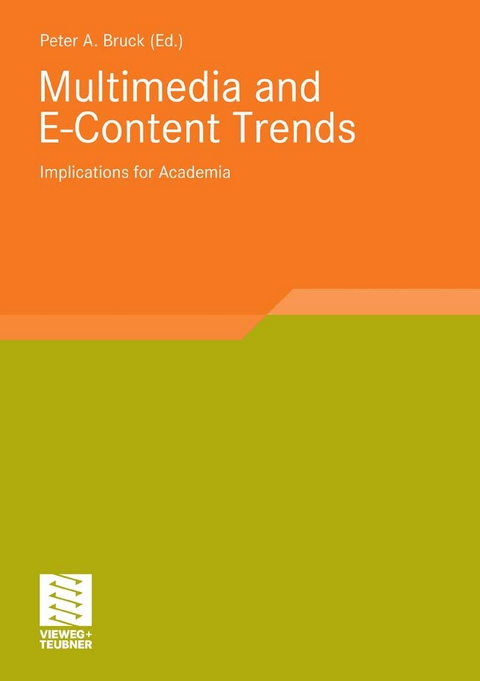
Multimedia and E-Content Trends (eBook)
VIII, 195 Seiten
Vieweg & Teubner (Verlag)
978-3-8348-9313-0 (ISBN)
Professor Dr. Peter A. Bruck is the General Manager and Chief Researcher of the Research Studios Austria.
Professor Dr. Peter A. Bruck is the General Manager and Chief Researcher of the Research Studios Austria.
Preface 6
Content 8
Introduction: the Technological and Economic Dynamics of the Multimedia Content Industry 10
A Augmented Realities and Smart Interfaces 14
TangibleCubes - Implementation of Tangible User Interfaces through the Usage of Microcontroller and Sensor Technology 14
Abstract 14
1 Introduction 14
2 Related Work 15
2.1 Telekom Austria Cube 15
2.2 ToolStone 16
3 HCI with Tangible User Interfaces 16
4 Arduino Platform 16
5 Tangible Cubes Application 17
5.1 System Overview 18
5.2 Software design 19
5.3 Hardware Design 19
5.4 Interaction 21
5.5 Further fields of usage 25
6 Usability Tests 26
6.1 Test method 26
6.2 Results 26
7 Conclusion 27
References 28
Investigation on the Relationships among Media Characteristics, Presence, Flow, and Learning Effects in Augmented Reality Based Learning 29
Abstract 29
1 Introduction 29
2 Theoretical Background 30
3 Research Methods 34
4 Research Results 34
5 Conclusions and Suggestions 40
References 42
Visualization of Machine-Aided Measurements of People Counts in Different Infrastructures 46
Abstract 46
1 Introduction 46
2 Machine-aided measurements of people counts 47
2.1 Reasons for People Counting 47
2.2 Measurement Technologies 47
3 Visualization 50
4 Interaction 51
4.1 Dynamic Queries 51
4.2 Brushing and Linking 52
4.3 Special Interface Elements 52
5 Prototype 53
5.1 Data Structure 53
5.2 Filter Settings 54
5.3 Graphical User Interface 55
5.4 Interaction 59
6 Usability Tests 60
6.1 Test Environment 60
6.2 Test Objectives 61
6.3 Profile of Test Users 61
6.4 Practical Tests 61
6.5 Final Questionnaire 62
6.6 Suggestions for Improvement 63
7 Conclusion 63
8 Acknlowlegdement 64
References 64
B Mobile Location Based Applications 66
Pushing Location Based Games Further – How To Gain End User Suitability 66
Abstract 66
1 Introduction 67
1.1Availability 67
2 Market Situation 68
3 Evaluation Criteria 69
3.1 Destination Platform 69
3.2 Game Related Costs 70
3.3 Positioning Technologies 71
3.4 Application Set-up 71
3.5 Network Aspect 72
3.6 Multiplayer Aspect 72
3.7 Availability 73
4 Conclusion 73
References 78
Mobile Game Based Learning: Designing a Mobile Location Based Game 80
Abstract 80
1 Introduction 80
2 Concept 81
3 Framework 82
3.1 Tools 82
3.2 Moodle Activity “GPS Area” 84
3.3 MoMo GPS 85
3.4 Moodle Block “Online Users” 86
3.5 Moodle Activity Module “GPS Game” 87
4 Physics Geocoaching 89
4.1 Story 90
4.2 Goal 91
4.3 Field 91
4.4 Tasks 91
4.5 Aids 92
4.6 Key 92
4.7 Notes 92
5 Usability Test 92
6 Conclusion 94
References 95
Thessaloniki’s City Guide: a Tourist Site for Handheld Devices 96
Abstract 96
1 Introduction 96
2 Background 96
3 Method 100
4 Testing 105
References 105
C The Mobile Content Paradigm 107
The Mobile Paradigm for Content Development 107
Abstract 107
1 Current Paradigm for Mobile Content Development and Delivery 107
2 The Problem 108
3 Clues for the future 109
4 Creating Connections 110
5 Making Sense of Technological and Cultural Shift 111
6 Parasitic Media 112
7 Reversal Effects 113
8 Conclusion 114
References 115
The Complexities of Developing Accessible Web Content for Mobile Devices 116
Abstract 116
1 Perceptions of Mobile Phones 116
2 The mobile advantage 117
3 Device Issues 117
4 Developing Content for Education 118
5 Content Design 118
6 A case study example 119
7 Conclusions 121
References 121
D Current Mega Trends in e-Content Creation 122
Teen Appeal – Touching the Moving Point 122
Abstract 122
1 Who are the teen generation 122
2 Traits and Trends 123
3 Usability and Interface Design 128
4 What this means for education 129
References 130
Happines and the Family 2.0 Paradigm s 132
Abstract 132
1 Introduction 132
2 Background Literature 133
3 Impacts of the Use of Technolog in the Home y 136
4 The Family 2.0 Paradigm 137
5 What does the Future in the Information Age Look Like for the Family? 139
References 139
Aesthetics as an Attribute to Usability: a Critique of (Some) Previous Works 141
Abstract 141
1 Introduction 141
2 Literature Review 141
3 Critique of Previous Works 142
4 Interaction, Usability and Aesthetics: What Influences Users’ Preferences? 143
5 Assessing the Reliability of Heuristic Evaluation for Website Attractiveness and Usability 144
6 Investigating Attractiveness in Web User Interfaces 145
7 A Critique: Assessing Interaction Styles in Web User Interfaces 147
8 Discussion 148
References 148
E Teaching Models 150
Is it Possible to Conciliate “e-Learning”, “Learning By Doing” and “Cross Cultural” Approaches when Learning New Technologies? 150
Abstract 150
1 Pedagogical Directions of the ITIN 151
2 Study of experimentation 1: Asynchronous Training 152
4 Conclusions of the remote practical training experiences 165
References 166
Events as Organisational Stories: an Event-Based Approach for Learning Media Production 169
Abstract 169
1 Storytelling 169
2 Event-Based Learning 170
3 Projects and storytelling 173
4 Stories in initiation 175
5 Stories in feedback and evaluation 176
6 Storytelling and mobile technology 177
7 EBL in practice 178
8 Conclusion 179
References 179
The Learning Effectiveness of Cross-Discipline Collaboration Within a Media Production BA Project 181
Abstract 181
1 Introduction 181
2 Objectives 184
3 The Case Study 184
4 Methodology 186
5 Results of Analysis 186
6 Summary and Conclusion 188
References 190
About the Authors 192
The Complexities of Developing Accessible Web Content for Mobile Devices (S. 111-112)
Richard Hancock, UK
Abstract
This paper is concerned with the development of accessible mobile content and the complexities that arise during this process. The paper gives an overview of the popularity and advantages of mobile devices before tackling the issues surrounding content development, particularly within an educational context. The paper concludes with an overview of an application that was developed for higher education students within a UK college that had a mobile counterpart, allowing the artefact to transcend the typical desktop environment.
1 Perceptions of Mobile Phones
The rise of the mobile phone and its popularity amongst the populations has been well documented and is comparative to the explosive use of the World Wide Web during the mid 1990’s. The perception of a mobile phone is still predominantly rooted in that of a voice communications device, but advances in technology have begun to change that view. With the development of smart phones and personal data assistants (PDA’s) the gap separating computing and the phone has diminished significantly.
In their book Mobile Interaction Design, Jones and Marsden (2006), indicate that as the processing power of mobile devices has increased, so too has the variety of uses that the device can be put to. This has lead to the creation of multi-functional devices that not only allow voice communication, but also mobile applications, video and music playback and mobile gaming. Business has already put the mobile technology to use, from equipping workers with PDA’s and Blackberry’s to developing a mobile variation of their Web presence. However, the educational sector has seen a much slower uptake of the technology and despite its apparent advantages there appear to be many barriers to its successful implementation. This paper will examine some of these barriers.
2 The mobile advantage
When dealing with mobile devices, particularly mobile phones, PDA’s, and smart phones, there are a number of positive factors that can be attributed to them. Firstly, buying a mobile phone in full is cheaper than buying a personal computer or laptop. Costs are further reduced when one is bought with some sort of service contract. Some smart phones now have processing power equal to that of the Pentium 3 CPU available at the turn of the millennium, allowing for the development of richer applications. Some mobile and smart phones today have more storage capacity than personal computers of six years ago, and they also have better communications technology, such as Bluetooth, WiFi and USB. Coupled with high resolution cameras and touch screen interfaces the modern handheld has the potential to fulfil a wide variety of activities anytime, anywhere.
The popularity of these devices cannot be ignored. With over three times as many mobile phones as personal computers the penetration of mobile devices has reached and breached 100% in many countries. In the developing world’s it is far cheaper to implement wireless technology than to implement wired technology. The ITU (2004) indicates that 70% of telephone users in Africa have mobile rather than land-line connectivity, and that the African growth rate is some 65%. This popularity and penetration is driving continued development, and with huge sums of money being poured into development it’s safe to say that handheld devices will continue to evolve over time.
| Erscheint lt. Verlag | 17.2.2009 |
|---|---|
| Reihe/Serie | Smart Media und Applications Research | Smart Media und Applications Research |
| Zusatzinfo | VIII, 195 p. |
| Verlagsort | Wiesbaden |
| Sprache | englisch |
| Themenwelt | Mathematik / Informatik ► Informatik ► Web / Internet |
| Wirtschaft | |
| Schlagworte | e-content • E-Learning • erweiterte Realität • Intelligente Oberflächen • learning • Mobiler Content • Multimedia • Multimedia Inhalt |
| ISBN-10 | 3-8348-9313-7 / 3834893137 |
| ISBN-13 | 978-3-8348-9313-0 / 9783834893130 |
| Informationen gemäß Produktsicherheitsverordnung (GPSR) | |
| Haben Sie eine Frage zum Produkt? |
 PDF (Wasserzeichen)
DRM: Digitales Wasserzeichen
Dieses eBook enthält ein digitales Wasserzeichen und ist damit für Sie personalisiert. Bei einer missbräuchlichen Weitergabe des eBooks an Dritte ist eine Rückverfolgung an die Quelle möglich.
Dateiformat: PDF (Portable Document Format)
Mit einem festen Seitenlayout eignet sich die PDF besonders für Fachbücher mit Spalten, Tabellen und Abbildungen. Eine PDF kann auf fast allen Geräten angezeigt werden, ist aber für kleine Displays (Smartphone, eReader) nur eingeschränkt geeignet.
Systemvoraussetzungen:
PC/Mac: Mit einem PC oder Mac können Sie dieses eBook lesen. Sie benötigen dafür einen PDF-Viewer - z.B. den Adobe Reader oder Adobe Digital Editions.
eReader: Dieses eBook kann mit (fast) allen eBook-Readern gelesen werden. Mit dem amazon-Kindle ist es aber nicht kompatibel.
Smartphone/Tablet: Egal ob Apple oder Android, dieses eBook können Sie lesen. Sie benötigen dafür einen PDF-Viewer - z.B. die kostenlose Adobe Digital Editions-App.
Buying eBooks from abroad
For tax law reasons we can sell eBooks just within Germany and Switzerland. Regrettably we cannot fulfill eBook-orders from other countries.
aus dem Bereich