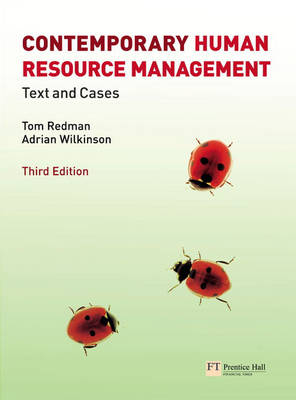
Contemporary Human Resource Management plus MyLab access code
Financial Times Prentice Hall
978-0-273-72862-7 (ISBN)
- Titel ist leider vergriffen;
keine Neuauflage - Artikel merken
Contemporary Human Resource Management provides students with a thorough and critical exploration of all the key functions and issues within HRM today.
Written in a clear yet thought-provoking style, the book contains chapters contributed by experts in their field to ensure coverage of the most recent ideas and practices. Each chapter is complemented by at least 2 more extensive case studies, exercises or activities to put concepts into recognisable context.
It is suitable for students studying human resource management on a wide range of HRM and general business / management undergraduate and postgraduate degree programmes.
Contemporary Human Resource Management: Text and Cases comes with a MyLab Access Card.
What is a MyLab?
Personalised learning | Online assessment |Your flexible resource to focussed study
Pearson Education's MyLab products provide an innovative and interactive web-based solution that personalises both the teaching and learning experience. With content developed to match the learning outcomes of the associated textbook, the power of a MyLab lies in the combination of assessment, reporting, and personalised study that helps both students and instructors succeed.
Within a flexible course management platform, instructors can:
Assess student progress through homework quizzes and tests that are easily set using the extensive pre-prepared question bank.
Assign short answer, discussion and essay questions from each chapter for student homework or tutorial preparation.
Track student activity and performance using detailed reporting capabilities.
Communicate with students and teaching staff using email and announcement tools.
Students will benefit from a personalised learning experience, where they can:
Complete a diagnostic 'pre-test' to generate a personal self-study plan that enables them to focus on the topics where their knowledge is weaker.
Improve their understanding through a variety of practice activities including; revision flashcards, e-book reading assignments, short answer questions, audio downloads and video cases.
Measure their progress with a follow-up 'post-test' that ensures they have mastered key learning objectives and gives them the confidence to move on to the next chapter.
A dedicated team will give you all the assistance you need to get online and make the most of a MyLab. If you would like to find out more about how to take advantage of this innovative opportunity to personalise your course, please email Katie.Thorn@pearson.com
Tom Redman is Professor of HRM and Director of Research at Durham University. Adrian Wilkinson is Professor of Employment Relations and Director of the Centre for Work, Organisation and Wellbeing at Griffith University, Queensland in Australia.
Contents
List of Case Studies
List of Contributors
Acknowledgements
Part I Fundamentals of Human Resource Management
1. Human Resource Management: a contemporary perspective
Tom Redman and Adrian Wilkinson
Introduction
The development of HRM
The new HRM?
The changing context of work
Strategy and HRM
Performance and HRM
The changing role of HRM
The book
Bibliography
2. Human Resource Management and Organisational Performance: in search of the HR advantage
Nick Kinnie and Juani Swart
Introduction
Strategy and HRM
HR and organisational performance: our approach and some background
Human resource advantage
Human capital advantage
Organisational process advantage
Conclusions and implications
Case study 2.1
Case study 2.2
Case study 2.3
Bibliography
3. Recruitment
Ann McCormack and Dora Scholarios
Introduction
The external environment
The organisation
The job
Pre-recruitment activities
Recruitment methods
The need for an applicant perspective
Conclusions
Case study 3.1
Case study 3.2
Bibliography
4. Selection
Dora Scholarios
Introduction
A brief overview of psychometric quality
The 'what' and 'how' of selection
Summary of trends
What do organisations actually do?
Explaining practice
Conclusions and implications for HRM
Case study 4.1
Case study 4.2
Case study 4.3
Bibliography
5. Training and Development
Irena Grugulis
Introduction
The case for training and development
Training and development in the workplace
Rethinking training and development
Discussion and conclusions
Case study 5.1
Case study 5.2
Case study 5.3
Bibliography
6. Reward Management
Mark W. Gilman
Introduction
Why pay systems vary
Paying for performance: variable pay
Pay for performance: how strategic is it?
Discussion
Case study 6.1
Case study 6.2
Bibliography
7. Performance Appraisal
Tom Redman
Introduction
Development of performance appraisal
The practice of performance appraisal
Recent developments in performance appraisal
Problems of performance appraisal
Conclusions
Case study 7.1
Bibliography
8. Industrial Relations
Nicolas Bacon
Introduction
Management approaches to industrial relations
Why employees join unions
The decline of joint regulation
The implications of declining joint regulation
Non-union workplaces
Non-union employee representation
Partnership with unions
Union organising and new types of union representative
Conclusions
Case study 8.1
Bibliography
9. Line Managers
Douglas Renwick
Introduction
developments in the literature
General questions emerging
Challenges arising
Future research
Conclusions
Case study 9.1
Case study 9.2
Bibliography
10. Organisation and Corporate Culture
Alistair Cheyne and John Loan-Clarke
Introduction
The concept of culture
Organisational culture
Categorisations of culture
Assessing organisational culture
Culture and organisational performance
Organisational culture and human resource management
Is culture change feasible?
Conclusion
Case study 10.1
Case study 10.2
Case study 10.3
Case study 10.4
Bibliography
Part II Contemporary Themes and Issues
11. International HRM
Geoffrey Wood, Leslie Szamosi and Alex Psychogios
Introduction
Thinking about international HRM: uniformity or diversity?
International HRM in practice
Conclusion
Case study 11.1
Case study 11.2
Case study 11.3
Bibliography
12. Comparative Human Resource Management
Geoffrey Wood and David Collings
Introduction
Convergence or divergence in HRM systems
Empirical ways of understanding diversity
Conclusion
Case study 12.1Case study 12.2
Bibliography
13. Understanding and Managing Careers in Changing Contexts
Laurie Cohen and Amal El-Sawad
Introduction
An 'elastic' concept: diverse understandings of career
Changing contexts of work and career
Change and continuity in career form
Gender and ethnicity in career debates
Career lenses and approaches
More dynamic, less static approaches?
Holistic perspectives: new metaphors for thinking about career
Managing careers: implications for HR practice
Conclusion
Case study 13.1
Case study 13.2
Case study 3.3
Bibliography
14. Managing Diversity
Catherine Cassell
Introduction
The managing diversity context
General principles
Implementing diversity initiatives
Global diversity management
Do diverstives deliver?
Conclusions
Case study 14.1
Case study 14.2
Case study 14.3
Bibliography
15. Work Life Balance
Keith Townsend and Paula Macdonald
Introduction
Is it work life balance or something elser?
Why WLB is important to employers
When the government gets involved
Unions and WLB
Finding the boundaries
Conclusions
Case study 15.1
Case study 15.2
Bibliography
16. Downsizing
Tom Redman and Adrian Wilkinson
Introduction
Downsizing: the reality of HRM?
Methods of downsizing
Alternatives to redundancy
The redundancy process
Conclusions: downsizing, rightsizing or dumbsizing?
Case study 16.1
Case study 16.2
Bibliography
17. Employee Participation
Tony Dundon and Adrian Wilkinson
Introduction
Defining participation
The context for employee participation
A framework for analysing employee participation
Employee participation in practice
The meanings and impact of participation
Employee participation and the EU
Conclusions
Case study 17.1
Case study 17.2
Case study 17.3
Bibliography
18. Knowledge Management and Human Resource Management
Donald Hislop
Introduction
Social context: the growing importance of knowledge
Defining knowledge work
Why worker participation is key to achieving participation in knowledge management initiatives
The organisational climate and workers' attitudes to knowledge management initiatives
HRM practices to support knowledge management initiatives
Case study 18.1
Case study 18.2
Bibliography
19. Employment Ethics
Peter Ackers
Introduction
Ethical theories: enter the moral maze
An employment ethics agenda
Shaping an ethical workplace
The history of ethical employment management
The advent of HRM
Conclusion: three fallacies of HRM ethics
Case study 19.1
Case study 19.2
Bibliography
20. Emotion at Work
Philip Hancock and Melissa Tyler
Introduction
The emotional turn: key concepts and issues
Emotion in management theory and practice
Critical perspectives on emotion
Conclusions
Case study 20.1
Case study 20.2
Case study 20.3
Bibliography
21 Flexibility
Stephen Procter and Stephen Ackroyd
Introduction: what do we mean by flexibility?
Flexibility in historical perspective
The flexible firm
Patterns of flexibili Flexible specialisation
The new flexible firm
The high-surveillance firm and lean production
Flexibility in the public services
Conclusions
Case study 21.1
Bibliography
22. Workplace bullying
Sara Branch, Sheryl Ramsay and Michelle Barker
Introduction
How is workplace bullying defined?
The importance of power and dependency in workplace bullying
Identifying workplace bullying behaviours
Reporting of frequency of workplace bullying behaviours and risk groups
Impact on the target
Impact on witnesses
Impact on the organisation
Antecedents of workplace bullying
Prevention and management of workplace bullying
Conclusion
Case study 22.1
Case study 22.2
Bibliography
Index
| Erscheint lt. Verlag | 4.9.2009 |
|---|---|
| Zusatzinfo | Illustrations (some col.) |
| Verlagsort | Harlow |
| Sprache | englisch |
| Maße | 194 x 262 mm |
| Gewicht | 1076 g |
| Themenwelt | Wirtschaft ► Betriebswirtschaft / Management ► Personalwesen |
| ISBN-10 | 0-273-72862-8 / 0273728628 |
| ISBN-13 | 978-0-273-72862-7 / 9780273728627 |
| Zustand | Neuware |
| Informationen gemäß Produktsicherheitsverordnung (GPSR) | |
| Haben Sie eine Frage zum Produkt? |
aus dem Bereich