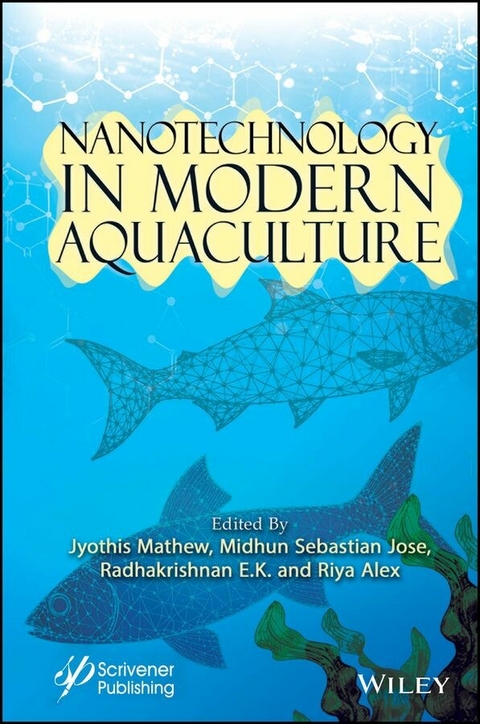
Nanotechnology in Modern Aquaculture (eBook)
298 Seiten
Wiley-Scrivener (Verlag)
978-1-119-85777-8 (ISBN)
Dive into the future of aquaculture with this comprehensive guide to how nanotechnology is being leveraged to revolutionize aquaculture, enhance fish feed, and advance vaccine and drug delivery.
Nanotechnology is revolutionizing various agricultural sectors, including aquaculture. This book is a unique and comprehensive exploration of the recent trends in aquaculture, specifically tailored for nanotechnology for aquaculture development. It aims to fill a gap in current literature by compiling important ideas into ten chapters that provide a holistic idea of how nanoparticles can be leveraged for aquaculture development.
The book begins with an overview of the history and development of nanomaterials in aquaculture. It further explores the biosynthesis of nanoparticles and nanomaterials for aquaculture, highlighting their important role in enhancing fish feed development, vaccine formulation, and drug delivery. The book also addresses the innovative application of nano-nutraceuticals, harvest and post-harvest processes, which are revolutionary in health, nutrition, and product quality in aquaculture. Additionally, the book discusses advanced nanotechnology techniques for water quality enhancement and bio-nanotechnology for sustainable aquaculture practices and future applications in aquaculture genetics. Furthermore, the book provides an in-depth knowledge of the development and management of nanomaterials for aquaculture devices, ensuring readers gain a complete understanding of the potential applications of nanoparticles in the aquaculture field.
Audience
Scientists, engineers, and healthcare professionals working in the area of nanotechnology for aquaculture fisheries departments.
Jyothis Mathew, PhD is a Professor in the School of Biosciences at Mahatma Gandhi University, Kottayam, India. During his 20 years of research, he has published more than 100 research publications, five book chapters, and two science articles. His research areas include characterization of medically important bacteria with an emphasis on the study of emerging pathogens, studies on the immunomodulatory effects of common thirst quenchers, the antimicrobial activities of some medicinal plants, microbial enzyme technology to produce enzymes, and studies on endophytes.
Midhun Sebastian Jose, PhD is a postdoctoral fellow at the Western College of Veterinary Medicine at the University of Saskatchewan, Saskatoon, Canada. During his eight years of research, he has published 28 research articles, nine book chapters, and four articles and co-edited one book. His research areas include characterization of bio-nanoparticles for controlling medicinally important bacteria as well as their application in aquaculture, microbial synthesis of nanoparticles, and microbial studies on animal models.
Radhakrishnan E.K., PhD is currently an Associate Professor in School of Biosciences, Mahatma Gandhi University, Kottayam, Kerala, India. During his 12 years of research, he has published 160 research publications, 52 book chapters, and three review papers, and edited two books. His research areas include plant-microbe interactions, microbial natural products, microbial synthesis of metal nanoparticles, and the development of polymer-based nanocomposites with antimicrobial effects for food packaging and medical applications.
Riya Alex is a PhD scholar in the School of Biosciences at Mahatma Gandhi University. Kottayam, India. She gained research experience as a trainee at the ICAR Institute of Spices Research. She has published two papers in academic journals and two book chapters.
Dive into the future of aquaculture with this comprehensive guide to how nanotechnology is being leveraged to revolutionize aquaculture, enhance fish feed, and advance vaccine and drug delivery. Nanotechnology is revolutionizing various agricultural sectors, including aquaculture. This book is a unique and comprehensive exploration of the recent trends in aquaculture, specifically tailored for nanotechnology for aquaculture development. It aims to fill a gap in current literature by compiling important ideas into ten chapters that provide a holistic idea of how nanoparticles can be leveraged for aquaculture development. The book begins with an overview of the history and development of nanomaterials in aquaculture. It further explores the biosynthesis of nanoparticles and nanomaterials for aquaculture, highlighting their important role in enhancing fish feed development, vaccine formulation, and drug delivery. The book also addresses the innovative application of nano-nutraceuticals, harvest and post-harvest processes, which are revolutionary in health, nutrition, and product quality in aquaculture. Additionally, the book discusses advanced nanotechnology techniques for water quality enhancement and bio-nanotechnology for sustainable aquaculture practices and future applications in aquaculture genetics. Furthermore, the book provides an in-depth knowledge of the development and management of nanomaterials for aquaculture devices, ensuring readers gain a complete understanding of the potential applications of nanoparticles in the aquaculture field. Audience Scientists, engineers, and healthcare professionals working in the area of nanotechnology for aquaculture fisheries departments.
1
History and Development of Nanomaterials in Relation to Aquaculture
Veena S.1, Remina M. Shajahan2*, Riya Alex1, Julit George1, Unnikrishnan B.1, Mithilesh Jaiswal2 and Radhakrishnan E.K.1
1School of Biosciences, Mahatma Gandhi University, Priyadarshini Hills, Kottayam, Kerala, India
2Agro Bio-Tech Research Centre Ltd., Kottayam, India
Abstract
Aquaculture has been a reliable food source for mankind since time immemorial, but productivity needs to be enhanced to meet the increasing demands and shifting consumption patterns of an ever-growing population. The limitations of traditional practices like inefficient resource use, higher carbon footprint, and frequent disease susceptibility were major driving forces for the introduction of nanotechnology into aquaculture. Nanoscience has revolutionized the aquaculture sector at various levels of nutrition, disease management, and environmental monitoring. The present chapter traces back the historical developments in nanoscience and aquaculture, highlighting the contribution of nanotechnology in enhancing the productivity and sustainability of the aquaculture industry in the present day.
Keywords: Aquaculture, history, nanoscience, nanotechnology, sustainability
1.1 Introduction
Global food security and nutrition persist as a significant challenge with rising hunger and malnutrition. Ensuring food security is crucial for the development of an economy, and aquaculture is an important sector in this regard as it provides an affordable source of protein and is produced using lesser terrestrial resources [1]. Moreover, the aquaculture industry employs several people and helps alleviate the strain on native aquatic populations due to overfishing. However, environmental pollution and climate change have posed significant threats to the productivity of aquaculture systems [2]. Sustaining life below water is one of the 17 sustainable development goals, and in 2021, the Food and Agriculture Organization initiated a Blue Transformation program to maximize the potential of aquatic food systems to ensure global food security. Hence, it becomes imperative to utilize innovative technologies for monitoring aquatic systems and boosting the productivity and quality of aquaculture products [2].
Nanomaterials have been utilized by humans since ancient times, evidenced by antique artifacts like the Lycurgus cup and dichroic glasses in medieval churches [3]. However, scientific knowledge about nanomaterials came to be known only in the early 1900s. The observations of Faraday about the different optical properties of gold nanoparticle solutions were one of the first studies that embarked a deep interest in the phenomena of minuscule particles among the scientific community [4], but it was only in the 1920s that scientists like Richard Zsigmondy began to use the word nano to measurements at the dimension of 10−9m. Finally, the idea of the manipulation of matter at atomic levels was first described by Richard Feynman in the 1960s — both scientists are considered the pioneers of nanoscience [5]. However, almost a decade after these studies, the Japanese scientist Norio Taniguchi coined the term nanotechnology to describe the interactions occurring between atomic substances in semiconductors at the nanodimensions [6]. Further studies revealed that nanomaterials have several unique properties, such as high surface area-to-volume ratio, enhanced reactivity, and tunable physicochemical characteristics, which make them promising candidates for improving aquaculture practices [7]. Nanomaterials could be synthesized by both top-down methods like lithography and ball milling and bottom-up methods like ionic gelation or hydrothermal processes. Nanotechnology can be applied to various aspects of aquaculture, such as water treatment, feed supplementation, disease control, and monitoring of environmental parameters [8]. However, a historical analysis connecting the developments of nanotechnology and modern aquaculture has not been attempted so far. The present chapter attempts to summarize the advent and early developments of nanoscience in aquaculture, revealing how nanomaterials have played a crucial role in advancing modern aquaculture.
1.2 Early Foundations of the Concept of Aquaculture
The beginnings of aquaculture are attributed to the Chinese civilizations since 2000 BC for growing carp in small ponds near homes as part of the local tradition. Early attempts in aquaculture were mainly confined to pisciculture, pond culture, or cage culture methods to cultivate aquatic fishes like salmons, carps, and tilapia. The Romans, Egyptians, and Indians also practiced growing captured fishes in aquariums for consumption or aesthetic purposes. However, according to historical reports, the use of scientific techniques in aquaculture began from the 1400s to the 1900s when techniques like commercial fishing vessels, artificial spawning and hatching, and inland fisheries were introduced in the aquaculture industry [9]. The most recent definition of the term “aquaculture” is stated as the breeding and caring for various aquatic creatures in facilities constructed by humans for ornamental, profitable, research, or culinary purposes [10]. Ancient forms of aquaculture primarily used small artificial freshwater reservoirs to store or grow locally captured fishes. Modern aquaculture differs from the ancient practices in several aspects, and a comparison is given in Table 1.1. The major difference is that modern aquaculture has wider applications, ranging from local culinary to global economic purposes. The methods like real-time monitoring of aquaculture systems in modern aquaculture are also more scientifically validated and advanced, which increases the controllability and yields.
Table 1.1 Comparison of ancient and modern aquaculture.
| Feature | Ancient aquaculture | Modern aquaculture |
|---|
| Period of origin | Originated centuries ago in small facilities. | Developed significantly in the 20th century in a large scale. |
| Aim | Primarily for local consumption, cultural practices, traditions, and aesthetic purposes. | Commercial production, global demand, and support economic growth. |
| Techniques | Used simple methods such as trapping fish, creating ponds and small closures, and natural spawning for reproduction. | Employs advanced techniques like water purifiers, aerators, sensors, artificial breeding techniques, and real-time monitoring. |
| Monitoring and control | Limited ability to monitor, relying on manual observation and experience. | Employs sensors, IoT technology, and data analytics for real-time tracking of water quality and fish health. |
1.3 Historical Aspects of Nanomaterials Used in Aquaculture
The scientific enlightenment about aquatic organisms resulted in the use of simple strategies like natural spawning and larger aquariums to cultivate more than one aquatic species at a time, which laid the foundation for modern aquaculture. Gradually, humans started using natural materials like clay and lime to improve water purification and enhance fish production in artificial reservoirs [11]. The historical background of modern aquaculture includes early attempts to conserve and artificially breed fishes by ichthyologists to sustain the diversity of aquatic organisms in several countries [12]. Simultaneously, during this time, nanomaterials gained popularity in the fields of physics, medicine, environmental science, and electronics [3]. Initially, aquaculture was used in nanotechnology from a utilitarian perspective of using zebrafishes as “gold standard” subjects for toxicological and environmental impact assessment of newly fabricated nanomaterials [13]. On the contrary, in environmental science, nanomaterials were deployed for various water treatment strategies, especially for the decontamination of polluted water at a larger scale, which could be a connecting link between the two disciplines [14]. Since then, different kinds of nanoparticles have been researched and tested for their applications in aquaculture because of their ability to interact with substances at the nanomolar level [15]. The bridge between nanotechnology and aquaculture emerged eventually when research in nanotechnology expanded for the betterment of the aquaculture industry by developing nutraceuticals, therapeutics specifically aimed for fish growth, nanomaterials for controlling aquatic diseases, and nano-based detectors for water quality detection in aquaculture systems, as represented in Table 1.2. Nanomaterials hold significant potential in revolutionizing various aspects of aquaculture due to their unique properties and versatile applications, including water quality management, disease control, feed supplementation, and environmental monitoring, as shown in Figure 1.1. Nanomaterials exhibit strong antimicrobial properties, serving as a sustainable alternative to conventional antibiotics and chemicals for controlling and preventing diseases in underwater life. Furthermore, nanocomposites have excellent adsorption capabilities that can effectively remove pollutants and pathogens from aquaculture systems [16]. The long-term application of antibiotics to fish generates concern about the...
| Erscheint lt. Verlag | 8.12.2025 |
|---|---|
| Sprache | englisch |
| Themenwelt | Naturwissenschaften ► Biologie |
| Weitere Fachgebiete ► Land- / Forstwirtschaft / Fischerei | |
| ISBN-10 | 1-119-85777-5 / 1119857775 |
| ISBN-13 | 978-1-119-85777-8 / 9781119857778 |
| Informationen gemäß Produktsicherheitsverordnung (GPSR) | |
| Haben Sie eine Frage zum Produkt? |
 EPUB (Adobe DRM)
Kopierschutz: Adobe-DRM
Adobe-DRM ist ein Kopierschutz, der das eBook vor Mißbrauch schützen soll. Dabei wird das eBook bereits beim Download auf Ihre persönliche Adobe-ID autorisiert. Lesen können Sie das eBook dann nur auf den Geräten, welche ebenfalls auf Ihre Adobe-ID registriert sind.
Details zum Adobe-DRM
Dateiformat: EPUB (Electronic Publication)
EPUB ist ein offener Standard für eBooks und eignet sich besonders zur Darstellung von Belletristik und Sachbüchern. Der Fließtext wird dynamisch an die Display- und Schriftgröße angepasst. Auch für mobile Lesegeräte ist EPUB daher gut geeignet.
Systemvoraussetzungen:
PC/Mac: Mit einem PC oder Mac können Sie dieses eBook lesen. Sie benötigen eine
eReader: Dieses eBook kann mit (fast) allen eBook-Readern gelesen werden. Mit dem amazon-Kindle ist es aber nicht kompatibel.
Smartphone/Tablet: Egal ob Apple oder Android, dieses eBook können Sie lesen. Sie benötigen eine
Geräteliste und zusätzliche Hinweise
Buying eBooks from abroad
For tax law reasons we can sell eBooks just within Germany and Switzerland. Regrettably we cannot fulfill eBook-orders from other countries.
aus dem Bereich