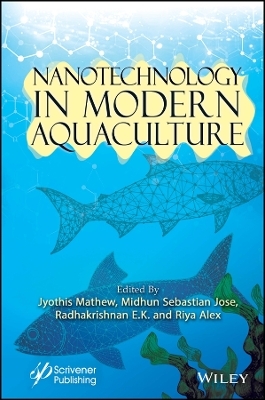
Nanotechnology in Modern Aquaculture
Wiley-Scrivener (Verlag)
978-1-119-85724-2 (ISBN)
Nanotechnology is revolutionizing various agricultural sectors, including aquaculture. This book is a unique and comprehensive exploration of the recent trends in aquaculture, specifically tailored for nanotechnology for aquaculture development. It aims to fill a gap in current literature by compiling important ideas into ten chapters that provide a holistic idea of how nanoparticles can be leveraged for aquaculture development.
The book begins with an overview of the history and development of nanomaterials in aquaculture. It further explores the biosynthesis of nanoparticles and nanomaterials for aquaculture, highlighting their important role in enhancing fish feed development, vaccine formulation, and drug delivery. The book also addresses the innovative application of nano-nutraceuticals, harvest and post-harvest processes, which are revolutionary in health, nutrition, and product quality in aquaculture. Additionally, the book discusses advanced nanotechnology techniques for water quality enhancement and bio-nanotechnology for sustainable aquaculture practices and future applications in aquaculture genetics. Furthermore, the book provides an in-depth knowledge of the development and management of nanomaterials for aquaculture devices, ensuring readers gain a complete understanding of the potential applications of nanoparticles in the aquaculture field.
Audience
Scientists, engineers, and healthcare professionals working in the area of nanotechnology for aquaculture fisheries departments.
Jyothis Mathew, PhD is a Professor in the School of Biosciences at Mahatma Gandhi University, Kottayam, India. During his 20 years of research, he has published more than 100 research publications, five book chapters, and two science articles. His research areas include characterization of medically important bacteria with an emphasis on the study of emerging pathogens, studies on the immunomodulatory effects of common thirst quenchers, the antimicrobial activities of some medicinal plants, microbial enzyme technology to produce enzymes, and studies on endophytes. Midhun Sebastian Jose, PhD is a postdoctoral fellow at the Western College of Veterinary Medicine at the University of Saskatchewan, Saskatoon, Canada. During his eight years of research, he has published 28 research articles, nine book chapters, and four articles and co-edited one book. His research areas include characterization of bio-nanoparticles for controlling medicinally important bacteria as well as their application in aquaculture, microbial synthesis of nanoparticles, and microbial studies on animal models. Radhakrishnan E.K., PhD is currently an Associate Professor in School of Biosciences, Mahatma Gandhi University, Kottayam, Kerala, India. During his 12 years of research, he has published 160 research publications, 52 book chapters, and three review papers, and edited two books. His research areas include plant-microbe interactions, microbial natural products, microbial synthesis of metal nanoparticles, and the development of polymer-based nanocomposites with antimicrobial effects for food packaging and medical applications. Riya Alex is a PhD scholar in the School of Biosciences at Mahatma Gandhi University. Kottayam, India. She gained research experience as a trainee at the ICAR Institute of Spices Research. She has published two papers in academic journals and two book chapters.
Preface xiii
1 History and Development of Nanomaterials in Relation to Aquaculture 1
Veena S., Remina M. Shajahan, Riya Alex, Julit George, Unnikrishnan B., Mithilesh Jaiswal and Radhakrishnan E.K.
1.1 Introduction 1
1.2 Early Foundations of the Concept of Aquaculture 3
1.3 Historical Aspects of Nanomaterials Used in Aquaculture 4
1.4 Factors that Led to the Introduction of Nanotechnology in Aquaculture 6
1.5 Early Developments of Nanotechnological Applications in Modern Aquaculture 8
1.6 Later Advancements and Integration of Nanotechnology into Modern Aquaculture 10
1.7 Environmental Concerns Relating to the Use of Nanotechnology in Aquaculture 13
1.8 Challenges in Implementation of Nanotechnology 14
1.9 Regulations on the Use of Nanomaterials 14
1.10 Conclusion 15
2 Nanotechnological Interventions in Aquaculture 25
Kingsley O. Iwuozor, Ebuka Chizitere Emenike, Ifeoluwa Peter Oyekunle, Chisom T. Umeh and Adewale George Adeniyi
2.1 Introduction 26
2.2 Emerging Nanotechnology in Aquaculture 27
2.3 Nanotechnological Tools and Development 32
2.4 Recent Trends in Aquaculture in Relation to Nanotechnology 39
2.5 Ecotoxicity of Nanotechnology in Aquaculture 44
2.6 Conclusion 45
3 Synthesis of Nanomaterials for Aquaculture 53
Sudheep N. M., Sruthi Parameswaran P. and Radhakrishnan E. K.
3.1 Introduction 54
3.2 Nanotechnology-Associated Challenges and Issues in General 54
3.3 Issues Existing in Pisciculture 56
3.4 Aquaponics and Nanotechnology 58
3.5 Importance of Nanoparticles and Nanocarriers in Aquaculture 60
3.6 Nanomaterials and Various Approaches for their Synthesis 63
3.7 Physical Methods 66
3.8 Chemical Methods 69
3.9 Biological Methods 72
3.10 Conclusions and Future Perspectives 73
4 Nanotechnology in Fish Feed Development: Revolutionizing Aquaculture for a Sustainable Future 81
Revathy. S
4.1 Introduction 81
4.2 Challenges in Fish Feed Development in Aquaculture 82
4.3 Nanotechnology’s Promise in Fish Feed 83
4.4 Nanotechnology in Nutrient Delivery 85
4.5 Controlled Release Systems 86
4.6 Nanoparticles in Fish Feed as Immunostimulants 88
4.7 Sustainability Benefits of Nanotechnology in Aquaculture 89
4.8 Conclusion 91
5 Nanotechnological Application in Aquaculture Vaccine Development and Drug Delivery 95
Renjithkumar C.R. and Roshni K.
5.1 Introduction 96
5.2 Drug Delivery for Health Management 97
5.3 Nanovaccines 97
5.4 Nanoparticles and the Immune System 101
5.5 Nanoparticles Used as Oral Nanovaccines in Fish 103
5.6 Oral Virus-Like Particle (VLP)-Based Nanovaccines 108
5.7 Conclusion 111
6 Nanoparticle Nutraceuticals in Aquaculture 119
Soumya Soman, Raji R.N. and Sudheep N.M.
6.1 Introduction 120
6.2 Introduction to Nanoparticle Nutraceuticals in Aquaculture 120
6.3 Understanding Aquaculture and Its Challenges 121
6.4 What are Nanoparticle Nutraceuticals? 122
6.5 Benefits of Using Nanoparticle Nutraceuticals in Aquaculture 124
6.6 Nanoparticle-Encapsulated Probiotics in Aquaculture 125
6.7 Research and Studies on the Effectiveness of Nanoparticle Nutraceuticals in Aquaculture 127
6.8 Major Concerns on Incorporation of Nanoparticle Nutraceuticals in Aquaculture Practices 131
6.9 Future Prospective 131
7 Nanotechnological Applications in Harvest and Post-Harvest Technology 139
Anisha S., Sudheep N.M. and Radhakrishnan E.K.
7.1 Introduction 140
7.2 Aquaculture and Food Security 141
7.3 Nanotechnology and Future Implications 141
7.4 Nanotechnology Applications in Harvest and Yield in Aquaculture 144
7.5 Postharvest Applications of Nanotechnology in Aquaculture 151
7.6 Possible Concerns and Apprehensions 159
7.7 Conclusion 160
8 Nanotechnology for Water Quality Enhancement 173
Sanooja M.S., Nazla K.A., Dhanya Mol T.S. and Vinny Vincent
8.1 Introduction 174
8.2 Water Purification 176
8.3 Detection and Monitoring by Nanosensors 186
8.4 Antimicrobial Application 188
8.5 Self-Cleaning Nanotechnology 190
8.6 Safety and Environmental Impacts of Nanoremediation 192
8.7 Conclusion 196
9 Nanobiotechnology in Fish Breeding and Genetic Modifications 203
Julit George, Sudheep N.M., Divya Mathew and Radhakrishnan E.K.
9.1 Introduction 204
9.2 The Significance of Genetic Modifications in Aquaculture 206
9.3 Role of Nanobiotechnology in Aquaculture 209
9.4 Nanobiotechnology Tools and Techniques for Fish Breeding 211
9.5 Potential Environmental Risks of Nanobiotechnology in Aquaculture 213
9.6 Conclusion 216
10 A Comprehensive Study on Nanomaterials for Aquaculture Device Development and Management 221
Jincemon Cyriac, Jisty Ann Jiji, Gouri G. Nair, Steve Saji George, K. Sreelatha and Riju K. Thomas
10.1 Introduction 222
10.2 Pathogen Detection 223
10.3 Drug Delivery for Health Management 225
10.4 Microbial Disinfection 227
10.5 Treatment of Pollutants in the Water 228
10.6 Nano-Enabled Water Disinfection Using Microwave Irradiation 238
10.7 Production Performance and Immunocompetence 240
10.8 Nano-Enabled Early Warning Systems: Water Quality Monitoring Combined with Big Data Collection and Analysis 242
10.9 Conclusion 244
References 244
Index 267
| Erscheinungsdatum | 17.12.2025 |
|---|---|
| Sprache | englisch |
| Themenwelt | Weitere Fachgebiete ► Land- / Forstwirtschaft / Fischerei |
| ISBN-10 | 1-119-85724-4 / 1119857244 |
| ISBN-13 | 978-1-119-85724-2 / 9781119857242 |
| Zustand | Neuware |
| Informationen gemäß Produktsicherheitsverordnung (GPSR) | |
| Haben Sie eine Frage zum Produkt? |
aus dem Bereich