


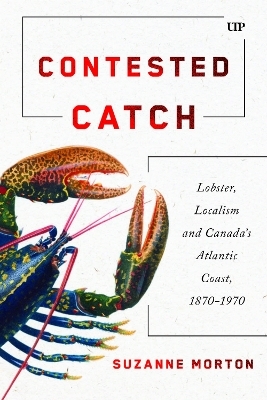
Contested Catch
Lobster, Localism, and Canada's Atlantic Coast, 1870-1970
Seiten
2025
University of Toronto Press (Verlag)
978-1-4875-7177-1 (ISBN)
University of Toronto Press (Verlag)
978-1-4875-7177-1 (ISBN)
This book examines how the lobster fishery in Canada has been shaped by evolving technologies, changing markets, shifting ideas about state governance, and the nature of lobsters themselves.
Contested Catch: Lobster and Localism on Canada's Atlantic Coast, 1870–1970 explores the complex development of the lobster fishery in Canada, focusing on the interplay between the ecology of lobsters, local fishing practices, evolving technologies, changing markets, and the role of the state. Drawing on nearly thirty different archives, this book spans the century from the expansion of the transnational commercial lobster industry and the introduction of government regulations around 1870 to the establishment of the first restricted-access ocean fishery on Canada’s East Coast in the late 1960s.
Suzanne Morton argues that lobster regulation was always about more than just protecting the lobster population – it reflected deeper local, political, and economic forces at play. She examines how the Canadian state, keeping its enforcement budget to a minimum and wanting to avoid electoral reprisals, interacted with local communities, businesses, and political groups to regulate fisheries. While the government and other officials implemented formal regulations and turned to commissions and government science, local fishers operated with informal systems based on tradition, economic interests, and sometimes coercion.
Following the Second World War, with economists playing a prominent role, policy shifted from managing lobster as a sustainable resource to increasing the standard of living for fishermen and their families through rationalized efficiency, ultimately limiting access to who could fish. Even then, the fishery was shaped by both formal government efforts and local, social dynamics.
Contested Catch: Lobster and Localism on Canada's Atlantic Coast, 1870–1970 explores the complex development of the lobster fishery in Canada, focusing on the interplay between the ecology of lobsters, local fishing practices, evolving technologies, changing markets, and the role of the state. Drawing on nearly thirty different archives, this book spans the century from the expansion of the transnational commercial lobster industry and the introduction of government regulations around 1870 to the establishment of the first restricted-access ocean fishery on Canada’s East Coast in the late 1960s.
Suzanne Morton argues that lobster regulation was always about more than just protecting the lobster population – it reflected deeper local, political, and economic forces at play. She examines how the Canadian state, keeping its enforcement budget to a minimum and wanting to avoid electoral reprisals, interacted with local communities, businesses, and political groups to regulate fisheries. While the government and other officials implemented formal regulations and turned to commissions and government science, local fishers operated with informal systems based on tradition, economic interests, and sometimes coercion.
Following the Second World War, with economists playing a prominent role, policy shifted from managing lobster as a sustainable resource to increasing the standard of living for fishermen and their families through rationalized efficiency, ultimately limiting access to who could fish. Even then, the fishery was shaped by both formal government efforts and local, social dynamics.
Suzanne Morton taught Canadian history at McGill University between 1992 and 2025, specializing in gender, the state, and Atlantic Canada.
Illustrations and Maps
Tables
Acknowledgments
Abbreviations
Introduction: Why Lobsters
1. Lobsters and Those Who Caught Them
2. Lobster Becomes a Commodity
3. Regulating the Lobster Fisher
4. The Politics of Knowledge and the Lobster Question, 1874–1939
5. Rejecting Regulation: Direct Action, Force and New Strategies, 1890s to 1960s
6. The Politics of Lobster and Catching Votes, 1871–1939
7. Lobster Regulation as Social Policy, 1929–1970
Conclusions and Epilogue: Contested Catch
Notes
Index
| Erscheinungsdatum | 27.11.2025 |
|---|---|
| Zusatzinfo | 23 illustrations |
| Verlagsort | Toronto |
| Sprache | englisch |
| Maße | 159 x 235 mm |
| Gewicht | 520 g |
| Themenwelt | Geschichte ► Teilgebiete der Geschichte ► Wirtschaftsgeschichte |
| Naturwissenschaften ► Biologie ► Ökologie / Naturschutz | |
| Naturwissenschaften ► Geowissenschaften ► Geografie / Kartografie | |
| Wirtschaft ► Volkswirtschaftslehre ► Finanzwissenschaft | |
| Weitere Fachgebiete ► Land- / Forstwirtschaft / Fischerei | |
| ISBN-10 | 1-4875-7177-1 / 1487571771 |
| ISBN-13 | 978-1-4875-7177-1 / 9781487571771 |
| Zustand | Neuware |
| Informationen gemäß Produktsicherheitsverordnung (GPSR) | |
| Haben Sie eine Frage zum Produkt? |
Mehr entdecken
aus dem Bereich



aus dem Bereich
wie Tech-Konzerne und Großmächte die Welt unter sich aufteilen
Buch | Hardcover (2025)
C.H.Beck (Verlag)
CHF 39,20
Aufstieg und Fall der Deutschland AG
Buch | Hardcover (2025)
Suhrkamp (Verlag)
CHF 41,95


