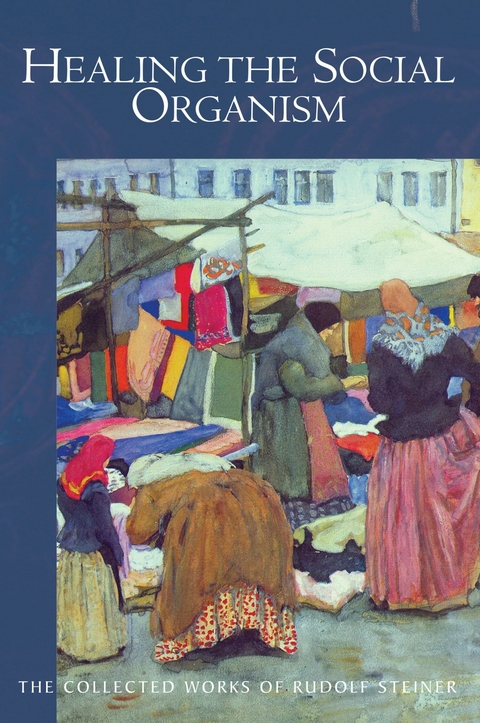
Healing the Social Organism (eBook)
320 Seiten
Rudolf Steiner Press (Verlag)
978-1-85584-654-8 (ISBN)
Introduction
With thoughtful reading, these seventeen fascinating lectures can work deeply in our souls, bringing us healing impulses. The literal translation of the German title would be, ‘healing impulses for the social organism’ (Heilfaktoren für den Sozialen Organismus). Rudolf Steiner strives with his thoughts to awaken in our souls the consciousness of what he calls reality. Reality can be found in the conscious, simultaneous perception and acknowledgement of the existence of both the spiritual and the material. Only in a unity of the two is there reality. In understanding this reality, we form concepts that reflect both spirit and matter. In unity, they penetrate deeply into the soul where the will-forces from the spiritual world awaken and lead us in freehood to do what is needed to heal the human being and the social. And even more important, human beings are then fulfilling their collective task, their responsibility to bring an understanding of materialism to the gods. The gods only have this understanding through human beings. Human beings are supporting the rightful evolution of the earth and, beyond, the universe—or, said differently, human beings are spiritualizing matter.
This undertaking is a daunting responsibility. This is the task of human beings, and we need to wake up to it. ‘Wake up,’ calls Steiner urgently and forcefully in these lectures, as he weaves spiritual insights from seemingly diverse angles to describe this reality for our souls. Wake up to the responsibility of transforming the polarities of matter and spirit, of materialism and spirituality. They must be understood as a unity. Wake up to the need to reform the structure of our thinking, first our perceiving and then following a transformed conceiving. He describes the thinking that is a remnant of previous ages and older ways of relating to the spiritual, that only works on as a corpse in our age in empty phrases and dogmas, hindering our ability to think with the consciousness demanded by our times and destroying the potential of relevant social initiatives. He also describes the abstract materialistic thinking that forms the concepts found in modern natural science and the humanities. These concepts leave our souls empty and they slowly lose their spiritual origins.
Wake up out of the comfortable study groups and fun events where anthroposophists gather to discuss the various facts of the spiritual world and then return to their usual life and way of thinking. Wake up to the reality of eternity which includes not only immortality, life after death, but also unbornness—life before birth. Through immortality, we create our future in freehood. Through unbornness, we recognize our responsibilities for our earthly life out of the wisdom of the past. Wake up to the need to fill our empty souls with spirit content. Over and over again he calls us to wake up!
And for Steiner, it is through anthroposophy that we can wake up in our times. We can develop a different type of perception that perceives the spiritual world within the material world. This seeing is similar to the reality that primeval peoples saw atavistically in outer nature. It was a natural clairvoyance. This atavistic spirituality, which looked solely to nature to understand the spiritual world, belongs to another age. Now, people must work to find the spiritual clairvoyance within them, within their skin, and Steiner speaks exactly those words: ‘within our skin’. People who are clairvoyant in the modern sense, have an inner sight that encompasses both the existence of spiritual beings, spiritual beingness and simultaneously encompasses the existence of materialistic beings—materialistic beingness. This is inner work; this is the challenge for anthroposophists and all who are seekers today of the spiritual here on earth. It is then that the will-forces will arise within us to give us the potential to make systematic changes in our thinking, ennoble our social relationships and create the initiatives that will truly transform our society and support the rightful evolution of the earth and beyond.
As an example, Steiner refers to one anthroposophical idea, the threefold social organism. This social concept simply flows out of understanding the reality of what is needed now in our society. There are many such ideas that have flowed into the practical from anthroposophical thinking, that can be realized with will-forces permeated with spirit knowledge. Steiner would continue to bring forth concrete suggestions for the practical transformation of agriculture, the medical fields, pedagogy, banking, economic activities, and more.
It is important to note that Rudolf Steiner does not consider it necessary to be clairvoyant, to consciously experience the spiritual world. It is necessary to grasp the results of modern clairvoyant research in our souls with a healthy understanding. For those who seek to experience the spiritual world more consciously, Steiner has given many paths forward. Among these are the Calendar of the Soul, How to Know Higher Worlds, and the Lessons of the First Class of the School of Spiritual Science. However, most important is to fill the soul with spirit knowledge and create out of this knowledge spiritual impulses appropriate for our times. We now live in the early twenty-first century and these are our times. Each of us has a task and we must wake up to it. We are being called to do the difficult work of transcending materialism and moving into the future that is calling us—in the now.
Let us put these lectures in an historical context. Steiner was speaking just after the horrific First World War. Western society, and especially Central Europe, was truly in chaos. Steiner used the word catastrophe to refer to the times. The war devasted Europe, and the casualties were enormous. Germany was especially crippled. The Versailles Treaty had just been signed. Germany lost significant land and was seriously weakened economically. Germans deeply resented that they were given sole responsibility for the war. Inflation, hunger, and homelessness raged. Extreme feelings of anger and pessimism filled the German psyche. Many different political ideologies were rising and fighting each other in the streets, and coups were happening in the government. At this time and in these lectures, Steiner was calling on people to think differently, to think beyond materialism in order to encompass spirit in thinking, in feeling, and in will-forces. Anthroposophy was giving people the means to transform the catastrophe of the times through their actions, yet most people seemed to be asleep. Steiner was trying at least to wake up the anthroposophists, but most were content to just learn about the spiritual world. Action was needed: the practical.
Steiner was warning people that the catastrophe they were experiencing in Germany would only worsen if people did not awaken to a reality that brings spirit knowledge into practical human impulses and actions. These are harrowing consequences for the individual human being, for civilized society, and for the evolution of the earth and the universe. Engage with anthroposophy, he stated. It can bring the spiritual knowledge necessary for the times. Study deeply the lectures, the writings, and let them work into the soul and awaken the will-forces. These will-forces will bring the necessary practical skills into doing.
Know thyself, the ancient mystery wisdom cried. Steiner cries out from a more modern perspective. All knowledge, all healing, and most especially the evolution of the earth, must now come from the agency of each human being. Know thyself today. This is not the knowledge of the human being, who is the highest being of the animal world. This materialistic way of knowing only comprehends the physical of the human being and all that will die at the being’s physical death. Nor is it the knowledge of the human being who lives with empty religious phrases from the past and then expects to die into a vague, heavenly world, forever without any responsibilities. In these cases, the soul cannot live on after death and just dissolves into the spirit world. The I is lost. When a sufficient number of people work with spiritual concepts and relate to each other as ethical individuals, as characterized in Steiner’s book The Philosophy of Freedom, and when they work out of their inner spiritual agency and not from outer authority, catastrophe will be averted, and the rightful evolution of the earth can continue.
Steiner often expresses frustration, anger and shock as he speaks in these lectures. He asks: How can people not be frustrated, angry, and shocked at what is happening? Now, over a hundred years have passed since Steiner gave these talks. Are we frustrated, angry and shocked as we see the catastrophe of our times? Enough to impel us to do something? There is still the polarity between a prevailing materialism and an inarticulate spirituality to be transformed into the third, unified way, an articulate spirituality that permeates materialism. Today, there is still the need to transform the structures of thinking and feeling that are based on materialism, and to birth the will-forces that can then arise in our souls. These lectures can stir us today. Most importantly, they encourage us to understand more deeply and to act out of deep wisdom to address the needs of today. We must create the relevant concepts. We must found the healing impulses to do what needs to be done.
There are many examples of the hindering forces active at the times of these lectures. What social forces today are hindering us from being more effective and more awake in our...
| Erscheint lt. Verlag | 18.11.2024 |
|---|---|
| Einführung | D. Hinkle-Uhlig |
| Übersetzer | D. Hinkle-Uhlig |
| Verlagsort | London |
| Sprache | englisch |
| Themenwelt | Geisteswissenschaften ► Religion / Theologie |
| Weitere Fachgebiete ► Anthroposophie | |
| ISBN-10 | 1-85584-654-3 / 1855846543 |
| ISBN-13 | 978-1-85584-654-8 / 9781855846548 |
| Informationen gemäß Produktsicherheitsverordnung (GPSR) | |
| Haben Sie eine Frage zum Produkt? |
 EPUB (Wasserzeichen)
DRM: Digitales Wasserzeichen
Dieses eBook enthält ein digitales Wasserzeichen und ist damit für Sie personalisiert. Bei einer missbräuchlichen Weitergabe des eBooks an Dritte ist eine Rückverfolgung an die Quelle möglich.
Dateiformat: EPUB (Electronic Publication)
EPUB ist ein offener Standard für eBooks und eignet sich besonders zur Darstellung von Belletristik und Sachbüchern. Der Fließtext wird dynamisch an die Display- und Schriftgröße angepasst. Auch für mobile Lesegeräte ist EPUB daher gut geeignet.
Systemvoraussetzungen:
PC/Mac: Mit einem PC oder Mac können Sie dieses eBook lesen. Sie benötigen dafür die kostenlose Software Adobe Digital Editions.
eReader: Dieses eBook kann mit (fast) allen eBook-Readern gelesen werden. Mit dem amazon-Kindle ist es aber nicht kompatibel.
Smartphone/Tablet: Egal ob Apple oder Android, dieses eBook können Sie lesen. Sie benötigen dafür eine kostenlose App.
Geräteliste und zusätzliche Hinweise
Buying eBooks from abroad
For tax law reasons we can sell eBooks just within Germany and Switzerland. Regrettably we cannot fulfill eBook-orders from other countries.
aus dem Bereich