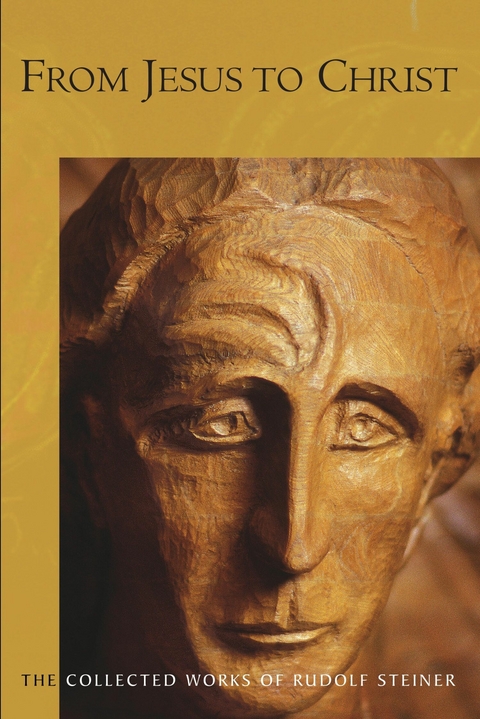
From Jesus to Christ (eBook)
280 Seiten
Rudolf Steiner Press (Verlag)
978-1-85584-656-2 (ISBN)
Lecture 1
KARLSRUHE, 5 OCTOBER 1911
The object of these lectures is to place before you an idea of the Christ-Event in so far as it is connected with the historical appearance of the Christ in the person of Jesus of Nazareth. So many questions of spiritual life are bound up with this subject that the choice of it will enable us to make a wide survey of the realm of anthroposophy and its mission, and to discuss the significance of the anthroposophical movement for the spiritual life of the present time. We shall also have the opportunity of learning what the content of religion is. And since this content must spring from the common heritage of humanity, we shall seek to know it in its relation to the deeper sources of religious life, and to what the sources of esoteric science have to tell us concerning the foundation of all religious and philosophic endeavours. Much that we shall have to discuss will seem to lie very far from the theme itself, but it will all lead us back to our main purpose.
We shall best come to a more precise understanding of our subject—modern religious life on the one hand and the anthroposophical deepening of spiritual life on the other—if we glance at the origins both of religious life and of esoteric spiritual life in recent centuries. For as regards spiritual development in Europe during this period, we can discern two directions of thought that have been cultivated with the utmost intensity: on the one hand an exaggeration of the principle of Jesus, and on the other a most careful, conscientious preservation of the principle of Christ. When we place before our minds these two recent streams of the last centuries, we must see in the exaggeration of the principle of Jesus a great and dangerous error in the spiritual life of those times, and on the other side a movement of deep significance, a movement which seeks above all the true paths and is careful to avoid the paths of error. From the outset, therefore, in our judgement of two entirely different spiritual movements, we have to ascribe serious errors to one of them and the most earnest efforts to reach the truth to the other.
The movement that interests us in connection with our anthroposophical point of view, and which we may call an extraordinarily dangerous error in a certain sense, is the movement known in the external world as Jesuitism.1 In Jesuitism, we encounter a dangerous exaggeration of the principle of Jesus. In the other movement, which for centuries has existed in Europe as Rosicrucianism, we have an intimate movement towards Christ that above all seeks carefully for the ways of truth.
Ever since a Jesuitical current arose in Europe, much has been said and written in exoteric life about Jesuitism. Those who wish to study spiritual life from its deeper sources will thus be concerned to see how far Jesuitism signifies a dangerous exaggeration of the principle of Jesus. If we wish to arrive at a true characterization of Jesuitism, we must get to know how the three chief principles of earthly evolution, which are indicated in the most varied ways in the different worldviews, find practical expression in human life, including exoteric life. Today we will first of all turn entirely away from the deeper significance and characterization of these three fundamental streams, which run through all life and all evolution, and will review them from an external point of view.
First of all, we have the cognitional element in our life of soul. Now, whatever may be said against the abstractions of a one-sided intellectual search for truth, or against the alienation from life of many scientific, philosophical, and theosophical endeavours, people who are clear in their own minds as to what they will and what they can will, know that cognition belongs to the most deeply rooted activities of the soul. For whether we seek knowledge chiefly through thinking, or more through sensation or feeling, cognition always signifies a taking account of the world around us, and also of ourselves. Hence, we must say that whether we are satisfied for the moment with the simplest experiences of the soul, or whether we wish to devote ourselves to the most complicated analysis of the mysteries of existence, cognition is the primary and most significant question. For it is basically through cognition that we form a picture of the content of the world—a picture we live by and from which our entire life of soul is nourished. The very first sensory impression, in fact the whole life of the senses, must be included in the realm of cognition, along with the highest formulations of the intellect.
Under cognition we must include also the impulse to distinguish between the beautiful and the ugly, for although it is true in a certain sense that there is no disputing about taste, yet cognition is involved when someone has adopted a certain judgement in a question of taste and can distinguish between the beautiful and the ugly. Again, our moral impulses—those which prompt us to do good and abstain from evil—must be seen as moral ideas, as cognition, or as impulses to do the one and avoid the other. Even what we call our conscience, however vague the impulses from it may be, comes under the heading of cognition. In short, the world we are consciously aware of, whether it be reality or maya;2 the world we live in consciously, everything we are conscious of—all this can be embraced under the heading: cognitive spiritual life.
Everyone, however, must acknowledge that under the surface of this cognitive life something else can be discerned; that in our everyday existence our life of soul gives evidence of many things that are not part of our conscious life. When we wake up in the morning, our life of soul is always strengthened and refreshed and newly born from sleep. During the unconsciousness of sleep, we have gained something that is outside the realm of conscious cognition, but comes from a region where our soul is active below the level of consciousness.
In waking life, too, we must admit that we are impelled by impulses, instincts, and forces that throw up their waves into our conscious life, while they work and have their being below it. We become aware that they work below consciousness when they rise above the surface that separates the conscious from the subconscious. And indeed, our moral life also makes us aware of a subconscious life of soul of this kind, for we can see how in the moral realm this or that ideal comes to birth. It takes only a little self-knowledge to realize that these ideals do rise up into our life of soul, but that we are far from always knowing how our great moral ideals are connected with the deepest questions of existence, or how they belong to the will of God, in which they must ultimately be grounded. We might indeed compare our life of soul in its totality with a deep ocean. The depths of this oceanic life of soul throw up waves to the surface, and those that break out into the realm of air, which we can compare with normal consciousness, are brought within the range of conscious cognition. All conscious life is rooted in a subconscious life of soul.
Fundamentally, the whole evolution of humanity can be understood only if this kind of subconscious life of soul is acknowledged. For what does the progress of spiritual life signify save that many things that have long dwelt down below take form for the first time when they are brought to surface level? So, it is, for example, when an inventive idea arises in the form of an impulse towards discovery. Subconscious psychic life, as real as our conscious life, must therefore be recognized as a second element in our life of soul.
If we place this subconscious psychic life in a realm that is at first unknown—but not unknowable—we must contrast it with a third element. This element is immediately apparent to external, exoteric observation, for if we turn our attention to the outer world through our senses, or approach it through our intellect or any form of mental activity, we come to know all sorts of things. But a more exact consideration of the whole realm of cognition compels us to admit that behind everything we can know about the world at large something else lies hidden: something that is certainly not unknowable, but in every epoch has to be described as something not yet known. And this not-yet-known, which lies below the surface of the known in the mineral, plant, and animal kingdoms, belongs as much to ourselves as it does to external nature. It belongs to us in so far as we absorb and elaborate in our physical organism the materials and forces of the outer world; and inasmuch as we have within us a portion of nature, we have also within us a portion of the unknown in nature. So, in the world wherein we live we must distinguish a triad: our conscious spiritual life; our subconscious life of soul below the threshold of consciousness; and what, as the unknown in nature and at the same time in the human being, lives in us as part of the great, unknown nature.
This triad emerges directly from a rational observation of the world. And if looking away from all dogmatic statements, from all philosophical or theosophical traditions, in so far as these are clothed in conceptual definitions or schemas, we may ask: How has the human mind always expressed the fact that this triad is present not only in the immediate environment, but in the whole world to which humans themselves belong? We must then reply: We give the name of spirit to all that can be known within the horizon of the conscious. We designate as the Son or the Logos3 what works in the subconscious and throws up only its waves from down below. And to what belongs equally to...
| Erscheint lt. Verlag | 18.11.2024 |
|---|---|
| Einführung | F. Amrine |
| Übersetzer | C. Davy |
| Verlagsort | London |
| Sprache | englisch |
| Themenwelt | Geisteswissenschaften ► Religion / Theologie |
| Weitere Fachgebiete ► Anthroposophie | |
| ISBN-10 | 1-85584-656-X / 185584656X |
| ISBN-13 | 978-1-85584-656-2 / 9781855846562 |
| Informationen gemäß Produktsicherheitsverordnung (GPSR) | |
| Haben Sie eine Frage zum Produkt? |
 EPUB (Wasserzeichen)
DRM: Digitales Wasserzeichen
Dieses eBook enthält ein digitales Wasserzeichen und ist damit für Sie personalisiert. Bei einer missbräuchlichen Weitergabe des eBooks an Dritte ist eine Rückverfolgung an die Quelle möglich.
Dateiformat: EPUB (Electronic Publication)
EPUB ist ein offener Standard für eBooks und eignet sich besonders zur Darstellung von Belletristik und Sachbüchern. Der Fließtext wird dynamisch an die Display- und Schriftgröße angepasst. Auch für mobile Lesegeräte ist EPUB daher gut geeignet.
Systemvoraussetzungen:
PC/Mac: Mit einem PC oder Mac können Sie dieses eBook lesen. Sie benötigen dafür die kostenlose Software Adobe Digital Editions.
eReader: Dieses eBook kann mit (fast) allen eBook-Readern gelesen werden. Mit dem amazon-Kindle ist es aber nicht kompatibel.
Smartphone/Tablet: Egal ob Apple oder Android, dieses eBook können Sie lesen. Sie benötigen dafür eine kostenlose App.
Geräteliste und zusätzliche Hinweise
Buying eBooks from abroad
For tax law reasons we can sell eBooks just within Germany and Switzerland. Regrettably we cannot fulfill eBook-orders from other countries.
aus dem Bereich