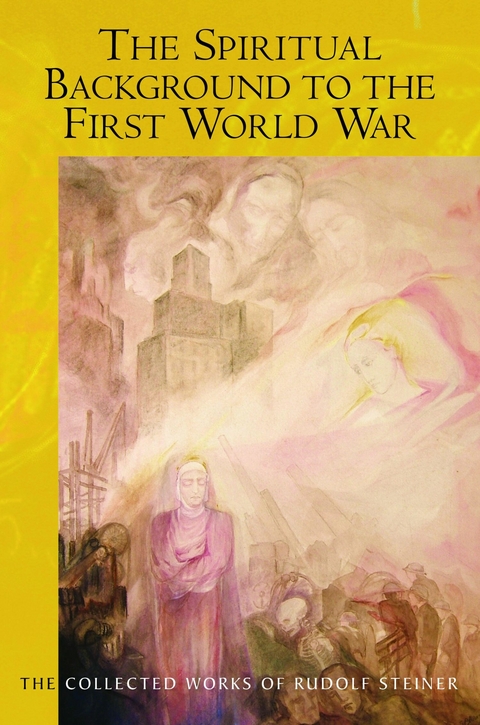
Spiritual Background to the First World War (eBook)
498 Seiten
Rudolf Steiner Press (Verlag)
978-1-85584-648-7 (ISBN)
With the unprecedented global conflict of the First World War as an overarching theme, Rudolf Steiner addresses timeless issues such as the search for harmony between peoples and nations, the development of the human capacity for love, the contemporary presence of Christ, and the questions of reincarnation and life after death. Speaking in the German city of Stuttgart during and after the war years, Steiner discusses the perpetual tension between East and West - particularly in relation to Europe. The war, he says, arose principally out of the Anglo-Saxon peoples' determination 'to exercise world-domination'. Knowing that Slavic culture is destined to be the precursor of the sixth cultural epoch, Western national interests resolved to make Eastern Europe - specifically Russia - 'the field for socialist experiments'. These events were aggravated by the failure of the Central European peoples in their own world-historical task, to 'rise to a broad sense of vision' as intermediaries between the two groups. Throughout, Steiner refers to the work of individual Folk Souls, but distinguishes them from the scourge of nationalism - especially when it is based on blood - whilst emphasizing the sovereignty of the individual human being. Although more than a century old, the enduring themes of these previously-untranslated lectures will resonate with many readers today. The main text is supplemented with an introduction by Simon Blaxland-de Lange, editorial notes and an index. Sixteen lectures, Stuttgart, Sept. 1914-March 1921, GA 174b
INTRODUCTION
Towards the end of Owen Barfield’s long novel English People, there is a scene where a terminally ill old man, who is evidently a leading member of some unspecified secret society, is giving some last advice before he dies to a person whom he intends to take over his responsibilities. One of his most important pieces of advice is to prevent ‘the Three’ from uniting, in that any form of threefoldness (as opposed to duality) would, he says, work ‘like dynamite!’, and, hence, torpedo the carefully laid plans of this society; and it is clear from the whole context of the novel that the society has as its aim the guidance and direction of the affairs of the Western world of ‘England’ and ‘America’ (which, he says, for the purposes of the brotherhood should preferably lose their separate identity to become a ‘united West’). A further aim specified by this elderly occultist is to defeat the movement led by ‘Brockmann’ (or Rudolf Steiner), which ‘remains a grave threat’.
Apart from the last of these sixteen lectures, which is itself – even more than any of the others – all about the war, all these lectures were given during the unprecedented global conflict of the First World War; and one can sense throughout the lectures – and perhaps all the more because they were given in a place and amidst a group of people where he felt able to speak with a particular degree of intimacy – that Rudolf Steiner was standing fervently for the Third Thing (the ‘Tertium Quid’ in Barfield’s novel) which he could see was under serious threat of destruction through the forces that had brought this war about. The purpose of this introduction is on the one hand briefly to characterize Rudolf Steiner’s standpoint in his own terms and from his own perspective and, on the other, to try to assess its significance and validity from the perspective of over a century of determination to assert – pace Barfield’s elderly occultist – the primacy of duality in the intellectual and social (and, of course, the political) affairs of humanity.
Already in the first of these lectures, which was given in September 1914 and thus shortly after the outbreak of the war, the themes which come to resound throughout are briefly encapsulated. It is also one of those lectures where Rudolf Steiner spoke quite explicitly about the national as opposed to the universally human aspect of the tumultuous events happening around him and his audience. Thus, for example, he states quite clearly that ‘the ego of Europe resides in the German spirit’, that ‘this war is a conspiracy against German spiritual and cultural life’ and that ‘we [i.e. the German or Central European people] did not want this war’. Both in this and in several of the other lectures there are copious references to what he had said previously in 1910 (thus, as he emphasizes, long before the outbreak of the war) in the lectures on Folk-souls and their mission given in Christiania (Oslo). He recounts his understanding of the way that different European peoples carry particular tasks on behalf of their Folk-souls or Folk-spirits with respect to the development of different attributes of human nature, while always emphasizing on the one hand that this is not a question of attributing value-judgements but, rather, of characterizing particular tasks on behalf of humanity and the spiritual world and, on the other hand, that the individual human being can – and ultimately should – always rise above such groupings even in our own time.
It is especially important to emphasize here what he says about the conflict and perpetual tension between East and West and constructively to understand their respective tasks in our time. Only in the last lecture, which was given on 21 March 1921 and thus well after the end of the war, do we have a full-scale rebuttal of the assertion that was the prevailing view throughout the war and even well into our present twenty-first century, namely that Germany was responsible for bringing about the war. Instead, he makes it very clear – as he also does to a lesser extent elsewhere in these lectures – that the war arose mainly out of the determination of the ‘Anglo-Saxon race to exercise world-domination’ and to ‘resolve the social question’ by ‘making the Eastern world, and specifically the world of Russia, the field for socialist experiments’, a tendency which, he says, was aggravated by the failure of the Central European peoples to ‘rise to a broad sense of vision’, to ‘grow together with a broad visionary outlook’ as befitted their particular world-historical task. Not that this prevented Rudolf Steiner from being accused (wholly unjustly, as he makes clear) by the precursors of the Nazi movement (including Adolf Hitler himself) of being responsible for the disastrous terms meted out to Germany by the Versailles Peace Treaty.
Thus throughout these lectures given in Stuttgart during the war, Rudolf Steiner was speaking at least in part as a defender of something utterly precious and essential to the present and future development of Europe and the wider world which was under serious assault, even in the earlier lectures hoping for a military victory and later for a victory of a more spiritual nature. This theme is present in the background even where – for example in the three lectures given in November 1915 – the focus is upon other matters relating to his spiritual-scientific research. Thus in these November 1915 lectures the insights that he gives into the life between death and a new birth are prompted by his reflections about the destiny of the etheric bodies and souls of those who had died prematurely on the battlefields, as evidenced by the meditative verse beginning ‘From the courage of the fighters…’, which he spoke at the end of the first eight of the present lectures. In some of the later lectures, Rudolf Steiner is, rather, devoting his attention to assaults of other than a military nature upon this precious Central European treasure of the individual human spirit, whether deriving from such as Annie Besant on behalf of the (Anglo-Saxon-oriented) Theosophical Society, from former, disaffected members of the Anthroposophical Society or from present members whose cultivation of anthroposophy he regards as theoretical and abstract, as insufficiently grounded in reality. The penultimate fifteenth lecture translates this understanding again into the broader canvas of outward events; and there is in this lecture an almost apocalyptic tone emanating out of Steiner’s awareness of, on the one hand, the abstract spiritual dissipation exemplified by the impulses of the world’s ‘schoolmaster’ President Woodrow Wilson (ever his bête noire) and, on the other, by the sinister nationalism of the blood which was to arise as a tragic distortion of his plea for a renewed visionary quality on the part of the Central European spirit.
How different the understanding that a contemporary English novelist, E. M. Forster, presents of the respective qualities of the German and English soul in his novel Howards End (1910), which is at any rate in some ways wholly consistent with that of Rudolf Steiner and has as its motto – in stark contrast to the bellicose hatefulness of wartime – the famous words ‘only connect’, from the impression that one may have of the situation in our present time! This was starkly exemplified for the present writer by the title of a book published this year (2023) chronicling the recent history of much of that European territory to which Rudolf Steiner assigned the designation Central Europe (Mitteleuropa). This book was written by a Polish-American academic Jacob Mikanowski with the title Goodbye Eastern Europe. In the course of the book he explicitly states that what he calls Eastern Europe is equivalent to Mitteleuropa (‘Eastern Europe’ in Rudolf Steiner’s understanding refers to Russia, including Belarus and Ukraine). The point here is not to dissent from the author’s analysis but to draw a very different conclusion, and to understand the significance of the author’s analysis in terms of the picture presented by Rudolf Steiner. For it is not difficult to see that ‘Central Europe’ including of course Germany, Austria and so forth has in our time become largely subsumed within an American-dominated West and that in cultural terms it has more or less lost its identity in a dualistic cultural and political scheme of East and West. Moreover, from this perspective it can be seen that the assumed supremacy of the materialistic Western (Anglo-American) world-view which, according to Rudolf Steiner, was the principal factor in bringing about the First World War, continues to be responsible at least in part for the most divisive conflicts with which our present world is assailed (to say nothing of environmental and ecological issues). There is therefore a need for a dramatic change in the predominant mind-set of modern times. Especially among younger people, there is a growing understanding of this; but here, Rudolf Steiner’s insights into national and group identities and characteristics, into the evolution of human consciousness, are badly needed if the tribalism of identity politics, strongly influenced as it is by the deadening anti-thoughts of the post-modernism advocated by such as Michel Foucault, can be transformed into a true commitment to universalism; to not only a respect for but also a deep understanding of the...
| Erscheint lt. Verlag | 24.5.2024 |
|---|---|
| Einführung | S. Blaxland-de Lange |
| Übersetzer | S. Blaxland-de Lange |
| Verlagsort | London |
| Sprache | englisch |
| Themenwelt | Geisteswissenschaften ► Religion / Theologie |
| Weitere Fachgebiete ► Anthroposophie | |
| ISBN-10 | 1-85584-648-9 / 1855846489 |
| ISBN-13 | 978-1-85584-648-7 / 9781855846487 |
| Informationen gemäß Produktsicherheitsverordnung (GPSR) | |
| Haben Sie eine Frage zum Produkt? |
 EPUB (Adobe DRM)
Kopierschutz: Adobe-DRM
Adobe-DRM ist ein Kopierschutz, der das eBook vor Mißbrauch schützen soll. Dabei wird das eBook bereits beim Download auf Ihre persönliche Adobe-ID autorisiert. Lesen können Sie das eBook dann nur auf den Geräten, welche ebenfalls auf Ihre Adobe-ID registriert sind.
Details zum Adobe-DRM
Dateiformat: EPUB (Electronic Publication)
EPUB ist ein offener Standard für eBooks und eignet sich besonders zur Darstellung von Belletristik und Sachbüchern. Der Fließtext wird dynamisch an die Display- und Schriftgröße angepasst. Auch für mobile Lesegeräte ist EPUB daher gut geeignet.
Systemvoraussetzungen:
PC/Mac: Mit einem PC oder Mac können Sie dieses eBook lesen. Sie benötigen eine
eReader: Dieses eBook kann mit (fast) allen eBook-Readern gelesen werden. Mit dem amazon-Kindle ist es aber nicht kompatibel.
Smartphone/Tablet: Egal ob Apple oder Android, dieses eBook können Sie lesen. Sie benötigen eine
Geräteliste und zusätzliche Hinweise
Buying eBooks from abroad
For tax law reasons we can sell eBooks just within Germany and Switzerland. Regrettably we cannot fulfill eBook-orders from other countries.
aus dem Bereich