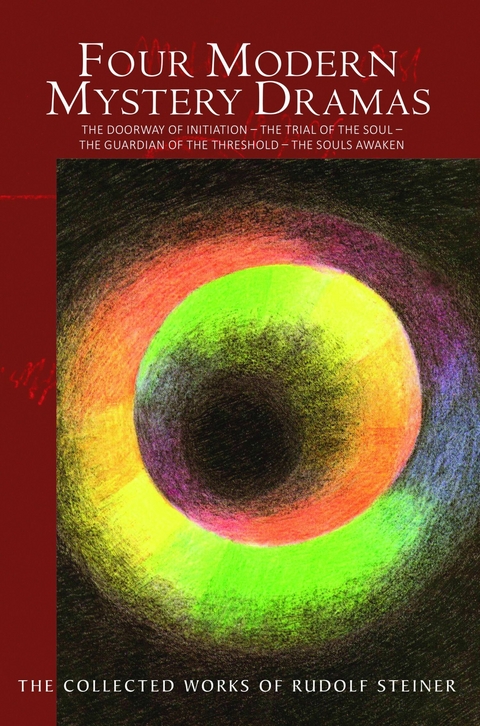
Four Modern Mystery Dramas (eBook)
Rudolf Steiner Press (Verlag)
978-1-85584-642-5 (ISBN)
The Doorway of Initiation - The Trial of the Soul - The Guardian of the Threshold - The Souls AwakenRudolf Steiner's four modern mystery dramas are powerful portrayals of the complex laws of reincarnation and karma, transporting us to landscapes of soul and spirit where supra-sensory beings are visible, active and influential. Through perception of these hidden worlds, we are given tools to comprehend the background to the struggles we face in everyday life both in human relationships and in our attempts to practise spiritual development. Written between the years 1910 and 1913, during periods of intense inner and outer work, the dramas are powerful testimonies to Steiner's artistic creativity. By manifesting soul and spirit forms on stage, they foreshadow a dramatic art of the future. Rudolf Steiner planned for all four mystery dramas to be performed in August 1923, but this was no longer possible because of the burning of the first Goetheanum on New Year's Eve, 1922. They were eventually performed together for the first time in 1930 and since then have been staged regularly, in many languages, throughout the world. This fresh rendering into English by Richard Ramsbotham also features an extensive introduction by him. >GA 14
PRELUDE
Sophia’s room—the main colour is yellow-red. Sophia with her two children, a boy and a girl. Then Estella.
THE CHILDREN, SINGING:
Sophia accompanies them on the piano.
The sunlight’s glory spreads
Through the world’s wide spaces,
The birdsong echoes in joy
Through the air’s heavenly fields,
The plants spring up and shine out grace
From the earth their mother,
And human souls arise
In their thankful hearts
Up to the spirits of the world.
SOPHIA:
Now, children—off to your room—and dwell on the words we’ve been singing.
Sophia leads the children out, Estella enters.
ESTELLA:
Hello, my dear Sophie. I hope I’m not disturbing you.
SOPHIA:
Not at all, my good Estella. I’m delighted to see you. (They greet one another and then:) Let’s sit over here.
ESTELLA:
Have you had good news from your husband?
SOPHIA:
Very good. He’s at a psychology conference. He says it’s interesting, although he finds the approach there to many huge and significant questions unappealing. But what fascinates him, as a psychologist, is how, through a particular spiritual short-sightedness, people make it impossible for themselves to gain a clear view of the mysteries they’re dealing with.
ESTELLA:
And he’s giving a talk himself, isn’t he, on an important theme?
SOPHIA:
Yes—on a theme both he and I find very important. He doesn’t hold out much hope, though, that what he brings will have any effect, given the scientific attitudes of the audience.
ESTELLA:
I’ve been led here by the wish, my dear Sophie, that you and I might spend the evening together. Tonight is the performance of the play Exiled and Uprooted, and you could give me no greater pleasure than by coming to see it with me.
SOPHIA:
It’s slipped your mind, dear Estella, that this evening our society has its own performance, which we’ve spent a long time preparing for.
ESTELLA:
Oh dear, yes, I’d forgotten. I’d so happily have spent this evening with my old friend. I’d been looking forward to sitting beside you and gazing into the depths that lurk beneath contemporary life. But your ideology—that I find so alienating—will soon destroy even what little remains of the beautiful bond that has joined our hearts since we shared that same little desk together at school.
SOPHIA:
You’ve often said that; yet you’ve always had to admit that our opinions need not be any hindrance to the affection that’s lived between us since the shared days of our youth.
ESTELLA:
It’s true—I have often said that. But it keeps on causing bitterness in me to see how with each year that passes you grow ever more estranged from all that I find valuable in life.
SOPHIA:
But that’s the very way we could be so much for one another—if we can each value and accept where our different perspectives have led us.
ESTELLA:
Aagh—I often let my reason tell me you are right. But something in me rebels against the way you look at life.
SOPHIA:
Then honestly admit to yourself that what you really ask of me is that I reject the inmost core of my being.
ESTELLA:
If not for one thing, I could have accepted it all. I can well imagine people with different ways of viewing the world resounding in complete sympathy with each other when they meet. But the direction of your ideas, in its whole nature, obliges you to assume a certain superiority. Other people are well able to stand side by side, and think of the other’s opinions as caused by different possible viewpoints, but nonetheless to be equally justified. But your view of the world declares itself to be deeper than all others. It sees these simply as outgrowths of lower stages of human evolution.
SOPHIA:
You could know, though, from all our conversations, that those who share my way of seeing things do not make knowledge or opinions the final measure of someone’s worth. And if we do indeed view our ideas as those that must be taken hold of, in a living way, if the rest of our life is not to lack all true foundation, we nonetheless try very hard not to set too high a value on someone because they have been able to become an instrument of what we see as the true goals of life.
ESTELLA:
That all seems finely said. But it doesn’t take away one nagging suspicion. For I’m not going to fool myself that a world-view, ascribing to itself illimitable depths, can only end up, through its pretences of profundity, at a certain superficiality. You are much too dear a friend for me to want to point the finger at those who share your way of thinking, who swear by your ideas and yet display the most grotesque spiritual arrogance, wholly unaware that the emptiness and banality of their souls shouts from everything they say and do. Nor do I wish to point out that many of those around you seem completely insensitive and even indifferent to the lives of others. The greatness of your own soul has, I know, never pulled you away from all that everyday life demands from those one must unhesitatingly call good. And yet, the very fact that you’re leaving me alone this evening, when real life is authentically and artistically to be seen on stage, shows me that the ideas you hold about life are creating even in you—forgive me for saying so—a certain superficiality.
SOPHIA:
What does it consist in, this superficiality?
ESTELLA:
As we’ve known each other for so long, it should be clear to you how I’ve fully freed myself from a way of life bound by convention and the banalities of popular opinion. I have sought to understand why so many people must undergo seemingly undeserved suffering. I have worked hard to get up close to both the depths and the heights of life. I have even explored the sciences, as far as they’re accessible to me, to glean all manner of explanations for things.
Well, to get to the point—the whole matter in front of us now— it has become quite clear to me what true art is. I understand, I believe, how it seizes hold of the wellsprings of life, and sets its true and higher reality before our souls. When I can open myself up to art like this, I feel I am sensing the beating, throbbing pulse of our times. And it’s appalling for me to think that you, my dear Sophie, should show so little interest in such art, brimming with the stuff of life, and should prefer instead something in a style I can only see as didactic, allegorical and hopelessly outmoded—which gazes on doll-like cyphers rather than living human beings and expresses its admiration for a series of symbolic happenings far removed from everything in daily life that arouses our compassion and our sense of being actively and sympathetically involved in it.
SOPHIA:
My dear Estella, you simply don’t wish to understand that life is only to be found in its richest abundance there where you see merely dry, spun out thoughts. And that there might be people for whom what you see as ‘reality brimming with life’ is hopelessly insufficient if not viewed in connection with the source from which it actually springs. Maybe my words sound harsh. But our friendship demands complete honesty between us. Like so many others, you know the spirit only as the bearer of knowledge; you’re only aware of the spirit in the form of thoughts. You want nothing to do with the living, creative spirit that fashions human beings with elemental power, the way that embryonic forces fashion the creatures of nature. In art, for example, what you and many others see as naïve, natural and original for me does away with the Spirit. Whereas our way of looking at the world unites fully free conscious activity with the naïve powers at work in the world. We raise the naïve and natural to consciousness, without robbing it of the fresh and abundant fountain-springs of its life. You believe that one’s thoughts about the human character have no part in it— that this must somehow be formed by itself. You don’t wish to see how thought wholly submerges itself in the creative spirit of the world, touches the living wellsprings of existence, and re-emerges as the creative seed-kernel itself. It’s absurd to think that the forces in the seed teach the plant to grow—they show themselves to be a living reality within it—and just as little do our ideas teach: life-giving, they pour into us, setting our lives aflame. I thank the ideas now available to me for everything that gives my life meaning. I thank them not only for the heart-filled courage but also for the understanding and the strength through which I hope to make of my children individuals who are not just conventionally able to perform some useful function in outer life, but who bear an inner peace and contentment within themselves. Well, my dear Estella—I won’t go into everything—I don’t want to say too much.
ESTELLA:
No…
SOPHIA:
But I’d like to say one more thing. I’m convinced that the dreams you share with so many can only come true if people are able to link what they call ‘reality’ and ‘life’ with the deeper experiences you have so often called fantasies and illusions. It might seem strange to you—but I experience much of what you see as genuine art...
| Erscheint lt. Verlag | 9.6.2023 |
|---|---|
| Einführung | R. Ramsbotham |
| Übersetzer | R. Ramsbotham |
| Verlagsort | London |
| Sprache | englisch |
| Themenwelt | Geisteswissenschaften ► Religion / Theologie |
| Weitere Fachgebiete ► Anthroposophie | |
| ISBN-10 | 1-85584-642-X / 185584642X |
| ISBN-13 | 978-1-85584-642-5 / 9781855846425 |
| Informationen gemäß Produktsicherheitsverordnung (GPSR) | |
| Haben Sie eine Frage zum Produkt? |
 EPUB (Adobe DRM)
Kopierschutz: Adobe-DRM
Adobe-DRM ist ein Kopierschutz, der das eBook vor Mißbrauch schützen soll. Dabei wird das eBook bereits beim Download auf Ihre persönliche Adobe-ID autorisiert. Lesen können Sie das eBook dann nur auf den Geräten, welche ebenfalls auf Ihre Adobe-ID registriert sind.
Details zum Adobe-DRM
Dateiformat: EPUB (Electronic Publication)
EPUB ist ein offener Standard für eBooks und eignet sich besonders zur Darstellung von Belletristik und Sachbüchern. Der Fließtext wird dynamisch an die Display- und Schriftgröße angepasst. Auch für mobile Lesegeräte ist EPUB daher gut geeignet.
Systemvoraussetzungen:
PC/Mac: Mit einem PC oder Mac können Sie dieses eBook lesen. Sie benötigen eine
eReader: Dieses eBook kann mit (fast) allen eBook-Readern gelesen werden. Mit dem amazon-Kindle ist es aber nicht kompatibel.
Smartphone/Tablet: Egal ob Apple oder Android, dieses eBook können Sie lesen. Sie benötigen eine
Geräteliste und zusätzliche Hinweise
Buying eBooks from abroad
For tax law reasons we can sell eBooks just within Germany and Switzerland. Regrettably we cannot fulfill eBook-orders from other countries.
aus dem Bereich