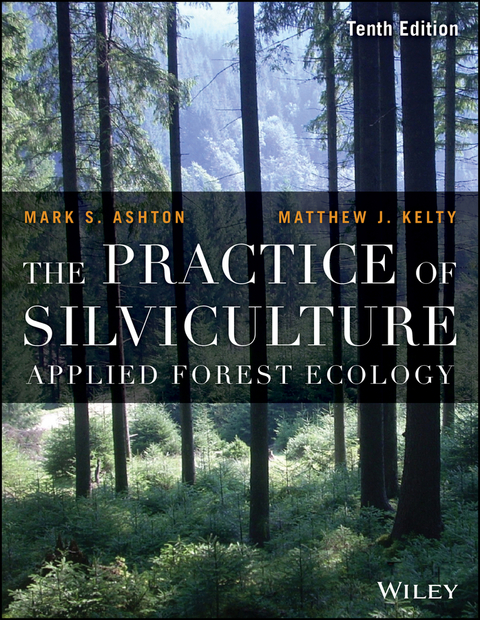
The Practice of Silviculture (eBook)
John Wiley & Sons (Verlag)
978-1-119-27130-7 (ISBN)

The most up-to-date, comprehensive resource on silviculture that covers the range of topics and issues facing today's foresters and resource professionals
The tenth edition of the classic work, The Practice of Silviculture: Applied Forest Ecology, includes the most current information and the results of research on the many issues that are relevant to forests and forestry. The text covers such timely topics as biofuels and intensive timber production, ecosystem and landscape scale management of public lands, ecosystem services, surface drinking water supplies, urban and community greenspace, forest carbon, fire and climate, and much more.
In recent years, silvicultural systems have become more sophisticated and complex in application, particularly with a focus on multi-aged silviculture. There have been paradigm shifts toward managing for more complex structures and age-classes for integrated and complementary values including wildlife, water and open space recreation. Extensively revised and updated, this new edition covers a wide range of topics and challenges relevant to the forester or resource professional today. This full-color text offers the most expansive book on silviculture and:
- Includes a revised and expanded text with clear language and explanations
- Covers the many cutting-edge resource issues that are relevant to forests and forestry
- Contains boxes within each chapter to provide greater detail on particular silvicultural treatments and examples of their use
- Features a completely updated bibliography plus new photographs, tables and figures
The Practice of Silviculture: Applied Forest Ecology, Tenth Edition is an invaluable resource for students and professionals in forestry and natural resource management.
Mark S. Ashton, Morris K. Jesup Professor of Silviculture and Forest Ecology and Director of School Forests, Yale School of Forestry & Environmental Studies, New Haven, CT, USA.
Matthew J. Kelty, Professor Emeritus, University of Massachusetts, Amherst, MA, USA.
Mark S. Ashton, Morris K. Jesup Professor of Silviculture and Forest Ecology and Director of School Forests, Yale School of Forestry & Environmental Studies, New Haven, CT, USA. Matthew J. Kelty, Professor Emeritus, University of Massachusetts, Amherst, MA, USA.
Preface
Acknowledgements
Part 1 Introduction to Silviculture
1 The History and Philosophy of Silviculture
2 Silviculture and its Place in Managing Current Forests and Woodlands
Part 2 Ecological Foundations of Silviculture
3 Ecological Site Classification, Stands as Management Units, and Landscape?]Scale Planning
4 Stand Dynamics: The Ecology of Forest Succession
5 Ecology of Regeneration
Part 3 Methods of Regeneration
6 Development of Silvicultural Systems and Methods of Regeneration
7 Site Treatments
Part 3A Natural Regeneration Methods
8 Natural Regeneration: The Clearcutting Method
9 Natural Regeneration: The Seed?]Tree Method
10 Natural Regeneration: The Shelterwood Method
11 Natural Regeneration: Irregular Seed-Tree and Shelterwood Methods (Multi-Aged Systems)
12 Natural Regeneration: The Coppice Method
13 Natural Regeneration: Selection Methods
Part 3B Methods Based on Artificial Regeneration
14 Species Selection and Genetic Improvement
15 Nursery, Planting, and Seeding Techniques
16 The Arrangement, Composition, and Methods of Planting
Part 4 Post-Establishment (Intermediate) Treatments
17 Tree and Stand Growth
18 Post-Establishment Tools in Silviculture
19 Pruning Methods and Applications
20 Release Operations in Seedling and Sapling Stands
21 Methods of Thinning
22 Quantitative Thinning: Theory and Application
Part 5 Silvicultural Considerations for Managing All Forests
23 Conservation Management Practices
24 Silviculture for Wildlife Habitat
25 Silvicultural Applications to Forest Restoration: Rehabilitation and Reclamation
26 Approaches to and Treatments for Maintaining Healthy Forest Ecosystems
27 Managing Forest Carbon in Changing Climates
Part 6 Silvicultural Applications for Different Land Uses
28 Ecosystem Management: Managing Public Natural Forests for Multiple Values
29 Application of Silviculture to Watershed Management
30 Industrial Timber Management
31 Application of Silviculture to Agroforestry
32 Application of Silviculture to Urban Ecosystems and the Urban-Rural Interface
Common and Scientific Names of Trees and Shrubs Mentioned in the Text
Glossary of Terms
Index
1
The History and Philosophy of Silviculture
Introduction
There are three parts to this chapter that describe silviculture as an evolving sub‐discipline of applied ecology and its contribution to the well‐being of society. The three parts include: (1) history, (2) philosophy, and (3) the literature and sub‐disciplines of research relevant to current resource issues. The first part summarizes the origins and evolution of silviculture as a part of an ancient indigenous agricultural practice used by many peoples for production of food and shelter in combination. Silviculture was originally the forest part of swidden systems where forest patches were cleared for agricultural use for a period of years to provide food, before being left fallow and allowed to grow back to trees, and secondary forest that was harvested for timber, fiber, fruits, and medicinals. With the development of permanent agricultural and pastoral fields, silvicultural systems followed suit and forests and woodlands were managed separately from agriculture. There is then a discussion of silviculture’s systematic evolution as a science in response to the degeneration and degradation of forest lands associated with the industrialization of economies in central Europe, then in North America, and subsequently elsewhere. A synopsis of silviculture’s roots to reforestation and restoration in Germany, British India, and the United States follows. Finally there is a discussion of silviculture as it is practiced at present.
The second part comprises a discussion of the different philosophical approaches of silviculture. It first describes silviculture as an ecological technology. It shows that silviculture has a relationship with the social sciences and contributes to the management discipline of forests and woodlands. It describes how silviculture should be used as part of a long‐term economic view for the betterment and sustainability of social values obtained from trees. It then discusses the variations in the intensity of practice in relation to circumstance. This part of the chapter concludes with a philosophical perspective of how silviculture should be applied to forests.
The third part comprises a synthesis of the silvicultural literature as a body of scientific knowledge. It uses the literature to discuss modern day developments in silvicultural research as a sub‐discipline of ecology, and then relates this body of research to today’s resource issues.
Silviculture, its Origin and Development as an Applied Ecology
Silviculture is the oldest application of the science of ecology and is a field that was recognized before the term ecology was coined (Toumey, 1928). Many of the ways of developing forest stands rest heavily on cuttings that alter or modify the stand environment in order to regulate the growth of remaining vegetation. The reliance on ecological knowledge in silviculture is therefore all the better for not simply resting on philosophical principle. The economic returns from forestry are usually not great enough to protect forests from all the shifts and changes of nature. Therefore, silviculture is usually far more the imitation of the natural processes of forest growth and development, than of completely substituting a new stand for them.
Silviculture as a Preindustrial Construct
Silviculture, as a practice of cultivating and growing vegetation within forests and woodlands, has a much longer history of development and learning over thousands of years than its more recent transformation into a science. The most ancient form of silviculture was, and still is in the more remote forests of the world, a part of what is called swidden agriculture. It is a temporary intensive cultivation of a patch of cleared forest for food crops, which is then either abruptly or more slowly relinquished back to forest through succession. It is widely practiced in the more remote forest regions of the world and can be a very sustainable form of agri‐silviculture.
Such systems have different lengths of successional development before returning back for cultivation. They are largely dependent upon the soil’s inherent capacity to become fertile again. After cultivation of arable crops is stopped, many swidden systems incorporate tree plantings and intentional natural regeneration methods that are then followed up with the tending and harvesting of tree crops. Trees that provide fruits, medicinals, and building materials can be harvested with the growth of the new forest into the future until the next cycle of forest clearance and cultivation (Box 1.1). People who practiced swidden agriculture knew exactly where, when, and what tree species to cultivate within a swidden. Many swidden systems can be regarded as very sophisticated, much more so than the credit given them by western science and the modern day practice of agriculture and forestry.
Box 1.1 Examples of preindustrial silviculture.
Swidden Cultivation System of the Yanomami in Brazil
The Yanomami Native Americans are one of the largest tribes in Latin America, straddling the borderlands of northern Brazil and southern Venezuela. The combined Yanomami territories of Brazil, comprising 23.7 million acres (9.6 million ha), and Venezuela, comprising 20.3 million acres (8.2 million ha), form the largest indigenous lands in the world (Chagnon and Gross, 1973). The lands are under threat from goldminers, cattle ranchers, and poor national government enforcement. The Yanomami live in relatively large communal houses called yanos. Men hunt and fish for game, providing about 10% of the food; women farm, providing about 80%. Only about 4 hours of work per day is necessary to maintain their way of life. Villages periodically move within the territory about every 30 years to accommodate the shifting agricultural systems. Large gardens are cleared by the men from primary forest (old‐growth) and crops (cassava, sweet potatoes, plantains, beans, corn, squash) are cultivated by the women for only 2–3 years because the soils are so infertile (Fig. 1). New gardens are then created in another patch of primary forest. Old gardens are used for hunting animals that like early successional habitat, harvesting insect grubs feeding upon young growth, and harvesting fruit, medicinals, and vines for cordage and basketry (Nilsson and Fearnside, 2011). It usually takes no longer than 2 hours walk to get to a garden from the village. Several gardens are worked at the same time. In other areas, the Yanomami have old groves of fruit trees planted and then protected from years ago. The total number of plant species used by the Yanomami is well over 500 and cater to every necessity of life ranging from toothpicks, to foods, to medicines, to fish poisons. Hunting for different purposes is carefully zoned across the forest for different kinds of game and for hunting at different seasons and even times of day. Other zones are restricted as game preserves. All of this means there is an extensive trail network for the different hunting and gardening practices.
Box 1.1 Figure 1 An aerial view of swidden cultivation in the Amazon comprising a patchwork of current and abandoned fields.
Source: R. Butler, 2008. Reproduced with permission from Rhett Butler/mongabay.com.
Cultivation Systems of Native Americans in Eastern North American Oak Forests
Indigenous peoples of North America strongly influenced the landscape vegetation of the eastern oak forests of the United States. They did this by cultivating crops. However they also manipulated tree density and species composition to increase mast and game populations, to encourage easy woodland travel, and to reduce pests and diseases. Eastern tribes cultivated maize, beans, squash, and tobacco, often on a large scale, and sited these clearings on fertile soils most suitable for agriculture, usually in large river flood plains. Early explorers reported extensive areas of cultivation. In 1616, Smith remarked that the Massachusetts coast “shewes you all along large cornfields” and “many Iles all planted with corne” (Day, 1953). In New England, cultivation shifted after soil exhaustion and more forest had to be cleared for new fields. This kind of cultivation created a patchwork of successional ages and structures (Cronon, 1983). In addition to intensively managing agricultural fields, Native Americans managed forests to create open savannah woodlands with grassy understories and widely spaced trees. These woodlands were primarily composed of fire‐adapted, masting species such as oaks, chestnuts, and hickories. In 1525, Giovanni da Verrazzano traveled 15–18 miles inland from Narragansett Bay, Rhode Island and observed open plains, completely free of trees, extending miles, as well as woodlands that “might well be traversed by an army ever so numerous.” (Verrazzano, 1825 in Day, 1953 p. 334). Other early explorers echoed such reports and also noted the large and numerous fires, which were ignited annually or twice a year in the spring and fall. These fire‐maintained savannahs had several purposes, chief among them being the provision of food. Frequent fires favored nut‐producing hardwoods, such as oaks, particularly the sweet acorn‐bearing white oaks, chestnuts, hickories, walnuts, and butternuts, and maintained them in open conditions, maximizing sun exposure and thus mast volumes. Nut...
| Erscheint lt. Verlag | 3.1.2018 |
|---|---|
| Sprache | englisch |
| Themenwelt | Naturwissenschaften ► Biologie ► Ökologie / Naturschutz |
| Weitere Fachgebiete ► Land- / Forstwirtschaft / Fischerei | |
| Schlagworte | Agriculture • Angewandte Ökologie • Applied Ecology • Biowissenschaften • Conservation of Site Productivity • Control of Stand Structure and Process • Definition of Silviculture • Environmental Science • Environmental Studies • forestry • Forstwirtschaft • Handbook to Silviculture • Imitating Nature through Silviculture • Landwirtschaft • Life Sciences • <p>Guide to Silviculture • Ökologie • Origin and Development of Silviculture as an Applied Ecology • Philosophical Applications of Silviculture • Philosophies of Silviculture • Relationship with Forest Management and the Social Sciences • Resource Issues Applicable to the Use of Silviculture • Resource to Silviculture • Scope and Terminology of Silvicultural Practice • Silviculture and the Long-Term Economic Viewpoint • Silviculture as a Current Practice • Silviculture as a Preindustrial Construct • Silviculture as a Western Construct • The Practice of Silviculture</p> • The Purpose of Implementing Silviculture • Umweltforschung • Umweltwissenschaften |
| ISBN-10 | 1-119-27130-4 / 1119271304 |
| ISBN-13 | 978-1-119-27130-7 / 9781119271307 |
| Informationen gemäß Produktsicherheitsverordnung (GPSR) | |
| Haben Sie eine Frage zum Produkt? |
 EPUB (Adobe DRM)
Kopierschutz: Adobe-DRM
Adobe-DRM ist ein Kopierschutz, der das eBook vor Mißbrauch schützen soll. Dabei wird das eBook bereits beim Download auf Ihre persönliche Adobe-ID autorisiert. Lesen können Sie das eBook dann nur auf den Geräten, welche ebenfalls auf Ihre Adobe-ID registriert sind.
Details zum Adobe-DRM
Dateiformat: EPUB (Electronic Publication)
EPUB ist ein offener Standard für eBooks und eignet sich besonders zur Darstellung von Belletristik und Sachbüchern. Der Fließtext wird dynamisch an die Display- und Schriftgröße angepasst. Auch für mobile Lesegeräte ist EPUB daher gut geeignet.
Systemvoraussetzungen:
PC/Mac: Mit einem PC oder Mac können Sie dieses eBook lesen. Sie benötigen eine
eReader: Dieses eBook kann mit (fast) allen eBook-Readern gelesen werden. Mit dem amazon-Kindle ist es aber nicht kompatibel.
Smartphone/Tablet: Egal ob Apple oder Android, dieses eBook können Sie lesen. Sie benötigen eine
Geräteliste und zusätzliche Hinweise
Buying eBooks from abroad
For tax law reasons we can sell eBooks just within Germany and Switzerland. Regrettably we cannot fulfill eBook-orders from other countries.
aus dem Bereich