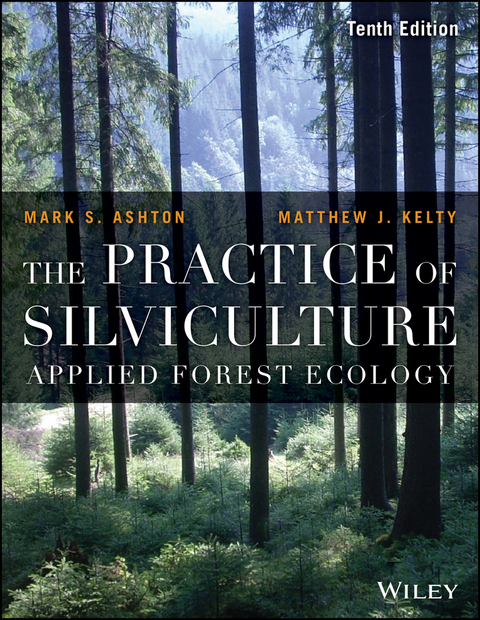
The Practice of Silviculture (eBook)
John Wiley & Sons (Verlag)
978-1-119-27128-4 (ISBN)
The most up-to-date, comprehensive resource on silviculture that covers the range of topics and issues facing today's foresters and resource professionals
The tenth edition of the classic work, The Practice of Silviculture: Applied Forest Ecology, includes the most current information and the results of research on the many issues that are relevant to forests and forestry. The text covers such timely topics as biofuels and intensive timber production, ecosystem and landscape scale management of public lands, ecosystem services, surface drinking water supplies, urban and community greenspace, forest carbon, fire and climate, and much more.
In recent years, silvicultural systems have become more sophisticated and complex in application, particularly with a focus on multi-aged silviculture. There have been paradigm shifts toward managing for more complex structures and age-classes for integrated and complementary values including wildlife, water and open space recreation. Extensively revised and updated, this new edition covers a wide range of topics and challenges relevant to the forester or resource professional today. This full-color text offers the most expansive book on silviculture and:
- Includes a revised and expanded text with clear language and explanations
- Covers the many cutting-edge resource issues that are relevant to forests and forestry
- Contains boxes within each chapter to provide greater detail on particular silvicultural treatments and examples of their use
- Features a completely updated bibliography plus new photographs, tables and figures
The Practice of Silviculture: Applied Forest Ecology, Tenth Edition is an invaluable resource for students and professionals in forestry and natural resource management.
Mark S. Ashton, Morris K. Jesup Professor of Silviculture and Forest Ecology and Director of School Forests, Yale School of Forestry & Environmental Studies, New Haven, CT, USA.
Matthew J. Kelty, Professor Emeritus, University of Massachusetts, Amherst, MA, USA.
The most up-to-date, comprehensive resource on silviculture that covers the range of topics and issues facing today s foresters and resource professionals The tenth edition of the classic work, The Practice of Silviculture: Applied Forest Ecology, includes the most current information and the results of research on the many issues that are relevant to forests and forestry. The text covers such timely topics as biofuels and intensive timber production, ecosystem and landscape scale management of public lands, ecosystem services, surface drinking water supplies, urban and community greenspace, forest carbon, fire and climate, and much more. In recent years, silvicultural systems have become more sophisticated and complex in application, particularly with a focus on multi-aged silviculture. There have been paradigm shifts toward managing for more complex structures and age-classes for integrated and complementary values including wildlife, water and open space recreation. Extensively revised and updated, this new edition covers a wide range of topics and challenges relevant to the forester or resource professional today. This full-color text offers the most expansive book on silviculture and: Includes a revised and expanded text with clear language and explanations Covers the many cutting-edge resource issues that are relevant to forests and forestry Contains boxes within each chapter to provide greater detail on particular silvicultural treatments and examples of their use Features a completely updated bibliography plus new photographs, tables and figures The Practice of Silviculture: Applied Forest Ecology, Tenth Edition is an invaluable resource for students and professionals in forestry and natural resource management.
Mark S. Ashton, Morris K. Jesup Professor of Silviculture and Forest Ecology and Director of School Forests, Yale School of Forestry & Environmental Studies, New Haven, CT, USA. Matthew J. Kelty, Professor Emeritus, University of Massachusetts, Amherst, MA, USA.
Preface
Acknowledgements
Part 1 Introduction to Silviculture
1 The History and Philosophy of Silviculture
2 Silviculture and its Place in Managing Current Forests and Woodlands
Part 2 Ecological Foundations of Silviculture
3 Ecological Site Classification, Stands as Management Units, and Landscape?]Scale Planning
4 Stand Dynamics: The Ecology of Forest Succession
5 Ecology of Regeneration
Part 3 Methods of Regeneration
6 Development of Silvicultural Systems and Methods of Regeneration
7 Site Treatments
Part 3A Natural Regeneration Methods
8 Natural Regeneration: The Clearcutting Method
9 Natural Regeneration: The Seed?]Tree Method
10 Natural Regeneration: The Shelterwood Method
11 Natural Regeneration: Irregular Seed-Tree and Shelterwood Methods (Multi-Aged Systems)
12 Natural Regeneration: The Coppice Method
13 Natural Regeneration: Selection Methods
Part 3B Methods Based on Artificial Regeneration
14 Species Selection and Genetic Improvement
15 Nursery, Planting, and Seeding Techniques
16 The Arrangement, Composition, and Methods of Planting
Part 4 Post-Establishment (Intermediate) Treatments
17 Tree and Stand Growth
18 Post-Establishment Tools in Silviculture
19 Pruning Methods and Applications
20 Release Operations in Seedling and Sapling Stands
21 Methods of Thinning
22 Quantitative Thinning: Theory and Application
Part 5 Silvicultural Considerations for Managing All Forests
23 Conservation Management Practices
24 Silviculture for Wildlife Habitat
25 Silvicultural Applications to Forest Restoration: Rehabilitation and Reclamation
26 Approaches to and Treatments for Maintaining Healthy Forest Ecosystems
27 Managing Forest Carbon in Changing Climates
Part 6 Silvicultural Applications for Different Land Uses
28 Ecosystem Management: Managing Public Natural Forests for Multiple Values
29 Application of Silviculture to Watershed Management
30 Industrial Timber Management
31 Application of Silviculture to Agroforestry
32 Application of Silviculture to Urban Ecosystems and the Urban-Rural Interface
Common and Scientific Names of Trees and Shrubs Mentioned in the Text
Glossary of Terms
Index
| Erscheint lt. Verlag | 21.12.2017 |
|---|---|
| Sprache | englisch |
| Themenwelt | Naturwissenschaften ► Biologie ► Ökologie / Naturschutz |
| Weitere Fachgebiete ► Land- / Forstwirtschaft / Fischerei | |
| Schlagworte | Agriculture • Angewandte Ökologie • Applied Ecology • Biowissenschaften • Conservation of Site Productivity • Control of Stand Structure and Process • Definition of Silviculture • Environmental Science • Environmental Studies • forestry • Forstwirtschaft • Handbook to Silviculture • Imitating Nature through Silviculture • Landwirtschaft • Life Sciences • <p>Guide to Silviculture • Ökologie • Origin and Development of Silviculture as an Applied Ecology • Philosophical Applications of Silviculture • Philosophies of Silviculture • Relationship with Forest Management and the Social Sciences • Resource Issues Applicable to the Use of Silviculture • Resource to Silviculture • Scope and Terminology of Silvicultural Practice • Silviculture and the Long-Term Economic Viewpoint • Silviculture as a Current Practice • Silviculture as a Preindustrial Construct • Silviculture as a Western Construct • The Practice of Silviculture</p> • The Purpose of Implementing Silviculture • Umweltforschung • Umweltwissenschaften |
| ISBN-10 | 1-119-27128-2 / 1119271282 |
| ISBN-13 | 978-1-119-27128-4 / 9781119271284 |
| Informationen gemäß Produktsicherheitsverordnung (GPSR) | |
| Haben Sie eine Frage zum Produkt? |
 PDF (Adobe DRM)
Kopierschutz: Adobe-DRM
Adobe-DRM ist ein Kopierschutz, der das eBook vor Mißbrauch schützen soll. Dabei wird das eBook bereits beim Download auf Ihre persönliche Adobe-ID autorisiert. Lesen können Sie das eBook dann nur auf den Geräten, welche ebenfalls auf Ihre Adobe-ID registriert sind.
Details zum Adobe-DRM
Dateiformat: PDF (Portable Document Format)
Mit einem festen Seitenlayout eignet sich die PDF besonders für Fachbücher mit Spalten, Tabellen und Abbildungen. Eine PDF kann auf fast allen Geräten angezeigt werden, ist aber für kleine Displays (Smartphone, eReader) nur eingeschränkt geeignet.
Systemvoraussetzungen:
PC/Mac: Mit einem PC oder Mac können Sie dieses eBook lesen. Sie benötigen eine
eReader: Dieses eBook kann mit (fast) allen eBook-Readern gelesen werden. Mit dem amazon-Kindle ist es aber nicht kompatibel.
Smartphone/Tablet: Egal ob Apple oder Android, dieses eBook können Sie lesen. Sie benötigen eine
Geräteliste und zusätzliche Hinweise
Buying eBooks from abroad
For tax law reasons we can sell eBooks just within Germany and Switzerland. Regrettably we cannot fulfill eBook-orders from other countries.
aus dem Bereich