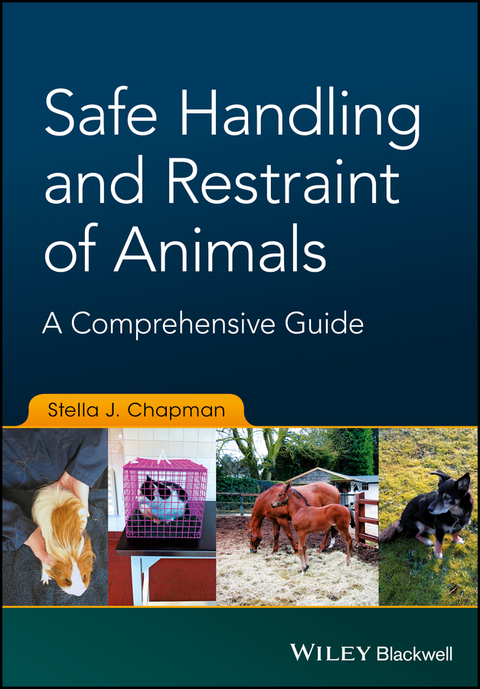
Safe Handling and Restraint of Animals (eBook)
John Wiley & Sons (Verlag)
978-1-119-07792-3 (ISBN)
Provides all you need to know about the safe and humane handling and restraint of animals.
Safe Handling and Restraint of Animals takes a holistic approach to the handling of a wide variety of animal species. This comprehensive resource offers a thorough overview of how to safely handle and restrain a number of commonly encountered species including dogs, cats, small mammals, exotic pets, horses and farm animals. Each chapter discusses the behaviour of the species and then outlines the appropriate handling and restraint methods, including any equipment required, multiple explanatory photographs, and useful further reading.
- Covers a wide range of species commonly encountered by veterinary staff and those working within animal industries
- Includes key points and self-assessment questions at the end of each chapter, and a glossary of terms
- Ideal for students of any animal-related degree or diploma programme, including veterinary medicine, veterinary nursing, and animal studies and husbandry
Written for students and professionals who work with animals, Safe Handling and Restraint of Animals: A Comprehensive Guide encompasses all aspects of handling and physical restraint, including biosecurity and welfare issues.
Stella Chapman is a veterinarian with a keen interest in animal welfare and behaviour, and the role that the veterinarian has to play in animal husbandry. She has formerly lectured at the Sydney School of Veterinary Science, University of Sydney, Australia and the School of Veterinary Medicine, University of Surrey, UK.
Stella J. Chapman is a veterinarian with a keen interest in animal welfare and behaviour, and the role that the veterinarian has to play in animal husbandry. Stella has lectured at the Sydney School of Veterinary Science, University of Sydney, Australia and the School of Veterinary Medicine, University of Surrey, UK.
1
Biosecurity and Personal Equipment for Safe Handling and Restraint of Animals
Stella J. Chapman
University Centre Hartpury, Gloucestershire, UK
When handling animals it is important that your own personal safety is top priority, yet at times this can be something that is overlooked. When dealing with large animals, particularly cattle and horses, events can happen that put us at great risk and many people have been injured, or even killed, by complacency as people are in a hurry to get things done. Preparation, suitable equipment and good facilities are key to providing a safe environment, not only for yourself but also the animals that you are handling. A good knowledge and understanding of the principles of biosecurity and disease transmission are also important, in order to prevent disease spreading from animals to humans, and also from animals to animals.
1.1 Transmission of Disease
There are many ways in which disease can be transmitted and this is largely dependent on the pathogen involved. Pathogens need to be able to leave an infected host, survive in the environment, enter a susceptible person or animal and then replicate in the new host. The term ‘transmission cycle’ is often used to describe this process and the cycle can either be ‘direct’ or ‘indirect’ (Table 1.1).
Table 1.1 Transmission routes.
| Direct transmission | Indirect transmission |
| Direct contact | Food or water |
| Secretions | Aerosol |
| Blood | Animal vectors |
| Urine or faeces | Fomites |
| Droplets | Medical devices and treatments |
1.1.1 Zoonoses
Many pathogens are specific to humans and some specific to animals; however, there are pathogens that are capable of transmitting disease to both humans and animals. A pathogen capable of causing disease from an animal to a human is known as a zoonosis. Knowledge of these pathogens and the diseases that they cause is essential in order to prevent the transmission of disease between the animals we look after and ourselves.
Ringworm is one example of a zoonotic disease. The disease is caused by a fungus and is common in many species, including dogs, cats, horses and cattle. Many animals that are infected show no clinical signs of the disease. People will become exposed by direct contact with the infected areas on the animal and will then show clinical signs (e.g. small circular areas of reddened, inflamed skin that itch) on exposed areas (i.e. hands, neck, lower arms and face). This is prevented by careful observation of the animals that you are in direct contact with and also good personal hygiene.
There are many other examples of zoonotic diseases but it is not the intention of this chapter to provide details on these. What is important is that handlers of animals have a good basic knowledge of some of the more common zoonotic diseases that they are at risk of being exposed to when working with different species. Some of the common zoonotic diseases that handlers should be aware of are outlined in Table 1.2.
Table 1.2 Examples of zoonotic diseases (Hiber and Darling, 2011. Reproduced with permission of John Wiley & Sons.).
| Disease | Route of transmission | Prevention |
| Brucellosis | Direct contact; aerosol | Vaccines for sheep, cattle and goats; PPE; good hand hygiene |
| Campylobacter | Faeces; bodily discharges; contaminated food and water; swimming in lakes; flies can be a mechanical vector | Good hand hygiene and disinfection protocols; control of flies and rodents; prevention of faecal contamination into water and feed sources |
| Leptospirosis | Contaminated food, water, equipment and surfaces; spread in aerosolized urine or water; direct contact with contaminated urine | PPE; face shields should be worn if there is a risk of urine splashing; good hand hygiene; vaccines for some species, e.g. dogs and cattle |
| Toxoplasmosis | Ingestion of infected animal tissues or contaminated water and food; direct contact with infected faeces and soil; inhalation of aerosols | Disinfection; pregnant women should be careful when handling raw meat and avoid contact with cat faeces; wear gloves when cleaning out cat litter trays; good hand hygiene |
In all cases, the risk of disease transmission can be reduced by using a good handwashing technique with soap and water after handling any animal. Wearing the correct personal protective equipment (PPE) is also important.
1.1.2 Carriers
With some pathogens the host does not always show obvious clinical signs of disease. In these cases, the host acts as a ‘carrier’ for the pathogen and will be capable of spreading the disease to susceptible animals.
Strangles is one example of a disease that has a ‘carrier’ status. The disease is caused by bacteria and is common in horses. It is important to note that with this disease there is no risk to humans becoming infected. However, strangles easily transmitted to other horses and, therefore, if you are in contact with an infected horse you must ensure that all necessary precautions are taken with regards to reducing the transmission of the disease. This will include isolation of the horse and putting biosecurity and barrier nursing protocols in place.
1.2 Infection Control
The majority of the time that people spend working with animals is with those that are healthy. However, as previously mentioned, it is not always possible to detect that the animals we are working with are ill. Therefore, it is important that handlers are aware of the methods by which the spread of disease can be prevented and controlled.
1.2.1 Biosecurity
Whereas biocontainment aims to reduce/prevent the movement of infectious diseases within a facility, biosecurity aims to reduce/prevent the introduction of new diseases into a facility from an outside source.
There are four basic principles to biosecurity:
- selection of animals from known sources with a known health status – of particular relevance to farm animals;
- isolation of new animals on arrival at the facility;
- movement control within the facility;
- sanitation using disinfection of materials and equipment and good personal hygiene.
It should be remembered that biosecurity is not just about protecting the health of the animals in your care but also about protecting your own personal health. It must also be noted that disease in animals does not always show obvious clinical signs, for example animals in the early stage of a disease or carrier animals.
1.2.2 Effective Cleaning and Disinfection
It is important when working with animals that we do so in as clean an environment as possible. Obviously, the degree to which this is done will depend to some extent on the species that we are working with and also the environment in which we are handling the animal. There are some general points to note (Dvorak and Petersen, 2009).
- Faeces: try to limit the amount of faecal contamination that surrounds the animal you are working with, for example always pick up faeces as soon as the dog defecates (if on a walk) or if noted in the kennels. Obviously, in a farm environment this is much harder to achieve; however, cleaning protocols should be in place and heavily soiled bedding should be removed on a regular basis.
- Physical cleaning: the physical removal of visible organic debris in the environment or on surfaces that you are handling an animal on is important. This may involve sweeping, brushing and scraping, depending on the organic material that you are dealing with. For example, sweeping the floor of the area where you are going to examine a horse if in a yard.
- Sanitation: this involves the use of hot water and some kind of detergent. These help to remove organic debris that can prevent disinfectants being effective. This has been shown to remove over 90% of bacteria from surfaces. Particular attention should be paid to floor drains and corners, as these are where debris can accumulate. A mop and bucket or bucket and washcloth with hot soapy water can be used for small areas and it is important that the water is changed several times during the process. For larger areas, mechanical washers that will remove organic debris can be used. Some of these work under high pressure to physically remove debris, whilst others produce steam to aid with removal. Care needs to be taken with high pressure machines as this method can aerosolize, and thus potentially spread pathogens. All surfaces should be rinsed with clean water, as some disinfectants will be inactivated by detergents. Personnel should also ensure that they are wearing the correct PPE when undertaking cleaning; what is worn will depend, to some extent, on the environment in which you are working.
- Disinfection: which disinfectant to use will very much depend on the microorganism involved, as each varies in its ability to persist in the environment as well as in its susceptibility to a particular disinfectant (Table 1.3)
Table 1.3 Physical and...
| Erscheint lt. Verlag | 16.8.2017 |
|---|---|
| Sprache | englisch |
| Themenwelt | Sachbuch/Ratgeber ► Natur / Technik ► Natur / Ökologie |
| Veterinärmedizin | |
| Weitere Fachgebiete ► Land- / Forstwirtschaft / Fischerei | |
| Schlagworte | handling and restraint of cats • handling and restraint of cattle • handling and restraint of dogs • handling and restraint of donkeys • handling and restraint of farm animals</p> • handling and restraint of ferrets • handling and restraint of horses • handling and restraint of rabbits • handling and restraint of rodents • Haustierhaltung / Sonstige Tiere • infection control in animals • lifestyle • lifestyles • <p>biosecurity and equipment for safe handling and restraint of animals • personal hygiene when working with animals • Pet Care / Other Animals • Pflege i. d. Veterinärmedizin • protective equipment working with animals • transmission of disease in animals • types of restraints and consideration for animal welfare • Veterinärmedizin • Veterinary Medicine • Veterinary Nursing & Animal Care • welfare considerations for the safe handling and restraint of animals |
| ISBN-10 | 1-119-07792-3 / 1119077923 |
| ISBN-13 | 978-1-119-07792-3 / 9781119077923 |
| Informationen gemäß Produktsicherheitsverordnung (GPSR) | |
| Haben Sie eine Frage zum Produkt? |
 EPUB (Adobe DRM)
Kopierschutz: Adobe-DRM
Adobe-DRM ist ein Kopierschutz, der das eBook vor Mißbrauch schützen soll. Dabei wird das eBook bereits beim Download auf Ihre persönliche Adobe-ID autorisiert. Lesen können Sie das eBook dann nur auf den Geräten, welche ebenfalls auf Ihre Adobe-ID registriert sind.
Details zum Adobe-DRM
Dateiformat: EPUB (Electronic Publication)
EPUB ist ein offener Standard für eBooks und eignet sich besonders zur Darstellung von Belletristik und Sachbüchern. Der Fließtext wird dynamisch an die Display- und Schriftgröße angepasst. Auch für mobile Lesegeräte ist EPUB daher gut geeignet.
Systemvoraussetzungen:
PC/Mac: Mit einem PC oder Mac können Sie dieses eBook lesen. Sie benötigen eine
eReader: Dieses eBook kann mit (fast) allen eBook-Readern gelesen werden. Mit dem amazon-Kindle ist es aber nicht kompatibel.
Smartphone/Tablet: Egal ob Apple oder Android, dieses eBook können Sie lesen. Sie benötigen eine
Geräteliste und zusätzliche Hinweise
Buying eBooks from abroad
For tax law reasons we can sell eBooks just within Germany and Switzerland. Regrettably we cannot fulfill eBook-orders from other countries.
aus dem Bereich