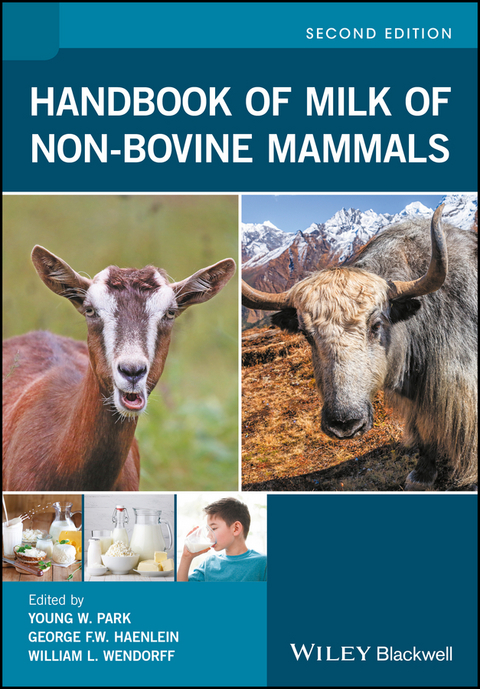
Handbook of Milk of Non-Bovine Mammals (eBook)
John Wiley & Sons (Verlag)
978-1-119-11030-9 (ISBN)
THE ONLY SINGLE-SOURCE GUIDE TO THE LATEST SCIENCE, NUTRITION, AND APPLICATIONS OF ALL THE NON-BOVINE MILKS CONSUMED AROUND THE WORLD
Featuring contributions by an international team of dairy and nutrition experts, this second edition of the popular Handbook of Milk of Non-Bovine Mammals provides comprehensive coverage of milk and dairy products derived from all non-bovine dairy species.
Milks derived from domesticated dairy species other than the cow are an essential dietary component for many countries around the world. Especially in developing and under-developed countries, milks from secondary dairy species are essential sources of nutrition for the humanity. Due to the unavailability of cow milk and the low consumption of meat, the milks of non-bovine species such as goat, buffalo, sheep, horse, camel, Zebu, Yak, mare and reindeer are critical daily food sources of protein, phosphate and calcium. Furthermore, because of hypoallergenic properties of certain species milk including goats, mare and camel are increasingly recommended as substitutes in diets for those who suffer from cow milk allergies. This book:
- Discusses key aspects of non-bovine milk production, including raw milk production in various regions worldwide
- Describes the compositional, nutritional, therapeutic, physio-chemical, and microbiological characteristics of all non-bovine milks
- Addresses processing technologies as well as various approaches to the distribution and consumption of manufactured milk products
- Expounds characteristics of non-bovine species milks relative to those of human milk, including nutritional, allergenic, immunological, health and cultural factors.
- Features six new chapters, including one focusing on the use of non-bovine species milk components in the manufacture of infant formula products
Thoroughly updated and revised to reflect the many advances that have occurred in the dairy industry since the publication of the acclaimed first edition, Handbook of Milk of Non-Bovine Mammals, 2nd Edition is an essential reference for dairy scientists, nutritionists, food chemists, animal scientists, allergy specialists, health professionals, and allied professionals.
ABOUT THE EDITORS:
YOUNG W. PARK, PhD is Senior Professor at the Georgia Small Ruminant Research and Extension Center, Fort Valley State University, Fort Valley, Georgia, and an Emeritus Adjunct Professor in the Department of Food Science and Technology, University of Georgia, Athens, Georgia.
GEORGE F.W. HAENLEIN, PhD is Emeritus Professor at the Department of Animal and Food Sciences, University of Delaware, Newark, Delaware.
WILLIAM L. WENDORFF, PhD is Emeritus Professor at the Wisconsin Center for Dairy Research, the University of Wisconsin-Madison, Madison, Wisconsin.
THE ONLY SINGLE-SOURCE GUIDE TO THE LATEST SCIENCE, NUTRITION, AND APPLICATIONS OF ALL THE NON-BOVINE MILKS CONSUMED AROUND THE WORLD Featuring contributions by an international team of dairy and nutrition experts, this second edition of the popular Handbook of Milk of Non-Bovine Mammals provides comprehensive coverage of milk and dairy products derived from all non-bovine dairy species. Milks derived from domesticated dairy species other than the cow are an essential dietary component for many countries around the world. Especially in developing and under-developed countries, milks from secondary dairy species are essential sources of nutrition for the humanity. Due to the unavailability of cow milk and the low consumption of meat, the milks of non-bovine species such as goat, buffalo, sheep, horse, camel, Zebu, Yak, mare and reindeer are critical daily food sources of protein, phosphate and calcium. Furthermore, because of hypoallergenic properties of certain species milk including goats, mare and camel are increasingly recommended as substitutes in diets for those who suffer from cow milk allergies. This book: Discusses key aspects of non-bovine milk production, including raw milk production in various regions worldwide Describes the compositional, nutritional, therapeutic, physio-chemical, and microbiological characteristics of all non-bovine milks Addresses processing technologies as well as various approaches to the distribution and consumption of manufactured milk products Expounds characteristics of non-bovine species milks relative to those of human milk, including nutritional, allergenic, immunological, health and cultural factors. Features six new chapters, including one focusing on the use of non-bovine species milk components in the manufacture of infant formula products Thoroughly updated and revised to reflect the many advances that have occurred in the dairy industry since the publication of the acclaimed first edition, Handbook of Milk of Non-Bovine Mammals, 2nd Edition is an essential reference for dairy scientists, nutritionists, food chemists, animal scientists, allergy specialists, health professionals, and allied professionals.
ABOUT THE EDITORS: YOUNG W. PARK, PhD is Senior Professor at the Georgia Small Ruminant Research and Extension Center, Fort Valley State University, Fort Valley, Georgia, and an Emeritus Adjunct Professor in the Department of Food Science and Technology, University of Georgia, Athens, Georgia. GEORGE F.W. HAENLEIN, PhD is Emeritus Professor at the Department of Animal and Food Sciences, University of Delaware, Newark, Delaware. WILLIAM L. WENDORFF, PhD is Emeritus Professor at the Wisconsin Center for Dairy Research, the University of Wisconsin-Madison, Madison, Wisconsin.
List of Contributors vii
1. Overview of Milk of Non-BovineMammals (Second Edition) 1
Young W. Park, George F.W. Haenlein, and W.L.Wendorff
2. GoatMilk 11
2.1 Production of Goat Milk 11
Mariana Marques de Almeida and George F.W. Haenlein
2.2 Goat Milk - Chemistry and Nutrition 42
Young W. Park
2.3 Goat Milk Products: Types of Products, Manufacturing Technology, Chemical Composition, and Marketing 84
Golfo Moatsou and Young W. Park
2.4 Therapeutic, Hypo-Allergenic and Bioactive Potentials of Goat Milk, and Manifestations of Food Allergy 151
Young W. Park and George F.W. Haenlein
3. SheepMilk 181
3.1 Production of Sheep Milk 181
David L. Thomas and George F.W. Haenlein
3.2 Sheep Milk - Composition and Nutrition 210
W.L.Wendorff and George F.W. Haenlein
3.3 Processing of Sheep Milk 222
W.L.Wendorff and Samir Kalit
4. Buffalo Milk 261
4.1 Buffalo Milk Production 261
Mian AnjumMurtaza, Ajit J. Pandya, and M.Mohamed H. Khan
4.2 Buffalo Milk Utilization for Dairy Products 284
Mian AnjumMurtaza, Ajit J. Pandya, and M. Mohamed H. Khan
4.3 Traditional Indian Dairy Products 343
Mian AnjumMurtaza, Ajit J. Pandya, George F.W. Haenlein, and M. Mohamed H. Khan
5. Mare Milk 369
Elisabetta Salimei and Young W. Park
6. CamelMilk 409
El-Sayed Ibrahim El-Agamy
7. YakMilk 481
Ying Ma, Shenghua He, and YoungW. Park
8. Zebu-Brahma andMithun Milk 515
Leorges M. Fonseca
9. ReindeerMilk 535
Øystein Holand, Halivard Gjøstein, Mauri Nieminen, and George F.W. Haenlein
10. Sow Milk 559
YoungW. Park
11. OtherMinor Species Milk 579
B´en´edicte Coud´e
12. Flavor and Sensory Characteristics of Non-Bovine Species Milk and Their Dairy Products 595
Pat Polowsky, B´en´edicte Coud´e, Luis A. Jim´enez-Maroto, Mark Johnson, and Young W. Park
13. Potential Applications of Non-Bovine Mammalian Milk in Infant Nutrition 625
Shane V. Crowley, Alan L. Kelly, John A. Lucey, and James A. O'Mahony
14. Human Milk 655
Young W. Park
Index 681
1
Overview of Milk of Non-Bovine Mammals (Second Edition)
Young W. Park,1 George F.W. Haenlein,2 and W.L. Wendorff 3
1 Agricultural Research Station, Fort Valley State University, Fort Valley, GA, USA
2 Department of Animal and Food Sciences, University of Delaware, Newark, DE, USA
3 Department of Food Science, University of Wisconsin-Madison, Madison, WI, USA
1 Introduction
The First Edition of Handbook of Milk of Non-Bovine Mammals, compiled information on the availability, composition, and technology of milk produced from domestic non-bovine mammals throughout the world, has been a success, so much so that it has been translated into two additional languages, Spanish and Chinese. Therefore, a Second Edition has been recommended by Blackwell-Wiley Publishers. We welcome the addition of W.L. Wendorff to the editor team, who is an international authority on cheese technology and dairy sheep besides representing the leading US dairy state Wisconsin. We also welcome several new expert co-author contributors: Mariana Marques de Almeida from Portugal, Golfo Moatso from Greece, Samir Kalit from Croatia, Elizabetta Salimei from Italy, Ying Ma and Shenghua He from China, Leorges M. Fonseca from Brazil, Benedicte Coude from France, Mian Murtaza from Pakistan, Shane Crowley from Ireland, David Thomas, John Lucey, Mark A. Johnson, and Pat Polowsky from Wisconsin, USA.
The First Edition of Handbook of Milk of Non-Bovine Mammals, published in 2006, covered the eight domestic non-bovine milk-producing species: goats, sheep, buffalo, mare, camel, yak, reindeer, human, as well as sow, llama, and other minor species. This Second Edition, after reviewing and updating the First Edition has added the milk of donkeys, zebu, and mithun species. Since 2006 much new information from research with these species has become available and two significant new publications from the international Food and Agriculture Organization in Rome, Italy (Kukovics, 2016; Muehlhoff, Bennett, and McMahon, 2013), have added emphasis on the importance of non-bovine domestic species for providing people in areas of difficult climate and geological conditions with essential nutrition and sustainance. “There is huge scope for developing other dairy species … and that alpaca, donkey, moose, reindeer and yak milk should be used to counteract high cow milk prices …” in the developing world (Muehlhoff, Bennett, and McMahon, 2013) has been stated in this latest authoritative FAO publication.
Dairy goats in particular have led in increasing numbers (66% during the last 20 years worldwide versus 14% for dairy cattle), because they are profitable for poor households by valorizing low quality forage, tolerate water shortage, and enhance rangeland biodiversity (Kukovics, 2016). Non-bovine commercial dairy products mean the reality that in many parts of the world the Western ideal milk-producing cow needs help from other domestic mammals, which are better adapted to adverse conditions of climate and geological environmental conditions. The knowledge of their productivity and composition of their products has not been published much in the Western world and non-Western scientists working with these mammals have not been heard much in the English literature. This Handbook, however, aspires to amend this situation by focusing on these other important milk-producing domestic mammals, the value of their products, and their future potential. As the FAO book stated, “there is huge scope for developing other dairy species …” (Muehlhoff, Bennett, and McMahon, 2013).
It has also been learnt that the Nordic countries, Norway, Denmark, Sweden, Finland, Iceland, and Greenland have invested $112 million for 2015–2018 in four new interdisciplinary Centers of Excellence to improve and develop animal products more and better for human nutrition and health in those adverse arctic regions of the world in order to sustain their human populations (Nordforsk, 2005). This is in addition to a research program by the University of Alaska at Fairbanks with reindeer in cooperation with the California Polytechnic Institute (Alaska, 2014).
As consumers in modern societies are seeking for diversified, sophisticated, and nutritious foods, more and more people in developing and developed countries have an interest in knowing about the composition and constituents in dairy products as they relate to human health (Campbell and Marshall, 1975; Smith, 1985; Park and Haenlein, 2006). Not many people paid much attention or knew much about good and bad types of fat and fatty acids until recently. Today's nutrition labels on food products indicate levels not only of protein, fat, carbohydrates, sodium, calcium, and vitamins but also of such special ingredients as saturated, unsaturated, omega-3, conjugated, and trans-fatty acids. This open knowledge leads to interest into which dairy products may be superior to others and which animal feeding system, such as pasturing versus barn feeding, or which animal species produces a more suitable or preferable human food to others. In terms of milk for infants or sick patients, they need to know which milk is closest to human milk and best for babies, which milk creates less allergies, which one is better tolerated by people with gastrointestinal ailments, which dairy product causes no lactose intolerance symptoms, or which species of milk and dairy products have better digestibility (Park and Haenlein, 2006).
2 Evolution of the Bovine and Non-bovine Dairy Industry
Throughout history, in search of socioeconomically feasible and nutritionally superior sources of food, man has domesticated some milk-producing dairy species, and selected and bred them to produce large volumes of milk in excess of the necessary amounts needed to nourish the animal's own offspring. This surplus production of milk beyond nourishing the young has become the foundation of the modern dairy industry. In North America, Europe, Australia, and New Zealand, the dairy industry is one of the most integral enterprises and important national economies among all agricultural production businesses (Park and Haenlein, 2006).
Even though the dairy cow has been the predominant domesticated animal species for dairy production in developed countries, the goat, sheep, water buffalo, yak, camel, mare, reindeer, as well as some other minor mammalian species have been domesticated, kept, and bred for milk production in regions of the world where the difficult environment required special adaptation, and for which many of the non-bovine mammals are better suited (Park and Haenlein, 2006).
The knowledge on anatomy, histology, physiology, and biochemistry of milk component synthesis and their secretory processes in the mammary gland is essential for the efficient production, maintenance, and utilization of milk for human consumption. Greater understanding of this will provide dairy producers with the integral and necessary capacity to improve management and environmental conditions of their dairy animals for higher efficiency, greater quality, and larger volumes of milk production. Such knowledge would also give dairy producers opportunities for affecting the composition of milk to meet more functionally the nutrition and health needs of people (Park and Haenlein, 2006).
Milk is one of the most nutritious natural foods and has been a basic component of the human diet since early history. Milk drawn from the lacteal glands is highly perishable and is adversely affected by improper practices of feeding and handling of the animals, handling of milk during and after milking, cooling, transportation, pasteurization, processing, packaging, processing equipment, and storage (Le Jaouen, 1987; Peters, 1990; Park, 2010). Through understanding of the basic science of lactation in domesticated mammals, the milk production volume and quality can be maximized for effective utilization and processing of milk products for human consumption.
Western animal science has demonstrated and developed tremendous genetic resources in dairy cows; where 50 years ago they produced about 12 kg of milk per day today many have evolved through genetic selection to produce 50 kg of milk per day. Likewise Western dairy sheep and dairy goats have evolved from producing 1 kg of milk per day to as much as 10 kg of milk per day during the last 50 years (Haenlein, 2007). This is the challenge to the developing world dairy science to which this Handbook wants to help catch up with the most up-to-date knowledge and to recognize scientists in the developing world. Overall there are three major challenges facing progress in non-bovine dairying:
- The size and metabolic activity of the mammary gland must increase through genetic selection, especially in mares, donkeys, camels, and reindeer.
- The size of the teats and their placement on the udder must become more practical for manual and machine milking procedures, especially in dairy sheep.
- The milk let-down reflex via the oxytocin hormone release must become habituated to the human presence and their stimulation without the need to have a calf or foal present.
3 Composition and Secretion of Milk of Minor Species
The milk composition data of at least 194 mammalian species have been identified in a comprehensive review (Oftedal, 1984), while relatively few studies on non-domestic species were found to...
| Erscheint lt. Verlag | 16.5.2017 |
|---|---|
| Sprache | englisch |
| Themenwelt | Naturwissenschaften ► Biologie |
| Technik ► Lebensmitteltechnologie | |
| Weitere Fachgebiete ► Land- / Forstwirtschaft / Fischerei | |
| Schlagworte | Agriculture • alpaca milk • alternatives to cow’s milk • animal agriculture • Büffelmilch • bear milk human consumption • buffalo milk human consumption • buffalo milk nutrition • Büffelmilch • camel milk human consumption • Dairy Food • Ernährungslehre • Ernährungslehre • Eselsmilch • Food Science & Technology • Gesundheits- u. Sozialwesen • goat milk consumption • goat milk nutrition • goat milk production • Health & Social Care • Kamelmilch • Landwirtschaft • Lebensmittelforschung u. -technologie • llama milk human consumption • mare’s milk health factors • mare’s milk human consumption • Milcherzeugnis • Milchprodukte • non-bovine cheese production • non-bovine human health characteristics • non-bovine milk • non-bovine milk nutrition • non-bovine milk processing • non-bovine milk production • non-bovine milk products • non-bovine milk safety • non-bovine milks allergenic properties • non-bovine milks immunological factors • non-bovine milks microbiological characteristics • non-bovine milks physio-chemical properties • non-bovine milks therapeutic uses • Nutrition • reindeer milk human consumption • Rentiermilch • Schafmilch • Schweinemilch • sheep milk human consumption • sheep milk nutrition • sheep milk production • sow’s milk • Stutenmilch • Tierhaltung • Yakmilch • yak milk human consumption • Zebu • Ziegenmilch |
| ISBN-10 | 1-119-11030-0 / 1119110300 |
| ISBN-13 | 978-1-119-11030-9 / 9781119110309 |
| Informationen gemäß Produktsicherheitsverordnung (GPSR) | |
| Haben Sie eine Frage zum Produkt? |
 EPUB (Adobe DRM)
Kopierschutz: Adobe-DRM
Adobe-DRM ist ein Kopierschutz, der das eBook vor Mißbrauch schützen soll. Dabei wird das eBook bereits beim Download auf Ihre persönliche Adobe-ID autorisiert. Lesen können Sie das eBook dann nur auf den Geräten, welche ebenfalls auf Ihre Adobe-ID registriert sind.
Details zum Adobe-DRM
Dateiformat: EPUB (Electronic Publication)
EPUB ist ein offener Standard für eBooks und eignet sich besonders zur Darstellung von Belletristik und Sachbüchern. Der Fließtext wird dynamisch an die Display- und Schriftgröße angepasst. Auch für mobile Lesegeräte ist EPUB daher gut geeignet.
Systemvoraussetzungen:
PC/Mac: Mit einem PC oder Mac können Sie dieses eBook lesen. Sie benötigen eine
eReader: Dieses eBook kann mit (fast) allen eBook-Readern gelesen werden. Mit dem amazon-Kindle ist es aber nicht kompatibel.
Smartphone/Tablet: Egal ob Apple oder Android, dieses eBook können Sie lesen. Sie benötigen eine
Geräteliste und zusätzliche Hinweise
Buying eBooks from abroad
For tax law reasons we can sell eBooks just within Germany and Switzerland. Regrettably we cannot fulfill eBook-orders from other countries.
aus dem Bereich