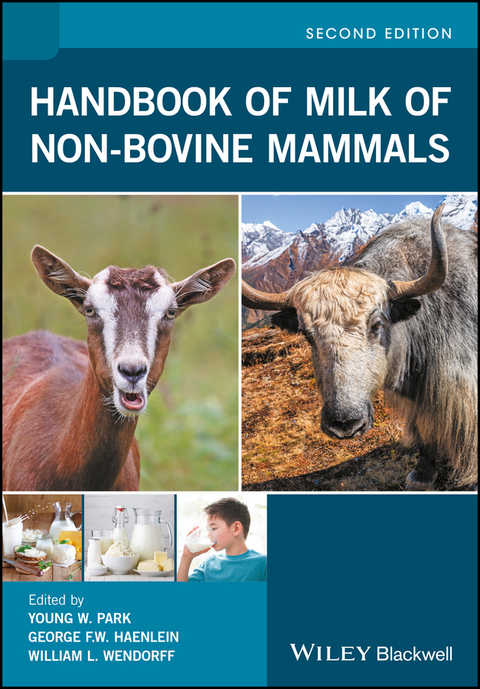
Handbook of Milk of Non-Bovine Mammals (eBook)
John Wiley & Sons (Verlag)
978-1-119-11028-6 (ISBN)
THE ONLY SINGLE-SOURCE GUIDE TO THE LATEST SCIENCE, NUTRITION, AND APPLICATIONS OF ALL THE NON-BOVINE MILKS CONSUMED AROUND THE WORLD
Featuring contributions by an international team of dairy and nutrition experts, this second edition of the popular Handbook of Milk of Non-Bovine Mammals provides comprehensive coverage of milk and dairy products derived from all non-bovine dairy species.
Milks derived from domesticated dairy species other than the cow are an essential dietary component for many countries around the world. Especially in developing and under-developed countries, milks from secondary dairy species are essential sources of nutrition for the humanity. Due to the unavailability of cow milk and the low consumption of meat, the milks of non-bovine species such as goat, buffalo, sheep, horse, camel, Zebu, Yak, mare and reindeer are critical daily food sources of protein, phosphate and calcium. Furthermore, because of hypoallergenic properties of certain species milk including goats, mare and camel are increasingly recommended as substitutes in diets for those who suffer from cow milk allergies. This book:
- Discusses key aspects of non-bovine milk production, including raw milk production in various regions worldwide
- Describes the compositional, nutritional, therapeutic, physio-chemical, and microbiological characteristics of all non-bovine milks
- Addresses processing technologies as well as various approaches to the distribution and consumption of manufactured milk products
- Expounds characteristics of non-bovine species milks relative to those of human milk, including nutritional, allergenic, immunological, health and cultural factors.
- Features six new chapters, including one focusing on the use of non-bovine species milk components in the manufacture of infant formula products
Thoroughly updated and revised to reflect the many advances that have occurred in the dairy industry since the publication of the acclaimed first edition, Handbook of Milk of Non-Bovine Mammals, 2nd Edition is an essential reference for dairy scientists, nutritionists, food chemists, animal scientists, allergy specialists, health professionals, and allied professionals.
ABOUT THE EDITORS:
YOUNG W. PARK, PhD is Senior Professor at the Georgia Small Ruminant Research and Extension Center, Fort Valley State University, Fort Valley, Georgia, and an Emeritus Adjunct Professor in the Department of Food Science and Technology, University of Georgia, Athens, Georgia.
GEORGE F.W. HAENLEIN, PhD is Emeritus Professor at the Department of Animal and Food Sciences, University of Delaware, Newark, Delaware.
WILLIAM L. WENDORFF, PhD is Emeritus Professor at the Wisconsin Center for Dairy Research, the University of Wisconsin-Madison, Madison, Wisconsin.
THE ONLY SINGLE-SOURCE GUIDE TO THE LATEST SCIENCE, NUTRITION, AND APPLICATIONS OF ALL THE NON-BOVINE MILKS CONSUMED AROUND THE WORLD Featuring contributions by an international team of dairy and nutrition experts, this second edition of the popular Handbook of Milk of Non-Bovine Mammals provides comprehensive coverage of milk and dairy products derived from all non-bovine dairy species. Milks derived from domesticated dairy species other than the cow are an essential dietary component for many countries around the world. Especially in developing and under-developed countries, milks from secondary dairy species are essential sources of nutrition for the humanity. Due to the unavailability of cow milk and the low consumption of meat, the milks of non-bovine species such as goat, buffalo, sheep, horse, camel, Zebu, Yak, mare and reindeer are critical daily food sources of protein, phosphate and calcium. Furthermore, because of hypoallergenic properties of certain species milk including goats, mare and camel are increasingly recommended as substitutes in diets for those who suffer from cow milk allergies. This book: Discusses key aspects of non-bovine milk production, including raw milk production in various regions worldwide Describes the compositional, nutritional, therapeutic, physio-chemical, and microbiological characteristics of all non-bovine milks Addresses processing technologies as well as various approaches to the distribution and consumption of manufactured milk products Expounds characteristics of non-bovine species milks relative to those of human milk, including nutritional, allergenic, immunological, health and cultural factors. Features six new chapters, including one focusing on the use of non-bovine species milk components in the manufacture of infant formula products Thoroughly updated and revised to reflect the many advances that have occurred in the dairy industry since the publication of the acclaimed first edition, Handbook of Milk of Non-Bovine Mammals, 2nd Edition is an essential reference for dairy scientists, nutritionists, food chemists, animal scientists, allergy specialists, health professionals, and allied professionals.
ABOUT THE EDITORS: YOUNG W. PARK, PhD is Senior Professor at the Georgia Small Ruminant Research and Extension Center, Fort Valley State University, Fort Valley, Georgia, and an Emeritus Adjunct Professor in the Department of Food Science and Technology, University of Georgia, Athens, Georgia. GEORGE F.W. HAENLEIN, PhD is Emeritus Professor at the Department of Animal and Food Sciences, University of Delaware, Newark, Delaware. WILLIAM L. WENDORFF, PhD is Emeritus Professor at the Wisconsin Center for Dairy Research, the University of Wisconsin-Madison, Madison, Wisconsin.
Handbook of Milk of Non-Bovine Mammals 3
Contents 7
List of Contributors 9
1 Overview of Milk of Non-Bovine Mammals (Second Edition) 11
1 Introduction 11
2 Evolution of the Bovine and Non-bovine Dairy Industry 12
3 Composition and Secretion of Milk of Minor Species 13
4 Features of this Second Edition of Handbook of Milk of Non-Bovine Mammals 14
5 Concluding Remarks 17
References 17
2 Goat Milk 21
2.1 Production of Goat Milk 21
1 Introduction 21
2 Milk Production 26
2.1 Breeds of Goats 26
2.2 Herd Management Systems 37
2.3 Age of Doe, Parity, Lactation Length, Litter Size 39
2.4 Nutrition of Doe 40
2.5 Milking Management Practices 42
2.6 Seasonal Impacts 44
References 45
2.2 Goat Milk – Chemistry and Nutrition 52
1 Introduction 52
2 Nutritional and Chemical Composition of Goat Milk 53
2.1 Basic Nutrient Composition 53
2.2 Lipids 54
2.3 Carbohydrates 61
2.4 Proteins 61
2.5 Polyamines and Nucleotides 73
2.6 Enzymes 76
2.7 Minerals 77
2.8 Vitamins 79
3 Physicochemical Characteristics of Goat Milk 79
3.1 Physicochemical Properties 79
3.2 Micelle Characteristics 80
3.3 Relationship between Physicochemical Properties and Rennetability 81
4 Nutritional Significance of Goat Milk 81
References 84
2.3 Goat Milk Products: Types of Products, Manufacturing Technology, Chemical Composition, and Marketing 94
1 Introduction 94
2 Production of Quality Goat Milk and Products – Regulations 95
3 Particularities of Raw Goat Milk in Relation to Product Manufacture 98
4 Types of Dairy Goat Products – Manufacturing Technologies 101
4.1 Fluid (Beverage) Goat Milk 101
4.2 Goat Milk Cheeses 106
4.3 Fermented Goat Milks 122
4.4 Evaporated and Powdered Goat Milk Products 133
4.5 Fat-Rich Goat Milk Products 135
4.6 Frozen Goat Milk Products 136
4.7 Miscellaneous Goat Milk Products 136
4.8 Sweet Goat Milk Products 137
4.9 Cosmetic Goat Milk Products 137
5 Chemical Composition of Dairy Goat Products 137
5.1 Composition of Various Goat Milk Types 137
5.2 Composition of Goat Milk Yogurt 140
5.3 Composition of Goat Milk Cheeses and Products 141
6 Marketing of Dairy Goat Products and Its Challenges 147
6.1 Marketing Strategies for Goat Milk Products 147
6.2 Promotion for the Growth of the Dairy Goat Industry 148
References 149
2.4 Therapeutic, Hypo-Allergenic and Bioactive Potentials of Goat Milk, and Manifestations of Food Allergy 161
1 Introduction 161
2 Causes of Hypersensitivity and Allergic Responses 162
3 Five Types of Allergic Reactions in the Human Body 163
4 Illustrations of Different Types of Food Sensitivities and Allergies 164
5 Symptoms of Food Allergy in General 165
6 Incidences of Milk and Food Allergies 166
7 Mechanisms of Pathogenesis of Food Allergy 167
7.1 Mechanism of Antigen Absorption by the Intestinal Epithelium 168
7.2 Mechanism of Immune Response by Host Cell (Animal) 169
7.3 Relationship between Food Allergy and Intestinal Permeability 170
8 Clinical Manifestations of Cow Milk Allergy 171
9 Hypoallergenicity of Goat Milk 172
9.1 Hypoallergenic Potentials of Goat Milk in Human Patients 172
9.2 Scientific Research on Hypoallergenic Properties of Goat Milk 173
10 Therapeutic and Nutritional Advantages of Goat Milk 174
10.1 Advantages of Goat Milk in Human Nutrition 174
10.2 Scientific Studies on Therapeutic and Nutritional Merits of Goat Milk 176
11 Recent Findings on Therapeutic and Biologically Active Agents in Goat Milk 177
11.1 Bioactive Peptides in Goat Milk 178
11.2 Polyamines in Goat Milk 179
11.3 Nucleotides and Nucleosides in Goat Milk 180
References 181
3 Sheep Milk 191
3.1 Production of Sheep Milk 191
1 Introduction 191
2 Milk Production 192
2.1 Breeds of Dairy Sheep 192
2.2 Genetic Improvement 199
2.3 Flock Management Systems 202
2.4 Age of Ewe, Parity, Lactation Length, and Litter Size 204
2.5 Nutrition of the Ewe 204
2.6 Milking Management Practices 207
2.7 Seasonal Impacts 213
References 213
3.2 Sheep Milk – Composition and Nutrition 220
1 Gross Composition 220
2 Fat 221
3 Proteins 224
4 Lactose 226
5 Minerals and Vitamins 226
6 Enzymes 227
7 Physicochemical Properties 227
8 Nutritive Value 228
References 228
3.3 Processing of Sheep Milk 232
1 Milk Handling and Quality 232
1.1 Cooling of Milk 232
1.2 Frozen Storage 232
1.3 Aroma and Flavor 234
1.4 Microbiological Concerns 234
1.5 Somatic Cell Counts 236
1.6 Adulteration with Other Species 237
2 Processing of Sheep Milk 238
2.1 Pasteurization 238
2.2 Homogenization 238
2.3 Separation 239
2.4 Concentration 240
2.5 Drying 241
3 Sheep Milk Products 241
3.1 Fluid Milk 241
3.2 Fermented Milks 241
3.3 Butter and Ghee 242
3.4 Ice Cream 244
3.5 Yogurt 244
3.6 Cheese 246
3.7 Whey Products 257
4 Markets for Sheep Milk Products 258
4.1 International 258
4.2 United States 259
References 259
4 Buffalo Milk 271
4.1 Buffalo Milk Production 271
1 Introduction 271
2 Classification of Bovini 272
2.1 Domesticated Buffaloes 273
3 Distribution of Buffaloes 274
4 Breed Characteristics 275
4.1 Murrah 275
4.2 Nili-Ravi 276
4.3 Mehsana 277
4.4 Surti 277
4.5 Zaffarabadi/Jafarabadi 277
4.6 Bhadawari 279
4.7 Nagapuri or Ellichpuri 279
4.8 Pandharpuri/Dharwari 279
4.9 Kalahandi/Peddakimedi 279
4.10 Mandal/Parlakimedi/Ganjam 280
4.11 Jerangi 280
4.12 Toda 280
4.13 Assamese/Mongoor 281
4.14 Buffaloes of the Near East and Europe 281
5 Genetics 281
5.1 Chromosomes 281
5.2 Color 281
5.3 Quantitative Genetics 282
5.4 Blood Groups and Protein Polymorphisms 284
6 Reproduction and Milk Production Traits 284
7 Environmental Physiology 285
8 Nutrition 286
8.1 Dry Matter Intake 286
8.2 Energy Requirements 286
8.3 Protein Requirements 287
8.4 Rumen Digestive Physiology 287
8.5 Water Intake 288
8.6 Environmental Factors 288
8.7 Photoperiod 288
Acknowledgments 289
References 289
4.2 Buffalo Milk Utilization for Dairy Products 294
1 Introduction 294
2 Composition of Buffalo Milk 294
2.1 Fats 294
2.2 Proteins 299
2.3 Lactose 302
2.4 Minerals 302
2.5 Vitamins 303
2.6 Pigments 303
2.7 Enzymes 303
2.8 Other Constituents 303
2.9 Factors Influencing Composition of Buffalo Milk 304
3 Physicochemical Properties 306
4 Microbial Quality of Raw Buffalo Milk 308
5 Buffalo Milk as a Raw Material for Dairy Products 308
6 Market Milk and Related Products 309
7 Fat-Rich Dairy Products 311
7.1 Cream 311
7.2 Butter 311
7.3 Ghee (Clarified Butter Fat) 312
7.4 Sterilized Cream 317
7.5 Cultured Cream 317
7.6 Butteroil 317
7.7 Fractionated Fat 317
7.8 Cream Powder 318
7.9 Butter Powder 318
7.10 Butter Spreads 318
7.11 Malai 318
7.12 Makkhan (Desi/Cooking Butter) 318
8 Concentrated and Dried Milk Products 319
8.1 Concentrated and Dried Milk 319
8.2 Infant Milk Foods 320
8.3 Skim Milk Powder 321
8.4 Some Dehydrated and Formulated Products 322
9 Buffalo Milk Cheeses and Yogurt 324
9.1 Cheddar Cheese 324
9.2 Mozzarella Cheese 327
9.3 Gouda Cheese 330
9.4 Buffalo Milk Swiss Cheese 330
9.5 Cheese Spreads from Buffalo Milk Cheeses 330
9.6 Buffalo Milk Yogurt 332
10 Summary 332
Acknowledgments 332
References 332
4.3 Traditional Indian Dairy Products 353
1 Introduction 353
2 Sweets 355
2.1 Khoa 355
2.2 Chhana 361
2.3 Rasogolla 364
2.4 Sandesh 365
3 Fermented Milk Products 366
3.1 Paneer 366
3.2 Dahi 368
3.3 Shrikhand 369
3.4 Other Fermented Milk Products 372
4 Summary 373
Acknowledgments 373
References 373
5 Mare Milk 379
1 Introduction 379
2 The Dairy Horse 380
2.1 Distribution of Dairy Horses 380
2.2 Breeds 381
3 Milk Production 382
3.1 Milking the Dairy Horse 382
3.2 Production of Mare Milk 383
3.3 Hygienic and Food Quality of Mare Milk 384
4 Dairy Horse Farming 385
4.1 Husbandry and Housing Elements 385
4.2 Feeds and Nutrition 386
4.3 Health Issues 390
5 Composition and Physicochemical Characteristics of Mare Milk 391
5.1 Gross Composition and Physicochemical Parameters 391
5.2 Lipids 393
5.3 Nitrogenous Fraction 398
5.4 Vitamins 402
5.5 Minerals 403
6 Manufacture and Utilization of Mare Milk Products 404
6.1 Fermented Mare Milk 404
6.2 Powdered Mare Milk Products 407
6.3 Frozen and Freeze-Dried Mare Milk 408
6.4 Other Mare Milk Products 409
6.5 Utilization and Beneficial Effects of Mare Milk Products 409
References 411
6 Camel Milk 419
1 Introduction 419
2 Camel Adaptations 421
3 Camel Populations and Distribution 421
4 Milk Yield and Lactation 421
5 Milk Composition 425
5.1 Colostrum 425
5.2 Normal Milk 428
6 Milk Protein Antigenicity 444
7 Immune System in Camel Milk 445
7.1 Specific Protective Proteins 445
7.2 Non-specific Protective Proteins 448
8 Medicinal Properties of Camel Milk 458
9 Lipids 460
9.1 Fat Globule Size and Creaming Properties 460
9.2 Fatty Acid Composition of Milk Fat 461
9.3 Phospholipids 462
9.4 Fat Globule Membrane 463
9.5 Lipid-Soluble Vitamins 463
9.6 Sterols 464
9.7 Milk Fat Constants 464
9.8 Triacylglycerols 465
10 Effects of Heat on Camel Milk Proteins 467
10.1 Low Heat Treatment 467
10.2 High Heat Treatment 467
11 Enzymatic Coagulation of Camel Milk 469
12 Milk Enzymes 470
13 Camel Milk Products 471
13.1 Fermented Milk and Milk Products 471
13.2 Cheese 472
13.3 Butter 473
13.4 Pasteurized Milk 474
13.5 Camel Milk Powder and Dried Milk Products 476
References 477
7 Yak Milk 491
1 Introduction 491
2 Yak Milk Compositions 492
2.1 The Gross Compositions 492
2.2 Proteins 494
2.3 Lipids 504
2.4 Minerals of Yak Milk 506
2.5 Vitamins of Yak Milk 507
3 Physical Characteristics of Yak Milk 507
3.1 Physical Properties 508
3.2 Buffering Capacity 510
3.3 Heat-Induced Coagulation of Yak Milk 512
3.4 The Heat-Induced Acidification of Yak Milk 513
4 Yak Milk Products and Processing Technology 514
4.1 Milk Tea 515
4.2 Butter 515
4.3 Yak Milk Cheese 517
4.4 Other Yak Milk Products 518
References 519
8 Zebu-Brahma and Mithun Milk 525
1 Introduction 525
2 Milk-Producing Zebu Breeds 528
2.1 Gyr Cattle 529
2.2 Guzerat 531
2.3 Zebu Cross-breeds 534
2.4 Milk Quality 536
3 Mithun Milk 539
4 Conclusion 540
References 541
9 Reindeer Milk 545
1 Introduction 545
2 History 546
2.1 Geographical Distribution 546
2.2 Management Regime 547
2.3 Utilization 548
3 Ecology and Life History 549
3.1 Constraints and Management Implications 549
3.2 Lactation Strategy 551
4 Milk Yield 552
4.1 Potential 552
4.2 Actual Yield 553
5 Milk Composition 553
5.1 Protein 555
5.2 Fat 556
5.3 Carbohydrates 556
5.4 Minerals 558
5.5 Vitamins 558
6 Energy Content and Output 558
7 Challenges 559
7.1 New Setting 559
7.2 Milk Ejection 560
7.3 Domestication and Management Regime 561
7.4 Reindeer Products and Their Properties 562
8 Conclusion 562
References 563
10 Sow Milk 569
1 Introduction 569
2 Anatomy of Porcine Mammary Glands 570
2.1 Structure of Mammary Glands 570
2.2 Growth of Mammary Glands 571
2.3 Galactopoiesis and Involution of Mammary Glands 571
3 Secretion of Milk from Mammary Glands and Lactation 573
4 Factors Affecting the Yield of Sow Milk 574
4.1 Maternal Nutrition 574
4.2 Amount of Mammary Tissue 574
4.3 Stage of Lactation 575
4.4 Suckling Frequency 575
4.5 Sow Body Weight and Metabolic State 576
4.6 Litter Size 576
4.7 Ambient Temperature 576
5 Composition of Sow Colostrum and Mature Milk 577
6 Dietary Manipulation on Sow Milk Composition and Productivity 579
7 Utilization of Sow Milk as a Model for Human Nutrition and Health Research 581
8 Conclusions 584
References 585
11 Other Minor Species Milk 589
1 Introduction 589
2 Important Aspects of the Milk Composition of Minor Species 589
3 Comparative Aspects of Lactation and Milk Compositions of Minor Species 591
3.1 Moose 591
3.2 Elk 593
3.3 Musk Ox 594
3.4 Alpaca and Llama 595
3.5 Elephant 597
3.6 Pinnipeds (Seal and Sea Lions) 599
3.7 Polar Bear (Ursus maritimus) 600
4 Differences in Milk Yields of Minor Species 601
5 Chemical Characteristics of Milk from Minor Species 602
6 Minor Species Dairy Products 602
References 603
12 Flavor and Sensory Characteristics of Non-Bovine Species Milk and Their Dairy Products 605
1 Introduction 605
2 Flavor Characteristics of Non-bovine Species of Milk and Their Products 606
2.1 Goat Milk 606
2.2 Goat Cheese 609
2.3 Other Goat Products 612
2.4 Sheep Milk 614
2.5 Other Non-Bovine Mammals 617
3 Sensory Characteristics of Non-Bovine Species of Milk and Their Products 619
3.1 Principles of Sensory Evaluation Techniques 619
3.2 Sensory Languages for Dairy Products Evaluation 621
3.3 Instrumental Techniques for Sensory Analysis 622
3.4 Recent Studies on Sensory Characteristics of Non-Bovine Species Milk and Products 623
4 Conclusions 627
References 627
13 Potential Applications of Non-Bovine Mammalian Milk in Infant Nutrition 635
1 Introduction 635
2 Overview of Infant Formula 637
2.1 Product Types 638
2.2 Formulation Considerations 639
2.3 Manufacture 639
3 Comparison of Bovine, Non-Bovine, and Human Milk 642
3.1 Gross Composition: General Comments 642
3.2 Protein Profile 643
3.3 Lipids 650
3.4 Carbohydrate Profile 652
3.5 Micronutrients 653
4 Outlook and Future Perspectives 656
5 Concluding Remarks 658
References 658
14 Human Milk 665
1 Introduction 665
2 The Current Trend of Human Milk Feeding 667
3 Physiological Changes and Nutritional Needs During Lactogenesis 669
3.1 Energy Needs 670
3.2 Protein Needs 670
3.3 Other Nutrient Needs 671
4 Importance of Breast-Feeding 671
5 Physiology of Milk Secretion 673
5.1 Mammary Glands and Lactogenesis 673
5.2 Milk Secretion and Biochemistry 673
6 Production and Composition of Human Milk 674
6.1 Production of Human Milk 674
6.2 Composition of Human Milk 675
7 Microorganisms in Human Milk 683
8 Alternative Infant Milk Products 684
9 Conclusion 685
References 686
Index 691
Supplemental Images 714
EULA 729
| Erscheint lt. Verlag | 8.5.2017 |
|---|---|
| Sprache | englisch |
| Themenwelt | Naturwissenschaften ► Biologie |
| Technik ► Lebensmitteltechnologie | |
| Weitere Fachgebiete ► Land- / Forstwirtschaft / Fischerei | |
| Schlagworte | Agriculture • alpaca milk • alternatives to cow’s milk • animal agriculture • bear milk human consumption • buffalo milk human consumption • buffalo milk nutrition • Büffelmilch • camel milk human consumption • Dairy Food • Ernährungslehre • Eselsmilch • Food Science & Technology • Gesundheits- u. Sozialwesen • goat milk consumption • goat milk nutrition • goat milk production • Health & Social Care • Kamelmilch • Landwirtschaft • Lebensmittelforschung u. -technologie • llama milk human consumption • mare’s milk health factors • mare’s milk human consumption • Milcherzeugnis • Milchprodukte • non-bovine cheese production • non-bovine human health characteristics • non-bovine milk • non-bovine milk nutrition • non-bovine milk processing • non-bovine milk production • non-bovine milk products • non-bovine milk safety • non-bovine milks allergenic properties • non-bovine milks immunological factors • non-bovine milks microbiological characteristics • non-bovine milks physio-chemical properties • non-bovine milks therapeutic uses • Nutrition • reindeer milk human consumption • Rentiermilch • Schafmilch • Schweinemilch • sheep milk human consumption • sheep milk nutrition • sheep milk production • sow’s milk • Stutenmilch • Tierhaltung • Yakmilch • yak milk human consumption • Zebu • Ziegenmilch |
| ISBN-10 | 1-119-11028-9 / 1119110289 |
| ISBN-13 | 978-1-119-11028-6 / 9781119110286 |
| Informationen gemäß Produktsicherheitsverordnung (GPSR) | |
| Haben Sie eine Frage zum Produkt? |
 PDF (Adobe DRM)
Kopierschutz: Adobe-DRM
Adobe-DRM ist ein Kopierschutz, der das eBook vor Mißbrauch schützen soll. Dabei wird das eBook bereits beim Download auf Ihre persönliche Adobe-ID autorisiert. Lesen können Sie das eBook dann nur auf den Geräten, welche ebenfalls auf Ihre Adobe-ID registriert sind.
Details zum Adobe-DRM
Dateiformat: PDF (Portable Document Format)
Mit einem festen Seitenlayout eignet sich die PDF besonders für Fachbücher mit Spalten, Tabellen und Abbildungen. Eine PDF kann auf fast allen Geräten angezeigt werden, ist aber für kleine Displays (Smartphone, eReader) nur eingeschränkt geeignet.
Systemvoraussetzungen:
PC/Mac: Mit einem PC oder Mac können Sie dieses eBook lesen. Sie benötigen eine
eReader: Dieses eBook kann mit (fast) allen eBook-Readern gelesen werden. Mit dem amazon-Kindle ist es aber nicht kompatibel.
Smartphone/Tablet: Egal ob Apple oder Android, dieses eBook können Sie lesen. Sie benötigen eine
Geräteliste und zusätzliche Hinweise
Buying eBooks from abroad
For tax law reasons we can sell eBooks just within Germany and Switzerland. Regrettably we cannot fulfill eBook-orders from other countries.
aus dem Bereich