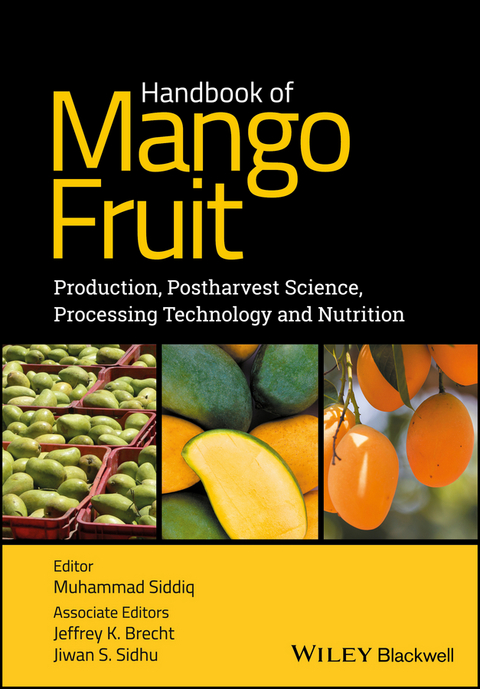
Handbook of Mango Fruit (eBook)
John Wiley & Sons (Verlag)
978-1-119-01438-6 (ISBN)
Written by noted experts in the field, Handbook of Mango Fruit: Production, Postharvest Science, Processing Technology and Nutrition offers a comprehensive resource regarding the production, trade, and consumption of this popular tropical fruit. The authors review the geographic areas where the fruit is grown and harvested, including information on the ever-expanding global marketplace that highlights United States production, imports and exports, and consumption, as well as data on the outlook for the European market.
Handbook of Mango Fruit outlines the postharvest handling and packaging techniques and reviews the fruit's processed products and byproducts that are gleaned from the processing of waste. The authors include information on the nutritional profile of the mango and review the food safety considerations for processing and transport of mangoes. This comprehensive resource:
- Reviews global mango production trends and countries that are the major exporters and importers of mangoes
- Explores the burgeoning marketplace for mangoes with special emphasis on the US and European marketplace
- Assesses latest trends in packaging of and shipping of mangoes
- Provides in depth coverage on value-added processing and by-products utilization
- Offers vital information on the innovative processing technologies and nutritional profile of popular tropical fruit
Written for anyone involved in the production, marketing, postharvest handling, processing and by-products of mangoes, Handbook of Mango Fruit is a vital resource offering the most current information and guidelines on the burgeoning marketplace as well as the safe handling, production, and distribution of mangoes.
MUHAMMAD SIDDIQ, PhD, is Associate Professor in the Department of Food Science and Human Nutrition, Michigan State University, East Lansing, USA.
JEFFREY K. BRECHT, PhD, is Professor of Horticultural Sciences Department, University of Florida, Gainesville, USA.
JIWAN S. SIDHU, PhD, is Professor and Director of Master's Program in Food Science & Nutrition, Department of Food Science and Nutrition, Kuwait University, Kuwait.
Written by noted experts in the field, Handbook of Mango Fruit: Production, Postharvest Science, Processing Technology and Nutrition offers a comprehensive resource regarding the production, trade, and consumption of this popular tropical fruit. The authors review the geographic areas where the fruit is grown and harvested, including information on the ever-expanding global marketplace that highlights United States production, imports and exports, and consumption, as well as data on the outlook for the European market. Handbook of Mango Fruit outlines the postharvest handling and packaging techniques and reviews the fruit s processed products and byproducts that are gleaned from the processing of waste. The authors include information on the nutritional profile of the mango and review the food safety considerations for processing and transport of mangoes. This comprehensive resource: Reviews global mango production trends and countries that are the major exporters and importers of mangoes Explores the burgeoning marketplace for mangoes with special emphasis on the US and European marketplace Assesses latest trends in packaging of and shipping of mangoes Provides in depth coverage on value-added processing and by-products utilization Offers vital information on the innovative processing technologies and nutritional profile of popular tropical fruit Written for anyone involved in the production, marketing, postharvest handling, processing and by-products of mangoes, Handbook of Mango Fruit is a vital resource offering the most current information and guidelines on the burgeoning marketplace as well as the safe handling, production, and distribution of mangoes.
MUHAMMAD SIDDIQ, PhD, is Associate Professor in the Department of Food Science and Human Nutrition, Michigan State University, East Lansing, USA. JEFFREY K. BRECHT, PhD, is Professor of Horticultural Sciences Department, University of Florida, Gainesville, USA. JIWAN S. SIDHU, PhD, is Professor and Director of Master's Program in Food Science & Nutrition, Department of Food Science and Nutrition, Kuwait University, Kuwait.
Cover 1
Title Page 5
Copyright 6
Contents 7
Preface 9
List of Contributors 11
Chapter 1 Mango Production, Global Trade, Consumption Trends, and Postharvest Processing and Nutrition 15
1.1 Introduction 15
1.2 Mango Production, Trade, and Consumption 16
1.2.1 Area Harvested and World Production 16
1.2.2 Global trade – Exports and Imports 17
1.2.3 US Production 19
1.2.4 US Imports and Exports 19
1.2.5 US Consumption 22
1.2.6 European Union Market 23
1.2.7 Market Outlook 23
1.3 Postharvest Handling and Packaging 24
1.4 Processed Products 26
1.5 By-products from Processing Waste 26
1.6 Food Safety Considerations 28
1.7 Nutritional Profile 28
References 28
Chapter 2 Mango Production 31
2.1 Introduction 31
2.2 Cultivar Diversity and Potential 31
2.3 Breeding and Propagation 35
2.3.1 Breeding 35
2.3.2 Propagation 35
2.4 Field Practices 37
2.4.1 Environmental Requirements 38
2.4.1.1 Elevation 38
2.4.1.2 Temperature 38
2.4.1.3 Rainfall 38
2.4.1.4 Soil 39
2.4.1.5 Light 39
2.4.2 Planting 39
2.4.3 Irrigation 39
2.4.4 Fertilization 39
2.4.5 Pruning 40
2.4.6 Pollination 40
2.4.7 Fruit Thinning 41
2.4.8 Fruit Bagging 41
2.4.9 Harvesting 41
2.4.10 Off-season Mango Production 41
2.5 Biotic and Abiotic Stresses 42
2.5.1 Biotic Stress 42
2.5.1.1 Plant Pathogens 42
2.5.1.2 Insects 42
2.5.1.3 Weeds 42
2.5.2 Abiotic Stress 42
2.5.2.1 Temperature 42
2.5.2.2 Drought 42
2.5.2.3 Floods 42
2.5.2.4 Wind 43
2.5.2.5 Fire 43
2.5.2.6 Nutrient Disorders 43
2.6 Good Agricultural Practices (GAPs) 43
2.7 Organic Mango Farming and Marketing 43
2.8 Biotechnological Innovations 44
2.9 Research Needs and Future Prospects 44
References 45
Chapter 3 Biology, Postharvest Physiology, and Biochemistry of Mango 51
3.1 Introduction 51
3.2 Botanical Description 51
3.2.1 Mango Tree 52
3.2.2 Mango Fruit 53
3.3 Tree and Fruit Growth and Development 54
3.3.1 Factors Affecting Tree and Fruit Development 54
3.3.1.1 Temperature 54
3.3.1.2 Relative Humidity and Rainfall 55
3.3.1.3 Water 55
3.3.1.4 Soil 56
3.3.1.5 Mineral Nutrition 56
3.3.1.6 Light 58
3.3.1.7 Wind 58
3.3.1.8 Growth Regulators and other Treatments 58
3.4 Fruit Ripening 58
3.4.1 Physiology and Biochemistry of Mango Ripening 58
3.4.2 Role of Ethylene and other Hormones 58
3.4.3 Compositional Changes during Fruit Growth and Maturity 59
3.4.3.1 Proximate/Nutritional 60
3.4.3.2 Phytochemicals and Antioxidants 61
3.4.4 Harvesting Indices 62
3.5 Fruit Quality Disorders 64
3.5.1 Spongy Tissue 64
3.5.1.1 Control Strategies 64
3.5.2 Jelly Seed 64
3.5.2.1 Control Strategies 64
3.5.3 Soft Nose 64
3.5.3.1 Control Strategies 64
3.5.4 Internal Necrosis 65
3.5.4.1 Control Strategies 65
3.5.5 Fruit Pitting 65
3.5.5.1 Control Strategies 65
3.5.6 Black Tip 65
3.5.6.1 Control Strategies 65
3.5.7 Fruit Drop 66
3.5.7.1 Control Strategies 66
3.5.8 Mango Malformation 66
3.5.8.1 Control Strategies 66
3.5.9 Clustering in Mango (Jhumka) 66
3.5.9.1 Control Strategies 66
3.5.10 Biennial Bearing 67
3.5.10.1 Control Strategies 67
3.5.11 Fruit Splitting 67
3.5.11.1 Control Strategies 67
3.5.12 Lenticel Discoloration 67
3.5.12.1 Control Strategies 67
3.5.13 Chilling Injury (CI) 68
3.5.13.1 Control Strategies 68
3.5.14 CO2 Injury 68
3.5.14.1 Control Strategies 68
3.6 Conclusions 68
References 69
Chapter 4 Pests of Mango 75
4.1 Introduction 75
4.2 Mites 75
4.3 Insects 76
4.3.1 Hemipterans 76
4.3.1.1 White and Black Flies 76
4.3.1.2 Leafhoppers 76
4.3.2 Scales 77
4.3.2.1 Armored Scales 77
4.3.2.2 Soft Scales 77
4.3.3 Mealybugs 77
4.3.4 Thrips 78
4.3.5 Diptera 78
4.3.6 Fruit Flies 79
4.3.6.1 Anastrepha 80
4.3.6.2 Bactrocera 81
4.3.6.3 Ceratitis 81
4.3.7 Fruit Fly Control 81
4.3.7.1 Monitoring 82
4.3.7.2 Chemical Control 84
4.3.7.3 Biological Control 85
4.3.7.3.1 Parasitoids 85
4.3.7.3.2 Insect Pathogens 86
4.3.7.3.3 Predators 86
4.3.7.4 Cultural Control 87
4.3.7.5 Host Resistance 87
4.3.7.6 Sterile Insect Technique 88
4.3.8 Coleoptera 88
4.3.8.1 Mango Seed Weevils 88
4.3.8.2 Ambrosia Beetles 89
4.4 Control Strategies 89
4.4.1 Selective Pesticides 90
4.4.2 Biological Control 90
4.4.3 Host Plant Resistance 90
4.4.4 Pheromones and Trapping Devices 90
4.4.5 Cultural and Physical Control 90
References 91
Chapter 5 Mango Pathology and Diseases 105
5.1 Introduction 105
5.2 Anthracnose 105
5.3 Powdery Mildew 107
5.4 Mango Malformation Disease 108
5.5 Mango Bacterial Canker 110
5.6 Dieback and Stem-end Rot 111
5.7 Mango Wilt or Mango Blight 113
References 114
Chapter 6 Harvesting and Postharvest Technology of Mango 119
6.1 Introduction 119
6.2 Harvest Maturity Indices 119
6.2.1 Fruit Development Period 121
6.2.2 Fruit Shape 121
6.2.3 External and Internal Color 122
6.2.4 Dry Matter Content 123
6.2.5 Combined Indices 123
6.3 Harvesting Practices 124
6.3.1 Fruit Bagging 124
6.3.2 Harvest Management 124
6.3.3 Harvest Aids 124
6.3.4 Mechanical Harvesting 124
6.3.5 Latex (sap) Staining and Control 125
6.3.6 Fruit Transport to the Packinghouse 126
6.4 Fruit Grades and Standards 126
6.4.1 Export Market Mangoes 127
6.4.2 Establishment of a Quality Control System 129
6.5 Field and Packinghouse Sanitation 130
6.6 Postharvest Handling 130
6.6.1 Handling at the Packinghouse 131
6.6.2 Sizing and Grading 131
6.6.3 Waxing 132
6.6.4 Packing 132
6.6.5 Palletizing 133
6.6.6 Cooling 133
6.7 Storage and Transport Technologies 134
6.7.1 Storage 134
6.7.2 Modified and Controlled Atmospheres (MA and CA) 135
6.7.3 Ripening 136
6.7.4 Transport 137
6.8 Quarantine Treatments for Insects 138
6.8.1 Hot Air Treatment 138
6.8.2 Hot Water Treatment 138
6.8.3 Irradiation 139
6.9 Nutritional and Quality Losses 139
6.10 Future Research Needs 140
References 141
Chapter 7 Packaging of Fresh Mangoes and Processed Mango Products 145
7.1 Introduction 145
7.2 Current Packaging Systems 146
7.2.1 Packaging of Fresh Mangoes (Bulk/Retail) 146
7.2.1.1 General Considerations for Fruit Packaging 146
7.2.1.2 Packaging ? Labeling and Phytosanitary Regulations 147
7.2.2 Bulk Shipment by Air, Sea, and Land 148
7.2.3 Packaging of Fresh?cut Mango 149
7.2.4 Packaging of Processed Mango Products 151
7.2.4.1 Mango Juice, Nectar, and Beverage 151
7.2.4.2 Canned Mango Slices, Chunks, and Pulp 151
7.2.4.3 Mango Products in Glass Containers 153
7.2.4.4 Frozen and Dried Mango Product 154
7.2.4.5 Mango Chunks in Syrup in Plastic Packages 155
7.3 Innovative Packaging Technologies 155
7.3.1 Modified Atmosphere Packaging (MAP) 155
7.3.2 Active Packaging 157
7.3.2.1 Ethylene Controllers 157
7.3.2.2 Scavengers (CO2 and O2) 157
7.3.2.3 Antimicrobial Substances 158
7.3.2.4 Edible Films 158
7.3.3 Intelligent Packaging 159
7.4 Future Directions 159
References 160
Chapter 8 Processing and Quality of Fresh-cut Mangoes 165
8.1 Introduction 165
8.2 Mango Fruit and Postharvest Handling 166
8.2.1 Fruit Characteristics 166
8.2.2 Postharvest Handling 166
8.2.2.1 Pre-treatments 167
8.2.2.2 Washing and Sanitation 168
8.3 Processing of Fresh-cut Mangoes 168
8.3.1 Preservation Methods 169
8.3.1.1 Dipping Treatments 170
8.3.1.2 Edible Coatings 170
8.3.1.3 Physical and Combined Treatments 171
8.3.1.4 Storage and Packaging 171
8.4 Quality Attributes of Fresh-Cut Mangoes 173
8.4.1 Physical Attributes 173
8.4.1.1 Color 173
8.4.1.2 Texture/Firmness 173
8.4.1.3 Flavor 174
8.4.2 Bioactive Compounds 175
8.4.2.1 Phenolic Compounds 175
8.4.2.2 Carotenoids 176
8.5 Conclusions and Future Trends 177
Acknowledgments 177
References 178
Chapter 9 Innovative Processing Technologies for Mango Products 183
9.1 Introduction 183
9.2 High Pressure Processing (HPP) 184
9.2.1 Effect of HPP on Nutrients 184
9.2.2 Effect of HPP on Microbial Inactivation 184
9.2.3 Effect of HPP on Enzymes 186
9.2.4 Effect of HPP on pH, Acidity, and Soluble Solids 187
9.2.5 Effect of HPP on Rheological Properties 187
9.2.6 Effect of HPP on Color and Sensory Properties 188
9.2.7 HPP as a Quarantine Method 189
9.3 Pulsed Electric Field (PEF) 190
9.3.1 Effect of PEF on Microbial Inactivation 190
9.3.3 PEF as Pre-treatment for Osmotic Dehydration 191
9.4 Ultraviolet Radiation (UV) 191
9.4.1 Effect of UV-C Radiation on Microbial Inactivation 192
9.4.2 Effect of UV-C Radiation on Enzymes 193
9.4.3 Effect of UV-C Radiation on Color 193
9.4.4 Effect of UV-C Radiation on Shelf Life and Nutrients 193
9.4.5 UV-C as Postharvest Treatment for Mangoes 193
9.4.6 UV-C Application in Fresh-cut Mangoes 194
9.5 Ultrasound Treatment 194
9.5.1 Ultrasound Processing for Mango Products 194
9.5.2 Ultrasonic as a Nondestructive Quality Technique 195
9.6 Irradiation Treatment 195
9.6.1 Effect of Irradiation on Texture of the Mango Fruit 195
9.6.2 Effect of Irradiation on Mango Pulp Rheology 196
9.6.3 Effect of Irradiation on Enzyme Activity 196
9.6.4 Effect of Irradiation on Microbial Inactivation and Pests 197
9.6.5 Effect of Irradiation on Nutrients 197
9.6.6 Effect of Irradiation on Physical Appearance 198
9.7 Machine Vision – Computer Vision System (CVS) 198
9.7.1 CVS for Grading/Sorting of Mangoes 199
9.7.2 CVS for Measuring Maturity/Ripening 199
9.7.3 CVS for Measuring Sweetness 201
9.7.4 CVS for Measuring Degree of Browning 202
9.7.5 CVS for Measuring Mass/Weight 202
9.8 Other Innovative Processing Technologies 202
9.8.1 Cold Atmospheric Plasma Processing (CAPP) 202
9.8.2 Ozone Pre-Treatment to Increase Shelf Life 202
9.9 Future Research Trends 203
References 203
Chapter 10 Mango Processing and Processed Products 209
10.1 Introduction 209
10.2 Processed Mango Products 209
10.2.1 Mango Puree and Pulp 210
10.2.2 Mango Juice and Juice Concentrate 213
10.2.3 Mango Nectar 215
10.2.4 Aseptically?packaged Mango Beverages and Squash 216
10.2.5 Dried Mango Products 218
10.2.5.1 Mango Slices/Dices and Chips 218
10.2.5.2 Mango Chips and Flakes 220
10.2.5.3 Mango Leather 221
10.2.5.4 Mango Powder 221
10.2.5.4.1 Spray Drying 222
10.2.5.4.2 Foam-mat Drying 222
10.2.5.4.3 Freeze Drying 223
10.2.5.4.4 Cabinet Drying 224
10.2.6 Frozen Mango Products 224
10.2.7 Other Products 224
10.2.7.1 Mango 224
10.2.7.2 Mango Chutney 224
10.2.7.3 Mango Jam and Jelly 224
10.3 Utilization of Mango Processing Waste 225
10.4 Nutritional Composition and Health Benefits 225
10.5 Summary 226
References 227
Chapter 11 Composition and Nutritional Properties of Mangoes 231
11.1 Introduction 231
11.2 Composition and Nutrition 231
11.2.1 Carbohydrates, Pectin, and Titratable Acidity 233
11.2.2 Antioxidant Compounds in Mango 235
11.2.3 Polyphenolics and Dietary Fiber 236
11.3 Changes during Fruit Ripening 237
11.3.1 Aroma Volatiles Production 238
11.3.2 Retention of Antioxidant Compounds 238
11.4 Changes during Fruit Processing 239
11.4.1 Pulp, Nectar, Juice, and Dried Mangoes 239
11.4.2 Fresh?cut Mangoes 241
11.4.3 High Hydrostatic Pressure (HHP) Processing 241
11.5 Health Benefits and Medicinal Uses 242
11.6 Functional Foods from Mango 243
11.7 Chemical Composition of Mango By-products 243
11.8 Future Research Needs 244
References 244
Chapter 12 Phytochemical Compounds in Functional Properties of Mangoes 251
12.1 Introduction 251
12.2 Phytochemical Compounds in Mango 251
12.2.1 Mango Pulp 253
12.2.2 Mango Peel 254
12.2.3 Mango Kernel 255
12.2.4 Mango Leaves and Bark 256
12.3 Flavonoids in Mango 257
12.4 Pigments in Mango 257
12.5 Functional Properties and Health Benefits 258
12.5.1 Anti?parasitic Activities 258
12.5.2 Antimicrobial Activity 258
12.5.3 Antitumor Activity 259
12.5.4 Anti?hyperlipidemic and Antidiabetic Activity 260
12.5.5 Analgesic and Anti?inflammatory Activity 260
12.5.6 Immuno?modulatory Effects 260
12.5.7 Antipyretic and Anti?allergic Activity 261
12.5.8 Hepatoprotective Activity 261
12.6 Future Research Needs 261
References 262
Chapter 13 Microbiology of Fresh Mangoes and Processed Products 269
13.1 Introduction 269
13.2 Microbiology of Fresh and Minimally processed Mango 269
13.2.1 Microflora of Whole Fresh Mangoes 269
13.2.2 Microflora of Minimally processed Mango Fruit 270
13.2.3 Microflora of Processed Mango Products 271
13.3 Factors Affecting Microbial Quality and Safety 271
13.3.1 Pre?harvest Factors, Postharvest Handling, and Processing 272
13.3.2 Mango Fruit Spoilage 273
13.3.3 Mango Fruit Safety Issues and HACCP 275
13.4 Maintaining Microbial Quality 280
13.4.1 Temperature 280
13.4.2 Relative Humidity 280
13.4.3 Control of Respiration and Ethylene Production 281
13.4.4 Irradiation 281
13.4.5 Packaging 281
13.4.6 Application of Biocontrol Agents 282
13.4.7 Nanomaterial?based Processing, Preservation, and Packaging 282
13.5 Methods to Evaluate Microbial Quality 283
13.5.1 PCR?based Assays 283
13.5.2 Spectroscopy/Spectrometric Techniques 284
13.5.2.1 Fourier Transform–Infra?red Spectroscopy (FT?IRS) 284
13.5.2.2 Liquid/Gas Chromatography?Mass Spectrometry (LC/GC?MS) 285
13.6 Predictive Microbiology 285
13.7 Future Research Needs 286
References 286
Chapter 14 Value-added Processing and Utilization of Mango By-products 293
14.1 Introduction 293
14.1.1 Waste Generation and Impact on the Environment 293
14.2 Value-added Processing of Mango Waste 294
14.2.1 Mango Peel 294
14.2.2 Mango Seed Kernel 295
14.2.3 Mango Seed Kernel Oil 297
14.2.4 Fiber Extraction 298
14.2.5 Modified Cellulose and Hemicellulose 299
14.2.6 Pectin 299
14.2.7 Starch 299
14.2.8 Enzymes Production 300
14.2.8.1 Cellulolytic Enzymes 300
14.2.8.2 Pectic Enzymes 300
14.2.9 Single?cell Protein (SCP) 301
14.2.10 Antioxidants and Bioactive Compounds 301
14.2.11 Ethanol Production 302
14.2.12 Other Products 302
14.2.12.1 Lactic Acid Production 302
14.12.2.2 Alcoholic Fermentation 302
14.12.2.3 Biogas Production 303
14.12.2.4 Antimicrobial Compounds 303
14.12.2.5 Activated Carbon 303
14.3 Summary 303
References 303
Index 309
EULA 323
| Erscheint lt. Verlag | 5.6.2017 |
|---|---|
| Mitarbeit |
Stellvertretende Herausgeber: Jeffrey K. Brecht, Jiwan S. Sidhu |
| Sprache | englisch |
| Themenwelt | Naturwissenschaften ► Biologie |
| Technik ► Lebensmitteltechnologie | |
| Weitere Fachgebiete ► Land- / Forstwirtschaft / Fischerei | |
| Schlagworte | Agriculture • byproducts from processing waste from mango fruit • consumption of mango fruit • cooling mango fruit • crops • Feldfrüchte • food safety considerations mango fruit • Food Science & Technology • Fruit & Vegetable • Functional Food • Functional Food, Nutraceuticals • Functional Foods & Nutraceuticals • global trade of mango fruit • guide to processing technology of mango fruit • guide to the nutrition of mango fruit • guide to the postharvest science of mango fruit • Guide to the production of mango fruit • Handbook of Mango Fruit • handling mango fruit at the destination • handling mango fruit at the retail market • Jeffrey K. Brecht • Jiwan S. Sidhu • Landwirtschaft • Lebensmittelforschung u. -technologie • Mango • Mangobaum • Muhammad Siddiq • nutritional profile of mango fruit • Obst • Obst u. Gemüse • processed mango products • shelf life of mango fruit • subtropical fruits and mangoes • technological developments of mango fruit • transportation of mango fruit |
| ISBN-10 | 1-119-01438-7 / 1119014387 |
| ISBN-13 | 978-1-119-01438-6 / 9781119014386 |
| Informationen gemäß Produktsicherheitsverordnung (GPSR) | |
| Haben Sie eine Frage zum Produkt? |
 PDF (Adobe DRM)
Kopierschutz: Adobe-DRM
Adobe-DRM ist ein Kopierschutz, der das eBook vor Mißbrauch schützen soll. Dabei wird das eBook bereits beim Download auf Ihre persönliche Adobe-ID autorisiert. Lesen können Sie das eBook dann nur auf den Geräten, welche ebenfalls auf Ihre Adobe-ID registriert sind.
Details zum Adobe-DRM
Dateiformat: PDF (Portable Document Format)
Mit einem festen Seitenlayout eignet sich die PDF besonders für Fachbücher mit Spalten, Tabellen und Abbildungen. Eine PDF kann auf fast allen Geräten angezeigt werden, ist aber für kleine Displays (Smartphone, eReader) nur eingeschränkt geeignet.
Systemvoraussetzungen:
PC/Mac: Mit einem PC oder Mac können Sie dieses eBook lesen. Sie benötigen eine
eReader: Dieses eBook kann mit (fast) allen eBook-Readern gelesen werden. Mit dem amazon-Kindle ist es aber nicht kompatibel.
Smartphone/Tablet: Egal ob Apple oder Android, dieses eBook können Sie lesen. Sie benötigen eine
Geräteliste und zusätzliche Hinweise
Buying eBooks from abroad
For tax law reasons we can sell eBooks just within Germany and Switzerland. Regrettably we cannot fulfill eBook-orders from other countries.
aus dem Bereich