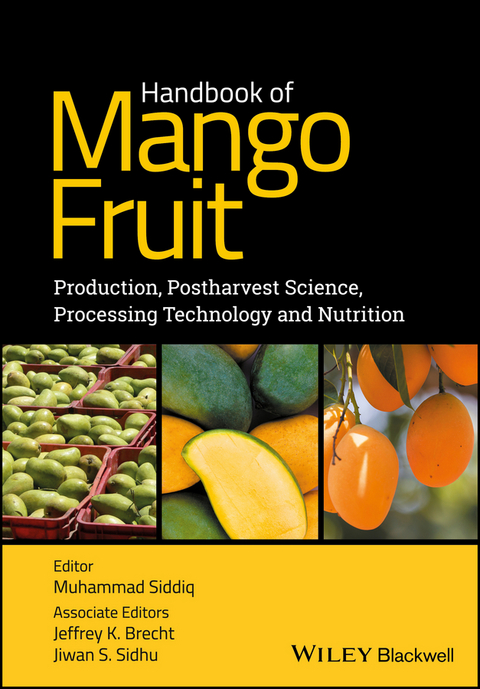
Handbook of Mango Fruit (eBook)
John Wiley & Sons (Verlag)
978-1-119-01437-9 (ISBN)
Written by noted experts in the field, Handbook of Mango Fruit: Production, Postharvest Science, Processing Technology and Nutrition offers a comprehensive resource regarding the production, trade, and consumption of this popular tropical fruit. The authors review the geographic areas where the fruit is grown and harvested, including information on the ever-expanding global marketplace that highlights United States production, imports and exports, and consumption, as well as data on the outlook for the European market.
Handbook of Mango Fruit outlines the postharvest handling and packaging techniques and reviews the fruit's processed products and byproducts that are gleaned from the processing of waste. The authors include information on the nutritional profile of the mango and review the food safety considerations for processing and transport of mangoes. This comprehensive resource:
- Reviews global mango production trends and countries that are the major exporters and importers of mangoes
- Explores the burgeoning marketplace for mangoes with special emphasis on the US and European marketplace
- Assesses latest trends in packaging of and shipping of mangoes
- Provides in depth coverage on value-added processing and by-products utilization
- Offers vital information on the innovative processing technologies and nutritional profile of popular tropical fruit
Written for anyone involved in the production, marketing, postharvest handling, processing and by-products of mangoes, Handbook of Mango Fruit is a vital resource offering the most current information and guidelines on the burgeoning marketplace as well as the safe handling, production, and distribution of mangoes.
MUHAMMAD SIDDIQ, PhD, is Associate Professor in the Department of Food Science and Human Nutrition, Michigan State University, East Lansing, USA.
JEFFREY K. BRECHT, PhD, is Professor of Horticultural Sciences Department, University of Florida, Gainesville, USA.
JIWAN S. SIDHU, PhD, is Professor and Director of Master's Program in Food Science & Nutrition, Department of Food Science and Nutrition, Kuwait University, Kuwait.
Written by noted experts in the field, Handbook of Mango Fruit: Production, Postharvest Science, Processing Technology and Nutrition offers a comprehensive resource regarding the production, trade, and consumption of this popular tropical fruit. The authors review the geographic areas where the fruit is grown and harvested, including information on the ever-expanding global marketplace that highlights United States production, imports and exports, and consumption, as well as data on the outlook for the European market. Handbook of Mango Fruit outlines the postharvest handling and packaging techniques and reviews the fruit s processed products and byproducts that are gleaned from the processing of waste. The authors include information on the nutritional profile of the mango and review the food safety considerations for processing and transport of mangoes. This comprehensive resource: Reviews global mango production trends and countries that are the major exporters and importers of mangoes Explores the burgeoning marketplace for mangoes with special emphasis on the US and European marketplace Assesses latest trends in packaging of and shipping of mangoes Provides in depth coverage on value-added processing and by-products utilization Offers vital information on the innovative processing technologies and nutritional profile of popular tropical fruit Written for anyone involved in the production, marketing, postharvest handling, processing and by-products of mangoes, Handbook of Mango Fruit is a vital resource offering the most current information and guidelines on the burgeoning marketplace as well as the safe handling, production, and distribution of mangoes.
MUHAMMAD SIDDIQ, PhD, is Associate Professor in the Department of Food Science and Human Nutrition, Michigan State University, East Lansing, USA. JEFFREY K. BRECHT, PhD, is Professor of Horticultural Sciences Department, University of Florida, Gainesville, USA. JIWAN S. SIDHU, PhD, is Professor and Director of Master's Program in Food Science & Nutrition, Department of Food Science and Nutrition, Kuwait University, Kuwait.
Preface vii
List of Contributors ix
1 Mango Production, Global Trade, Consumption Trends, and Postharvest Processing and Nutrition 1
Edward A. Evans, Fredy H. Ballen and Muhammad Siddiq
2 Mango Production 17
Chantalak Tiyayon and Robert E. Paull
3 Biology, Postharvest Physiology, and Biochemistry of Mango 37
Maria Gloria Lobo and Jiwan S. Sidhu
4 Pests of Mango 61
Daniel Carrillo, Andrea Birke, Larissa Guillen and J.E. Peña
5 Mango Pathology and Diseases 91
Andressa de Souza-Pollo and Antonio de Goes
6 Harvesting and Postharvest Technology of Mango 105
Jeffrey K. Brecht and Elhadi M. Yahia
7 Packaging of Fresh Mangoes and Processed Mango Products 131
Aman Ullah Malik, Farihah Siddiq and Muhammad Siddiq
8 Processing and Quality of Fresh-cut Mangoes 151
Blanca Salinas-Roca, Jorge Welti-Chanes, Olga Martin-Belloso and Robert Soliva-Fortuny
9 Innovative Processing Technologies for Mango Products 169
Deepti Salvi, Ender Arserim and Mukund Karwe
10 Mango Processing and Processed Products 195
Muhammad Siddiq, Dalbir S. Sogi and Sunisa Roidoung
11 Composition and Nutritional Properties of Mangoes 217
Tasleem A. Zafar and Jiwan S. Sidhu
12 Phytochemical Compounds in Functional Properties of Mangoes 237
Yearul Kabir, Hossain Uddin Shekhar and Jiwan S. Sidhu
13 Microbiology of Fresh Mangoes and Processed Products 255
Anu Kalia and Rajinder P. Gupta
14 Value-added Processing and Utilization of Mango By-products 279
Poonam Aggarwal, Amarjeet Kaur and Suresh Bhise
Index 295
Chapter 1
Mango Production, Global Trade, Consumption Trends, and Postharvest Processing and Nutrition
Edward A. Evans1, Fredy H. Ballen1 and Muhammad Siddiq2
1Center for Tropical Agriculture, University of Florida, IFAS, Homestead, Florida, USA
2Department of Food Science and Human Nutrition, Michigan State University, East Lansing, Michigan,, USA
1.1 Introduction
In terms of production, mangoes, pineapples, papayas, and avocados are considered the major tropical fruits, while lychees, durian, rambutan, guavas, and passion fruits are among the minor ones. Out of global production of the major tropical fruits, mangoes accounted for more than half of the total production in 2012, followed at a distance by pineapples, papayas, and avocados, with shares of 28.36, 15.08, and 5.33%, respectively (FAO 2015). It is to be noted that the FAO reports mango, mangosteen, and guava production and trade as one aggregated category. There are over a thousand different varieties of mangoes, giving rise to various shapes, sizes, colors, texture, and nutritional properties. The fruit is considered to be one of the most consumed fresh fruits in the world, with production taking place in more than 100 countries. However, despite its nutritional value, popularity in developed countries, and tremendous potential for export revenues in many developing countries, only a relatively small portion of the produce enters into international trade; the bulk of production is consumed in the producing country. In 2013, for example, less than 4% of global mango production reached international markets. The USA and Europe are the leading importers of mangoes and have shown steady increases in the volume of fruit absorbed over the past few years.
In recent years, since the mango fruit has made its way into mainstream market outlets in most of the developed countries and is available all year round, it is no longer classified as exotic. The year-round availability of the fruit is attributed to several factors. These include the fact that the fruit is grown under diverse climatic conditions, which allows harvesting throughout the year, and improvements in transportation, market access, preharvest production practices, and postharvest treatment allow the crop to be shipped over long distances, while remaining relatively free of pests and diseases. Demand for the fruit is also on the rise, as more health conscious consumers incorporate the fruit in their diet based on its nutritional value.
Although mangoes no longer command the high prices associated with exotic fruits and with its past scarcity on the international market, prices have not declined substantially. A likely explanation for the relative buoyancy of prices is due to promotional and consumer educational activities, which have had the effect of increasing the overall demand for the fruit despite increases in supply. Notwithstanding, prices of the fruit vary considerably depending on variety, source of origin, and time of the year.
This chapter gives an overview of mango fruit world production, exports, and imports, consumption trends, postharvest storage, processing, nutritional quality, and food safety aspects.
1.2 Mango Production, Trade, and Consumption
1.2.1 Area Harvested and World Production
The global area of mangoes harvested in 2013 was 5.41 million hectares, an increase of about 52% as compared to that in 2000 (Figure 1.1). Given the expansion in the harvested area, global production of mangoes have also increased, growing from 24.71 million metric tons (MMT) in 2000 to 42.66 MMT in 2013, which represented an increase of about 73%. Since 2010, the area harvested and production have shown an increase of 8.95% and 14.62%, respectively. It is noted that the majority of the increase in production since 2010 has been due to corresponding increase in area harvested (52%) versus improvements in yield per unit area (14%).
Figure 1.1 World mango production and area harvested (2000–2013).
Source: FAO (2015).
Mangoes are grown under very diverse climatic conditions, in tropical and subtropical regions. Asia is the dominant producing region, with over 77.17%, based on the 2013 production figures, followed by the Americas and the Caribbean (12.22%), Africa (10.50%), and Oceania (0.11%) (FAO 2015). Because of the wide distribution of the growing regions, these fruits are produced in 115 countries, with the vast majority being developing economies. Table 1.1 shows the leading mango producing countries for selected years from 2000 to 2013. Although the fruit is produced in over 100 countries, the data provided in Table 1.1 indicate that the bulk of production is highly concentrated, with 10 countries accounting for 82.06% of the total production in 2013, and since 2000 this share has remained fairly stable at or above 80%. India is by far the largest producer, accounting for 42.19% (18.00 MMT) of global output. Next are China and Thailand, with shares of 10.43% (4.45 MMT) and 7.36% (3.14 MMT), respectively. India's dominance as a producer is evident from the fact that in the top 10 producers, the rest of the 9 countries combined had a global share of 39.86%. Other important mango producing countries, with their share of world production include Indonesia (4.82%), Mexico (4.44%), Pakistan (3.89%), Brazil (2.73%), Bangladesh (2.23%), Nigeria (1.99%), and Egypt (1.96%).
Table 1.1 World's ten major mango1 producing countries for selected years since 2000 (million metric tons).
| Country | 2000 | 2005 | 2010 | 2013 | Percent Change |
| 2000–13 | 2010–13 |
| India | 10.50 | 11.83 | 15.03 | 18.00 | 71.39 | 19.80 |
| China | 3.00 | 4.10 | 4.00 | 4.45 | 48.33 | 11.25 |
| Thailand | 1.62 | 1.80 | 2.55 | 3.14 | 93.57 | 23.18 |
| Indonesia | 0.88 | 1.41 | 1.29 | 2.06 | 134.99 | 59.92 |
| Mexico | 1.56 | 1.68 | 1.63 | 1.90 | 21.97 | 16.49 |
| Pakistan | 0.94 | 1.67 | 1.85 | 1.66 | 76.87 | −10.13 |
| Brazil | 0.54 | 1.00 | 1.19 | 1.16 | 116.05 | −2.24 |
| Bangladesh | 0.19 | 0.62 | 1.05 | 0.95 | 408.02 | −9.34 |
| Nigeria | 0.73 | 0.73 | 0.85 | 0.85 | 16.44 | 0.00 |
| Egypt | 0.30 | 0.42 | 0.51 | 0.83 | 179.22 | 65.01 |
| Others | 4.46 | 6.36 | 7.21 | 7.66 | 71.51 | 6.24 |
| World Total | 24.72 | 31.63 | 37.14 | 42.67 | 72.61 | 14.87 |
1FAO reports mango, mangosteen, and guava data as one aggregated category.
Source: FAO (2015).
1.2.2 Global trade – Exports and Imports
Despite the consistent growth in mango exports, the bulk of the production is still consumed in domestic markets. In 2013, only 1.65 MMT, or 3.85% of the global production, was exported, valued at about $1.69 billion (US dollars) (FAO 2016). Exports of mangoes showed a 165% increase over the 2000–2013 period, from 0.62 to 1.65 MMT. The situation was even more striking in value terms, with total exports increasing from US$ 386 million to US$ 1.69 billion over the same period, representing a 26% annual average growth rate. The higher growth rate observed for value of exports reflected a combination of increased demand for the mangoes as well as improvements in the quality of the fruit shipped. The leading mango exporting countries are shown in Table 1.2. The top 10 countries have an 85.24% share of global exports, with the top 3 countries (Mexico, India, and Thailand), accounting for 52% of the trade. Historically, Mexico and India have dominated the mango export market. However, over the 2000–2013 time period, the largest increase in exports was recorded by Thailand, from 8.76 thousand metric tons (TMT) to 252.90 TMT in 2013, which represented a 29-fold increase. Other major mango exporting countries include Peru, The Netherlands (re-export), Pakistan, Ecuador, Yemen, and the Philippines.
Table 1.2 World's ten major mango1 exporting countries for selected years since 2000 (‘000’ metric tons).
| Country | 2000 | 2005 | 2010 | 2013 | Percent... |
| Erscheint lt. Verlag | 30.5.2017 |
|---|---|
| Mitarbeit |
Stellvertretende Herausgeber: Jeffrey K. Brecht, Jiwan S. Sidhu |
| Sprache | englisch |
| Themenwelt | Naturwissenschaften ► Biologie |
| Technik ► Lebensmitteltechnologie | |
| Weitere Fachgebiete ► Land- / Forstwirtschaft / Fischerei | |
| Schlagworte | Agriculture • byproducts from processing waste from mango fruit • consumption of mango fruit • cooling mango fruit • crops • Feldfrüchte • food safety considerations mango fruit • Food Science & Technology • Fruit & Vegetable • Functional Food • Functional Food, Nutraceuticals • Functional Foods & Nutraceuticals • global trade of mango fruit • guide to processing technology of mango fruit • guide to the nutrition of mango fruit • guide to the postharvest science of mango fruit • Guide to the production of mango fruit • Handbook of Mango Fruit • handling mango fruit at the destination • handling mango fruit at the retail market • Jeffrey K. Brecht • Jiwan S. Sidhu • Landwirtschaft • Lebensmittelforschung u. -technologie • Mango • Mangobaum • Muhammad Siddiq • nutritional profile of mango fruit • Obst • Obst u. Gemüse • processed mango products • shelf life of mango fruit • subtropical fruits and mangoes • technological developments of mango fruit • transportation of mango fruit |
| ISBN-10 | 1-119-01437-9 / 1119014379 |
| ISBN-13 | 978-1-119-01437-9 / 9781119014379 |
| Informationen gemäß Produktsicherheitsverordnung (GPSR) | |
| Haben Sie eine Frage zum Produkt? |
 EPUB (Adobe DRM)
Kopierschutz: Adobe-DRM
Adobe-DRM ist ein Kopierschutz, der das eBook vor Mißbrauch schützen soll. Dabei wird das eBook bereits beim Download auf Ihre persönliche Adobe-ID autorisiert. Lesen können Sie das eBook dann nur auf den Geräten, welche ebenfalls auf Ihre Adobe-ID registriert sind.
Details zum Adobe-DRM
Dateiformat: EPUB (Electronic Publication)
EPUB ist ein offener Standard für eBooks und eignet sich besonders zur Darstellung von Belletristik und Sachbüchern. Der Fließtext wird dynamisch an die Display- und Schriftgröße angepasst. Auch für mobile Lesegeräte ist EPUB daher gut geeignet.
Systemvoraussetzungen:
PC/Mac: Mit einem PC oder Mac können Sie dieses eBook lesen. Sie benötigen eine
eReader: Dieses eBook kann mit (fast) allen eBook-Readern gelesen werden. Mit dem amazon-Kindle ist es aber nicht kompatibel.
Smartphone/Tablet: Egal ob Apple oder Android, dieses eBook können Sie lesen. Sie benötigen eine
Geräteliste und zusätzliche Hinweise
Buying eBooks from abroad
For tax law reasons we can sell eBooks just within Germany and Switzerland. Regrettably we cannot fulfill eBook-orders from other countries.
aus dem Bereich