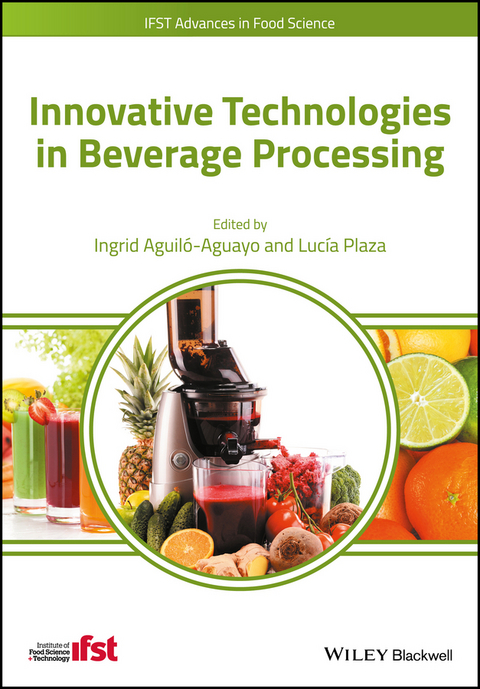
Innovative Technologies in Beverage Processing (eBook)
John Wiley & Sons (Verlag)
978-1-118-92936-0 (ISBN)
An in-depth look at new and emerging technologies for non-alcoholic beverage manufacturing
The non-alcoholic beverage market is the fastest growing segment of the functional food industry worldwide. Consistent with beverage consumption trends generally, the demand among consumers of these products is for high-nutrient drinks made from natural, healthy ingredients, free of synthetic preservatives and artificial flavor and color enhancers. Such drinks require specialized knowledge of exotic ingredients, novel processing techniques, and various functional ingredients.
The latest addition to the critically acclaimed IFST Advances in Food Science series this book brings together edited contributions from internationally recognized experts in their fields who offer insights and analysis of the latest developments in non-alcoholic beverage manufacture. Topics covered include juices made from pome fruits, citrus fruits, prunus fruits, vegetables, exotic fruits, berries, juice blends and non-alcoholic beverages, including grain-based beverages, soups and functional beverages. Waste and by-products generated in juice and non-alcoholic beverage sector are also addressed.
- Offers fresh insight and analysis of the latest developments in non-alcoholic beverage manufacture from leading international experts
- Covers all product segments of the non-alcoholic beverage market, including juices, vegetable blends, grain-based drinks, and alternative beverages
- Details novel thermal and non-thermal technologies that ensure high-quality nutrient retention while extending product shelf life
- Written with the full support of The Institute of Food Science and Technology (IFST), the leading qualifying body for food professionals in Europe
Innovative Technologies in Beverage Processing is a valuable reference/working resource for food scientists and engineers working in the non-alcoholic beverage industry, as well as academic researchers in industrial food processing and nutrition.
About the Editors
Ingrid Aguiló-Aguayo, IRTA, XaRTA-Postharvest, Edifici Fruitcentre, Parc Científic i Tecnològic Agroalimentari de Lleida, Lleida, Spain
Lucía Plaza, Research & Development Department, Cincagroup, Huesca, Spain
An in-depth look at new and emerging technologies for non-alcoholic beverage manufacturing The non-alcoholic beverage market is the fastest growing segment of the functional food industry worldwide. Consistent with beverage consumption trends generally, the demand among consumers of these products is for high-nutrient drinks made from natural, healthy ingredients, free of synthetic preservatives and artificial flavor and color enhancers. Such drinks require specialized knowledge of exotic ingredients, novel processing techniques, and various functional ingredients. The latest addition to the critically acclaimed IFST Advances in Food Science series this book brings together edited contributions from internationally recognized experts in their fields who offer insights and analysis of the latest developments in non-alcoholic beverage manufacture. Topics covered include juices made from pome fruits, citrus fruits, prunus fruits, vegetables, exotic fruits, berries, juice blends and non-alcoholic beverages, including grain-based beverages, soups and functional beverages. Waste and by-products generated in juice and non-alcoholic beverage sector are also addressed. Offers fresh insight and analysis of the latest developments in non-alcoholic beverage manufacture from leading international experts Covers all product segments of the non-alcoholic beverage market, including juices, vegetable blends, grain-based drinks, and alternative beverages Details novel thermal and non-thermal technologies that ensure high-quality nutrient retention while extending product shelf life Written with the full support of The Institute of Food Science and Technology (IFST), the leading qualifying body for food professionals in Europe Innovative Technologies in Beverage Processing is a valuable reference/working resource for food scientists and engineers working in the non-alcoholic beverage industry, as well as academic researchers in industrial food processing and nutrition.
About the Editors Ingrid Aguiló-Aguayo, IRTA, XaRTA-Postharvest, Edifici Fruitcentre, Parc Científic i Tecnològic Agroalimentari de Lleida, Lleida, Spain Lucía Plaza, Research & Development Department, Cincagroup, Huesca, Spain
Chapter 1
Pome Fruit Juices
Ingrid Aguiló-Aguayo1*, Lucía Plaza1, Gloria Bobo1, Maribel Abadias1 and Inmaculada Viñas2
1IRTA, XaRTA-Postharvest, Edifici Fruitcentre, Parc Científic I Tecnològic Agroalimentari de Lleida, Lleida, Catalonia, Spain
2Food Technology Department, University of Lleida, XaRTA-Postharvest, Agrotecnio Center, Lleida, Catalonia, Spain
*Corresponding author: Ingrid Aguiló-Aguayo, Ingrid.Aguilo@irta.cat
1.1 Introduction
Apple and pear are the two major commercial importance pome fruits that are grown in most temperate regions of the world. Apples (Malus domestica) have a strong antioxidant activity, which is mainly being attributed to the polyphenolic fraction. Pears (European pears: Pyrus communis L.; Asian pears: Pyrus serotina L.) are a good source of dietary fiber and vitamin C. Both apples and pears are often consumed fresh and also canned, dried, baked, freeze-dried, and as a cloudy or concentrate juice. The concentrated pome juices are usually obtained by extraction or pressing and later, clarification. The first step produces a juice of about 12 °Brix, and, after concentration, a final product of about 70 °Brix is obtained (Falguera et al., 2013). However, its properties are also constantly changing when the juices are subjected to processing, storage, transport, marketing, and consumption (Rao, 1986). Through the years, the process of optimization for obtaining and preserve these products has been conducted in order to avoid undesirable quality changes. This chapter discusses the application of conventional and emerging techniques in the processing of pome fruit juices and their effect on the final quality of the product.
1.2 Conventional Processing Techniques
The juice production starts with handling, which, in the case of apples and pears, is with the use of water or conveyor belts. Rotten or moldy apples and pears should be removed. Later, washing is required to remove leaves and twigs and dirt or other water-soluble agricultural spray residues. Sanitizing process will then be carried out to avoid a high microbial load, undesirable flavors, or mycotoxin contamination (Barret et al., 2005).
Prior to juice extraction, the fruit has to be pulped to release the trapped juices, and in the case of apples and pears, they need to be pressed at fairly high pressure to force the juice to flow through the cell structure (Downes, 1995). The fruits are milled to a pulp by a disintegration process that starts with a crushing step to break down the cell tissue. When fruits have been crushed, it undergoes a pressing step where the juice is extracted from the fruit by using conventional pack presses or horizontal rotatory presses. Juice extraction can also be performed by pectolytic enzymes, but apples and pears can normally be pressed fresh without any assistance. In general, juice-extraction process should be carried out as quickly as possible in order to minimize oxidation of the product. When juice has been extracted, clarification and filtration methods are generally conducted depending on the characteristics of the final product. For cloudy juices, clarification will not be necessary and only controlled centrifugation or a course filtration will be conducted to remove larger insoluble particles. To obtain a clarified juice, it will be necessary to remove the turbidity by a clarification step. Therefore, a complete depectinization by addition of pectinase enzymes, fine filtration, or high-speed centrifugation will be required (Barret et al., 2005). To obtain concentrate juices, a multiple-stage evaporation process after clarification is carried out. The clarified juice has a soluble solid content of around 15 °Brix, and processing industries normally obtain juices with a content of 70 °Brix. Hence, in the concentration process, the juice changes its soluble solids content and temperature flows from one evaporator. This process, which often works at a temperature of 60 °C, not only preconcentrates the juice but also subjects the product to some reduction in quality and loss of nutrients (Falguera & Ibarz, 2014). Then, the concentrate is immediately cooled below 20 °C (NPCS, 2008). In order to destroy microorganisms and inactivate the enzymes that are present in all the obtained products, thermal pasteurization process is conducted in a flow-through heat exchanger by high-temperature–short-time (HTST) treatment, for example, 76.6–87.7 °C for holding time between 25 and 30 s (Moyer & Aitken, 1980). In-pack pasteurization directly processes into the preheated pack ensuring product integrity (e.g., held at 75 °C for 30 min) (NPCS, 2008). However, slight correction of acidity of pome fruit juices to reach equilibrium pH of 4.6 or below by addition of commercial citric acid is necessary before pasteurization process. Pome fruit juices can also be processed by an aseptic method, in which temperatures are risen well over 100 °C, but holding times are shortened to only few seconds. Aseptic technology, also known as ultrahigh-temperature (UHT) processing, involves the production of a sterile product by rapid heating at high temperatures, followed by a short holding time and ending with rapid cooling (Charles-Rodríguez, 2002).
1.2.1 Influence on Microbial Quality
Microflora present in fruit juices are normally associated to the surface of fruits during harvest and postharvest processing including transport, storage, and processing (Tournas et al., 2006). The severity and extent of the thermal treatment will depend on factors such as type and heat resistance of target microorganisms, spore or enzyme present in food, pH, oxidation–reduction potential, or water activity of the food (Ramaswamy & Singh, 1997). The pH is also a critical factor, taking into account that foods may be broadly divided into high-acid (pH < 3.7) and low-acid (pH > 4.5) foods. Apple juices have the pH range between 3.35 and 4.00 serving as important barrier for microbial growth. Pears are not abundant in ascorbic acid (Kopera & Mitek, 2006) and some pear varieties have pH sometimes higher than 4.6 (Visser et al., 1968). The acidic nature of apple or pear juices allows pasteurization, defining the use of temperatures close to 100 °C in order to inactivate spoilage microorganisms. However, when pH is greater than 4.6, spore heat resistance marks the process temperature that should be greater than 115 °C for extended shelf life. Therefore, the pH reduction by acid addition is a widely practice in the juice food industries.
Spoilage organisms of particular interest to fruit juice manufacturers are Alicyclobacillus and yeasts and molds. Alicyclobacillus acidoterrestris is acidophilic spore-forming, heat-resistant organism that may be found in fruit juices. This microorganism can survive commercial pasteurization processes commonly applied to apple and pear juices spoiling fruit juice by producing cloud loss, development of off-flavors, CO2 production, or changes in color and appearance (Lawlor et al., 2009). Saritas et al. (2011) evaluated the effect of ascorbic and cinnamic acid addition and different pasteurization parameters on the inactivation of A. acidoterrestris. They concluded that the increase in the acid concentrations led to a decline in the z-value of the microorganisms, which is greater in the clear apple juice than in the apple nectar.
Several studies have been conducting regarding the recommended pasteurization treatments in apple juice. Mazzotta (2001) recommended a general thermal process of 3 s at 71.1 °C for achieving a 5-log reduction of Escherichia coli O157:H7, Salmonella, and Listeria monocytogenes in apple juices adjusted to a pH of 3.9. They reported that pH ranges from 3.6 to 4.0 in apple juice had no significant impact on the heat resistance of E. coli O157:H7. However, the acid tolerance of some microorganisms including E. coli and Salmonella led to the use of chemical preservatives such as benzoic acid in pome fruit juices to help processors to increase, substantially, the safety of the pasteurized products (Albashan, 2009; Koodie & Dhople, 2001). According to the Food and Drug Administration (FDA) recommendations, the pasteurization process must ensure a 5-log reduction of the three stated vegetative bacterial pathogens (E. coli O157:H7, Salmonella, and L. monocytogenes) at pH values of 3.9. However, thermal destruction of the protozoan parasite Cryptosporidium parvum oocysts causing illness outbreaks associated with the consumption of apple juice must be taken into consideration. Published studies suggest that C. parvum might be more resistant to heat processing than the indicated three vegetative bacterial pathogens (Deng & Cliver, 2001). Therefore, FDA suggests a treatment at 71.7 °C for 15 s for apple juice at pH values of 4.0 or less to achieve the 5-log reduction for the three mentioned vegetative bacterial pathogens and for oocysts of C. parvum (FDA, 2004). For the case of pear juice with pH of 4.6 or less, FDA recommends to conduct the pasteurization process that guarantees the same 5-log reduction for the indicated microorganisms. Regarding patulin, a mycotoxin produced by certain species of Penicillium, Aspergillus, and Byssochlamys molds, the regulations limit their content in apple juice to no more than 50 µg/kg (Codex, 1999).
1.2.2 Influence on Nutritional Attributes
Apple and...
| Erscheint lt. Verlag | 22.5.2017 |
|---|---|
| Reihe/Serie | IFST Advances in Food Science |
| IFST Advances in Food Science | IFST Advances in Food Science |
| Sprache | englisch |
| Themenwelt | Naturwissenschaften ► Biologie |
| Technik ► Lebensmitteltechnologie | |
| Weitere Fachgebiete ► Land- / Forstwirtschaft / Fischerei | |
| Schlagworte | alternative beverage manufacturing • alternative beverage markets • alternative beverage processing technologies • citrus fruit juice processing • exotic fruit juice processing • Fermented Foods & Beverages • Fermentierte Nahrungsmittel u. Getränke • Food Processing • food processing industry trends • Food Processing, Production & Manufacture • Food processing technology • Food Science & Technology • fruit juice manufacturing technologies • Functional Food • Functional Food, Nutraceuticals • Functional Foods & Nutraceuticals • Getränke • grain based beverage processing • ?grain-based drink processing technologies • Herstellung u. Verarbeitung von Lebensmitteln • juices manufacturing technologies • Lebensmittelforschung u. -technologie • new technologies for non-alcoholic drink processing • non-alcoholic beverage manufacturing • non-alcoholic beverage processing technologies • non-thermal technologies for non-alcoholic beverage processing • ? pome fruit juice processing • prunus fruit juice processing • soup processing technologies • thermal processing for non-alcoholic beverages • trends in non-alcoholic beverage manufacturing • vegetable blend drink processing technologies • vegetable juice manufacturing technologies • vegetable juice processing • waste and byproduct usage in non-alcoholic beverage processing |
| ISBN-10 | 1-118-92936-5 / 1118929365 |
| ISBN-13 | 978-1-118-92936-0 / 9781118929360 |
| Informationen gemäß Produktsicherheitsverordnung (GPSR) | |
| Haben Sie eine Frage zum Produkt? |
 EPUB (Adobe DRM)
Kopierschutz: Adobe-DRM
Adobe-DRM ist ein Kopierschutz, der das eBook vor Mißbrauch schützen soll. Dabei wird das eBook bereits beim Download auf Ihre persönliche Adobe-ID autorisiert. Lesen können Sie das eBook dann nur auf den Geräten, welche ebenfalls auf Ihre Adobe-ID registriert sind.
Details zum Adobe-DRM
Dateiformat: EPUB (Electronic Publication)
EPUB ist ein offener Standard für eBooks und eignet sich besonders zur Darstellung von Belletristik und Sachbüchern. Der Fließtext wird dynamisch an die Display- und Schriftgröße angepasst. Auch für mobile Lesegeräte ist EPUB daher gut geeignet.
Systemvoraussetzungen:
PC/Mac: Mit einem PC oder Mac können Sie dieses eBook lesen. Sie benötigen eine
eReader: Dieses eBook kann mit (fast) allen eBook-Readern gelesen werden. Mit dem amazon-Kindle ist es aber nicht kompatibel.
Smartphone/Tablet: Egal ob Apple oder Android, dieses eBook können Sie lesen. Sie benötigen eine
Geräteliste und zusätzliche Hinweise
Buying eBooks from abroad
For tax law reasons we can sell eBooks just within Germany and Switzerland. Regrettably we cannot fulfill eBook-orders from other countries.
aus dem Bereich