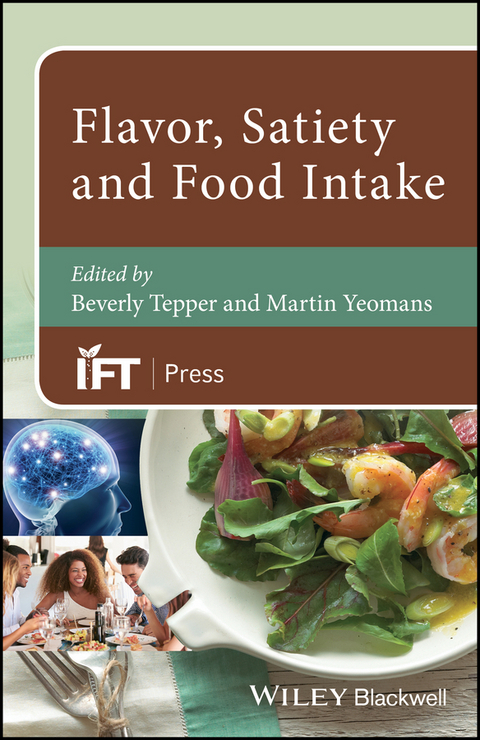
Flavor, Satiety and Food Intake (eBook)
John Wiley & Sons (Verlag)
978-1-119-04493-2 (ISBN)
This unique book provides a comprehensive review of the latest science on a key aspect of appetite control. It brings together contributions by leading researchers worldwide who approach this complex, multifaceted issue from a variety of differing perspectives, including those of food science, psychology, nutrition, and medicine, among others.
It is well known that products that require greater oral processing tend to be more sating. At the same time, the orosensory exposure hypothesis holds that flavor and texture in the mouth are critical in determining meal-size. They may act as key predictors of nutritional benefits and so promote better processing of foods. These two related ideas are at the forefront of current thinking on flavor-satiety interactions. Yet, until Flavor, Satiety and Food Intake no book has offered an integrated treatment of both concepts. The only single-source reference of its kind, it brings health professionals, product developers, and students up to speed on the latest thinking and practices in this fascinating and important area of research.
- Provides readers with a unique and timely summary of critical recent developments in research on the impact of flavor on satiety
- Explores a topic of central importance both for food professionals seeking to develop healthier products and health professionals concerned with obesity and over-eating
- Brings together relevant topics from the fields of food science, psychology, nutrition and medicine
Flavor, Satiety and Food Intake provides product developers with valuable information on how to integrate sensory evaluation with product formulation and marketing. It will also serve as a useful resource for health professionals and is a must-read for students of a range of disciplines in which appetite and satiety are studied.
Beverly Tepper, PhD is a professor in the Department of Food Science of Rutgers University, New Brunswick, New Jersey. She is also the Director and Co-Founder of the Rutgers University Center for Sensory Sciences and Innovation.
Martin Yeomans, PhD is a professor of Experimental Psychology in the School of Psychology of the University of Sussex, Falmer, Sussex, UK.
This unique book provides a comprehensive review of the latest science on a key aspect of appetite control. It brings together contributions by leading researchers worldwide who approach this complex, multifaceted issue from a variety of differing perspectives, including those of food science, psychology, nutrition, and medicine, among others. It is well known that products that require greater oral processing tend to be more sating. At the same time, the orosensory exposure hypothesis holds that flavor and texture in the mouth are critical in determining meal-size. They may act as key predictors of nutritional benefits and so promote better processing of foods. These two related ideas are at the forefront of current thinking on flavor-satiety interactions. Yet, until Flavor, Satiety and Food Intake no book has offered an integrated treatment of both concepts. The only single-source reference of its kind, it brings health professionals, product developers, and students up to speed on the latest thinking and practices in this fascinating and important area of research. Provides readers with a unique and timely summary of critical recent developments in research on the impact of flavor on satiety Explores a topic of central importance both for food professionals seeking to develop healthier products and health professionals concerned with obesity and over-eating Brings together relevant topics from the fields of food science, psychology, nutrition and medicine Flavor, Satiety and Food Intake provides product developers with valuable information on how to integrate sensory evaluation with product formulation and marketing. It will also serve as a useful resource for health professionals and is a must-read for students of a range of disciplines in which appetite and satiety are studied.
Beverly Tepper, PhD is a professor in the Department of Food Science of Rutgers University, New Brunswick, New Jersey. She is also the Director and Co-Founder of the Rutgers University Center for Sensory Sciences and Innovation. Martin Yeomans, PhD is a professor of Experimental Psychology in the School of Psychology of the University of Sussex, Falmer, Sussex, UK.
Flavor, Satiety and Food Intake 1
Contents 9
List of Contributors 11
Preface 13
Acknowledgements 15
1: Introducing Sensory and Cognitive Influences on Satiation and Satiety 17
1.1 Appetite Control in Context 17
1.2 Satiation and Satiety: A Brief Overview 18
1.3 Sensory Influences on Satiation and Satiety: A Brief History 20
1.4 New Directions 23
1.5 Concluding Remarks 24
References 24
2: Satiety and Liking Intertwined 29
2.1 Chapter Overview 29
2.2 Liking 30
2.3 Postingestive Satiety 30
2.4 The Five-Factor Satiety Questionnaire 31
2.5 The Intertwining of Liking and Satiety 33
2.5.1 Sensory Perceptions Affect Hunger and Fullness 33
2.5.2 Conditioning to Postingestional Satiety Creates Liking 33
2.5.3 Liking Influences Hunger and Fullness Ratings 34
2.6 Sensory-Specific Satiety, a Relative Change in Liking 35
2.6.1 History and Definition 35
2.6.2 Different Foods Produce Different Amounts of Sensory-Specific Satiety 38
2.6.3 What Determines the Extent of Sensory-Specific Satiety? 39
2.6.4 Sensory-Specific Satiety Crossovers 43
2.6.5 Can Sensory-Specific Satiety Occur to Just Odors? Appearance? 44
2.6.6 Potential Uses of Sensory-Specific Satiety 45
2.6.6.1 Can Sensory-Specific Satiety Serve As an Indicator of Long-Term Acceptability? 45
2.6.6.2 Can Sensory-Specific Satiety be Useful for Delineating an Assortment of Products? 46
2.7 Summary 47
References 48
3: The Chemical Senses and Nutrition: The Role of Taste and Smell in the Regulation of Food Intake 51
3.1 Introduction 51
3.2 The Role of Taste in Food Intake 53
3.2.1 The Taste of Our Diet: Taste Nutrient Relationships Across the Food Supply 53
3.2.2 Texture, Eating Rate and Food Intake 55
3.2.3 The Role of Oro-Sensory Exposure to Taste in Satiation 57
3.2.4 Translation into the Real World 59
3.2.5 Remaining Questions 59
3.3 The Role of Odour in Food Intake 60
3.3.1 Odours in the Diet and Their Relationship with Nutrients in Foods 60
3.3.2 Retronasal Odour Stimulation and Satiation 62
3.3.3 Role of Orthonasal Odour Stimulation in Subjective Appetite 62
3.3.4 Role of Orthonasal Stimulation in Choice and Intake 64
3.3.5 Remaining Questions 65
3.4 Discussion 66
References 67
4: Sweetness and Satiety 73
4.1 Sweet Taste Detection 74
4.1.1 Sweet Taste Sensing in the Oral Cavity 74
4.1.2 Sweet Taste Sensing in the Gastrointestinal System 75
4.1.3 Sweet Taste Processing in the Brain 75
4.1.4 Perception of Sweet Taste 77
4.2 Sweetness and Satiety 79
4.2.1 The Effect of Low-Energy Sweeteners and Caloric Sweeteners on Energy Intake and Body Mass Index 82
4.2.1.1 Animal studies 83
4.2.1.2 Observational (prospective cohort) studies in humans 85
4.2.1.3 Short-term intervention studies (& le
4.2.1.4 Sustained intervention studies (& gt
4.2.2 The Effect of Different Types of Sugars on Energy Intake and BMI: Sucrose vs. Fructose 89
4.2.3 Effects of Different Types of Sugars on Energy Intake and BMI: A Role for Glycaemic Index? 91
4.2.4 Sweetness and Sensory-Specific Satiety 92
4.3 Sweetness and Reward 93
4.4 Summary and Considerations 95
References 96
5: Reinforcing Value of Food, Satiety, and Weight Status 105
5.1 Introduction 105
5.2 Reinforcing Value 106
5.3 How Is the Reinforcing Value of FoodMeasured? 109
5.4 Relationship between Food Reinforcement and Ad Libitum EnergyIntake 111
5.5 Relationship between the Reinforcing Value of Food and Obesity 113
5.6 Satiety and Satiation 115
5.7 How Does the Reinforcing Value of Food Influence Satiation and Satiety? 116
5.8 Can We Alter the Reinforcing Value of Food? 117
5.9 Implications of Reinforcing Value of Food Research 118
5.10 Summary and Conclusions 119
References 119
6: Cognitive and Sensory Enhanced Satiety 125
6.1 Introduction 125
6.1.1 Satiety is Multifactorial 126
6.1.1.1 Measuring Satiety 128
6.2 Cognitions and Consumption 128
6.2.1 Expectations of Satiation and Satiety 129
6.2.2 Product Labelling 130
6.2.3 Contextual Cues 131
6.2.4 Memory 132
6.3 Oro-Sensory Influences on Satiety 134
6.3.1 Palatability 134
6.3.2 Satiety-Relevant Sensory Cues 135
6.3.2.1 Texture 136
6.3.2.2 Taste Intensity 138
6.3.2.3 Umami 139
6.4 Case Study: Optimising Beverages For Satiety 140
6.5 Conclusions 146
References 147
7: Umami and the Control of Appetite 155
7.1 Introduction 155
7.2 Umami Taste Perception 156
7.3 Where in the Diet Does Glutamate Occur? 158
7.4 Umami, Palatability and the Stimulation of Appetite 160
7.4.1 Umami As a Flavour Enhancer 160
7.4.2 The Appetizing Effect of Umami 161
7.4.3 Enhanced Flavour Liking Conditioned by MSG 161
7.4.4 Top-Down Influences on Umami Taste 162
7.4.5 Applications of the Appetizing Effects of Umami Taste 164
7.4.6 Does Enhancement of Appetite by MSG Lead to Obesity? 165
7.5 Umami, Satiation and Satiety 166
7.5.1 Regulation of Protein Intake 166
7.5.2 Protein-Induced Satiety 167
7.5.3 Sensory Influences on Protein-Induced Satiety 168
7.5.4 A Role for Umami in Protein-Based Satiety? 169
7.5.4.1 Glutamate and Satiety in Human Infants 169
7.5.4.2 Umami-Enhanced Satiety: Human Experimental Studies 170
7.5.5 Effects of Changes in Protein Status on Expression of Liking for Protein and Umami Taste 178
7.6 The Uniqueness of Umami: a Biphasic Impact on Appetite 179
7.7 Summary 180
References 180
8: Colour, Flavour and Haptic Influences on Satiety 189
8.1 Introduction 189
8.1.1 Interoceptive and Exteroceptive Cues 190
8.2 Colour Contributions to the Perception and Consumption of Food 192
8.2.1 Underlying Mechanisms 193
8.2.1.1 Boredom 193
8.2.1.2 Sensory-Specific Satiety 193
8.2.1.3 Sensory Habituation 194
8.2.2 Sensory-Specific Satiety 194
8.2.3 Food Colour Monotony 197
8.2.4 Product Variety Display 197
8.2.5 Interim Summary 200
8.3 Haptic Influences on Food Perception and Satiety 202
8.3.1 Food (Texture) Perception 202
8.3.2 Satiety and Satiation 203
8.3.3 Underlying Mechanisms 206
8.3.4 Interim Summary 207
8.4 Concluding Notes 208
References 208
9: Engineering satiety 213
9.1 Introduction 213
9.2 Emulsions 215
9.2.1 Pre-Ingestive Approaches 217
9.2.1.1 Oil Droplet Size 219
9.2.1.2 Emulsifier 221
9.2.1.3 Fat Content 222
9.2.1.4 Hydrocolloids 223
9.2.2 Post-Ingestive Approaches 223
9.2.2.1 Intra-Gastric Layering 224
9.2.2.2 Lipolysis 225
9.2.3 Next steps 226
9.3 Viscous, Gelling and Fermentable Polysaccharides 227
9.3.1 Viscous Structures 228
9.3.2 Gelled Networks 230
9.3.3 Fermentability 232
9.3.4 Potential Product Applications 232
9.4 Conclusion 233
References 234
Index 241
End User License Agreement 249
| Erscheint lt. Verlag | 5.4.2017 |
|---|---|
| Reihe/Serie | Institute of Food Technologists Series |
| Institute of Food Technologists Series | Institute of Food Technologists Series |
| Sprache | englisch |
| Themenwelt | Naturwissenschaften ► Biologie |
| Naturwissenschaften ► Chemie | |
| Technik ► Lebensmitteltechnologie | |
| Weitere Fachgebiete ► Land- / Forstwirtschaft / Fischerei | |
| Schlagworte | cognitive aspects of appetite control • Ernährung • flavor and appetite control • flavor and food preference in children • flavor and satiety • flavor and satiety in food product development • flavor and satiety in food science • flavor and satiety in obesity • flavor and satiety research • flavor engineering • flavor perception and satiety • food science • Food Science & Technology • food science flavor and satiety • food science research on flavor • Gesundheit, Ernährung u. Diät • Gesundheits- u. Sozialwesen • Health & Social Care • Health, Diet & Nutrition • how flavor affects satiety • Lebensmittelforschung u. -technologie • Lebensmittelsensorik • maximizing satiety • Nutrition • orosensory stimulation • satiety engineering • Sensory Science • the influence of color and flavor on satiety • the psychology of food satisfaction • the psychology of satiety and flavor • the science of food satisfaction • the science of satiety • weight status and satiety |
| ISBN-10 | 1-119-04493-6 / 1119044936 |
| ISBN-13 | 978-1-119-04493-2 / 9781119044932 |
| Informationen gemäß Produktsicherheitsverordnung (GPSR) | |
| Haben Sie eine Frage zum Produkt? |
 PDF (Adobe DRM)
Kopierschutz: Adobe-DRM
Adobe-DRM ist ein Kopierschutz, der das eBook vor Mißbrauch schützen soll. Dabei wird das eBook bereits beim Download auf Ihre persönliche Adobe-ID autorisiert. Lesen können Sie das eBook dann nur auf den Geräten, welche ebenfalls auf Ihre Adobe-ID registriert sind.
Details zum Adobe-DRM
Dateiformat: PDF (Portable Document Format)
Mit einem festen Seitenlayout eignet sich die PDF besonders für Fachbücher mit Spalten, Tabellen und Abbildungen. Eine PDF kann auf fast allen Geräten angezeigt werden, ist aber für kleine Displays (Smartphone, eReader) nur eingeschränkt geeignet.
Systemvoraussetzungen:
PC/Mac: Mit einem PC oder Mac können Sie dieses eBook lesen. Sie benötigen eine
eReader: Dieses eBook kann mit (fast) allen eBook-Readern gelesen werden. Mit dem amazon-Kindle ist es aber nicht kompatibel.
Smartphone/Tablet: Egal ob Apple oder Android, dieses eBook können Sie lesen. Sie benötigen eine
Geräteliste und zusätzliche Hinweise
Buying eBooks from abroad
For tax law reasons we can sell eBooks just within Germany and Switzerland. Regrettably we cannot fulfill eBook-orders from other countries.
aus dem Bereich