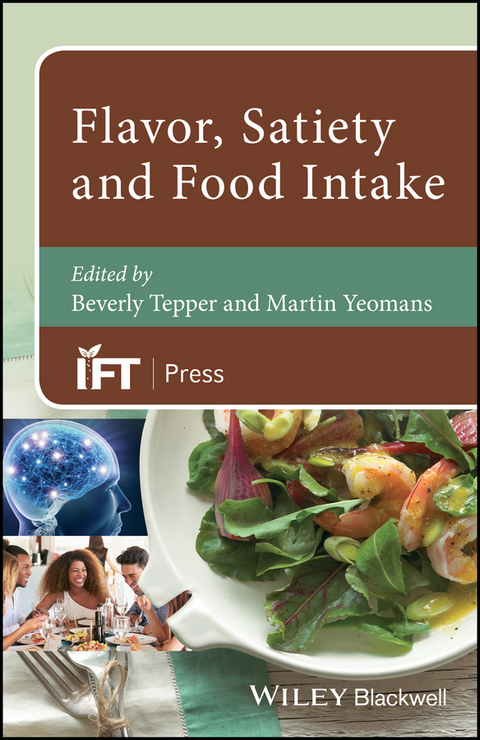
Flavor, Satiety and Food Intake (eBook)
John Wiley & Sons (Verlag)
978-1-119-04492-5 (ISBN)
This unique book provides a comprehensive review of the latest science on a key aspect of appetite control. It brings together contributions by leading researchers worldwide who approach this complex, multifaceted issue from a variety of differing perspectives, including those of food science, psychology, nutrition, and medicine, among others.
It is well known that products that require greater oral processing tend to be more sating. At the same time, the orosensory exposure hypothesis holds that flavor and texture in the mouth are critical in determining meal-size. They may act as key predictors of nutritional benefits and so promote better processing of foods. These two related ideas are at the forefront of current thinking on flavor-satiety interactions. Yet, until Flavor, Satiety and Food Intake no book has offered an integrated treatment of both concepts. The only single-source reference of its kind, it brings health professionals, product developers, and students up to speed on the latest thinking and practices in this fascinating and important area of research.
- Provides readers with a unique and timely summary of critical recent developments in research on the impact of flavor on satiety
- Explores a topic of central importance both for food professionals seeking to develop healthier products and health professionals concerned with obesity and over-eating
- Brings together relevant topics from the fields of food science, psychology, nutrition and medicine
Flavor, Satiety and Food Intake provides product developers with valuable information on how to integrate sensory evaluation with product formulation and marketing. It will also serve as a useful resource for health professionals and is a must-read for students of a range of disciplines in which appetite and satiety are studied.
Beverly Tepper, PhD is a professor in the Department of Food Science of Rutgers University, New Brunswick, New Jersey. She is also the Director and Co-Founder of the Rutgers University Center for Sensory Sciences and Innovation.
Martin Yeomans, PhD is a professor of Experimental Psychology in the School of Psychology of the University of Sussex, Falmer, Sussex, UK.
This unique book provides a comprehensive review of the latest science on a key aspect of appetite control. It brings together contributions by leading researchers worldwide who approach this complex, multifaceted issue from a variety of differing perspectives, including those of food science, psychology, nutrition, and medicine, among others. It is well known that products that require greater oral processing tend to be more sating. At the same time, the orosensory exposure hypothesis holds that flavor and texture in the mouth are critical in determining meal-size. They may act as key predictors of nutritional benefits and so promote better processing of foods. These two related ideas are at the forefront of current thinking on flavor-satiety interactions. Yet, until Flavor, Satiety and Food Intake no book has offered an integrated treatment of both concepts. The only single-source reference of its kind, it brings health professionals, product developers, and students up to speed on the latest thinking and practices in this fascinating and important area of research. Provides readers with a unique and timely summary of critical recent developments in research on the impact of flavor on satiety Explores a topic of central importance both for food professionals seeking to develop healthier products and health professionals concerned with obesity and over-eating Brings together relevant topics from the fields of food science, psychology, nutrition and medicine Flavor, Satiety and Food Intake provides product developers with valuable information on how to integrate sensory evaluation with product formulation and marketing. It will also serve as a useful resource for health professionals and is a must-read for students of a range of disciplines in which appetite and satiety are studied.
Beverly Tepper, PhD is a professor in the Department of Food Science of Rutgers University, New Brunswick, New Jersey. She is also the Director and Co-Founder of the Rutgers University Center for Sensory Sciences and Innovation. Martin Yeomans, PhD is a professor of Experimental Psychology in the School of Psychology of the University of Sussex, Falmer, Sussex, UK.
List of Contributors ix
Preface xi
Acknowledgements xiii
1 Introducing sensory and cognitive influences on satiation and satiety 1
Martin R. Yeomans
2 Satiety and liking intertwined 13
Zata Vickers
3 The chemical senses and nutrition: the role of taste and smell in the regulation of food intake 35
Cees de Graaf and Sanne Boesveldt
4 Sweetness and satiety 57
Pleunie Hogenkamp
5 Reinforcing value of food, satiety, and weight status 89
Jennifer L. Temple
6 Cognitive and sensory enhanced satiety 109
Keri McCrickerd
7 Umami and the control of appetite 139
Martin R. Yeomans and Una Masic
8 Colour, flavour and haptic influences on satiety 173
Betina Piqueras Fiszman
9 Engineering satiety 197
Aaron Mitchell Lett and Jennifer Norton
Index 225
2
Satiety and Liking Intertwined
Zata Vickers, Ph.D.
2.1 Chapter Overview
Liking is closely related to many phrases consumers use to describe sensations of hunger and fullness. Consumers' concepts of both hunger and fullness are multisensory and include aspects of desire and satisfaction that depend on liking. People express less hunger and more mental fullness after eating better-liked versions of a food.
Sensory-specific satiety for foods is operationally defined as a relative change in liking of a food immediately after eating it compared to the change in liking of uneaten foods. Typical sensory-specific satiety protocols are designed to disentangle many feelings of hunger and fullness from the changes in liking. Foods clearly differ in the extent to which they produce sensory-specific satiety. Higher-protein foods produce more sensory-specific satiety than lower-protein foods. Breads produce less sensory-specific satiety than many other foods. Testing of other hypotheses to explain differences in the amount of sensory-specific satiety produced (i.e. initial liking, complexity, and added fiber content) has not provided support for the relevance of those attributes. Sensory-specific satiety crosses over to uneaten foods having sensory qualities similar to the eaten food. Thus consuming a sweet food will often diminish liking for other sweet foods; consuming salty foods can diminish liking for other salty foods. Measurements of sensory-specific satiety for foods in a specific product category such as potato chips can be useful for predicting patterns of switching among those products in both laboratory and real-life settings.
2.2 Liking
Liking is the pleasure one experiences when eating or using a product. Liking is of utmost importance to food manufacturers because it is central to people's choice to consume foods [1]. Liking is of utmost importance for nutrition because people generally eat food they like and do not eat food they don't like. We routinely measure liking using a scale where people can indicate the extent to which they like or dislike something.
2.3 Postingestive Satiety
Most laypeople have an understanding of satiety—how satisfied you are, how full you are, or at least that you aren't hungry. Understanding satiety depends partly on understanding hunger because satiety is closely related to having one's hunger satisfied. Measuring satiety is more complex than measuring liking. Rating the single attributes hunger and fullness doesn't seem to encompass all we may mean by satiety.
In response to the inadequacy of the two terms (hunger and fullness) for capturing the complexity of satiety and to inconsistencies in the measurement of satiety among studies reported in the literature, the Appetite Regulation Task Force was convened to examine the broad array of experimental methodologies related to appetite control. The need for this was stimulated partly by the desire to use specific foods to combat obesity and by the food industry's interest in providing those foods, and perhaps having label claims for them. The findings of the task force were summarized in a review [2] and included five key scales for measuring satiety: (1) How hungry are you; (2) How full are you; (3) How satiated are you; (4) How strong is your desire to eat; (5) How much do you think you could eat right now.
At that time, work in our laboratory by Murray and Vickers [3] and Karalus (neé Murray) [4] also noted frequent inconsistency in the satiety measurements used, which made comparing across studies difficult if not impossible. To address the proliferation and inconsistent use of rating scales, we conducted focus group discussions about feelings of hunger and satiety [3]. These discussions enabled us to better understand the breadth and depth of hunger and fullness feelings and guided the development of an improved methodology for measuring satiety.
People who came to the focus group discussions received a gift bag of breakfast foods the week prior to their visit. In that bag were five different breakfasts: instant oatmeal, a breakfast drink, Cheerios®, a granola bar, and two oranges. We asked participants to have one of these each day during the week prior to their scheduled focus group. They recorded their feelings of hunger/fullness after each of these meals in preparation for their focus group session.
We learned the following from these focus groups: (1) Feelings of hunger and satiety were highly complex. (2) Participants described two types of hunger (physical and mental). Physical hunger, as the word suggests, included sensations of emptiness, stomach pain, and growling; the other type of hunger, mental hunger, included irritability, a fixation on food, and the desire to eat. (3) Participants described two types of fullness (again physical and mental). Physical fullness included the feeling of food in the stomach, being stuffed or bloated. Mental fullness included feeling comfortable, energized, satisfied, and the lack of any desire to eat. (4) Participants clearly indicated that they could be both hungry and full at the same time. They illustrated this using their experience with having the oranges for breakfast. Eating two oranges made participants feel physically full, but they were still mentally hungry—looking for or wanting something else to eat. (If you have ever finished eating a meal and opened the cupboards or refrigerator looking for something else, you have experienced some residual mental hunger.)
2.4 The Five-Factor Satiety Questionnaire
Karalus [4] collected as many different rating scales as she could find from the hunger and satiety literature—a little over 100. She assembled them into a questionnaire, sent them out to Facebook® friends and friends of friends, and had over 200 people rate each of those items. From those data she used factor analysis to sort most of the items into five factors [4] (Figure 2.1).
Figure 2.1 Components of the Five-Factor Satiety Questionnaire. Two specific questions are listed here for each factor. The more comprehensive list of questions for each factor is available in Karalus [4] and Karalus et al. [5]. Figure designed by MZ Mattes.
The first four factors, as foretold by her focus group interviews, included physical fullness, mental fullness, physical hunger, and mental hunger. The fifth factor was liking. Interestingly, four of the five scales proposed in the Blundell paper [2] fell into the mental hunger factor.
Karalus [4] validated this five-factor satiety instrument in tests comparing the hunger and fullness produced by different foods and by different versions of the same food. This instrument has proved useful for discriminating differences in hunger and fullness produced by small changes in the formulations of specific food products.
2.5 The Intertwining of Liking and Satiety
2.5.1 Sensory Perceptions Affect Hunger and Fullness
Jordan [6] studied the contributions of oral and gastric sensations to hunger by having participants consume meals both intragastrically and by normal oral ingestion. An attending experimenter recorded participants' comments and collected hunger and fullness ratings. His participants consumed sufficient calories by both methods, but reported that feeding by tube was not as satisfying as eating by mouth. Eliminating sensory properties by tube feeding diminished the drop in hunger perceived after consuming the food. His participants that were tube fed for two days expressed a desire to have something to eat by mouth and talked about what they were going to eat after the experiment ended. Their comments and ratings indicated they experienced more mental hunger and less mental fullness after consuming meals intragastrically than after consuming meals orally.
2.5.2 Conditioning to Postingestional Satiety Creates Liking
One of the fundamental ways we acquire liking is from Pavlovian conditioning to the postingestional effects of consuming foods. Conditioning induces responses from one stimulus (the unconditioned stimulus) to another stimulus (the conditioned stimulus) by repeatedly pairing them. When the conditioned stimulus is later presented alone, the response to the unconditioned stimulus is elicited. Ingesting foods of higher-calorie density produces increased liking [7–9], a conditioning of the sensory properties of the food (the conditioned stimulus) to the postingestional pleasant sensations of satiety (the unconditioned stimulus). This unconscious intertwining of satiety and liking produces high levels of liking for foods that produce high levels of satiation, such as high-fat or calorie-dense foods. Thus calorie density is a true cause of liking, although because of the unconscious learning, consumers almost never provide it as a reason why they like a specific food product.
2.5.3 Liking Influences Hunger and Fullness Ratings
In some cases higher liking produced more fullness (e.g. [10,11]); in other studies higher liking produced less fullness (e.g. [12,13]). Warwick and her colleagues [11] had subjects consume a milk-based beverage for breakfast. One of the breakfasts was bland (just milk and some added oil and glucose polymer). The other (tasty) product contained added sweetener and vanilla flavor. The graph on the left of Figure 2.2 shows the change in hunger after consuming the meal; the tasty product decreased hunger more than the bland product. The graph on the right shows the change in fullness rating; participants felt more...
| Erscheint lt. Verlag | 5.4.2017 |
|---|---|
| Reihe/Serie | Institute of Food Technologists Series |
| Institute of Food Technologists Series | Institute of Food Technologists Series |
| Sprache | englisch |
| Themenwelt | Naturwissenschaften ► Biologie |
| Naturwissenschaften ► Chemie | |
| Technik ► Lebensmitteltechnologie | |
| Weitere Fachgebiete ► Land- / Forstwirtschaft / Fischerei | |
| Schlagworte | cognitive aspects of appetite control • Ernährung • flavor and appetite control • flavor and food preference in children • flavor and satiety • flavor and satiety in food product development • flavor and satiety in food science • flavor and satiety in obesity • flavor and satiety research • flavor engineering • flavor perception and satiety • food science • Food Science & Technology • food science flavor and satiety • food science research on flavor • Gesundheit, Ernährung u. Diät • Gesundheits- u. Sozialwesen • Health & Social Care • Health, Diet & Nutrition • how flavor affects satiety • Lebensmittelforschung u. -technologie • Lebensmittelsensorik • maximizing satiety • Nutrition • orosensory stimulation • satiety engineering • Sensory Science • the influence of color and flavor on satiety • the psychology of food satisfaction • the psychology of satiety and flavor • the science of food satisfaction • the science of satiety • weight status and satiety |
| ISBN-10 | 1-119-04492-8 / 1119044928 |
| ISBN-13 | 978-1-119-04492-5 / 9781119044925 |
| Informationen gemäß Produktsicherheitsverordnung (GPSR) | |
| Haben Sie eine Frage zum Produkt? |
 EPUB (Adobe DRM)
Kopierschutz: Adobe-DRM
Adobe-DRM ist ein Kopierschutz, der das eBook vor Mißbrauch schützen soll. Dabei wird das eBook bereits beim Download auf Ihre persönliche Adobe-ID autorisiert. Lesen können Sie das eBook dann nur auf den Geräten, welche ebenfalls auf Ihre Adobe-ID registriert sind.
Details zum Adobe-DRM
Dateiformat: EPUB (Electronic Publication)
EPUB ist ein offener Standard für eBooks und eignet sich besonders zur Darstellung von Belletristik und Sachbüchern. Der Fließtext wird dynamisch an die Display- und Schriftgröße angepasst. Auch für mobile Lesegeräte ist EPUB daher gut geeignet.
Systemvoraussetzungen:
PC/Mac: Mit einem PC oder Mac können Sie dieses eBook lesen. Sie benötigen eine
eReader: Dieses eBook kann mit (fast) allen eBook-Readern gelesen werden. Mit dem amazon-Kindle ist es aber nicht kompatibel.
Smartphone/Tablet: Egal ob Apple oder Android, dieses eBook können Sie lesen. Sie benötigen eine
Geräteliste und zusätzliche Hinweise
Buying eBooks from abroad
For tax law reasons we can sell eBooks just within Germany and Switzerland. Regrettably we cannot fulfill eBook-orders from other countries.
aus dem Bereich