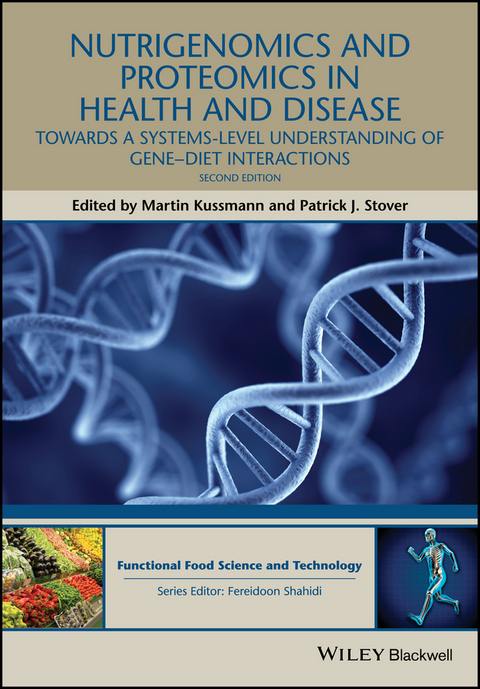
Nutrigenomics and Proteomics in Health and Disease (eBook)
John Wiley & Sons (Verlag)
978-1-119-10126-0 (ISBN)
Now in a revised second edition, Nutrigenomics and Proteomics in Health and Disease brings together the very latest science based upon nutrigenomics and proteomics in food and health. Coverage includes many important nutraceuticals and their impact on gene interaction and health. Authored by an international team of multidisciplinary researchers, this book acquaints food and nutrition professionals with these new fields of nutrition research and conveys the state of the science to date.
Thoroughly updated to reflect the most current developments in the field, the second edition includes six new chapters covering gut health and the personal microbiome; gut microbe-derived bioactive metabolites; proteomics and peptidomics in nutrition; gene selection for nutrigenomic studies; gene-nutrient network analysis, and nutrigenomics to nutritional systems biology. An additional five chapters have also been significantly remodelled. The new text includes a rethinking of in vitro and in vivo models with regard to their translatability into human phenotypes, and normative science methods and approaches have been complemented by more comprehensive systems biology-based investigations, deploying a multitude of omic platforms in an integrated fashion. Innovative tools and methods for statistical treatment and biological network analysis are also now included.
About the Editors
Martin Kussmann is Professor of 'Systems Biology in Nutrition and Health' at the Liggins Institute, University of Auckland, New Zealand. He is also Chief Scientist of New Zealand's National Science Challenge 'High-Value Nutrition'. In 2011, Martin joined the Nestlè Institute of Health Sciences (NIHS) on the campus of the Ecole Polytechnique Fèdèrale Lausanne (EPFL), Switzerland, as Head of the 'Molecular Biomarkers Core'. From 2012 to 2016, he has been Lecturer at the Faculty of Life Sciences, EPFL. Since June 2009, Martin is Honorary Professor for Nutritional Science at the Faculty of Science, Aarhus University, Denmark. He holds a MSc and PhD in Chemistry from the University of Konstanz, Germany.
Patrick J. Stover is Professor and Director of the Division of Nutritional Sciences at Cornell University. He graduated from Saint Joseph's University with a BS degree in Chemistry, and received a PhD degree in Biochemistry and Molecular Biophysics from the Medical College of Virginia, and performed his postdoctoral studies in Nutritional Sciences at the University of California at Berkeley.
Now in a revised second edition, Nutrigenomics and Proteomics in Health and Disease brings together the very latest science based upon nutrigenomics and proteomics in food and health. Coverage includes many important nutraceuticals and their impact on gene interaction and health. Authored by an international team of multidisciplinary researchers, this book acquaints food and nutrition professionals with these new fields of nutrition research and conveys the state of the science to date. Thoroughly updated to reflect the most current developments in the field, the second edition includes six new chapters covering gut health and the personal microbiome; gut microbe-derived bioactive metabolites; proteomics and peptidomics in nutrition; gene selection for nutrigenomic studies; gene-nutrient network analysis, and nutrigenomics to nutritional systems biology. An additional five chapters have also been significantly remodelled. The new text includes a rethinking of in vitro and in vivo models with regard to their translatability into human phenotypes, and normative science methods and approaches have been complemented by more comprehensive systems biology-based investigations, deploying a multitude of omic platforms in an integrated fashion. Innovative tools and methods for statistical treatment and biological network analysis are also now included.
About the Editors Martin Kussmann is Professor of "Systems Biology in Nutrition and Health" at the Liggins Institute, University of Auckland, New Zealand. He is also Chief Scientist of New Zealand's National Science Challenge "High-Value Nutrition". In 2011, Martin joined the Nestlè Institute of Health Sciences (NIHS) on the campus of the Ecole Polytechnique Fèdèrale Lausanne (EPFL), Switzerland, as Head of the "Molecular Biomarkers Core". From 2012 to 2016, he has been Lecturer at the Faculty of Life Sciences, EPFL. Since June 2009, Martin is Honorary Professor for Nutritional Science at the Faculty of Science, Aarhus University, Denmark. He holds a MSc and PhD in Chemistry from the University of Konstanz, Germany. Patrick J. Stover is Professor and Director of the Division of Nutritional Sciences at Cornell University. He graduated from Saint Joseph's University with a BS degree in Chemistry, and received a PhD degree in Biochemistry and Molecular Biophysics from the Medical College of Virginia, and performed his postdoctoral studies in Nutritional Sciences at the University of California at Berkeley.
1
The use of transcriptomics as a tool to identify differences in the response to diet
Juri C. Matualatupauw and Lydia A. Afman
1.1 New concepts in nutrition research
The role of nutrition in the pathogenesis of metabolic diseases, such as type 2 diabetes and cardiovascular disease, is clearly recognized. In the past, nutritional research was aimed at providing general dietary advice with the goal of improving population health. A problem with this approach is that even though dietary changes may be of great benefit at the population level, the effects at the individual level are very small and hardly noticeable [1]. The ultimate way to improve health is by providing personalized dietary advice. New approaches and methodologies are essential if we want to demonstrate nutritional effects on health at the individual level. The main challenges that we are facing within the nutrition field are the high variability in response to nutrition between subjects, the relatively small effects of nutrition, and the long period it may take before effects become evident. One of the key issues with the high variability in response is that not only non‐mutable factors such as age, gender, and genotype affect the response but also changeable factors such as health status affect the response to nutrition. The drawback with the latter is the lack of appropriate biomarkers to characterize individual health status. The markers used to show efficacy of interventions are often late single biomarkers of disease state. These biomarkers are relevant to demonstrate the efficacy of pharmacological interventions but are less applicable to show the efficacy of nutritional interventions, which are mostly performed in a relatively healthy population.
1.2 Comprehensive phenotyping
A new concept in nutrition research is the measurement of a wide range of markers to characterize health, which is called “comprehensive phenotyping” [2]. The arrival of comprehensive genomics techniques in the last decade drove this development, as it allowed the measurement of the expression of thousands of genes, proteins, and metabolites in one sample. These techniques can be applied to a range of samples, including blood, urine, cells, and tissue biopsies, that can be collected fairly easily during dietary intervention studies in healthy volunteers. In the last few years, we have demonstrated the sensitivity of these techniques by showing nutritional effects on health where classical approaches failed [3,4]. Comprehensive phenotyping not only includes omics techniques but also requires the measurement of classical markers and intermediary endpoint measures that have been shown to be associated with disease. Better characterization of health status by using a comprehensive phenotyping approach not only helps to demonstrate the efficacy of a nutritional intervention but also supports the identification of people at risk for disease development who can still profit from dietary advice.
Comprehensive phenotyping is still in an early phase, and very few studies have been published so far that integrated omics techniques with functional and classical markers in the field of nutrition. Recently, a study has been published in which a huge amount of data was integrated to characterize individual responses to nutrition [5]. The ultimate goal was to develop a machine‐learning algorithm that predicts personal postprandial glycemic responses to real‐life meals. Week‐long glucose levels and responses to 46 898 meals were continuously measured in a cohort of 800 people. This study adopted a comprehensive phenotyping approach by integrating the glucose responses with blood parameters, dietary habits, anthropometrics, physical activity, and gut microbiota. The predictions of postprandial glycemic responses were validated in an independent 100‐person cohort. Furthermore, a blinded randomized controlled dietary intervention based on this algorithm resulted in significantly lower postprandial glucose responses and consistent alterations to gut microbiota composition. This study shows that with the use of comprehensive phenotyping and adequate data integration, personalized nutrition is potentially within our reach.
1.3 Phenotypic flexibility
Another new development within the nutrition field is the measurement of an individual’s capacity to adapt to dietary challenges, which is called “phenotypic flexibility” [2,6,7]. A dietary challenge, such as a high‐fat challenge or an oral glucose tolerance test (OGTT), triggers the adaptation capacity of organs, cells, and tissues and challenges metabolic and inflammatory homeostasis. For example, oral high‐fat challenges have been used to study postprandial lipid metabolism, showing a high variation in individual responses. Individuals with a more pronounced postprandial response were at an increased risk of developing CVD. Similarly, an OGTT is used to evaluate insulin resistance. At fasting, insulin insensitivity may not be detectable, but after an OGGT, insulin insensitivity becomes apparent. Phenotypic flexibility can be an important indicator of individual health status, as it might reflect the (dys‐)functioning of metabolic organs, such as liver and adipose tissue. It might therefore be able to characterize health status better or reveal effects of nutrition on health that otherwise would have remained undetected.
The combination of both approaches, comprehensive phenotyping and phenotypic flexibility, will result in a dynamic biomarker profile as outcome measure. This profile is expected to provide more information on health status and thus the efficacy of dietary interventions than the static single biomarkers that have been used so far.
Studies using a comprehensive phenotyping approach to characterize individual responses to diet are rare. Most studies that examined individual responses to diet using comprehensive omics techniques performed these analyses retrospectively and only few studies stratified groups beforehand. The same scarcity accounts for studies that used challenge tests in combination with omics techniques to characterize individual responses based on phenotype.
In this chapter, we summarize the studies that either used non‐mutable factors such as age, gender, and genotype or mutable factors such as health status to characterize individual response to diet, in the long or medium term or after a nutritional challenge, with a specific focus on studies that used the comprehensive‐omics technique transcriptomics as the outcome measure.
1.4 Factors that influence the transcriptome response to diet
Transcriptomics was one of the first of the omics technologies to be used in nutrition‐related research in humans. Much of the research has been focused on examining changes in gene expression patterns using microarrays, upon either acute challenges or longer‐term dietary interventions. One of the types of cells that is frequently used to asses transcriptome profiles is blood cells, which are easy and non‐invasive to harvest in humans. A subpopulation of blood immune cells regularly studied are peripheral blood mononuclear cells (PBMCs). Subcutaneous adipose tissue is also often studied in human nutrigenomics investigations, because it is relatively non‐invasive to take biopsies from this tissue and adipose tissue is known to play a key role in the pathogenesis of metabolic diseases. Lastly, skeletal muscle has also been examined in some studies.
Several studies that investigated the change in whole‐genome gene expression upon a nutritional intervention observed large inter‐individual differences in response to a dietary intervention [8–11]. The reasons for these large inter‐individual differences are not yet fully understood, but can include genetic, phenotypic, or environmental differences between individuals. Of particular interest in the context of personalized nutrition are the studies that identified factors that have an interaction effect on the response to diet. This chapter focuses on studies that examined this interaction effect using transcriptomics as outcome measure. Factors that are discussed are gender, age, genotype, anthropometric measurements, plasma biochemical markers and gut microbiota. Furthermore, we discuss some studies that used other outcome measures to identify responders and non‐responders to diet and subsequently used transcriptomics to examine mechanistically the differences between these two groups.
1.4.1 Gender
Gender is one of the most obvious phenotypes for which a difference in response to diet can be expected. However, the number of studies that investigated the difference in gene expression response to diet between men and women is limited. One study examined the postprandial changes in PBMC gene expression after a breakfast based on olive oil with a high or low amount of phenol compounds [12]. Microarray analysis demonstrated a significant change in expression of 98 genes between the high‐ and low‐phenol breakfasts. However, on performing additional separate analyses for men and women, they found a higher number of differentially expressed genes: 250 and 143, respectively. Only 32 genes were differentially expressed in both men and women, indicating that the effect of the phenols on PBMC gene expression might be affected by gender.
Rudkowska et al. [13] examined the effects of 6 weeks of supplementation with n‐3 polyunsaturated fatty acids (PUFAs) on PBMC gene expression in 29 overweight and obese men and...
| Erscheint lt. Verlag | 21.3.2017 |
|---|---|
| Reihe/Serie | Food Science and Technology |
| Food Science and Technology | Hui: Food Science and Technology |
| Sprache | englisch |
| Themenwelt | Medizin / Pharmazie ► Gesundheitsfachberufe ► Diätassistenz / Ernährungsberatung |
| Studium ► 2. Studienabschnitt (Klinik) ► Humangenetik | |
| Naturwissenschaften ► Biologie | |
| Technik ► Lebensmitteltechnologie | |
| Weitere Fachgebiete ► Land- / Forstwirtschaft / Fischerei | |
| Schlagworte | book acquaints • Edition • Field • Fields • Food • Food Science & Technology • Functional Food, Nutraceuticals • Functional Foods & Nutraceuticals • Gene • Health • important • interaction • international • Latest • Lebensmittelforschung u. -technologie • many • multidisciplinary researchers • New • Nutrigenomics • Nutrition • Proteomics • Research • revised second • Science • State • Team • upon |
| ISBN-10 | 1-119-10126-3 / 1119101263 |
| ISBN-13 | 978-1-119-10126-0 / 9781119101260 |
| Informationen gemäß Produktsicherheitsverordnung (GPSR) | |
| Haben Sie eine Frage zum Produkt? |
 EPUB (Adobe DRM)
Kopierschutz: Adobe-DRM
Adobe-DRM ist ein Kopierschutz, der das eBook vor Mißbrauch schützen soll. Dabei wird das eBook bereits beim Download auf Ihre persönliche Adobe-ID autorisiert. Lesen können Sie das eBook dann nur auf den Geräten, welche ebenfalls auf Ihre Adobe-ID registriert sind.
Details zum Adobe-DRM
Dateiformat: EPUB (Electronic Publication)
EPUB ist ein offener Standard für eBooks und eignet sich besonders zur Darstellung von Belletristik und Sachbüchern. Der Fließtext wird dynamisch an die Display- und Schriftgröße angepasst. Auch für mobile Lesegeräte ist EPUB daher gut geeignet.
Systemvoraussetzungen:
PC/Mac: Mit einem PC oder Mac können Sie dieses eBook lesen. Sie benötigen eine
eReader: Dieses eBook kann mit (fast) allen eBook-Readern gelesen werden. Mit dem amazon-Kindle ist es aber nicht kompatibel.
Smartphone/Tablet: Egal ob Apple oder Android, dieses eBook können Sie lesen. Sie benötigen eine
Geräteliste und zusätzliche Hinweise
Buying eBooks from abroad
For tax law reasons we can sell eBooks just within Germany and Switzerland. Regrettably we cannot fulfill eBook-orders from other countries.
aus dem Bereich