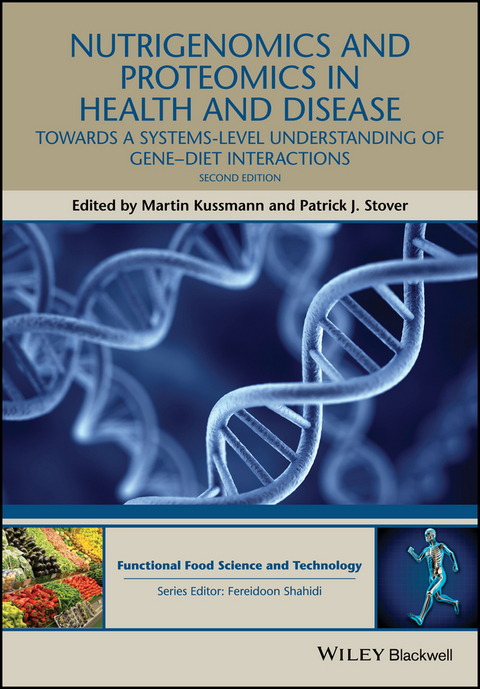
Nutrigenomics and Proteomics in Health and Disease (eBook)
John Wiley & Sons (Verlag)
978-1-119-10125-3 (ISBN)
Now in a revised second edition, Nutrigenomics and Proteomics in Health and Disease brings together the very latest science based upon nutrigenomics and proteomics in food and health. Coverage includes many important nutraceuticals and their impact on gene interaction and health. Authored by an international team of multidisciplinary researchers, this book acquaints food and nutrition professionals with these new fields of nutrition research and conveys the state of the science to date.
Thoroughly updated to reflect the most current developments in the field, the second edition includes six new chapters covering gut health and the personal microbiome; gut microbe-derived bioactive metabolites; proteomics and peptidomics in nutrition; gene selection for nutrigenomic studies; gene-nutrient network analysis, and nutrigenomics to nutritional systems biology. An additional five chapters have also been significantly remodelled. The new text includes a rethinking of in vitro and in vivo models with regard to their translatability into human phenotypes, and normative science methods and approaches have been complemented by more comprehensive systems biology-based investigations, deploying a multitude of omic platforms in an integrated fashion. Innovative tools and methods for statistical treatment and biological network analysis are also now included.
About the Editors
Martin Kussmann is Professor of 'Systems Biology in Nutrition and Health' at the Liggins Institute, University of Auckland, New Zealand. He is also Chief Scientist of New Zealand's National Science Challenge 'High-Value Nutrition'. In 2011, Martin joined the Nestlè Institute of Health Sciences (NIHS) on the campus of the Ecole Polytechnique Fèdèrale Lausanne (EPFL), Switzerland, as Head of the 'Molecular Biomarkers Core'. From 2012 to 2016, he has been Lecturer at the Faculty of Life Sciences, EPFL. Since June 2009, Martin is Honorary Professor for Nutritional Science at the Faculty of Science, Aarhus University, Denmark. He holds a MSc and PhD in Chemistry from the University of Konstanz, Germany.
Patrick J. Stover is Professor and Director of the Division of Nutritional Sciences at Cornell University. He graduated from Saint Joseph's University with a BS degree in Chemistry, and received a PhD degree in Biochemistry and Molecular Biophysics from the Medical College of Virginia, and performed his postdoctoral studies in Nutritional Sciences at the University of California at Berkeley.
Now in a revised second edition, Nutrigenomics and Proteomics in Health and Disease brings together the very latest science based upon nutrigenomics and proteomics in food and health. Coverage includes many important nutraceuticals and their impact on gene interaction and health. Authored by an international team of multidisciplinary researchers, this book acquaints food and nutrition professionals with these new fields of nutrition research and conveys the state of the science to date. Thoroughly updated to reflect the most current developments in the field, the second edition includes six new chapters covering gut health and the personal microbiome; gut microbe-derived bioactive metabolites; proteomics and peptidomics in nutrition; gene selection for nutrigenomic studies; gene-nutrient network analysis, and nutrigenomics to nutritional systems biology. An additional five chapters have also been significantly remodelled. The new text includes a rethinking of in vitro and in vivo models with regard to their translatability into human phenotypes, and normative science methods and approaches have been complemented by more comprehensive systems biology-based investigations, deploying a multitude of omic platforms in an integrated fashion. Innovative tools and methods for statistical treatment and biological network analysis are also now included.
About the Editors Martin Kussmann is Professor of "Systems Biology in Nutrition and Health" at the Liggins Institute, University of Auckland, New Zealand. He is also Chief Scientist of New Zealand's National Science Challenge "High-Value Nutrition". In 2011, Martin joined the Nestlè Institute of Health Sciences (NIHS) on the campus of the Ecole Polytechnique Fèdèrale Lausanne (EPFL), Switzerland, as Head of the "Molecular Biomarkers Core". From 2012 to 2016, he has been Lecturer at the Faculty of Life Sciences, EPFL. Since June 2009, Martin is Honorary Professor for Nutritional Science at the Faculty of Science, Aarhus University, Denmark. He holds a MSc and PhD in Chemistry from the University of Konstanz, Germany. Patrick J. Stover is Professor and Director of the Division of Nutritional Sciences at Cornell University. He graduated from Saint Joseph's University with a BS degree in Chemistry, and received a PhD degree in Biochemistry and Molecular Biophysics from the Medical College of Virginia, and performed his postdoctoral studies in Nutritional Sciences at the University of California at Berkeley.
Title Page 5
Copyright Page 6
Contents 7
Contributors 12
Preface 15
Biography of Martin Kussmann 16
Section I Genes, Proteins, and Nutrition 19
Chapter 1 The use of transcriptomics as a tool to identify differences in the response to diet 21
1.1 New concepts in nutrition research 21
1.2 Comprehensive phenotyping 21
1.3 Phenotypic flexibility 22
1.4 Factors that influence the transcriptome response to diet 23
1.5 Using transcriptomics to explain the mechanism behind differences in response to diet 28
1.6 Conclusion 28
1.7 Future perspectives 33
References 34
Chapter 2 Genetic or nutritional disturbances in folate-related pathways and epigenetic interactions 37
2.1 Introduction 37
2.2 Nutrition and one-carbon metabolism 38
2.3 Importance of DNA?methylation at CpG dinucleotides 41
2.4 Folate-dependent disorders: Dietary impact 42
2.5 Genetic influences on phenotype and interactions with epigenetics 45
2.6 Epigenetic inheritance across generations 49
2.7 Conclusions 52
References 53
Chapter 3 Early-life development and epigenetic mechanisms: Mediators of metabolic programming and obesity risk 60
3.1 Introduction 60
3.2 Origins of DOHaD and its conceptual basis 61
3.3 Epigenetic mechanisms 62
3.4 Early-life nutrition, epigenetics, and metabolic programming 66
3.5 Paternal effects 70
3.6 Transgenerational epigenetic inheritance 72
3.7 The potential value of DOHaD principles and epigenetic biology to the improvement of human health 73
3.8 Conclusion 75
Acknowledgments 75
References 76
Section II Bioactives and Phytonutrients 83
Chapter 4 Bioactive interactions in food and natural extracts 85
4.1 Natural compounds as all compounds produced by nature 85
4.2 Not all natural compounds are created active 88
4.3 On the road of modern technologies for bioactive discovery 89
4.4 Metabolomics strategies applied to bioactives biochemistry 95
4.5 Bioactives as multi?target network instigators 99
4.6 ‘Let food be thy medicine and medicine be thy food’ – outlook 103
Acknowledgments 103
References 103
Chapter 5 Anthocyanins in metabolic health and disease 110
5.1 Introduction 110
5.2 Chemical structure 111
5.3 Structural effects on stability 111
5.4 Systemic bioavailability and tissue distribution 114
5.5 Metabolism and nutrigenomic effects 120
5.6 Conclusions 132
Acknowledgments 132
References 132
Chapter 6 Dietary antioxidants and bioflavonoids in atherosclerosis and angiogenesis 143
6.1 Introduction 143
6.2 Dietary vitamins E and C and CVD 144
6.3 Dietary polyphenols and CVD 146
6.4 Flavonoids and angiogenesis 152
6.5 Conclusion 153
Acknowledgments 154
References 155
Chapter 7 Genomics and proteomics approaches to identify resveratrol targets in cancer 161
7.1 Introduction 161
7.2 Sources and health benefits of resveratrol 162
7.3 Resveratrol for cancer prevention and therapy 163
7.4 Functional genomics approaches to identify resveratrol targets in cancer 165
7.5 Proteomics approaches to identify resveratrol targets in cancer 166
7.6 Metabolomics approaches to identify pathways modified by resveratrol in cancer 168
7.7 Epigenomic events induced by resveratrol in cancer 170
7.8 Conclusions and perspectives 171
References 171
Chapter 8 Genomic effects of food bioactives in neuroprotection 174
8.1 Introduction: Nature and nurture 174
8.2 Mechanism underlying food nurture 174
8.3 Natural cellular nurture mechanisms 175
8.4 Effects of food bioactives on genomic activity 176
8.5 Epigenetic modulation 176
8.6 Modulation of the epigenome by food bioactives 177
8.7 Possible role of the genome in neuroprotection 178
8.8 Countering risk factors associated with neurodegeneration 179
8.9 Using food bioactives to restore epigenetic balance 179
8.10 Targeting inflammation, energy, and free radicals 179
8.11 Food bioactives that reduce inflammation 181
8.12 Food bioactive effects on bioenergetics and redox balance 181
8.13 Role of food bioactive acetyl-l-carnitine in neurodegeneration 181
8.14 Process of S-palmitoylation and the role of carnitine palmitoyltransferase 1c?enzyme in the brain 182
8.15 Conclusion 182
References 183
Chapter 9 MicroRNAs: Bioactive molecules at the nexus of nutrition and disease 188
9.1 Introduction to micro RNAs as dietary bioactive compounds 188
9.2 Characteristics, biogenesis, and functions of miRNAs 189
9.3 miRNA detection methods 191
9.4 Small RNAs in the circulation 192
9.5 Endogenous miRNAs and metabolic control 194
9.6 miRNAs as biomarkers for diet and disease 196
9.7 Absorption of dietary animal miRNAs in animal consumers 202
9.8 Absorption of dietary plant miRNAs in animal consumers 203
9.9 Contradictory evidence of dietary miRNA uptake 206
9.10 Therapeutic potential of miRNAs 208
9.11 Gut pathology may influence dietary miRNA uptake 209
9.12 Conclusion 211
Acknowledgments 213
References 213
Section A Section III?Prebiotics, Probiotics, Synbiotics, and the Gut Ecosystem 219
Chapter 10 Gut health and the personal microbiome 221
10.1 Gut health and its concepts 221
10.2 Microbiome and gut health – from composition to function 224
10.3 The personalized microbiome – towards precision nutrition 229
10.4 Conclusions and next-generation interventions 232
Acknowledgments 233
References 233
Chapter 11 Infant nutrition and the microbiome: Systems biology approaches to uncovering host–microbe interactions 238
11.1 Introduction 238
11.2 Environmental factors influencing development of the infant gut microbiota 239
11.3 Infant nutrition and the development of gut microbiota 241
11.4 Host genetics and the development of gut microbiota 244
11.5 Host–microbe interactions regulating host phenotype and gene expression 248
11.6 Systems biology approaches to diet?dependent host–microbe interaction 261
11.7 Summary and conclusions 265
References 265
Chapter 12 Bioactive host–microbial metabolites in human nutrition with a focus on aromatic amino acid co-metabolism 276
12.1 Introduction: Gut microbiota metabolism in nutrition, health and disease 276
12.2 Short-chain fatty acid metabolism 277
12.3 Bile acid metabolism 278
12.4 Aromatic amino acid metabolism 279
12.5 Conclusions and perspectives 287
References 288
Section IV Nutrigenomic and Proteomic Technologies 293
Chapter 13 Network analysis in systems nutrition 295
13.1 Introduction 295
13.2 Biological networks 296
13.3 Network topology 299
13.4 A general framework for network analysis of throughput data 300
13.5 Examples of network analyses 302
13.6 Conclusions and perspectives 304
References 305
Chapter 14 Nutrigenomics analyses: Biostatistics and systems biology approaches 308
14.1 Gene selection for nutrigenomics studies 308
14.2 Specificity of high-dimension data and preprocessing before gene selection 309
14.3 Exploratory and differential gene expression analysis 310
14.4 Biomarker discovery in nutrigenomics: Gene selection and discrimination 315
14.5 A step towards data integration: searching for correlation/covariance between two datasets 328
14.6 From gene selection to systems biology 331
References 333
Index 337
Supplemental Images 347
EULA 353
| Erscheint lt. Verlag | 21.3.2017 |
|---|---|
| Reihe/Serie | Food Science and Technology |
| Food Science and Technology | Hui: Food Science and Technology |
| Sprache | englisch |
| Themenwelt | Medizin / Pharmazie ► Gesundheitsfachberufe ► Diätassistenz / Ernährungsberatung |
| Studium ► 2. Studienabschnitt (Klinik) ► Humangenetik | |
| Naturwissenschaften ► Biologie | |
| Technik ► Lebensmitteltechnologie | |
| Weitere Fachgebiete ► Land- / Forstwirtschaft / Fischerei | |
| Schlagworte | book acquaints • Edition • Field • Fields • Food • Food Science & Technology • Functional Food, Nutraceuticals • Functional Foods & Nutraceuticals • Gene • Health • important • interaction • international • Latest • Lebensmittelforschung u. -technologie • many • multidisciplinary researchers • New • Nutrigenomics • Nutrition • Proteomics • Research • revised second • Science • State • Team • upon |
| ISBN-10 | 1-119-10125-5 / 1119101255 |
| ISBN-13 | 978-1-119-10125-3 / 9781119101253 |
| Informationen gemäß Produktsicherheitsverordnung (GPSR) | |
| Haben Sie eine Frage zum Produkt? |
 PDF (Adobe DRM)
Kopierschutz: Adobe-DRM
Adobe-DRM ist ein Kopierschutz, der das eBook vor Mißbrauch schützen soll. Dabei wird das eBook bereits beim Download auf Ihre persönliche Adobe-ID autorisiert. Lesen können Sie das eBook dann nur auf den Geräten, welche ebenfalls auf Ihre Adobe-ID registriert sind.
Details zum Adobe-DRM
Dateiformat: PDF (Portable Document Format)
Mit einem festen Seitenlayout eignet sich die PDF besonders für Fachbücher mit Spalten, Tabellen und Abbildungen. Eine PDF kann auf fast allen Geräten angezeigt werden, ist aber für kleine Displays (Smartphone, eReader) nur eingeschränkt geeignet.
Systemvoraussetzungen:
PC/Mac: Mit einem PC oder Mac können Sie dieses eBook lesen. Sie benötigen eine
eReader: Dieses eBook kann mit (fast) allen eBook-Readern gelesen werden. Mit dem amazon-Kindle ist es aber nicht kompatibel.
Smartphone/Tablet: Egal ob Apple oder Android, dieses eBook können Sie lesen. Sie benötigen eine
Geräteliste und zusätzliche Hinweise
Buying eBooks from abroad
For tax law reasons we can sell eBooks just within Germany and Switzerland. Regrettably we cannot fulfill eBook-orders from other countries.
aus dem Bereich