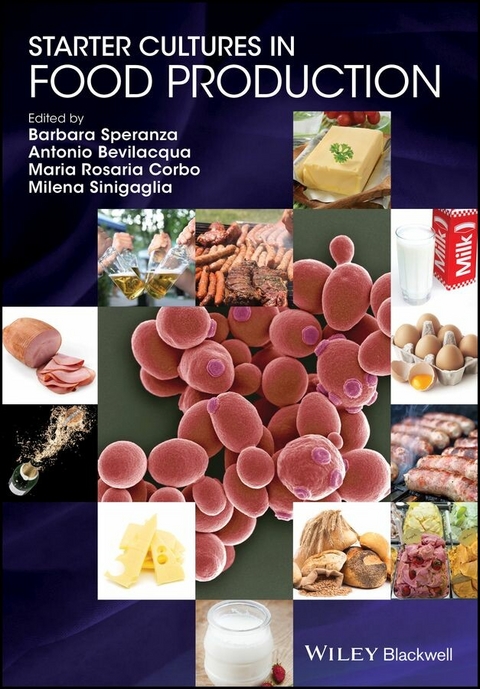
Starter Cultures in Food Production (eBook)
John Wiley & Sons (Verlag)
978-1-118-93378-7 (ISBN)

About the Editors Barbara Speranza, Antonio Bevilacqua, Maria Rosaria Corbo, and Milena Sinigaglia, Department of the Science of Agriculture, Food and Environment (SAFE), University of Foggia, Italy.
List of contributors vii
Preface xi
1 Lactic acid bacteria as starter cultures 1
Clelia Altieri, Emanuela Ciuffreda, Barbara Di Maggio and Milena Sinigaglia
2 Yeasts as starter cultures 16
Pietro Buzzini, Simone Di Mauro and Benedetta Turchetti
3 Fungal starters: An insight into the factors affecting the germination of conidia 50
Philippe Dantigny and Antonio Bevilacqua
4 Non-starter bacteria 'functional' cultures 64
Patricia Ruas-Madiedo and Ana Rodríguez
5 Industrial production of starter cultures 79
Sanna Taskila
6 Safety evaluation of starter cultures 101
Pasquale Russo, Giuseppe Spano and Vittorio Capozzi
7 Management of waste from the food industry: A new focus on the concept of starter cultures 129
Daniela Campaniello, Salvatore Augello, Fabio de Stefano, Stefano Pignatiello and Maria Rosaria Corbo
8 A new frontier for starter cultures: Attenuation and modulation of metabolic and technological performance 148
Antonio Bevilacqua, Barbara Speranza, Mariangela Gallo and Maria Rosaria Corbo
9 The role of the pangenome concept in selecting new starter cultures 162
Antonio Bevilacqua, Francesca Fuccio, Maria Clara Iorio, Martina Loi and Milena Sinigaglia
10 Commercial starters or autochtonous strains? That is the question 174
Maria Rosaria Corbo, Angela Racioppo, Noemi Monacis and Barbara Speranza
11 Sourdough and cereal-based foods: Traditional and innovative products 199
Luca Settanni
12 The role of starter cultures and spontaneous fermentation in traditional and innovative beer production 231
Antonietta Baiano and Leonardo Petruzzi
13 Wine microbiology 255
Patrizia Romano and Angela Capece
14 Starter cultures in vegetables with special emphasis on table olives 283
Francisco Noé Arroyo-López, Antonio Garrido-Fernández and Rufino Jiménez-Díaz
15 New trends in dairy microbiology: Towards safe and healthy products 299
Ana Rodríguez, Beatriz Martínez, Pilar García, Patricia Ruas-Madiedo and Borja Sánchez
16 Sausages and other fermented meat products 324
Renata E.F. Macedo, Fernando B. Luciano, Roniele P. Cordeiro and Chibuike C. Udenigwe
17 Fermentation of fish-based products: A special focus on traditional Japanese products 355
Takashi Kuda
18 Traditional alkaline fermented foods: Selection of functional Bacillus starter cultures for soumbala production 370
Labia Irène I. Ouoba
19 Ethnic fermented foods 384
Marianne Perricone, Ersilia Arace, Giuseppe Calò and Milena Sinigaglia
Index 407
CHAPTER 1
Lactic acid bacteria as starter cultures
Clelia Altieri, Emanuela Ciuffreda, Barbara Di Maggio and Milena Sinigaglia
Department of the Science of Agriculture, Food and Environment, University of Foggia, Italy
Introduction
Starter cultures have a basic role: to drive the fermentation process. Concomitantly, they contribute to all the characteristics of products, as well as to their sensorial and safety characteristics. Therefore, the introduction of starter cultures has undoubtedly improved the quality of products and the standardization of the industrial process.
A very important aspect is to have a good knowledge of the metabolic properties required to improve a specific product and to select useful microbial strains. Nevertheless, the limited number of already selected and studied strains that are also able to possess highly technological properties, as well as the constant risk of bacteriophage attacks, are stimulating research into new starter strains, in order to obtain higher quality and product diversification, in response to more and more aware consumers.
General aspects of starter cultures
The production of fermented foods today is based on the use of starter cultures, for example lactic acid bacteria (LAB), which initiate fast acidification of raw material. The great advantage of starter cultures is that they can provide controlled and predictable fermentation.
Starter cultures of LAB can contribute to microbial safety or offer one or more technological, organoleptic, nutritional or health advantages. Examples are LAB that produce antimicrobial substances, sugar polymers, sweeteners, aromatic compounds, vitamins or useful enzymes, or that have probiotic properties (Leroy and De Vuyst 2004).
While starter cultures, chosen on the basis of their good safety and ‘functional’ characteristics, can benefit the consumer, they must first be able to be manufactured under industrial conditions (Saarela et al. 2000). Safety aspects of LAB include specifications such as origin, non‐pathogenicity, certain metabolic activities (e.g. deconjugation of bile salts), toxin production, haemolytic potential, side effects in human studies (i.e. systemic infections, deleterious metabolic activities, excessive immune stimulation in susceptible individuals and gene transfer) and epidemiological surveillance of adverse incidents in consumers (post‐market). Functional aspects can be related to viability and persistence in the gastrointestinal (GI) tract, survival at low and high pH and in the presence of bile salts, hydrophobic properties, antibiotic resistance patterns, immunomodulation, and antagonistic and antimutagenic properties. Technological aspects concern growth at different sodium chloride (NaCl) amounts, temperatures, pH values, acidifying ability and metabolism (arginin deamination, esculin hydrolysis, acetoin production) and the ability to produce adequate flavour/texture.
With regard to the effect of salting, the addition of NaCl is a common practice in most fermented dairy foods, and also affects the growth of starter bacteria. Most LAB are partially or fully inhibited by levels of NaCl higher than 5%. However, it is evident that salt tolerance is a strain‐dependent characteristic, thus this criterion is important in starter selection (Powell et al. 2011).
LAB starters are primarily used because of their ability to produce lactic acid from lactose and for consequent pH reduction, leading also to important effects like inhibition of undesirable organisms, improvement of sensorial and textural properties, as well as contribution to health benefits. A major role of starter cultures in dairy production is the degradation of peptides generated by the coagulant to small peptides and amino acids. Starter cultures are also capable of degrading caseins and converting amino acids to a range of flavour compounds. However, since many of the proteolytic enzymes are intracellular, flavour development in maturing cheese also depends on the release of the enzymes from starter cultures into the cheese matrix through cell lysis. Cell lysis, and the consequent release into the cheese matrix of intracellular enzymes, particularly peptidases and amino acid‐degrading enzymes, is an important characteristic for both general protein degradation and also the control of bitterness. Autolysis results from the enzymatic degradation of the bacterial cell wall by indigenous peptidoglycan hydrolases released into the growth medium, although it is still unclear how this process is controlled in the cell. The process is highly strain dependent and is also influenced by factors such as the nutrient status of the growth medium and environmental conditions (Lortal and Chapot‐Chartier 2005).
Generally, in maturing cheese there is a positive relationship between the period of starter culture autolysis and the flavour‐forming reactions, involving not only proteolysis but also lipolysis. Consequently, various screening assays using buffers or model cheese and milk solutions have been proposed to select highly autolytic strains for use in cheese manufacture. Lysis positively influences the ripening and flavour of the cheese, but the type of peptidases is also very important, in particular since low peptidase activities and low lytic properties produce bitter cheese. One of the most successful strategies to counteract this defect involves the use of LAB with high peptidase activities, particularly Pep N.
For these reasons, the use of good starter cultures can ensure the safety, quality and acceptability of both traditional and innovative fermented dairy products.
Types of starter cultures
In practice starter cultures may be categorized as mesophilic or thermophilic, according to the incubation and manufacturing temperatures under which they are used. Mesophilic cultures grow and produce lactic acid at optimal levels, at a moderate temperature (about 30 °C), whereas thermophilic cultures optimally function at a higher temperature (about 42 °C). Examples of mesophilic dairy starter cultures are the species Lactococcus lactis subsp. lactis, Lactococcus lactis subsp. cremoris, Leuconostoc mesenteroides subsp. cremoris and Leuconostoc lactis. On the other hand, the most thermophilic LAB species are Streptococcus thermophilus, Lactobacillus delbrueckii and Lactobacillus helveticus.
Nevertheless, the most common classification of starter cultures is based on the complexity of the culture and the way it is reproduced. All starter cultures available today are derived in one way or another from natural starters (or artisanal starters) of undefined composition (i.e. containing an undefined mixture of different strains and/or species). For some types of products, natural starters have been replaced by commercial mixed‐strain starters (MSS), derived from the ‘best’ natural starters and reproduced under controlled conditions by specialized institutions and commercial starter companies, then distributed to the industries that use them to build up bulk starter or for direct vat inoculation. Natural starter cultures and commercial MSS, because of their long history, are called traditional starters (Limsowtin et al. 1996) as opposed to defined strain starters (DSS). DSS are usually composed of only a small number of selected strains and allow greater control over the composition and properties of the cultures. Table 1.1 shows a summary of culture types.
Table 1.1 Culture types and their preparation.
| Types of starter cultures | Description |
| Traditional starters | Natural starters | Low cost. Undefined composition. Highly variable composition and performance. Prone to undesirable contamination; microbiologically hazardous |
| Traditional starters | Mixed‐strain starters (MSS) | Undefined composition. Variable composition and performance. With careful handling and some quality control testing, these are still in limited use, but have largely been replaced by laboratory‐maintained cultures |
| Defined strain starters (DSS) | Defined composition, usually composed of only a small number of strains. This gives a high degree of control over starter performance parameters and product properties, as long as strains are carefully selected and managed |
Traditional cultures contain many strains of many microbial species, sometimes including yeasts and moulds as well as bacteria; they all contribute biochemically to the complexity (and the variability) of the final product (Powell et al. 2011). Therefore, traditional starter preparation methods are still in use for some particular or traditional products, and have been adapted to a limited industrial scale. Industrial‐scale production requires starters that give reproducible performance and are free of undesirable organisms. These goals are difficult to achieve using traditional methods. Thus, DSS have replaced traditional starters in industrial‐scale production because of their optimized, highly reproducible performance and their high phage resistance.
Traditional starters: Natural starters
The production of natural starters is derived from the ancient practice of backslopping (the use of an old batch of a fermented product...
| Erscheint lt. Verlag | 27.2.2017 |
|---|---|
| Sprache | englisch |
| Themenwelt | Naturwissenschaften ► Biologie ► Mikrobiologie / Immunologie |
| Technik ► Lebensmitteltechnologie | |
| Weitere Fachgebiete ► Land- / Forstwirtschaft / Fischerei | |
| Schlagworte | Angewandte Mikrobiologie • applied microbiology • Biowissenschaften • Food Processing, Production & Manufacture • Food Science & Technology • Herstellung u. Verarbeitung von Lebensmitteln • Lebensmittelforschung u. -technologie • Lebensmitteltechnik • Life Sciences • Microbiology, Food Safety & Security • Mikrobiologie • Mikrobiologie u. Nahrungsmittelsicherheit • Starterkultur • Starter selection, Fermentation, Lactic acid bacteria, Fungal starters, Functional starters, Autochthonous strains, Biodiversity, Fermented foods, Attenuation, Pan-genome |
| ISBN-10 | 1-118-93378-8 / 1118933788 |
| ISBN-13 | 978-1-118-93378-7 / 9781118933787 |
| Informationen gemäß Produktsicherheitsverordnung (GPSR) | |
| Haben Sie eine Frage zum Produkt? |
 EPUB (Adobe DRM)
Kopierschutz: Adobe-DRM
Adobe-DRM ist ein Kopierschutz, der das eBook vor Mißbrauch schützen soll. Dabei wird das eBook bereits beim Download auf Ihre persönliche Adobe-ID autorisiert. Lesen können Sie das eBook dann nur auf den Geräten, welche ebenfalls auf Ihre Adobe-ID registriert sind.
Details zum Adobe-DRM
Dateiformat: EPUB (Electronic Publication)
EPUB ist ein offener Standard für eBooks und eignet sich besonders zur Darstellung von Belletristik und Sachbüchern. Der Fließtext wird dynamisch an die Display- und Schriftgröße angepasst. Auch für mobile Lesegeräte ist EPUB daher gut geeignet.
Systemvoraussetzungen:
PC/Mac: Mit einem PC oder Mac können Sie dieses eBook lesen. Sie benötigen eine
eReader: Dieses eBook kann mit (fast) allen eBook-Readern gelesen werden. Mit dem amazon-Kindle ist es aber nicht kompatibel.
Smartphone/Tablet: Egal ob Apple oder Android, dieses eBook können Sie lesen. Sie benötigen eine
Geräteliste und zusätzliche Hinweise
Buying eBooks from abroad
For tax law reasons we can sell eBooks just within Germany and Switzerland. Regrettably we cannot fulfill eBook-orders from other countries.
aus dem Bereich