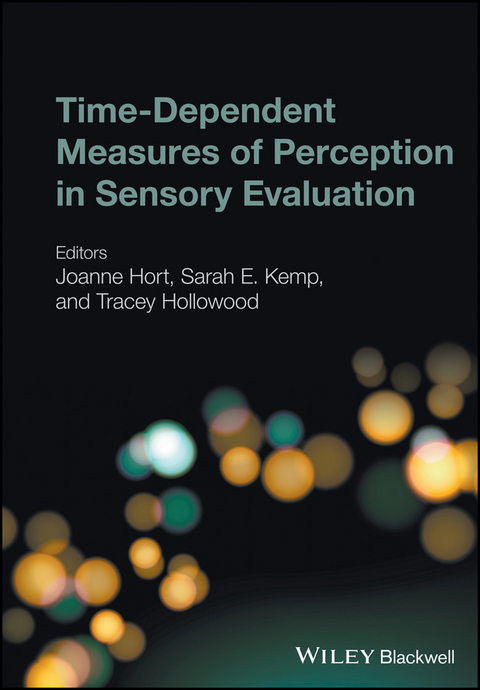
Time-Dependent Measures of Perception in Sensory Evaluation (eBook)
John Wiley & Sons (Verlag)
978-1-118-99162-6 (ISBN)
Sensory evaluation is a scientific discipline used to evoke, measure, analyse and interpret responses to products perceived through the senses of sight, smell, touch, taste and hearing. It is used to reveal insights into the way in which sensory properties drive consumer acceptance and behaviour, and to design products that best deliver what the consumer wants. It is also used at a more fundamental level to provide a wider understanding of the mechanisms involved in sensory perception and consumer behaviour.
Sensory perception of products alters considerably during the course of consumption/use. Special techniques are used in product development to measure these changes in order to optimise product delivery to consumers. Time-Dependent Measures of Perception in Sensory Evaluation explores the many facets of time-dependent perception including mastication and food breakdown, sensory-specific satiety and sensory memory. Both traditional and cutting-edge techniques and applications used to measure temporal changes in sensory perception over time are reviewed, and insights into the way in which sensory properties drive consumer acceptance and behaviour are provided.
This book will be a valuable resource for sensory professionals working in academia and industry, including sensory scientists, practitioners, trainers and students; and industry-based researchers in QA/QC, R&D and marketing.
Notes on Authors, ix
List of Contributors, xi
Preface, xiii
Preface to the Series, xvi
Acknowledgements, xix
Section 1: Introduction
1 Time?-dependent Measures of Perception: An Introduction, 3
Joanne Hort, Tracey Hollowood and Sarah E. Kemp
Section 2: Physiological and psychological aspects of time?-dependent sensory perception
2 Mastication, Salivation and their Interactions during Eating, 27
Guy Carpenter and Annie Blissett
3 Sensory?-specific Satiation and Satiety, 48
Marion M. Hetherington, Samantha Caton and Chandani Nekitsing
4 Sensory Adaptation, 67
Louise Hewson and Amparo Tarrega
5 Sensory Memory, 88
Ep Köster and Jos Mojet
6 The Dynamics of Liking, 124
Jos Mojet and Ep Köster
Section 3: Techniques
7 General Considerations, 159
Erminio Monteleone and Caterina Dinnella
8 Time-Intensity Using Discrete Time Points, 182
Carla Kuesten
9 Continuous Time-Intensity, 237
Caroline Chaya
10 Dual-attribute Time-intensity, 267
Christopher J. Findlay
11 Temporal Dominance of Sensations, 283
Pascal Schlich and Nicolas Pineau
12 Multiple-ingestion Time-Intensity, 321
Linda Jamieson and Emma Watling
Section 4: Applications
13 Application of Time?-dependent Measures to Food Products, 345
Nathalie Martin
14 Temporal Methods for the Assessment of Household and Personal Care Products, 362
Tracey Sanderson and Tracey Hollowood
15 Application of Time-Dependent Measures to Understand Sensory Perception, 388
Joanne Hort
Section 5: Summary
16 Summary, 401
Joanne Hort, Tracey Hollowood and Sarah E. Kemp
Index, 000
CHAPTER 1
Time‐Dependent Measures of Perception: An Introduction
Joanne Hort, Tracey Hollowood and Sarah E. Kemp
1.1 Introduction
Perception of a product is a dynamic process. This description concerning drinking beer (Bickham, 1997) is a great example outlining one of the many temporal sensory journeys encountered by consumers when interacting with products.
From the moment the bottle is opened and the beer is poured into a glass, our ears are greeted by the hiss of escaping carbon dioxide. Our eyes are attracted by the sparkling clarity of a Pilsener, the hazy sheen of a Weizen, or the black depth of a stout. We patiently wait for the creamy head to slowly collapse, leaving wisps of Belgian lace on the sides of the glass. As we bring the beer to our lips, our nose detects the aroma of citrusy hops in an American pale ale, bittersweet chocolate in a porter, or perhaps fruity, spicy esters in a Trappist ale. Finally, we imbibe, savouring the malt, hop, and ester flavours before swallowing to let the hop alpha‐acids wake the taste buds on the back of the tongue. We take another drink and swish the beer through our mouth to evaluate the body and mouthfeel. Ah, this seems like a well‐made beer – but wait! What is that lingering aftertaste? Does it taste like cooked cabbage, or is it perhaps reminiscent of newly mown grass? Is that a hint of paper or leather in the background?’
Wine, chocolate, ice cream and chewing gum are all further obvious examples of food products whose sensory properties change dynamically during oral processing, but in fact all food and beverages will be warmed, mixed and manipulated to some degree in the mouth resulting in changeable sensory profiles. Of course, it is not just simply foods which exhibit temporal sensory profiles – for example, the vibrancy of lipstick, persistency of a hair dye and the intensity and nature of perfumes, cologne, air fresheners, fabric conditioners and deodorants are all attributes which also change overtime and are regarded as quality attributes by the consumer. Descriptive techniques at different time points have been widely adopted and adapted for many different types of products including foods, beverages, fragrances, cosmetics, personal care and household products.
1.2 Development of Time‐Dependent Techniques for Dynamic Changes in Sensory Attributes
Measures made at a single time point, such as those obtained through traditional descriptive analysis techniques (Kemp et al., 2016) require assessors, or even consumers, to make an evaluation at one time point and hence do not capture the full temporal sensory encounter. Such evaluations are likely to be an integration of the whole experience (Dijksterhuis and Piggot, 2000), or depending on the assessor or tasting protocol, specific to a certain point in time. Thus, it is not surprising that temporal methods that captured dynamic changes began to be developed alongside other sensory techniques. The need to measure attribute intensity over time was initially recognised in the literature as an important aspect of taste perception in 1937 by Holway and Hurvich (1937). In the fifties, Sjostrom (1954) began quantifying the temporal response and, over the next three decades, developments in the technique and particularly its data acquisition methods (for example: Jellinek, 1964; Meiselman, 1968; McNulty and Moskowitz, 1974; Larson‐Powers and Pangborn, 1978; Lawless and Skinner, 1979; Birch and Munton, 1981; Munoz et al., 1986; Guinard et al., 1985; Lee, 1985) saw its wide application to taste and flavour perception (Cliff and Heymann, 1993). Not surprisingly, there have been several useful published reviews of the technique to which the reader is directed (Lee and Pangborn, 1986; Cliff and Heymann, 1993; and Dijksterhuis and Piggott, 2000).
Initially, time–intensity (TI) data were collected at discrete time points defined by the investigator. However, the development of chart recorders and computer programs allowed for the collection of continuous data. Nowadays, the choice between discrete and continuous TI (CTI) techniques is related to the objective of the test – for short events, CTI is ideal but for longer investigations, e.g. the intensity of fabric conditioner fragrance on laundry, judgements made at discrete well‐defined time points are most effective. Chapters 8 and 9 in this text provide an updated look at developments in discrete and CTI methods, respectively, and provide guidance on specific methodological considerations and data analysis techniques. Each also provides useful case studies highlighting the effective application of these techniques.
CTI was designed to follow the perceptual intensity of a single attribute, and has been useful to investigate key product attributes, such as mint flavour in chewing gum, but it is rare for products to vary in just one characteristic over time. Methods have since been developed which track the intensity of more than one attribute, such as progressive profiling (Jack et al., 1994); the dynamic flavour profile method (DeRovira 1996), sequential profiling (Methven et al., 2010) and dual‐attribute TI (DATI; Duizer et al., 1996, 1997). The last is the subject of Chapter 10.
Changes in attribute intensity are not the only changes that occur to sensory properties over time and, although TI continues to be a well‐used tool in the sensory toolbox, the 21st century has seen the development of new approaches which enable other aspects of a sensory temporal profile to be explored. The most notable development has been the technique that emerged from Pascal Schlich’s laboratory at INRA, Dijon, called temporal dominance of sensations (TDS; Pineau et al., 2003, 2009), recently reviewed by Di Monaco et al. (2014). Rather than focusing on single attribute intensities, this approach considers all product attributes from which the panel then identify those that are perceived to be dominant at any time during consumption. It captures data that allows the sequence of dominant sensations experienced during product interactions to be described. It is not proposed as a replacement to TI but as a complementary and different way of looking at the temporal profile experienced by the consumer over time. Chapter 11 provides a comprehensive review of the technique, aspects of data analysis and presentation and considerations relating to the practical application of the technique.
The application of the aforementioned techniques has often been restricted to single bites or sips of products but this is rarely representative of real situations where individuals consume multiple bites or sips of the product. The TDS approach has already been extended to multiple sips with success (Jappinen 2014; Zorn et al., 2014; Hort et al., 2015). Where researchers have required a fuller sensory profile of how attribute intensity for a full range of sensory characteristics evolves during repeated exposure to a product, multi‐sampling TI has provided a solution. Essentially, assessors perform a series of single‐attribute evaluations across multiple sips/bites of the product. This approach is the subject of Chapter 12, which contains two interesting case studies on measuring the temporal profiles of ice cream and tea.
The measurement of temporal changes in sensory attributes appears to have been re‐energised in that last few years with new methods such as temporal order of sensations (TOS; Pecore et al., 2009) and temporal check‐all‐that‐apply (TCATA; Castura et al., 2014a,b) methodologies presented at recent Sensory meetings, which are already available within some commercial data collection and analysis software programmes. Although these approaches do not have dedicated chapters in this book, they are described in the final summary chapter.
The use of time‐dependent measures continues to evolve. In the early years, the focus was on development of the original TI approach, its data collection and analysis, and its application to understand fundamental elements of taste and aroma perception one attribute at a time. Developments in techniques that have enabled multiple attributes to be considered concurrently have seen broader application of the technique beyond technical understanding to much wider product development applications.
1.3 Time‐dependent Methods as Tools in Sensory Evaluation
Time‐dependent methods are a distinctive subset of descriptive analysis techniques that allow the changes in the temporal sensory profile of a product to be monitored. Like all descriptive techniques, they generally provide detailed, precise, reliable and objective information concerning the sensory attributes of a product. However, uniquely, they are focused on capturing information about the dynamic changes in an attribute or attributes, whereas other descriptive techniques provide a profile of an overall impression of an attribute or an attribute at a single time point. Non‐time‐dependent descriptive techniques provide an overall sensory profile of the product, although sometimes temporal elements are captured by stating the stage during consumption/use at which a measure is taken – for example, initial sweetness, sweetness in the mouth, sweet aftertaste. This provides useful information and researchers should consider whether such a level of information is sufficient for their particular objectives before investing in what are often more time‐consuming and costly approaches with time‐dependent techniques (Lawless and Heymann, 1998). However, where...
| Erscheint lt. Verlag | 21.2.2017 |
|---|---|
| Sprache | englisch |
| Themenwelt | Naturwissenschaften ► Biologie |
| Naturwissenschaften ► Chemie | |
| Technik ► Lebensmitteltechnologie | |
| Weitere Fachgebiete ► Land- / Forstwirtschaft / Fischerei | |
| Schlagworte | Food Management • Food Marketing & Product Development • Food Science & Technology • Lebensmittelforschung u. -technologie • Lebensmittel-Management • Lebensmittelsensorik • Lebensmittel-Vermarktung u. -Produktentwicklung • Sensory Evaluation, Temporal measures, Time Intensity, Food choice, Temporal Dominance of Sensations, Food memory, sensory Liking, Sensory Specific Satiety, Sensory Methods • Sensory Science |
| ISBN-10 | 1-118-99162-1 / 1118991621 |
| ISBN-13 | 978-1-118-99162-6 / 9781118991626 |
| Informationen gemäß Produktsicherheitsverordnung (GPSR) | |
| Haben Sie eine Frage zum Produkt? |
 EPUB (Adobe DRM)
Kopierschutz: Adobe-DRM
Adobe-DRM ist ein Kopierschutz, der das eBook vor Mißbrauch schützen soll. Dabei wird das eBook bereits beim Download auf Ihre persönliche Adobe-ID autorisiert. Lesen können Sie das eBook dann nur auf den Geräten, welche ebenfalls auf Ihre Adobe-ID registriert sind.
Details zum Adobe-DRM
Dateiformat: EPUB (Electronic Publication)
EPUB ist ein offener Standard für eBooks und eignet sich besonders zur Darstellung von Belletristik und Sachbüchern. Der Fließtext wird dynamisch an die Display- und Schriftgröße angepasst. Auch für mobile Lesegeräte ist EPUB daher gut geeignet.
Systemvoraussetzungen:
PC/Mac: Mit einem PC oder Mac können Sie dieses eBook lesen. Sie benötigen eine
eReader: Dieses eBook kann mit (fast) allen eBook-Readern gelesen werden. Mit dem amazon-Kindle ist es aber nicht kompatibel.
Smartphone/Tablet: Egal ob Apple oder Android, dieses eBook können Sie lesen. Sie benötigen eine
Geräteliste und zusätzliche Hinweise
Buying eBooks from abroad
For tax law reasons we can sell eBooks just within Germany and Switzerland. Regrettably we cannot fulfill eBook-orders from other countries.
aus dem Bereich