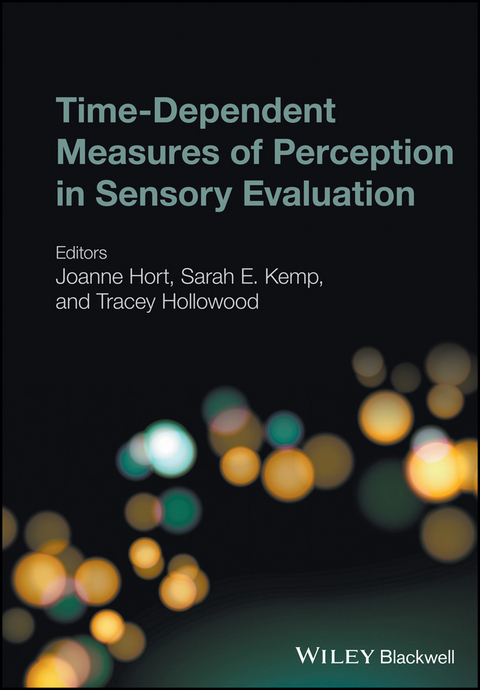
Time-Dependent Measures of Perception in Sensory Evaluation (eBook)
John Wiley & Sons (Verlag)
978-1-118-99168-8 (ISBN)
Sensory evaluation is a scientific discipline used to evoke, measure, analyse and interpret responses to products perceived through the senses of sight, smell, touch, taste and hearing. It is used to reveal insights into the way in which sensory properties drive consumer acceptance and behaviour, and to design products that best deliver what the consumer wants. It is also used at a more fundamental level to provide a wider understanding of the mechanisms involved in sensory perception and consumer behaviour.
Sensory perception of products alters considerably during the course of consumption/use. Special techniques are used in product development to measure these changes in order to optimise product delivery to consumers. Time-Dependent Measures of Perception in Sensory Evaluation explores the many facets of time-dependent perception including mastication and food breakdown, sensory-specific satiety and sensory memory. Both traditional and cutting-edge techniques and applications used to measure temporal changes in sensory perception over time are reviewed, and insights into the way in which sensory properties drive consumer acceptance and behaviour are provided.
This book will be a valuable resource for sensory professionals working in academia and industry, including sensory scientists, practitioners, trainers and students; and industry-based researchers in QA/QC, R&D and marketing.
Joanne Hort, Associate Professor in Sensory Science, University of Nottingham, UK. Joanne Hort, BEd (Hons), PhD, MIFST, initially studied Food Technology and began her career in teaching. However, she returned to the university to receive her doctorate concerning the modelling of the sensory attributes of cheese from analytical and instrumental measures in 1998. As a lecturer at Sheffield Hallam University, she carried out sensory consultancy for local industry, developed a sensory program at undergraduate level and oversaw the installation of new sensory facilities before being appointed as Lecturer in Sensory Science at the University of Nottingham in 2002. She has since established the University of Nottingham Sensory Science Centre, which is renowned for both its sensory training and research into flavour perception. She delivers sensory courses at both undergraduate and postgraduate levels and is the Course Director for the Postgraduate Certificate in Sensory Science. Her research interests focus on the multimodal aspects of flavour perception and she has published several articles in this area, together with oral presentations and posters at international symposia. She is a founder member and current Chair of the Professional Food Sensory Group of the Institute of Food Science and Technology and was on the organising committee of the 6th International Pangborn Symposium in the United Kingdom in 2005.
Dr Sarah E. Kemp, Consultant and formerly Head of Global Sensory and Consumer Guidance, Cadbury Schweppes, Broadstairs, Kent, UK. Sarah Kemp, BSc (Hons), PhD, CSci, FIFST, is a sensory and consumer science professional with more than 20 years of experience in academia and industry. Dr Kemp gained a BSc in Food Technology in 1986 and a PhD in Taste Chemistry in 1989 from the Food Science and Technology Department at Reading University, UK. In 1990, she did a postdoctoral research fellowship on sensory analysis at the Monell Chemical Senses Center in Philadelphia, USA. Dr Kemp has held numerous positions in the industry, including Manager of Sensory Psychology in the Fragrance Division of Givaudan-Roure in New Jersey, USA, Director of European Consumer and Marketing Research in the Fragrance Division at Givaudan-Roure, France, Product Area Leader and Sensory Science Leader in Foods Consumer Science at Unilever Research Colworth, UK, Head of Global Sensory and Consumer Guidance at Cadbury Schweppes, UK, and Director of Sensory and Consumer Services at Reading Scientific Services Ltd, UK. Dr Kemp has also set up and run her own consultancy service, Kemps Research Solutions Ltd. She has written numerous scientific articles in the field of sensory evaluation, has provided sensory training courses, including lecturing on the European Masters Course in Food Science, and has worked with bodies developing standards in sensory evaluation, such as the American Society for Testing and Materials and the British Standards Institute. She is a founder member of the Professional Food Sensory Group of the Institute of Food Science and Technology, and a member of several other professional bodies, including the Sensory Evaluation Division of the Institute of Food Technologists, and the Consumer and Sensory Research Technical Interest Group of the Society of Chemical Industry.
Tracey Hollowood, Director of Sensory and Consumer Research, Sensory Dimensions Ltd, Nottingham, UK. Hollowood, BSc (Hons), PhD, MIFST, has over 15 years of experience in academia and industry; she worked at Nottingham University for 10 years during which time she achieved her doctorate investigating perceptual taste-texture-aroma interactions. She established the United Kingdom's first Post Graduate Certificate in Sensory Science, and designed and managed the university's prestigious Sensory Science Centre. Her early research focused on psychophysical studies, and interactions in sensory modalities; more latterly with Sensory Dimensions her research has centred more on method development and evaluation against excepted procedures. She has over 20 peer-reviewed publications; has given numerous oral presentations and workshops; and has participated in the organisation of seven international symposia, including International Symposium of Taste 2000 and Pangborn Sensory Science Symposium 2005. She is the current Chair of the Institute of Food Science and Technology (IFST), Midland Branch and an active founder member of the Professional Food Sensory Group (PFSG).
Title Page 5
Copyright Page 6
Contents 9
Notes on Editors 11
List of Contributors 13
Preface to the Series 15
Preface 18
Acknowledgements 21
Section I Introduction 23
Chapter 1 Time-Dependent Measures of Perception: An Introduction 25
1.1 Introduction 25
1.2 Development of Time-Dependent Techniques for Dynamic Changes in Sensory Attributes 26
1.3 Time-dependent Methods as Tools in Sensory Evaluation 28
1.4 Time-dependent Measures of the Affective Response 31
1.5 Applications of Time-Dependent Measures of Perception 32
1.6 Summary 38
References 39
Section II Physiological and psychological aspects of time-dependent sensory perception 47
Chapter 2 Mastication, Salivation and their Interactions during Eating 49
2.1 Introduction 49
2.2 Mastication 49
2.3 Saliva and Salivation 58
2.4 Summary 65
References 66
Chapter 3 Sensory-Specific Satiation and Satiety 70
3.1 Introduction 70
3.2 Theory 71
3.3 Traditional Methodology 73
3.4 Practical Aspects of Measuring Sensory-Specific Satiety 77
3.5 Future Developments 82
3.6 Summary and Conclusions 82
3.7 Case Study 83
3.8 Conclusion 85
References 85
Chapter 4 Sensory Adaptation 89
4.1 Introduction 89
4.2 Olfactory Adaptation 90
4.3 Gustatory Adaptation 92
4.4 Adaptation in the Trigeminal System 95
4.5 Cross-Adaptation, Potentiation and Reversal of Mixture Suppression 96
4.6 Adaptation in ‘Normal’ Consumption of Food and Drink Products 100
4.7 Impact of Adaptation in Sensory Evaluation 101
4.8 Summary 105
References 105
Chapter 5 Sensory Memory 110
5.1 Introduction 110
5.2 Theory 112
5.3 Methodology 116
5.4 Statistics 127
5.5 Application 129
5.6 Future Developments 135
5.7 A Case Study 136
5.8 Conclusion 139
References 140
Chapter 6 The Dynamics of Liking 146
6.1 Introduction 146
6.2 Theory 148
6.3 Traditional Methodology 159
6.4 New Leading-edge Methodology 160
6.5 Statistics 166
6.6 Practical Applications 167
6.7 General Conclusions 172
References 172
Section III Techniques 179
Chapter 7 General Considerations 181
7.1 General Introduction 181
7.2 Aims and Applications of Time-Dependent Methods 184
7.3 General Protocols for Time-Dependent Evaluations 187
7.4 Choice of Methodology 194
7.5 Factors Affecting Results 195
7.6 Data Analysis 196
7.7 Future 198
References 199
Chapter 8 Time–Intensity Using Discrete Time Points 204
8.1 Introduction 204
8.2 DTI Methodology 206
8.3 Advances in DTI Methodology 208
8.4 Statistical Analysis of DTI Data 210
8.5 Applications 211
8.6 Practical Considerations for Performing DTI 229
8.7 Case Study 1: Development of Palatable Drug Formulations Using Discrete TI Sensory Methodology 232
8.8 Case Study 2: Beer Glass Design Optimisation Using Discrete Time Intensity Throughout Full-Glass Consumption 238
8.9 Case Study 3: Taffy Chew Flavour and Texture Evaluation Using MATI 243
8.10 Case Study 4: Consumer-Focused Shelf-life Validation Study: Illustration of Consumer Affective Evaluation for Air Fresheners 248
8.11 Future Developments 253
8.12 Conclusion 254
References 254
Chapter 9 Continuous Time–Intensity 259
9.1 Definition 259
9.2 History 259
9.3 Dynamics of Sensory Perception 260
9.4 CTI Methodology 261
9.5 Relationship to Conventional Sensory Profiling 263
9.6 Recruitment, Selection and Training of Assessors 264
9.7 Panel Performance Evaluation 265
9.8 Data Analysis 267
9.9 Practical Considerations 272
9.10 Applications 276
9.11 Case Study 277
9.12 Further Developments 285
References 285
Chapter 10 Dual-Attribute Time–Intensity 289
10.1 Introduction 289
10.2 Collecting Dual-Attribute Time-Intensity Data 290
10.3 A Practical Example of DATI 291
10.4 Research Studies to Explore DATI 294
10.5 Considerations for Test Design 298
10.6 Orientation of Attributes 298
10.7 The Myth of Multi-tasking 300
10.8 Some Thoughts on Attribute Selection 300
10.9 Conclusions 302
References 303
Chapter 11 Temporal Dominance of Sensations 305
11.1 Introduction 305
11.2 What is TDS? 306
11.3 TDS Experiment and Panel Training 310
11.4 Data Analysis 316
11.5 Some Applications 331
11.6 TDS in the Future 335
11.7 Conclusion 338
References 340
Chapter 12 Multiple-Ingestion Time–Intensity 343
12.1 Introduction 343
12.2 Studying Adaptation and Build-up Effects with MITI 345
12.3 MITI Approach 346
12.4 Case Study: Beverages 350
12.5 Case Study of Ice-cream 356
12.6 Practicalities: Food and Drink Products 360
12.7 Application to Non-food Products 361
12.8 Future Developments 362
References 363
Section IV Applications 365
Chapter 13 Application of Time-Dependent Measures to Food Products 367
13.1 Introduction 367
13.2 Dynamics of Perception 369
13.3 Dynamics of Oral Food Breakdown 372
13.4 Dynamics of Liking 376
13.5 Conclusion and Next Steps 381
References 383
Chapter 14 Temporal Methods for Assessment of Household and Personal Care Products 384
14.1 General Introduction 384
14.2 Samples and Experimental Design 388
14.3 Assessors 390
14.4 Temporal Methods 392
14.5 Case Studies 400
References 408
Chapter 15 Application of Time-Dependent Measures to Understand Sensory Perception 410
15.1 Introduction 410
15.2 Early Application of Time-Dependent Methods to Understand Perception 410
15.3 Application of Time-Dependent Methods to Understand Taste Perception 411
15.4 Application of Time-Dependent Methods to Understand Trigeminal Perception 413
15.5 Application of Time-Dependent Methods to Understand Aroma/Flavour Perception 414
15.6 Application of Time-Dependent Methods to Understand Texture Perception 415
15.7 Using Time-Dependent Methods to Understand Multimodal Perceptual Mechanisms 415
15.8 Summary and Future 416
References 416
Section V Summary 421
Chapter 16 Summary 423
16.1 Introduction 423
16.2 Recently Developed Time-Dependent Techniques 424
16.3 Relative Merits of Time-Dependent Measures of Perception 428
16.4 Complementary use of Time-Dependent and Single-point Measures of Perception 431
16.5 Current Developments in Time-Dependent Measures of Perception 431
16.6 The Future 436
16.7 Conclusion 437
References 437
Index 439
EULA 456
| Erscheint lt. Verlag | 21.2.2017 |
|---|---|
| Sprache | englisch |
| Themenwelt | Naturwissenschaften ► Biologie |
| Naturwissenschaften ► Chemie | |
| Technik ► Lebensmitteltechnologie | |
| Weitere Fachgebiete ► Land- / Forstwirtschaft / Fischerei | |
| Schlagworte | Food Management • Food Marketing & Product Development • Food Science & Technology • Lebensmittelforschung u. -technologie • Lebensmittel-Management • Lebensmittelsensorik • Lebensmittel-Vermarktung u. -Produktentwicklung • Sensory Evaluation, Temporal measures, Time Intensity, Food choice, Temporal Dominance of Sensations, Food memory, sensory Liking, Sensory Specific Satiety, Sensory Methods • Sensory Science |
| ISBN-10 | 1-118-99168-0 / 1118991680 |
| ISBN-13 | 978-1-118-99168-8 / 9781118991688 |
| Informationen gemäß Produktsicherheitsverordnung (GPSR) | |
| Haben Sie eine Frage zum Produkt? |
 PDF (Adobe DRM)
Kopierschutz: Adobe-DRM
Adobe-DRM ist ein Kopierschutz, der das eBook vor Mißbrauch schützen soll. Dabei wird das eBook bereits beim Download auf Ihre persönliche Adobe-ID autorisiert. Lesen können Sie das eBook dann nur auf den Geräten, welche ebenfalls auf Ihre Adobe-ID registriert sind.
Details zum Adobe-DRM
Dateiformat: PDF (Portable Document Format)
Mit einem festen Seitenlayout eignet sich die PDF besonders für Fachbücher mit Spalten, Tabellen und Abbildungen. Eine PDF kann auf fast allen Geräten angezeigt werden, ist aber für kleine Displays (Smartphone, eReader) nur eingeschränkt geeignet.
Systemvoraussetzungen:
PC/Mac: Mit einem PC oder Mac können Sie dieses eBook lesen. Sie benötigen eine
eReader: Dieses eBook kann mit (fast) allen eBook-Readern gelesen werden. Mit dem amazon-Kindle ist es aber nicht kompatibel.
Smartphone/Tablet: Egal ob Apple oder Android, dieses eBook können Sie lesen. Sie benötigen eine
Geräteliste und zusätzliche Hinweise
Buying eBooks from abroad
For tax law reasons we can sell eBooks just within Germany and Switzerland. Regrettably we cannot fulfill eBook-orders from other countries.
aus dem Bereich