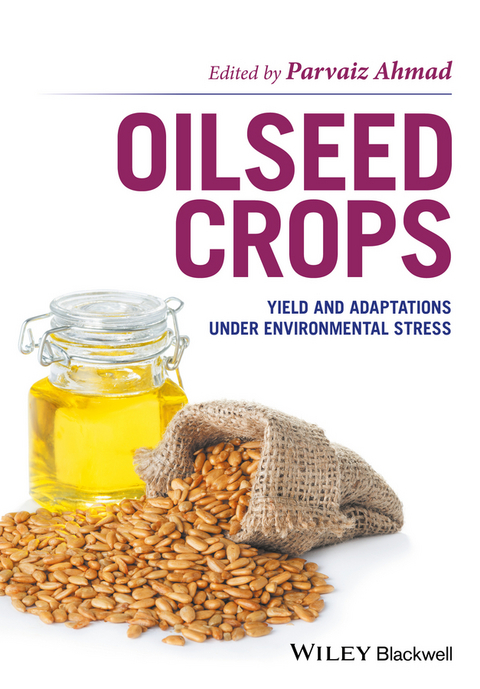
Oilseed Crops (eBook)
312 Seiten
Wiley-Blackwell (Verlag)
978-1-119-04878-7 (ISBN)
Oil Seed Crops: Yield and Adaptations under Environmental Stress is a state-of-the-art reference that investigates the effect of environmental stress on oil seed crops and outlines effective ways to reduce stress and improve crop yield.
With attention to physiological, biochemical, molecular, and transgenic approaches, the chapters discuss a variety of oil seed crops and also cover a broad range of environmental stressors including microbes, salt, heavy metals, and climate change.
Featuring up-to-date research from a global group of experts, this reference provides innovative recommendations for mitigating environmental stress and promoting the healthy growth, development, and adaptation of crops.
About the Editor
Parvaiz Ahmad, Department of Botany, Sri Pratap College, India
About the Editor Parvaiz Ahmad, Department of Botany, Sri Pratap College, India
List of contributors, vii
Preface, x
About the editor, xii
1 Oilseed crops: Present scenario and future prospects, 1
Sarah Waseem, Sameen Ruqia Imadi, Alvina Gul, and Parvaiz Ahmad
2 Castor bean (Ricinus communis L.): Diversity, seed oil and uses, 19
Ezzeddine Saadaoui, José J. Martín, Nizar Tlili, and Emilio Cervantes
3 Seed composition in oil crops: Its impact on seed germination performance, 34
Natalia Izquierdo, Roberto Benech-Arnold, Diego Batlla, Raúl González Belo, and Jorge Tognetti
4 Oilseed crops and biodiesel production: Present and future prospects, 52
Abdalbasit A. Mariod and Mohammed Salaheldeen
5 Vegetable oil yield and composition influenced by environmental stress factors, 80
Sandra Balbino
6 Soybean: Growth, development and yield under salt stress, 102
Olimpia Gladysz, Agnieszka Waskiewicz, Bartosz Ciorga, and Piotr Golinski
7 Sunflower resistance to the vampire weed broomrape: A Van Helsing quest story, 123
Pascal Labrousse and David Delmail
8 Biochemical and molecular studies on the commercial oil-yielding desert shrub Simmondsia chinensis (jojoba, a desert gold), 152
Suphiya Khan, Swati Agarwal, and Vinay Sharma
9 Role of phytohormones in improving the yield of oilseed crops, 165
Mohammad Ashfaq and Suphiya Khan
10 Plant-microbe interaction in oilseed crops, 184
Faisal Islam, Basharat Ali, Muhammad A. Farooq, Rafaqat A. Gill, Jian Wang, and Weijun Zhou
11 Brassicaceae plants: Metal accumulation and their role in phytoremediation, 207
Zeshan Ali, Hina Waheed, Alvina Gul, Farzana Afzal, Kiran Anwaar, and Saiqa Imran
12 Role of organic and inorganic amendments in alleviating heavy metal stress in oilseed crops, 224
Muhammad Rizwan, Shafaqat Ali, Farhat Abbas, Muhammad Adrees, Muhammad Zia-ur-Rehman, Mujahid Farid, Rafaqat Ali Gill, and Basharat Ali
13 Biochemical and molecular responses of oilseed crops to heavy metal stress, 236
Zaid ul Hassan, Shafaqat Ali, Rehan Ahmad, Muhammad Rizwan, Farhat Abbas, Tahira Yasmeen, and Muhammad Iqbal
14 The role of oilseed crops in human diet and industrial use, 249
Olufunmilola A. Abiodun
15 Appraisal of biophysical parameters in Indian mustard (Brassica juncea) using thermal indices, 264
Tarun Adak and N.V.K. Chakravarty
Index, 286
CHAPTER 1
Oilseed crops: Present scenario and future prospects
Sarah Waseem1, Sameen Ruqia Imadi1, Alvina Gul1, and Parvaiz Ahmad2
1 Atta‐ur‐Rahman School of Applied Biosciences, National University of Sciences and Technology, Islamabad, Pakistan
2 Department of Botany, S.P. College, Jammu and Kashmir, India
1.1 Introduction
Oilseed crops belong to numerous plant families and their seeds are used not only as a source of oil but also as raw materials for various oleo‐chemical industries. The raw materials act as a renewable source of energy and are associated with power generation (Jankowski & Budzynski, 2003). Among various oilseed crops, the preferred ones are soybean, sesame, safflower, sunflower, groundnut, and castor (Weiss, 2000). The crops of sunflower, soybean, and canola offer good management options for irrigation reduction, thus enhancing the benefits of reduced input costs of these oilseed crops (Aiken & Lamm, 2006). There exists a positive correlation between soil water extraction and rooting depth in oilseed crops. The tap root, along with the well‐formed root growth system of safflower, allows this oilseed crop to extract moisture at greater depths from the soil. When safflower water requirements are satisfied with 68.6% and 78.4% water content, the crop provides the yield of 392 kgha−1 after only one turn of irrigation. Safflower yields 762 kgha−1 with two irrigations (Kar et al., 2007). Oilseed crops like soybean, sunflower, and canola are susceptible to Sclerotinia sclerotiorum, a fungal pathogen that is responsible for a reduction in the yield of these crops. The application of sulfur as fertilizer on the oilseed crops results in increased concentration of oil as well as protein content of the Brassica seeds (Malhi et al., 2006). For the production of a ton of oilseed, approximately 12 Kg sulfur is required (Ghosh et al., 2000). Some 23.5% of protein content has been observed in canola after the application of 80 kgha−1 of nitrogen but this did not play a significant role in increasing the oil content (Ahmad et al., 2007). There has been an increased risk of blackleg in canola fields when crops are planted adjacent to canola stubble that is six months mature. To avoid serious damage by blackleg in canola fields, it is recommended that the crops should be sown in such a way that there is a distance of at least 500 m from last season’s canola stubble (Marcroft et al., 2004). Among the various oilseed crops, there are some anti‐nutritive compounds such as condensed tannins, inositol phosphates, and glucosinolates, etc. All such anti‐nutritive compounds are responsible for lowering the nutritive value of oilseed crops. In most situations these compounds do not harm the crop plants (Matthaus & Angelini, 2005). Advances in plant technology and the advent of metabolic engineering have enabled the modification of oilseed crops, thus establishing transgenic crop plants. Such transgenic oilseed crops have novel biosynthetic genes taken from noncommercial plants that provide the oilseed plants with good fatty acids (Thelen & Ohlrogge, 2002). To modify the fatty acid content of oilseed crops, the technique of mutagenesis is very important (Velasco & Fernández‐Martínez, 2000). In this way, these modified crops are responsible for the provision of great benefits to human health (Thelen & Ohlrogge, 2002). Various catabolic as well as biosynthetic enzymes have also been shown to play a significant role in the regulation of the fatty acid component of the oilseed crops. Among such biosynthetic and catabolic enzymes, the best characterized ones include KAS (β‐ketoacyl‐ACP synthases), TE (thioesterases), and acyltransferases (Dehesh, 2001). In soils that are tainted with a high cadmium content, that has accumulated due to the application of phosphatic fertilizers, specifically in Australia, the linseed crops accumulated much greater concentrations of cadmium compared to other crop species, such as wheat, canola, lupins, and Indian mustard (Hocking & McLaughlin, 2000). Linseed crops follow a model of simulation termed STICS that ensures the calibrations of linseed are in harmony with water consumption, with the crop yield as well as the nitrogen content of the crop (Flenet et al., 2004). Of GM crops, one of the first to be modified was oilseed rape (Brassica napus), and various concerns were raised regarding pollution of the environment due to oilseed rape pollen contamination of non‐GM crops from GM crops (Rieger et al., 2002).
1.2 Cultivation of oilseed crops
Aimed at the production of high quality seed crops via conventional breeding as well as through genetic engineering, it is worthwhile typifying the overall genetic variety of the crop plants (Iman et al., 2011). In the rankings of oilseed crops across the world, canola (Brassica napus) is the second leading oilseed crop in the world (Maheshwari et al., 2011). However, the oilseed crop, Brassica napus, when cultivated on large acreages of land, causes problems for the ecosystem as its large‐scale cultivation results in a slanted relationship between the pollinator and the crop. The distorted relationship is the consequence of a decline in the bumblebee population along with an increase in nectar robbers (Diekotter et al., 2010). In vitro generation of canola through tissue culture using an MS medium showed that, in contrast to the root and hypocotyl, cotyledons of the seed are very able to regenerate (Kamal et al., 2007). As it is rich in protein content, canola is cultivated as food for shrimps and fish in the aquatic environment. The limiting factors why canola is not used for animal feed are the anti‐nutritive compounds that include phytates and the phenolic compounds (Enami, 2011). Genetically modified canola crops for herbicide resistance were nurtured in Canada but stayed impotent in order to have good weed control (Gusta et al., 2011). Various rhizobacteria played significant roles in increasing the growth of the canola plant, along with the application of chemical fertilizers. Azospirillum brasilense (a rhizobacteria) triggered the canola seed to increase in size as well as in protein content. Azotobactervinelandii was responsible for the noteworthy rise of the oleic acid content in canola seeds (Nosheen et al., 2011).
Mustard, one of the best‐known oilseed crops, is cultivated because of its wholesome strengths. Sinapis alba, ordinarily known as white mustard, when grown on contaminated soils tainted with Thallium, introduced that element into the oilseed crop, hence, providing an unwelcome element within the food chain (Vane&c.breve;k et al., 2010). The cultivation of rapeseed‐mustard requires special management strategies. Such management stratagems first of all include soil testing to check the nutrient content of the soil at the specific site. Apposite use of natural resources along with appropriate irrigation and defense against pests and diseases works as one of the best approaches to increase the yield of rapeseed‐mustard (Shekhawat et al., 2012). In the rhizosphere, Indian mustard has exhibited pronounced growth in acidic loams whereas little growth has been observed in basic soils (Kim et al., 2010). In combination with sucrose, mustard is also responsible for the provision of a positive upshot towards ergo sterol, carbon, nitrogen, and phosphorus. However, the consequences are not as pronounced as they are in the case of sucrose. Sucrose application to mustard instigated a reduction in the root and shoot growth of the mustard crop (Khan et al., 2010).
There is a huge genetic diversity within the genome of soybean crops. Evidence has been provided by the comparison between the wild and the cultivated soybean crop plants. In the soybean genome there are degrees of linkage disequilibrium (Lam et al., 2010). There is a conflict between the soybean crops that have been genetically modified and those that have not been genetically modified. The differences between these two varieties can be examined through the use of a spectroscopic procedure called NIRS (Near‐Infrared Reflectance Spectroscopy) (Lee & Choung, 2011). The anti‐oxidative potential of soybean can be boosted naturally through the process of solid state fermentation. A fungal species called Trichoderma harzianum had been used as an entrant for the fermentation procedure. The fermented soybeans showed resistance to oxidative stresses and are also involved in the manufacture of various flavonoids in high amounts (Singh et al., 2010).
Pronounced interruptions in growth arise during the cultivation of sesame. The problems are associated with the pathogens that are soil‐borne and hence are responsible for seedling rot. The issue can be overcome through a bio‐formulation that uses the strain Pseudomonas fluorescens (Choi et al., 2014). Sesame crops demand very low operational costs and less irrigation for their cultivation (Sarkar & Roy, 2013).
In the category of non‐edible oilseed crops, castor crops play a significant role. Castor farming can be enhanced through its production in highly rain‐fed expanses (Cheema et al., 2013). Weeds are one of the chief problems in the inadequacy of castor cultivation (Sofiatti et al., 2012).
Several heavy metals like copper, zinc, cadmium, and nickel have had a deleterious influence on safflower...
| Erscheint lt. Verlag | 15.2.2017 |
|---|---|
| Sprache | englisch |
| Themenwelt | Naturwissenschaften ► Biologie |
| Technik | |
| Weitere Fachgebiete ► Land- / Forstwirtschaft / Fischerei | |
| Schlagworte | Adaptations • Agriculture • Agriculture & Ecology • attention • Biowissenschaften • Botanik • Botanik / Biotechnologie • broad • Chapters • crops • effect • environmental • Experts • Global • Group • growth • Including • Landwirtschaft • Landwirtschaft u. Ãkologie • Landwirtschaft u. Ökologie • Life Sciences • microbes • Oil • Plant Biotechnology • plant science • Range • Reference • StateoftheArt • Stress • stressors • uptodate research • variety |
| ISBN-10 | 1-119-04878-8 / 1119048788 |
| ISBN-13 | 978-1-119-04878-7 / 9781119048787 |
| Informationen gemäß Produktsicherheitsverordnung (GPSR) | |
| Haben Sie eine Frage zum Produkt? |
 EPUB (Adobe DRM)
Kopierschutz: Adobe-DRM
Adobe-DRM ist ein Kopierschutz, der das eBook vor Mißbrauch schützen soll. Dabei wird das eBook bereits beim Download auf Ihre persönliche Adobe-ID autorisiert. Lesen können Sie das eBook dann nur auf den Geräten, welche ebenfalls auf Ihre Adobe-ID registriert sind.
Details zum Adobe-DRM
Dateiformat: EPUB (Electronic Publication)
EPUB ist ein offener Standard für eBooks und eignet sich besonders zur Darstellung von Belletristik und Sachbüchern. Der Fließtext wird dynamisch an die Display- und Schriftgröße angepasst. Auch für mobile Lesegeräte ist EPUB daher gut geeignet.
Systemvoraussetzungen:
PC/Mac: Mit einem PC oder Mac können Sie dieses eBook lesen. Sie benötigen eine
eReader: Dieses eBook kann mit (fast) allen eBook-Readern gelesen werden. Mit dem amazon-Kindle ist es aber nicht kompatibel.
Smartphone/Tablet: Egal ob Apple oder Android, dieses eBook können Sie lesen. Sie benötigen eine
Geräteliste und zusätzliche Hinweise
Buying eBooks from abroad
For tax law reasons we can sell eBooks just within Germany and Switzerland. Regrettably we cannot fulfill eBook-orders from other countries.
aus dem Bereich