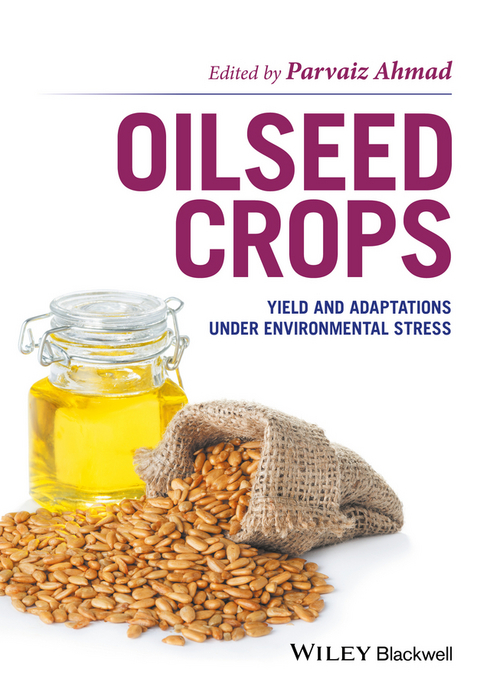
Oilseed Crops (eBook)
312 Seiten
Wiley-Blackwell (Verlag)
978-1-119-04879-4 (ISBN)
Oil Seed Crops: Yield and Adaptations under Environmental Stress is a state-of-the-art reference that investigates the effect of environmental stress on oil seed crops and outlines effective ways to reduce stress and improve crop yield.
With attention to physiological, biochemical, molecular, and transgenic approaches, the chapters discuss a variety of oil seed crops and also cover a broad range of environmental stressors including microbes, salt, heavy metals, and climate change.
Featuring up-to-date research from a global group of experts, this reference provides innovative recommendations for mitigating environmental stress and promoting the healthy growth, development, and adaptation of crops.
About the Editor
Parvaiz Ahmad, Department of Botany, Sri Pratap College, India
About the Editor Parvaiz Ahmad, Department of Botany, Sri Pratap College, India
Title Page 5
Copyright Page 6
Contents 7
List of contributors 9
Preface 12
About the editor 14
Chapter 1 Oilseed crops: Present scenario and future prospects 15
1.1 Introduction 15
1.2 Cultivation of oilseed crops 16
1.3 Uses of major oilseed crops 17
1.3.1 Rapeseed 18
1.3.2 Soybean 19
1.3.3 Sunflower 19
1.3.4 Brassica 20
1.3.5 Coconut 21
1.3.6 Peanut 21
1.3.7 Rice 22
1.3.8 Cotton 23
1.4 Applications of oilseed crops 23
1.4.1 The biofuel industry 23
1.4.2 The food industry 24
1.4.3 The pharmaceutical industry 24
1.4.4 Sustainability of the environment 25
1.5 Conclusion and future prospects 25
References 27
Chapter 2 Castor bean (Ricinus communis L.): Diversity, seed oil and uses 33
2.1 Introduction 33
2.2 Botanical description 34
2.3 Genetic resources 34
2.4 Seed diversity of R. communis 36
2.5 Drought and salinity tolerance 36
2.6 Seed yield of R. communis 37
2.7 Seed toxicity 37
2.8 Physicochemical characters of RCO (Ricinus communis oil) 38
2.9 Oil fatty acids 39
2.10 Uses of oil of R. communis 41
2.10.1 Medicinal interest 41
2.10.2 R. communis as a biofuel 41
2.10.3 Other uses of RCO 42
2.11 Conclusion and future prospects 42
References 43
Chapter 3 Seed composition in oil crops: Its impact on seed germination performance 48
3.1 Introduction 48
3.2 Sources of variation in seed lipid quantity and quality 49
3.2.1 Variation in seed lipid concentration 49
3.2.2 Variation in oil fatty acid composition 50
3.3 How quantity and composition of oil reserves may affect germination 53
3.3.1 Models describing seed germination performance 54
3.3.2 Does the concentration and composition of oil reserves affect seed germination? 55
3.4 Conclusion and future prospects 60
References 60
Chapter 4 Oilseed crops and biodiesel production: Present and future prospects 66
4.1 Introduction 66
4.2 Biodiesel definition 67
4.3 Biodiesel background and sources 67
4.4 Biodiesel fuel: Present prospects and production 68
4.5 Biodiesel plant capacity 68
4.6 Biodiesel processing techniques and methods 68
4.6.1 The transesterification reaction 69
4.6.2 Homogeneous catalysis 70
4.6.3 Acid-base catalyzed process 73
4.6.4 Heterogeneous catalyzed transesterification 73
4.6.5 Enzymatic catalysis 74
4.6.6 Supercritical alcohol transesterification 75
4.6.7 Transesterification using ultrasonic irradiation 75
4.6.8 Transesterification using microwave irradiation 76
4.6.9 In-situ transesterification 76
4.7 Biodiesel characterization and standards 77
4.7.1 Fatty acid composition of biodiesel 79
4.8 Biodiesel from conventional oils 81
4.9 Biodiesel from unconventional oils 83
4.9.1 Biodiesel from jatropha (Jatropha curcas L.) 83
4.9.2 Biodiesel from Moringa peregrina 84
4.9.3 Biodiesel from insect oils 86
4.9.4 Biodiesel from Sclerocarya birrea (Marula) oil 88
4.10 Conclusion and future prospects 88
References 88
Chapter 5 Vegetable oil yield and composition influenced by environmental stress factors 94
5.1 Introduction 94
5.2 Abiotic and biotic stress factors 95
5.3 Oil crops’ yield and the content of lipids 96
5.3.1 Soy 96
5.3.2 Rapeseed 97
5.3.3 Sunflower 99
5.3.4 Palm 100
5.3.5 Olive 101
5.4 Free fatty acids 103
5.5 Fatty acids composition 103
5.5.1 Fatty acids’ composition under temperature stress 104
5.5.2 Mechanisms behind the changes in the fatty acid composition 105
5.5.3 Fatty acid composition under water stress 106
5.6 Antioxidants 106
5.6.1 Phenolic compounds under environmental stress 107
5.6.2 Tocopherols under environmental stress 108
5.7 Conclusion and future prospects 109
References 110
Chapter 6 Soybean: Growth, development and yield under salt stress 116
6.1 Introduction 116
6.2 Chemical composition of soybean 117
6.2.1 Soybean proteins 118
6.2.2 Soybean oils 119
6.2.3 Bioactive soybean components 119
6.2.4 Carbohydrates in soybean 120
6.2.5 Minerals and vitamins in soybean 121
6.3 Salinity and salt stress 121
6.4 Plant response to salt stress 122
6.5 Soybean under salt stress 124
6.5.1 Micronutrients and bioactive compounds under salt stress 124
6.5.2 Adaptation of roots and leaves 125
6.5.3 Wild and cultivated soybean under salt stress 126
6.5.4 Pulsed magnetic field 127
6.5.5 Endophytic fungi 127
6.5.6 Plant growth-promoting bacteria (PGPB) 127
6.5.7 Symbiotic nitrogen-fixing bacteria 128
6.5.8 Exogenous substances 128
6.6 Role of transgenic soybean in agriculture 129
6.7 Conclusion and future prospects 130
References 131
Chapter 7 Sunflower resistance to the vampire weed broomrape: A Van Helsing quest story 137
7.1 Introduction 137
7.2 Vampires among the vegetables 137
7.3 The vampirism lifestyles 138
7.4 The broomrape family: Vampire invaders 139
7.5 Broomrape biology 140
7.5.1 A so cute vampire 140
7.5.2 The vampire’s bite 144
7.5.3 Vampirism effect 145
7.6 The sunflower vampire Orobanche cumana (Wallr) 145
7.6.1 Vampire identification 145
7.6.2 A widespread vampire 148
7.7 Fighting against vampire weeds 148
7.7.1 Cultural practices 148
7.7.2 Physical methods 151
7.7.3 Chemical control methods 151
7.7.4 Biological control methods 152
7.7.5 Integrated management 152
7.8 Sunflower 153
7.8.1 Helianthus genus 153
7.8.2 A brief history of cultivated sunflower 153
7.8.3 Sunflower production and use 153
7.9 Resistance 154
7.9.1 Vampire resistance in crops (sunflower excluded) 154
7.9.2 Sunflower resistance 155
7.10 Conclusion and future prospects 159
References 161
Chapter 8 Biochemical and molecular studies on the commercial oil-yielding desert shrub Simmondsia chinensis (jojoba, a desert gold) 166
8.1 Introduction 166
8.1.1 Origin and distribution 167
8.1.2 Botanical description 167
8.1.3 Reproduction 168
8.1.4 Cultivation and harvesting 169
8.1.5 Physico-chemical properties of jojoba oil 170
8.1.6 Economic uses 171
8.2 Advances in jojoba oil research 172
8.3 Genetic improvement 173
8.4 Market 173
8.4.1 International status 173
8.4.2 National status 174
8.5 Barriers to progress 174
8.6 Conclusion and future prospects 174
Acknowledgements 175
References 175
Chapter 9 Role of phytohormones in improving the yield of oilseed crops 179
9.1 Introduction 179
9.2 Phytohormones 180
9.3 Characteristics of phytohormones 180
9.4 Biosynthesis of phytohormones 180
9.4.1 Biosynthesis of auxin 180
9.4.2 Biosynthesis of cytokinin 181
9.4.3 Biosynthesis of ethylene 182
9.4.4 Biosynthesis of gibberellin 182
9.4.5 Biosynthesis of salicylic acid 183
9.4.6 Biosynthesis of ABA 183
9.5 Signaling of phytohormones 186
9.5.1 Auxin signaling 186
9.5.2 Cytokinin signaling 187
9.5.3 GA signaling 187
9.5.4 Ethylene signaling 188
9.5.5 ABA signaling 189
9.5.6 Salicylic acid signaling 189
9.6 Role of phytohormones 190
9.6.1 Auxin 190
9.6.2 Salicyclic acid (SA) 191
9.6.3 Ethylene 191
9.6.4 Abscisic acid (ABA) 191
9.6.5 Gibberellin 191
9.6.6 Cytokinins 192
9.7 Mode of action of phytohormones 192
9.8 Phytohormones in the development of silique (pods) 193
9.9 Role of phytohormones in plant protection 193
9.10 Phytohormones interact with other hormones 194
9.11 Conclusion and future prospects 194
References 194
Chapter 10 Plant–microbe interaction in oilseed crops 198
10.1 Introduction 198
10.2 Ecology and diversity of microbes associated with plant roots 199
10.3 Role of microbial diversity for soil, plant health and plant nutrition 201
10.4 Plant and microbe communication in diverse rhizospheric environments 201
10.5 Mechanisms employed by microbes to mitigate stress-induced adverse effects on oilseed crops 203
10.6 Effects of beneficial microorganisms on oilseed crops’ cultivation and productivity 206
10.6.1 Groundnut/peanut 206
10.6.2 Sunflower 206
10.6.3 Soybean 207
10.6.4 Rapeseed 208
10.6.5 Olive plant 209
10.6.6 Maize 209
10.7 Conclusion and future prospects 213
Acknowledgments 213
References 213
Chapter 11 Brassicaceae plants: Metal accumulation and their role in phytoremediation 221
11.1 Brassicaceae: introduction to family 221
11.2 Phylogenetic status 222
11.3 Heavy metal pollution in the environment 223
11.4 Hyperaccumulation potential and phytoremediation of contaminated soils 223
11.5 Natural phytoremediation vs. chemically enhanced phytoremediation 226
11.6 Role of genetic manipulation in increasing hyperaccumulation potential 227
11.7 Physiological and biochemical responses 229
11.8 Food safety and health concerns 230
11.9 Safe disposal practices for hyperaccumulator Brassicas 231
11.10 Conclusion and future prospects 232
References 232
Chapter 12 Role of organic and inorganic amendments in alleviating heavy metal stress in oilseed crops 238
12.1 Introduction 238
12.2 Sources of heavy metal contamination of agricultural soils 239
12.3 Heavy metals toxicity in oilseed crops 239
12.4 Soil amendments for the remediation of metal toxicity in oilseed crops 240
12.4.1 Inorganic amendments 240
12.4.2 Organic amendments 243
12.5 Conclusion and future prospects 245
References 245
Chapter 13 Biochemical and molecular responses of oilseed crops to heavy metal stress 250
13.1 Introduction 250
13.2 Biochemical responses 251
13.2.1 Proline 251
13.2.2 Ascorbic acid 251
13.2.3 Chlorophyll 252
13.2.4 Carotenoids 252
13.2.5 Phenolic compounds 252
13.2.6 Total soluble protein content 252
13.3 Production of reactive oxygen species (ROS) and antioxidant defense agents 253
13.3.1 SOD activity 253
13.3.2 GPX activity 253
13.3.3 CAT activity 253
13.3.4 Oxylipin 253
13.4 Molecular response 254
13.5 Significance of oilseed crops 254
13.6 What are essential and non?essential elements? 254
13.7 Relationship between oilseed crops and heavy metals stress 255
13.8 Different heavy metals stress on biochemical and molecular responses of oilseed crops 255
13.9 Conclusion and future prospects 256
References 258
Chapter 14 The role of oilseed crops in human diet and industrial use 263
14.1 Introduction 263
14.2 Classifications of oilseed crops 263
14.2.1 Soyabean 263
14.2.2 Groundnut 264
14.2.3 Rapeseed 264
14.2.4 Sunflower 264
14.2.5 Cotton seed 265
14.2.6 Mustard 265
14.2.7 Sesame seed 265
14.2.8 Linseed 265
14.2.9 Olive seed 265
14.2.10 Castor oilseed 266
14.2.11 Safflower seed 266
14.2.12 Oil palm 266
14.2.13 Coconut 266
14.3 Production of oilseed meal and oil 266
14.4 Processing of oilseed crops 267
14.5 Major nutrients in oilseed and their roles in human nutrition 267
14.5.1 Protein 268
14.5.2 Bioactives in oilseed crops 268
14.5.3 Fatty acids 269
14.6 Industrial utilization of oilseeds 270
14.6.1 Source of energy 270
14.6.2 Fertilizer 270
14.6.3 Food industries 270
14.6.4 Animal feeds 271
14.6.5 Cosmetics 271
14.6.6 Medicine 271
14.6.7 Other products 271
14.7 Conclusion and future prospects 272
References 272
Chapter 15 Appraisal of biophysical parameters in Indian mustard (Brassica juncea) using thermal indices 278
15.1 Introduction 278
15.2 Thermal indices and biophysical parameters 279
15.3 Thermal energy use efficiency and biophysical parameters 284
15.4 Radiation dynamics and biophysical parameters 287
15.5 Soil temperature and biophysical parameters 290
15.6 Conclusion and future prospects 294
References 294
Index 300
EULA 310
| Erscheint lt. Verlag | 15.2.2017 |
|---|---|
| Sprache | englisch |
| Themenwelt | Naturwissenschaften ► Biologie |
| Technik | |
| Weitere Fachgebiete ► Land- / Forstwirtschaft / Fischerei | |
| Schlagworte | Adaptations • Agriculture • Agriculture & Ecology • attention • Biowissenschaften • Botanik • Botanik / Biotechnologie • broad • Chapters • crops • effect • environmental • Experts • Global • Group • growth • Including • Landwirtschaft • Landwirtschaft u. Ãkologie • Landwirtschaft u. Ökologie • Life Sciences • microbes • Oil • Plant Biotechnology • plant science • Range • Reference • StateoftheArt • Stress • stressors • uptodate research • variety |
| ISBN-10 | 1-119-04879-6 / 1119048796 |
| ISBN-13 | 978-1-119-04879-4 / 9781119048794 |
| Informationen gemäß Produktsicherheitsverordnung (GPSR) | |
| Haben Sie eine Frage zum Produkt? |
 PDF (Adobe DRM)
Kopierschutz: Adobe-DRM
Adobe-DRM ist ein Kopierschutz, der das eBook vor Mißbrauch schützen soll. Dabei wird das eBook bereits beim Download auf Ihre persönliche Adobe-ID autorisiert. Lesen können Sie das eBook dann nur auf den Geräten, welche ebenfalls auf Ihre Adobe-ID registriert sind.
Details zum Adobe-DRM
Dateiformat: PDF (Portable Document Format)
Mit einem festen Seitenlayout eignet sich die PDF besonders für Fachbücher mit Spalten, Tabellen und Abbildungen. Eine PDF kann auf fast allen Geräten angezeigt werden, ist aber für kleine Displays (Smartphone, eReader) nur eingeschränkt geeignet.
Systemvoraussetzungen:
PC/Mac: Mit einem PC oder Mac können Sie dieses eBook lesen. Sie benötigen eine
eReader: Dieses eBook kann mit (fast) allen eBook-Readern gelesen werden. Mit dem amazon-Kindle ist es aber nicht kompatibel.
Smartphone/Tablet: Egal ob Apple oder Android, dieses eBook können Sie lesen. Sie benötigen eine
Geräteliste und zusätzliche Hinweise
Buying eBooks from abroad
For tax law reasons we can sell eBooks just within Germany and Switzerland. Regrettably we cannot fulfill eBook-orders from other countries.
aus dem Bereich